



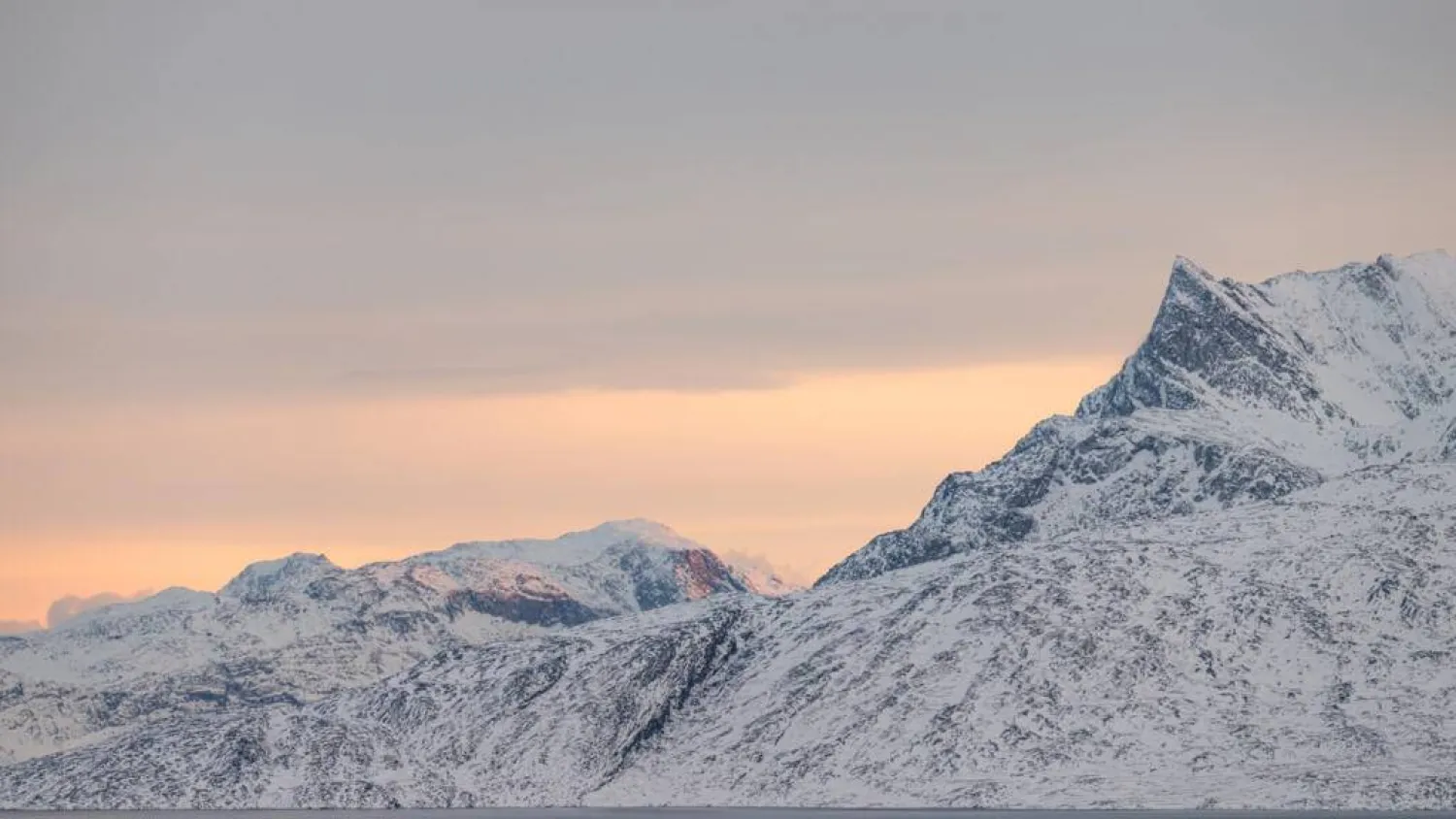

Greenland and Denmark have formed a united front to face down US President Donald Trump, momentarily setting aside the troubled history between them.
The Arctic island, a Danish colony for three centuries, still has a complicated relationship with Denmark, which now rules it as an autonomous territory.
Greenland's main political parties all want independence, but disagree on how exactly to get there. Trump's designs on the island led them to forge a coalition government in March last year, AFP said.
Greenland's leaders made clear last week they had no interest in Trump's bid to take over the vast island -- an idea he pushed hard, before backing off on Wednesday after reaching what he called a framework deal on Arctic security with NATO's secretary-general.
"Greenlanders still have a lot of grievances concerning Denmark's lack of ability to reconsider its colonial past," said Ulrik Pram Gad, a researcher at the Danish Institute for International Studies (DIIS).
"But Trump's pressure has prompted the wide majority of the political spectrum that forms (Greenland's) coalition government to put independence preparations -- always a long-term project -- aside for now," he told AFP.
"The clear European support has made this easier in the sense that the relation to Denmark feels a lot less claustrophobic when joined by others," he added.
While the main Greenland parties differ on how to achieve independence, the growing US pressure led them in March 2025 to put their differences to one side to form their coalition.
Only the Naleraq party, which wants a fast track to independence, stayed in opposition.
At the height of the crisis, Greenland's Prime Minister Jens-Frederik Nielsen made it clear that if the government had to choose between the United States and Denmark, it would choose Denmark.
Colonial past
Trump's talk of a framework deal negotiated with NATO chief Mark Rutte prompted Denmark and Greenland to reiterate that only they can take decisions concerning them.
In the last month of diplomatic back-and-forth, Greenland and Denmark have presented a united front, speaking with one voice.
On January 14, Greenland's Foreign Minister Vivian Motzfeldt was in Washington alongside her Danish counterpart Lars Lokke Rasmussen for talks with US Vice President JD Vance and Secretary of State Marco Rubio.
By Monday, she was in Brussels for talks with Rutte, this time with Denmark's Defense Minister Troels Lund Poulsen.
But that unity conceals the scars of their colonial past.
Greenland was a Danish colony from the early 18th century. It became a Danish territory in 1953, a full part of Denmark -- before becoming an autonomous territory in 1979, a status that was strengthened in 2009.
"It's a long history. It has gone through different stages," said Astrid Andersen, a specialist in Danish-Greenlandic relations at the Danish Institute for International Studies.
"Any colonial relation is a question of domination and there have been some injustices committed."
Forced sterilization
Those injustices include a 1951 social experiment in which 22 Inuit children were forcibly separated from their families and prevented from speaking Greenlandic -- part of bid to create a Danish-speaking elite.
In 2021, the six still alive were each awarded compensation of 250,000 crowns (33,500 euros).
Another dark chapter was Denmark's efforts from the 1960s and for three decades on to reduce the birth rate in Greenland.
Several thousand women and teenagers -- at least 4,000 -- had IUDs fitted without their consent to prevent them conceiving.
Prime Minister Mette Frederiksen has presented her apologies to the women concerned -- nearly half of whom were unable to have children -- and a compensation procedure is underway.
Denmark's social services even used controversial psychological tests to -- as they saw it -- evaluate if Greenlandic mothers were fit to be parents.
A 2022 study showed that in metropolitan Denmark, children born to Greenlandic families were five to seven times more at risk of being placed in children's homes than those born to Danish families.
The use of such tests was only discontinued last year.
The recent debate over these issues has, for the moment, been put to one side, said Andersen.
"Right now I think there's a general agreement with a few exceptions that the common opponent right now is Trump and we kind of need to face this together somehow."


