


Over 8,000 Flights Canceled as Major Winter Storm Bears Down across Much of the US

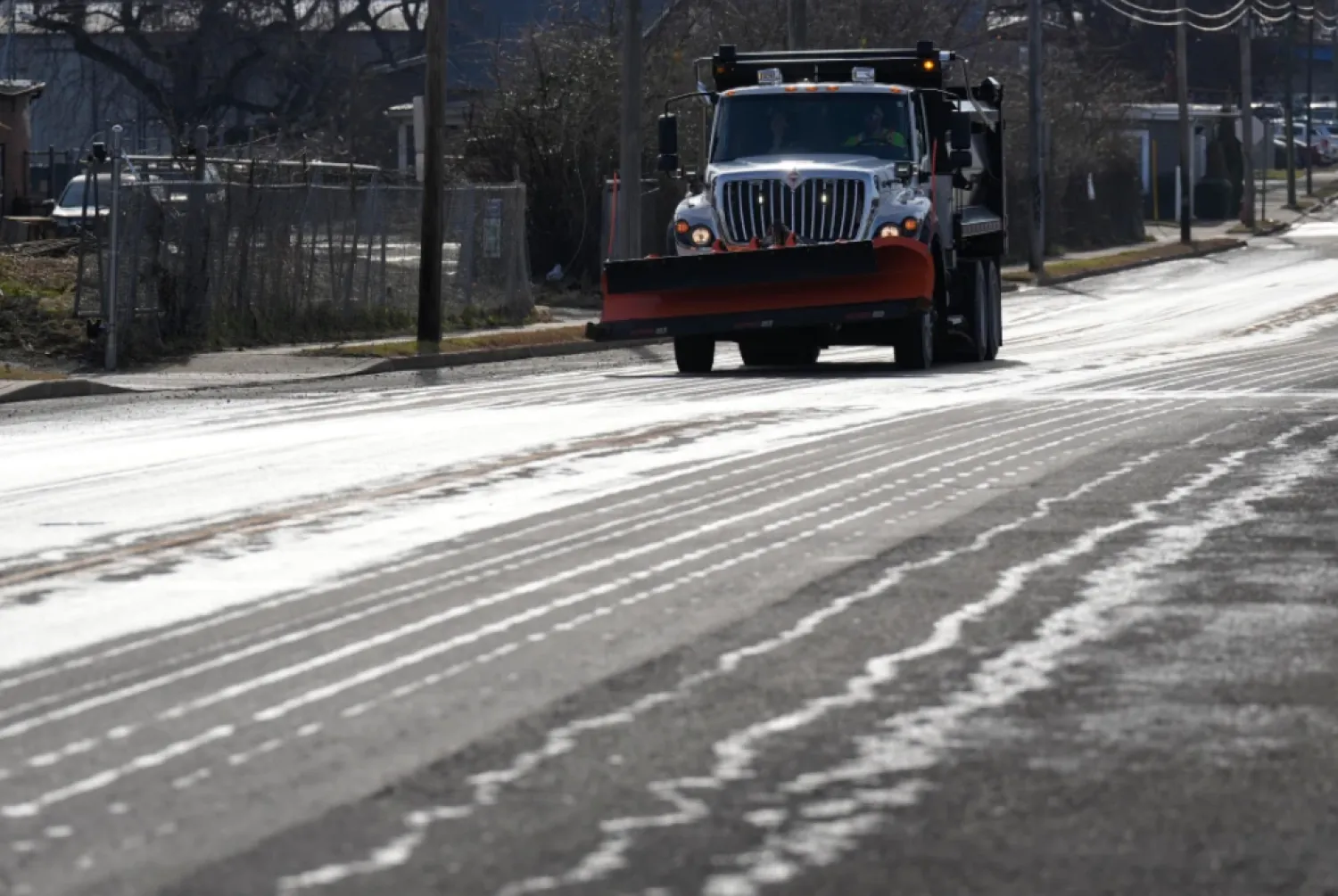
A Nashville Department of Transportation truck applies salt brine to a roadway Thursday, Jan. 22, 2026, in Nashville, Tenn. ahead of a winter storm expected to hit the state over the weekend. (AP Photo/George Walker IV)
TT

Over 8,000 Flights Canceled as Major Winter Storm Bears Down across Much of the US

A Nashville Department of Transportation truck applies salt brine to a roadway Thursday, Jan. 22, 2026, in Nashville, Tenn. ahead of a winter storm expected to hit the state over the weekend. (AP Photo/George Walker IV)

More than 8,000 flights across the US set to take off over the weekend have been canceled as a major storm expected to wreak havoc across much of the country bears down, threatening to knock out power for days and snarl major roadways.

Roughly 140 million people were under a winter storm warning from New Mexico to New England. The National Weather Service forecast warns of widespread heavy snow and a band of catastrophic ice stretching from east Texas to North Carolina.

Forecasters warned that damage, especially in areas pounded by ice, could rival that of a hurricane, The Associated Press said.

By Friday night, the edge of the storm was sending freezing rain and sleet into parts of Texas while snow and sleet were falling in Oklahoma. After sweeping through the South, the storm was expected to move into the Northeast, dumping about a foot (30 centimeters) of snow from Washington through New York and Boston, the weather service predicted.

Governors in more than a dozen states sounded the alarm about the turbulent weather ahead, declaring emergencies or urging people to stay home.

Texas Gov. Greg Abbott told residents on the social media platform X that the state Department of Transportation was pretreating the roads and told residents, “Stay home if possible.”

More than 3,400 flights were delayed or canceled Saturday, according to the flight tracking website FlightAware. More than 5,000 were called off for Sunday.

Angela Exstrom was supposed to fly back to Omaha, Nebraska, from a trip in Mexico, but she learned her Saturday flight out of Houston had been canceled. So instead, she is going back via Los Angeles.

“If you live in the Midwest and travel in the winter, stuff can happen,” she said.

Frigid temperatures and ice Utility companies braced for power outages because ice-coated trees and power lines can keep falling long after a storm has passed.

The Midwest saw wind chills as low as minus 40 degrees Fahrenheit (minus 40 Celsius), meaning that frostbite could set in within 10 minutes.

In Bismarck, North Dakota, where the wind chill was minus 41 (minus 41 Celsius), Colin Cross was bundled up Friday in long johns, two long-sleeve shirts, a jacket, hat, hood, gloves and boots as he cleaned out an empty unit for the apartment complex where he works.

“I’ve been here awhile and my brain stopped working,” Cross said.

The storm has been a popular topic of discussion for days at Saint Paul Mini Market in Baltimore.

“Every single person that walks in talks about the storm,” said owner Ayaz Ahmed.

“Somehow, this time around, they did a good job letting people know that here’s a storm coming their way, and everybody knows about the storm, but how to deal with that is another thing,” Ahmed said.

Government prepares to respond

The federal government put nearly 30 search and rescue teams on standby. Officials had more than 7 million meals, 600,000 blankets and 300 generators placed throughout the area the storm was expected to cross, according to the Federal Emergency Management Agency.

President Donald Trump said via social media on Friday that his administration was coordinating with state and local officials and “FEMA is fully prepared to respond.”

After the storm passes, it will take a while to thaw out. Ice can add hundreds of pounds to power lines and branches and make them more susceptible to snapping, especially if it's windy.

In at least 11 Southern states from Texas to Virginia, a majority of homes are heated by electricity, according to the US Census Bureau.

A severe cold snap five years ago took down much of the power grid in Texas, leaving millions without power for days and resulting in hundreds of deaths. Abbott vowed that will not happen again, and utility companies were bringing in thousands of employees to help keep the lights on.

Church, Carnival and classes canceled

Churches moved Sunday services online, and the Grand Ole Opry in Nashville, Tennessee, decided to hold its Saturday night radio performance without fans. Carnival parades in Louisiana were canceled or rescheduled.

Philadelphia announced schools would be closed Monday. Superintendent Tony B. Watlington Sr. told students, “It’s also appropriate to have one or two very safe snowball fights.”

Some universities in the South canceled classes for Monday, including the University of North Carolina at Chapel Hill and the University of Mississippi's main campus in Oxford.

At the University of Georgia, in Athens, sophomore Eden England stayed on campus to ride things out with friends, even as the school encouraged students to leave dorms and go home because of concerns about losing power.

“I’d rather be with my friends,” England said, “kind of struggling together if anything happens.”



Iran Police Chief Says Anti-Government Protesters Treated as ‘Enemies’

 People walk past closed shops at the nearly empty Tajrish traditional bazaar in northern Tehran, Iran, Tuesday, March 10, 2026. (AP)
People walk past closed shops at the nearly empty Tajrish traditional bazaar in northern Tehran, Iran, Tuesday, March 10, 2026. (AP)
TT

Iran Police Chief Says Anti-Government Protesters Treated as ‘Enemies’

 People walk past closed shops at the nearly empty Tajrish traditional bazaar in northern Tehran, Iran, Tuesday, March 10, 2026. (AP)
People walk past closed shops at the nearly empty Tajrish traditional bazaar in northern Tehran, Iran, Tuesday, March 10, 2026. (AP)

Iranian protesters will be treated as enemies if they support Tehran's foes, the country's top police officer warned, as the Middle East war sparked fears mass anti-government rallies could reignite.

"If anyone comes forward in line with the wishes of the enemy, we will no longer see them as merely a protester, we will see them as an enemy," said national police chief Ahmad-Reza Radan in comments aired by state broadcaster IRIB late on Tuesday.

"And we will do to them what we do to an enemy. We will deal with them in the same way we deal with enemies," he added.

"All our forces are also ready, with their hands on the trigger, prepared to defend their revolution."

His warning comes after the government cracked down on anti-government protests in January, sparked a month before over economic grievances in the sanctions-hit country.

The authorities deemed the protests to be "riots" and Radan at one point issued an ultimatum to protesters to hand themselves in or face the full force of the law.

Iranian authorities acknowledge more than 3,000 deaths in the unrest, including members of the security forces and bystanders, but say the violence was caused by "terrorist acts" fueled by Iran's enemies.

The US-based Human Rights Activists News Agency (HRANA), however, has recorded more than 7,000 killings in the crackdown, the vast majority protesters, though the toll may be far higher. More than 50,000 have been arrested, it says.

US President Donald Trump had initially cheered on the protesters, threatening to intervene on their behalf as authorities launched a deadly crackdown, but his threats soon shifted to Iran's nuclear program.

Washington launched strikes with Israel on Iran on February 28, sparking retaliatory strikes by Tehran against Israel and US bases across the Gulf region.


UN Warns Hormuz Standstill Will Hit World’s Most Vulnerable

 The Parnassos crude oil tanker sits anchored as the traffic is down in the Strait of Hormuz, amid the US-Israeli conflict with Iran, in Muscat, Oman, March 10, 2026. (Reuters)
The Parnassos crude oil tanker sits anchored as the traffic is down in the Strait of Hormuz, amid the US-Israeli conflict with Iran, in Muscat, Oman, March 10, 2026. (Reuters)
TT

UN Warns Hormuz Standstill Will Hit World’s Most Vulnerable

 The Parnassos crude oil tanker sits anchored as the traffic is down in the Strait of Hormuz, amid the US-Israeli conflict with Iran, in Muscat, Oman, March 10, 2026. (Reuters)
The Parnassos crude oil tanker sits anchored as the traffic is down in the Strait of Hormuz, amid the US-Israeli conflict with Iran, in Muscat, Oman, March 10, 2026. (Reuters)

The standstill in the Strait of Hormuz caused by the Middle East war could hammer some of the world's most vulnerable people, the United Nations warned Tuesday.

The strait is the only sea passage from the Gulf towards the Indian Ocean, through which nearly a quarter of the world's seaborne oil supplies pass, as well as a significant amount of cargo.

Iran has all but blocked the waterway following the launch of the February 28 US-Israeli airstrikes on the country that triggered the war.

"The current shock comes at a time when many developing economies struggle to service their debt, face a tightening of fiscal space and limited capacity to absorb new price shocks," the UN trade and development agency UNCTAD said.

"Higher energy, fertilizer and transport costs -- including freight rates, bunker fuel prices and insurance premiums -- may increase food costs and intensify cost-of-living pressures, particularly for the most vulnerable," it said.

UNCTAD added that, in terms of seaborne trade volume, in the week before the conflict 38 percent of crude oil, 29 percent of liquified petroleum gas, 19 percent of liquified natural gas and 19 percent refined oil products went through the strait.

But while an average of 129 ships transited daily through the passage between February 1 and 27, that number dropped to just three on March 3.

UNCTAD said the disruptions underscored the vulnerability of critical maritime chokepoints and their potential for disruption to them to send shocks across supply chains and commodity markets.

"Rising energy, transport and food costs could strain public finances and increase pressure on household budgets, potentially heightening economic and social pressures... particularly in economies heavily dependent on imported energy, fertilizers and staple foods," it said.

- Food aid hit -

UN rights chief Volker Turk echoed the alarm for the effect the plunge in commercial shipping activity could have, "particularly for the world's most vulnerable".

"The impact of an oil price surge will have a knock-on effect for macro-economic and social stability in many countries, particularly those already experiencing debt distress," he said.

The UN's World Food Program said the costs and time lost to the Strait of Hormuz disruptions were already impacting its humanitarian operations.

"This is nothing less than another seminal moment in global supply chain history," Jean-Martin Bauer, the director of WFP's food and nutrition analysis service, told reporters in Geneva.

Speaking from the WFP's Rome headquarters, he said shipping lines were diverting services and adding surcharges, leading to congestion "in places that are very far from Hormuz".

"We're seeing congestion in Asia. It's quite a severe disruption that's taking place right now," Bauer said.

"We're needing to go the long way around the Cape of Good Hope to reach some of our key geographies."

WFP's biggest operation is in Sudan, but now it is facing approximately 25 days of additional shipping time.

"It's basically 50 percent more than we would usually have. So that's really extending the supply chain and adding to cost," said Bauer.


Israel Says Iran Hacked Security Cameras

People exercise on the beach in Tel Aviv, Israel, 10 March 2026. (EPA)
TT

Israel Says Iran Hacked Security Cameras

People exercise on the beach in Tel Aviv, Israel, 10 March 2026. (EPA)

Israel's cybersecurity directorate said it had identified "dozens of Iranian breaches into security cameras for espionage purposes" since the start of the war in the Middle East, urging the public to be vigilant.

"The directorate is working to alert hundreds of camera owners and calls on the public to change their passwords and update their software to prevent any security risk, whether national or personal," Cyber Israel wrote on X Monday.

Cyberattacks between Iran and Israel have been a frequent occurrence in recent years, as the two foes conducted a shadow war that culminated in open conflict last June and again on February 28.

In December 2025, former Israeli prime minister Naftali Bennett -- who is set to run against incumbent premier Benjamin Netanyahu in a general election this year -- said he had been the victim of a cyberattack targeting his Telegram account, after hackers claimed to have broken into his phone.

Private messages, videos and photographs said to be taken from Bennett's phone were published on a hacker site named after "Handala", a character symbolizing the Palestinian cause, and on an associated X account.

Iran-linked hackers have stepped up their operations in the region since strikes began on the country, an expert told AFP.

Israeli cybersecurity firm Check Point said in a report that since the launch of the US-Israeli offensive on February 28, it has seen hackers accessing surveillance cameras, which are widely used but often poorly secured.

The images were likely used to assess damage caused by the attacks or "to gather the necessary information" on "the habits (of targeted individuals) or locations to hit", Gil Messing, head of cyberintelligence at Check Point, told AFP.

The hackers "are part of (Iran's) army" and "are largely supported by the state", notably by the Revolutionary Guards and the ministry of intelligence and security, he added.

Last week, the Financial Times reported that Israel had hacked nearly all of Tehran's traffic cameras for years in preparation for the operation that killed Iran's supreme leader Ali Khamenei on the first day of the offensive.