

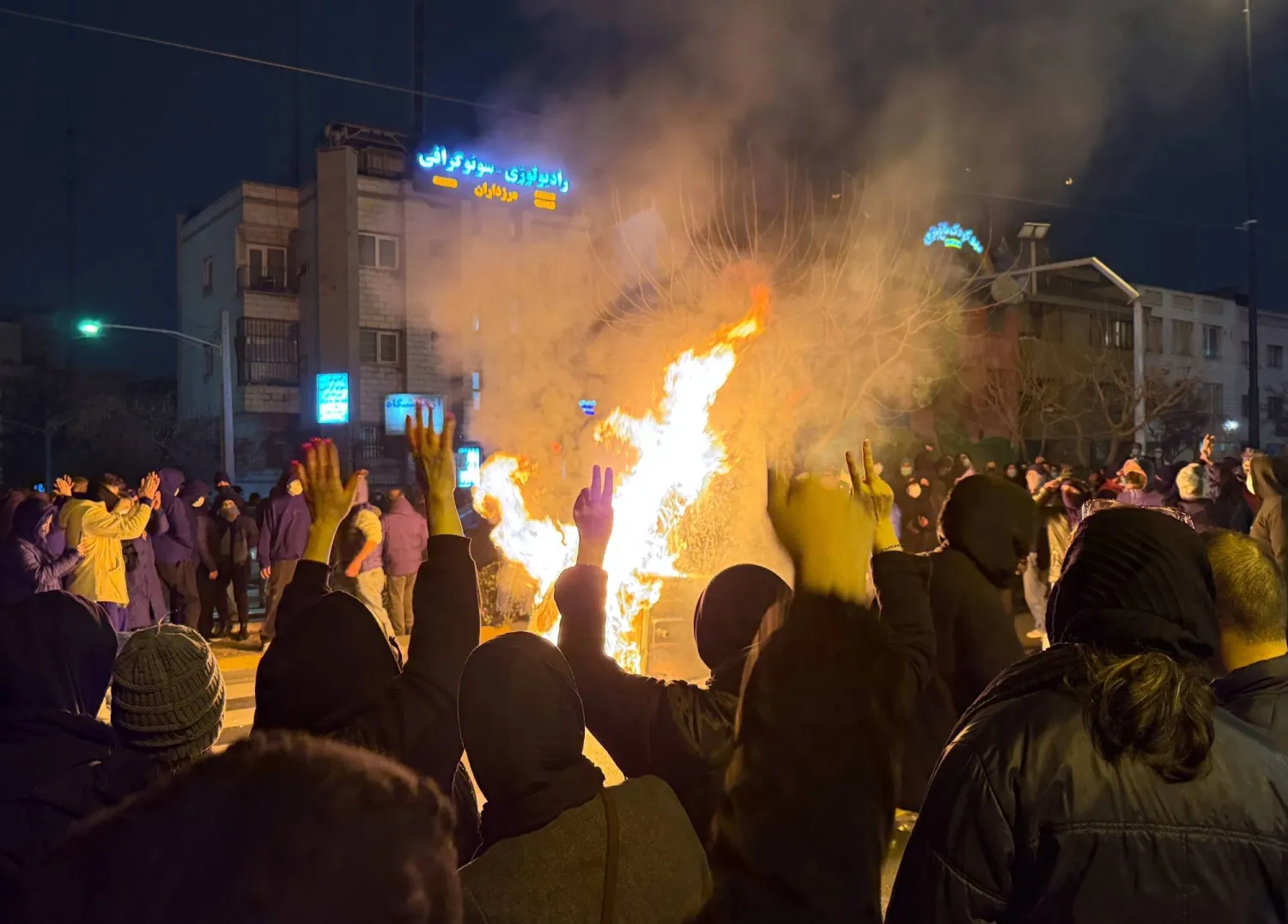

Iran Judicial Chief Says Protest Instigators to Receive No Leniency

In this photo obtained by The Associated Press, Iranians attend an anti-government protest in Tehran, Iran, Jan. 9, 2026. (UGC via AP, File)
TT

Iran Judicial Chief Says Protest Instigators to Receive No Leniency

In this photo obtained by The Associated Press, Iranians attend an anti-government protest in Tehran, Iran, Jan. 9, 2026. (UGC via AP, File)

The head of Iran's judiciary warned on Sunday that those behind a recent wave of anti-government protests could expect punishment "without the slightest leniency".

What began earlier this month as demonstrations against the high cost of living boiled over into a broader protest movement that represented the gravest challenge to the country's clerical leadership in years.

The protests have abated following a government crackdown, carried out under an internet blackout that left the country largely cut off from the outside world.

"The people rightly demand that the accused and the main instigators of the riots and the acts of terrorism and violence be tried as quickly as possible and punished if found guilty," judicial chief Gholamhossein Mohseni Ejei was quoted as saying by the official Mizan online news portal.

He went on to say "the greatest rigor must be applied in the investigations," but insisted that "justice entails judging and punishing without the slightest leniency the criminals who took up arms and killed people, or committed arson, destruction and massacres".

The Iranian government has put the death toll from the protests at 3,117, including 2,427 people it has labelled "martyrs" -- a term used to distinguish members of the security forces and innocent bystanders from those described by authorities as "rioters" incited by the US and Israel.

Rights groups, however, have said protesters account for the vast majority of the deaths, documenting several thousand killed, with the Norway-based NGO Iran Human Rights saying the final figure could top 25,000 dead.

- 'Just in case' -

The US-based Human Rights Activists News Agency (HRANA) has said more than 26,000 people have been arrested in relation to the demonstrations.

Iran is the world's second most prolific user of the death penalty after China, and the soaring number of arrests and vows of stiff punishment have raised fears it could use executions to repress dissent.

US President Donald Trump has threatened to intervene militarily should Iran begin putting protest suspects to death, but has recently softened his rhetoric after claiming Tehran had suspended planned executions.

On Thursday, he told reporters on the way back from Davos that the United States was nonetheless sending a "massive fleet" toward Iran "just in case".

The United States carried out strikes on Iranian nuclear facilities in June when it briefly joined Israel's 12-day war against the country.

Rights groups have accused authorities of repeatedly using live ammunition on protesters, but Colonel Mehdi Sharif Kazemi, commander of Iran's special police, maintained authorities had used only non-lethal measures such as water cannons to quell the unrest.

"The use of weapons (by the police) during this operation has sparked some criticism, but in fact, the police did not resort to using any firearms," he was quoted as saying by the Mehr news agency on Sunday.

"We used non-lethal means in order to guarantee the safety of the population and avoid any killings."



Pezeshkian Says Middle East Has No Need for US 'Policeman'

Indian Prime Minister Narendra Modi, right, greets Iranian President Masoud Pezeshkian upon his arrival for the BRICS summit in New Delhi, India, Saturday, Sept. 12, 2026. (Indian Foreign Ministry via AP)
TT

Pezeshkian Says Middle East Has No Need for US 'Policeman'

Indian Prime Minister Narendra Modi, right, greets Iranian President Masoud Pezeshkian upon his arrival for the BRICS summit in New Delhi, India, Saturday, Sept. 12, 2026. (Indian Foreign Ministry via AP)

Iran's President Masoud Pezeshkian said on Saturday that the Middle East does not need the United States to be a "regional policeman,” with the two countries at war and vying for control of the Strait of Hormuz.

"We do not need a regional policeman," he said on the sidelines of a BRICS summit in India during a meeting with Malaysian Prime Minister Anwar Ibrahim.

"The territorial integrity and security of the region can only be guaranteed by its main players and the countries that comprise it," he added, according to the Iranian presidency.

Iran has been at war since February 28, when US-Israeli strikes killed its supreme leader.

Tehran retaliated with attacks across the region and blockaded the Strait of Hormuz, through which one-fifth of the world's oil previously flowed.

Iran and the US have since been vying for control of the strategic waterway.

The strait was free to transit before the war, but Iran now requires vessels to obtain permission and is considering a mechanism to impose service fees.

Ships that do not comply are regularly targeted by Iranian strikes, while the US periodically bombs the Iranian coastline to challenge the country's control of the strait.

More than six months into the Middle East war, the blockade continues to drive up oil prices, which soared past $100 a barrel this week.

"Despite all the injustices suffered by our people, we neither desire war nor its continuation. Peace remains our priority," Pezeshkian added.


Trump Says Iran War Will End after US Midterm Elections

US President Donald Trump meets with Ireland's Prime Minister (Taoiseach) Micheal Martin (not pictured) at Farmleigh House in Dublin, Ireland, September 12, 2026. REUTERS/Kylie Cooper
TT

Trump Says Iran War Will End after US Midterm Elections

US President Donald Trump meets with Ireland's Prime Minister (Taoiseach) Micheal Martin (not pictured) at Farmleigh House in Dublin, Ireland, September 12, 2026. REUTERS/Kylie Cooper

President Donald Trump repeated on Saturday that he believed the war with Iran will end after US midterm elections in November and that oil ⁠prices will tumble once ⁠it does.

"I think very soon. I think it'll be probably ⁠right after the mid-terms. They're trying to hold out as long as they can to complicate the election. But I think people are wise to ⁠it," Trump ⁠told reporters in Dublin.

"When that happens, oil prices will come tumbling down."

Earlier, Iran's President Masoud Pezeshkian said that the Middle East does not need the United States to be a "regional policeman.”

Iran has been at war since February 28, when US-Israeli strikes killed its supreme leader.

Tehran retaliated with attacks across the region and blockaded the Strait of Hormuz, through which one-fifth of the world's oil previously flowed.

Iran and the US have since been vying for control of the strategic waterway.


French Police Suspect Train Derailment Was Sabotage

SNCF workers stand next to a derailed train carriage in Cléon, northwestern France, on September 12, 2026, the morning after the train derailed. (Photo by Guillaume SALIGOT / AFP)
TT

French Police Suspect Train Derailment Was Sabotage

SNCF workers stand next to a derailed train carriage in Cléon, northwestern France, on September 12, 2026, the morning after the train derailed. (Photo by Guillaume SALIGOT / AFP)

Investigators suspect that a train derailment in northwest France which injured 44, one gravely, was the result of sabotage, a police source told AFP on Saturday.

A fragment of rail was found on the track, with the possibility of a malicious act being treated as the main line of inquiry as a result, the source said.

Carrying 186 passengers, the train was running between the Normandy cities of Rouen and Caen when it derailed around 7:45 pm (1745 GMT) Friday.

Authorities activated a mass-casualty response plan, with 130 firefighters, five medical teams and 80 vehicles drafted in.

Rouen prosecutor Sebastien Gallois said 44 people were injured including an 18-year-old woman evacuated "in a critical condition", while tests for drugs and alcohol on the train driver had come back negative.

SNCF Reseau, which controls the French rail network, told AFP that traffic on the line has been suspended and power to the tracks cut to allow emergency services to operate.