

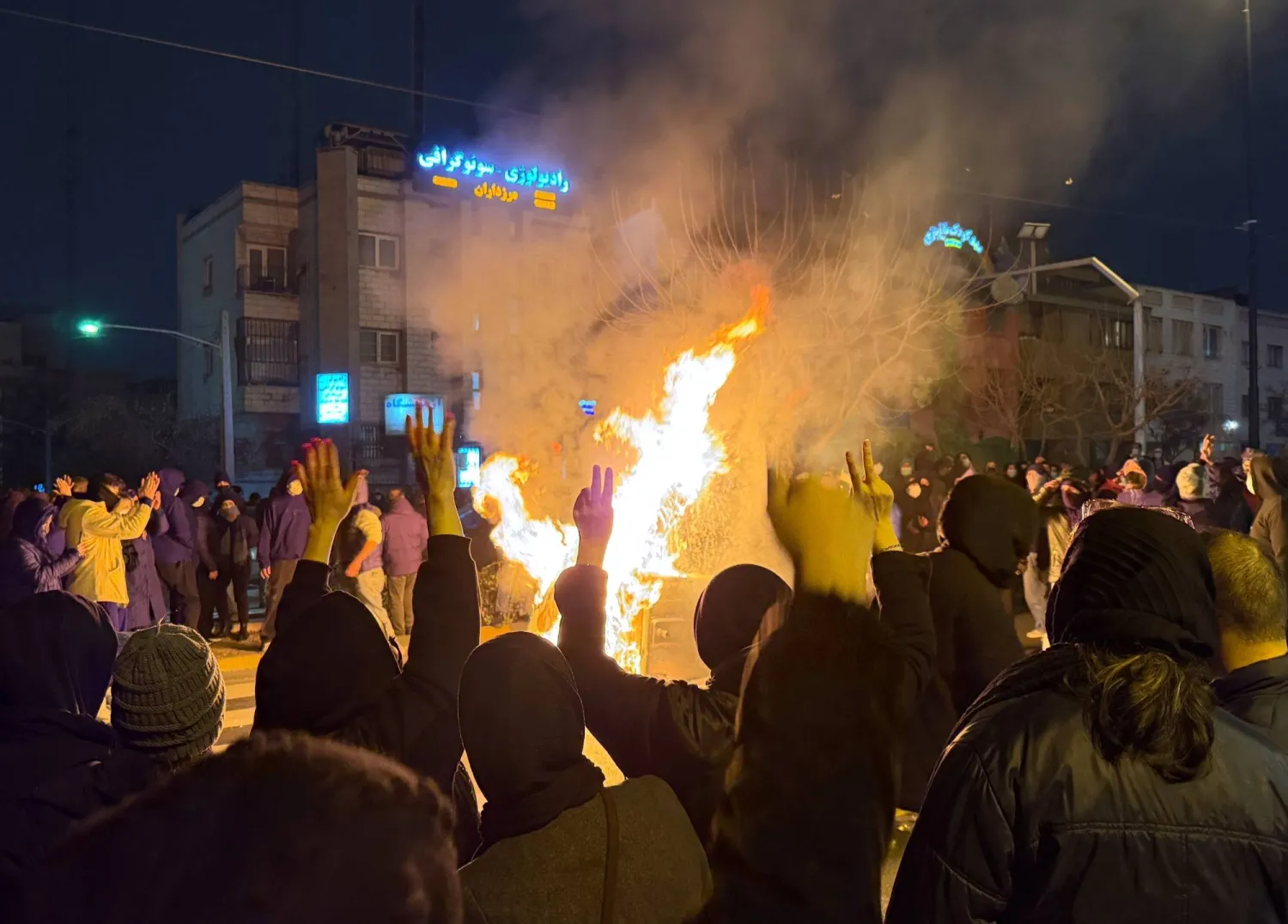

Iran’s Crackdown Has Killed at Least 6,126 People, Activists Say as Country’s Currency Plunges

FILE - In this photo obtained by The Associated Press, Iranians attend an anti-government protest in Tehran, Iran, Jan. 9, 2026. (UGC via AP, File)
TT

Iran’s Crackdown Has Killed at Least 6,126 People, Activists Say as Country’s Currency Plunges

FILE - In this photo obtained by The Associated Press, Iranians attend an anti-government protest in Tehran, Iran, Jan. 9, 2026. (UGC via AP, File)

Iran's bloody crackdown on nationwide protests killed at least 6,126 people while many others still are feared dead, activists said Tuesday, as a US aircraft carrier group arrived in the Middle East to lead any American military response to the crisis. Iran's currency, the rial, meanwhile fell to a record low of 1.5 million to $1.

The arrival of the USS Abraham Lincoln aircraft carrier and guided missile destroyers accompanying it provide the US the ability to strike Iran.

Two Iranian-backed militias in the Middle East have signaled their willingness to launch new attacks, likely trying to back Iran after US President Donald Trump threatened military action over the killing of peaceful protesters or Tehran launching mass executions in the wake of the demonstrations.

Iran has repeatedly threatened to drag the entire region into a war, though its air defenses and military are still reeling after the June war launched by Israel against the country. But the pressure on its economy may spark new unrest as everyday goods slowly go out of reach of its people.

Activists offer new death toll

The new figures Tuesday came from the US-based Human Rights Activists News Agency, which has been accurate in multiple rounds of unrest in Iran. The group verifies each death with a network of activists on the ground in Iran.

It identified the dead as including at least 5,777 protesters, 214 government-affiliated forces, 86 children and 49 civilians who weren't demonstrating. The crackdown has seen over 41,800 arrests, it added.

The Associated Press has been unable to independently assess the death toll given authorities cutting off the internet and disrupting calls into the country.

Iran’s government has put the death toll at a far lower 3,117, saying 2,427 were civilians and security forces, and labeled the rest “terrorists.” In the past, Iran’s theocracy has undercounted or not reported fatalities from unrest.

That death toll exceeds that of any other round of protest or unrest there in decades, and recalls the chaos surrounding Iran’s 1979 revolution.

The protests in Iran began on Dec. 28, sparked by the fall of the Iranian currency, the rial, and quickly spread across the country. They were met by a violent crackdown by Iran’s theocracy, the scale of which is only starting to become clear as the country has faced more than two weeks of internet blackout — the most comprehensive in its history.

Iran’s UN ambassador told a UN Security Council meeting late Monday that Trump’s repeated threats to use military force against the country “are neither ambiguous nor misinterpreted.” 

Amir Saeid Iravani also repeated allegations that the US leader incited violence by “armed terrorist groups” supported by the United States and Israel, but gave no evidence to support his claims.

Iranian state media has tried to accuse forces abroad for the protests as the theocracy remains broadly unable to address the country's ailing economy, which is still squeezed by international sanctions, particularly over its nuclear program.

On Tuesday, exchange shops offered the record-low rial-to-dollar rate in Tehran.

Already, Iran has vastly limited its subsidized currency rates to cut down on corruption. It also has offered the equivalent of $7 a month to most people in the country to cover rising costs. However, Iran's people have seen the rial fall from 32,000 to $1 just a decade ago — which has devoured the value of their savings.

Willingness to fight 

Iran's “Axis of Resistance” network of proxy militant groups in Gaza, Lebanon, Yemen, Syria and Iraq, and other places has collapsed after Israel targeted Hamas, Hezbollah in Lebanon and others during the Gaza war. Meanwhile, opposition groups in 2024 overthrew Syria’s Bashar al-Assad after a yearslong, bloody war in which Iran backed his rule.

Yemen's Houthi militias, backed by Iran, have repeatedly warned they could resume fire if needed on shipping in the Red Sea, releasing old footage of a previous attack Monday.

Ahmed “Abu Hussein” al-Hamidawi, the leader of Iraq's Kataib Hezbollah militia, warned "the enemies that the war on the (Islamic) Republic will not be a picnic; rather, you will taste the bitterest forms of death, and nothing will remain of you in our region.”

The Lebanese group Hezbollah, one of Iran’s staunchest allies, refused to say how it planned to react in the case of a possible attack.

“During the past two months, several parties have asked me a clear and frank question: If Israel and America go to war against Iran, will Hezbollah intervene or not?” Hezbollah leader Sheikh Naim Qassem said in a video address.

He said the group is preparing for “possible aggression and is determined to defend” against it. But as to how it would act, he said, “these details will be determined by the battle and we will determine them according to the interests that are present.”



Rule of Law 'Routinely Challenged', Says ICC Head

The International Criminal Court building is seen in The Hague, Netherlands, January 16, 2019. (Reuters)
TT

Rule of Law 'Routinely Challenged', Says ICC Head

The International Criminal Court building is seen in The Hague, Netherlands, January 16, 2019. (Reuters)

The global rule of law is frequently coming under threat, the president of the International Criminal Court warned on Tuesday, vowing to stand up for justice and victims of atrocities.

At a ceremony marking the opening of the ICC's judicial year, Tomoko Akane said international justice was facing an "extraordinary moment."

"The ICC, as well as other judicial institutions around the globe, have been facing significant pressures, coercive measures and attempts to undermine their function," she said.

"Values and premises that we have accepted as a given, as well as the very notion of the rule of law, are being routinely questioned and challenged," added Akane.

The ICC is facing the most difficult period in its history.

Furious at arrest warrants against Israeli Prime Minister Benjamin Netanyahu, the United States has slapped sanctions on top ICC officials, including judges.

This has hindered the court's ability to function and affected the lives of those sanctioned.

In addition, Russia has sentenced ICC officials to jail terms, in retaliation for arrest warrants against President Vladimir Putin over the Ukraine war.

"Now, more than ever, we must return to the fundamental ideas upon which we stand, the values of justice and humanity that transcend borders," said Akane.

She revealed the court had issued "numerous" further arrest warrants, although these have not yet been made public.

The ICC, based in The Hague, tries individuals suspected of war crimes and crimes against humanity.

On Monday, it announced a major step in one of its most high-profile cases.

Former Philippines president Rodrigo Duterte will face a so-called "confirmation of charges" hearing on February 23, after judges passed him fit.


France’s President to Meet Denmark, Greenland Leaders

France's President Emmanuel Macron waits before the arrival of Indonesia's president at the Elysee palace in Paris, on January 23, 2026. (AFP)
TT

France’s President to Meet Denmark, Greenland Leaders

France's President Emmanuel Macron waits before the arrival of Indonesia's president at the Elysee palace in Paris, on January 23, 2026. (AFP)

France's president will meet the leaders of Denmark and Greenland in Paris on Wednesday for "a working lunch", his office said Tuesday.

Emmanuel Macron will "reaffirm European solidarity and France's support for Denmark, Greenland, their sovereignty and their territorial integrity", the presidency said.

The meeting comes days after US President Donald Trump backed down from threats to seize Greenland, a mineral-rich Arctic island that is an autonomous Danish territory.

The three leaders will discuss "security issues in the Arctic and the economic and social development of Greenland, which France and the European Union are ready to support", Macron's office said.

Faced with Russian threats and US ambitions for Greenland, Danish Prime Minister Mette Frederiksen and Greenland leader Jens-Frederik Nielsen have been making rounds with European allies this week including talks in Hamburg and Berlin ahead of visiting Paris Wednesday.

Trump earlier this month had threatened to seize Greenland and impose tariffs on any European countries, including France, Germany and Britain, that opposed him.

Trump later backed down on the threat to take the territory after meeting NATO Secretary-General Mark Rutte last week.

Trump and Rutte had agreed on what the US leader called a "framework", the details of which have not been disclosed.

France has positioned itself at the forefront of European solidarity with Denmark, and is planning to open a consulate in the Greenland capital of Nuuk next month.


Israel 'Not Sure' Whether US Will Strike Iran

 This photo provided by the US Navy shows a Boeing F/A-18E Super Hornet landing on the Nimitz-class aircraft carrier USS Abraham Lincoln in the Indian Ocean on Jan. 22, 2026. (Mass Communication Specialist Seaman Daniel Kimmelman/US Navy via AP)
 This photo provided by the US Navy shows a Boeing F/A-18E Super Hornet landing on the Nimitz-class aircraft carrier USS Abraham Lincoln in the Indian Ocean on Jan. 22, 2026. (Mass Communication Specialist Seaman Daniel Kimmelman/US Navy via AP)
TT

Israel 'Not Sure' Whether US Will Strike Iran

 This photo provided by the US Navy shows a Boeing F/A-18E Super Hornet landing on the Nimitz-class aircraft carrier USS Abraham Lincoln in the Indian Ocean on Jan. 22, 2026. (Mass Communication Specialist Seaman Daniel Kimmelman/US Navy via AP)
 This photo provided by the US Navy shows a Boeing F/A-18E Super Hornet landing on the Nimitz-class aircraft carrier USS Abraham Lincoln in the Indian Ocean on Jan. 22, 2026. (Mass Communication Specialist Seaman Daniel Kimmelman/US Navy via AP)

Israeli observers are in agreement that the final decision on military action against Iran remains in the hands of President Donald Trump alone, Israeli media reported on Monday.

The reports came despite a strategic partnership between Tel Aviv and Washington, intensive coordination meetings at the highest levels, and the prevailing impression among Israeli officials that a US strike against Iran could be carried out soon.

“Trump is dealing with the issue of war as a businessman,” the observers said. “The President could easily back off with a certain deal that offers him clear gains,” they said, stressing that Tehran might also defuse tension with Washington through serious negotiating.

Political and military sources in Tel Aviv said Israel was surprised not to be secretly involved in the size and timing of a potential US strike on Iran.

They said Israeli Chief of Staff Eyal Zamir raised the issue with US Central Command (CENTCOM) chief Brad Cooper, who visited Israel on Saturday.

The sources said Cooper explained that even the US command is short of details on a decision to carry out a strike against Iran. The matter is limited to President Trump who ordered military readiness without offering further details, they quoted Cooper as saying.

The sources added that US and Israeli military officials discussed coordination for worst-case scenarios and on means to jointly counter them, and shared intelligence on the deployment of Iranian forces.

The Walla website said the two sides also coordinated their preparations for a possible US strike, which could lead to an Iranian attack against Israel.

In an analysis for the Yedioth Ahronoth newspaper, military expert Ron Ben-Yishai said neither the Pentagon nor US Central Command has received instructions beyond preparing a large naval and air force capable of delivering precise strikes on Iran if ordered, while simultaneously preparing to defend American troops and bases and US interests and allies in the Middle East, including Israel.

Ben-Yishai wrote that joint US-Israeli defense against Iranian missile and drone retaliation, were the main focus of discussions between Cooper and Zamir. They also coordinated how the Israeli army would assist with intelligence and other support for a possible American strike, and how the Israeli Air Force would join an offensive campaign alongside US naval and air forces if Israel were attacked.

In the absence of a presidential decision, the two generals appear to have conducted what the Israeli army calls a strategic “contingency discussion,” with details to be finalized later, he said.

He explained that the US president is probably weighing five questions before striking Iran.

The first is whether a limited but highly precise and powerful strike can bring about the collapse of the regime, or at least significantly weaken it and the security apparatus that protects it.

The second is whether there is anyone in Iran who could exploit such weakness to topple the regime completely, or at least force a fundamental change in its domestic policies toward its citizens and its external behavior on the nuclear issue, ballistic missiles and regional policies.

The third question asks whether the military threat should be stabilized and reinforced for several more weeks to allow the Iranian regime and its leader to accept the US demands set as conditions for entering negotiations on lifting sanctions and removing the military threat.

In this regard, he said it is quite possible that the Iranians, even Supreme Leader Ali Khamenei, will again conclude that their situation is so dire that it is time for a “heroic compromise.”

The fourth question is “if it becomes clear that the Iranian regime cannot be toppled through air strikes alone, should the massive American force now being assembled in the Middle East be used to deliver another blow to Iran?”

The fifth, and most critical question, the expert said, is whether the Americans have sufficient precise intelligence and whether they even have the capability to achieve any of their objectives, either regime collapse or a blow severe enough to disable Iran’s military infrastructure for many years, and above all, at what cost?

In any case, the decision is in Trump’s hands alone, and as "we have learned, even when he decides, he may change his mind at the last moment," Ben-Yishai said.

Trump does not want to pay the price in American lives or the high cost of a prolonged operation, he added.