


Satellite Photos Show Activity at Iran Nuclear Sites as Tensions Rise over Protest Crackdown

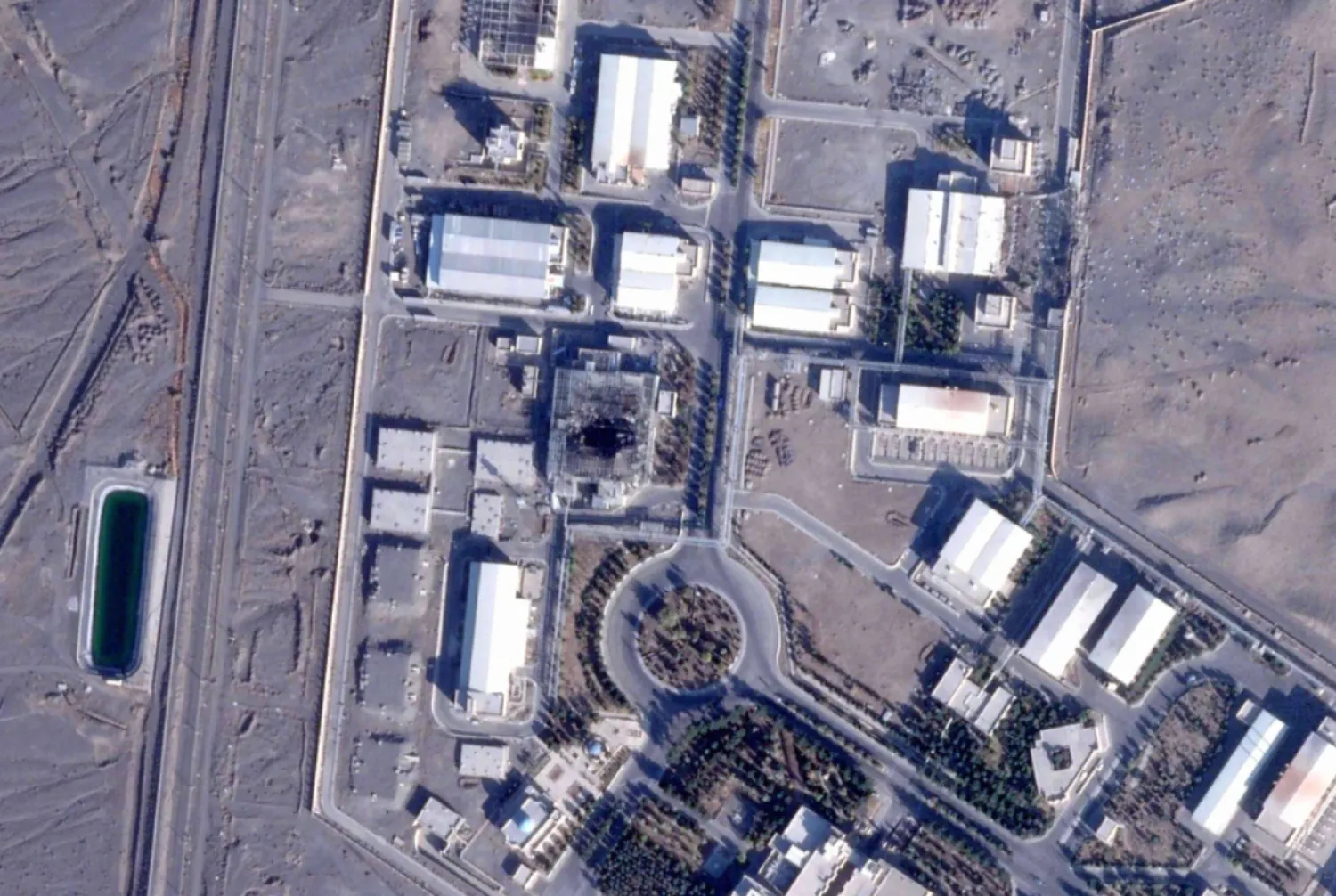
This satellite image from Planet Labs PBC shows the rubble of the Pilot Fuel Enrichment Plant at Iran’s Natanz nuclear enrichment site on Dec. 3, 2025. (Planet Labs PBC via AP)
TT

Satellite Photos Show Activity at Iran Nuclear Sites as Tensions Rise over Protest Crackdown

This satellite image from Planet Labs PBC shows the rubble of the Pilot Fuel Enrichment Plant at Iran’s Natanz nuclear enrichment site on Dec. 3, 2025. (Planet Labs PBC via AP)

As tensions soar over Iran’s bloody crackdown on nationwide protests, satellite images show activity at two Iranian nuclear sites bombed last year by Israel and the United States that may be a sign of Tehran trying to obscure efforts to salvage any materials remaining there.

The images from Planet Labs PBC show roofs have been built over two damaged buildings at the Isfahan and Natanz facilities, the first major activity noticeable by satellite at any of the country’s stricken nuclear sites since Israel’s 12-day war with Iran in June.

Those coverings block satellites from seeing what’s happening on the ground — right now the only way for inspectors from the International Atomic Energy Agency to monitor the sites as Iran has prevented access.

Iran has not publicly discussed the activity at the two sites. The IAEA, a watchdog agency of the United Nations, did not respond to requests for comment, The AP news reported.

US President Donald Trump repeatedly has demanded Iran negotiate a deal over its nuclear program to avert threatened American military strikes over the country’s crackdown on protesters. The US has moved the USS Abraham Lincoln and several guided-missile destroyers into the Middle East, but it remains unclear whether Trump will decide to use force.

The new roofs do not appear to be a sign of reconstruction starting at the heavily damaged facilities, experts who examined the sites said. Instead, they are likely part of Iran’s efforts “to assess whether key assets — such as limited stocks of highly enriched uranium — survived the strikes,” said Andrea Stricker, who studies Iran for the Washington-based Foundation for Defense of Democracies, which has been sanctioned by Tehran.

“They want to be able to get at any recovered assets they can get to without Israel or the United States seeing what survived,” she said.

Isfahan and Natanz are 2 key Iran sites Prior to Israel launching a 12-day war with Iran in June, the Islamic Republic had three major nuclear sites associated with its program. Iran long has insisted its nuclear program is peaceful. However, Iranian officials in recent years have increasingly threatened to pursue the bomb. The West and the IAEA say Iran had an organized nuclear weapons program up until 2003.

The Natanz site, some 220 kilometers (135 miles) south of the capital, is a mix of above- and below-ground laboratories that did the majority of Iran’s uranium enrichment.

Before the war, the IAEA said Iran used advanced centrifuges there to enrich uranium up to 60%, a short, technical step from weapons-grade levels of 90%. Some of the material is presumed to have been onsite for when the entire complex was attacked.

The facility outside the city of Isfahan was mainly known for producing the uranium gas that is fed into centrifuges to be spun and purified.

A third site, Fordo, some 95 kilometers (60 miles) southwest of the capital, housed a hardened enrichment site under a mountain.

During last year’s war, Israel targeted the sites first, followed by US strikes using bunker-busting bombs and Tomahawk cruise missiles. The US strikes “significantly degraded Iran’s nuclear program,” the White House’s National Security Strategy published in November said, though specifics on the damage have been hard to come by publicly.

Iran has not allowed IAEA inspectors to visit the sites since the attacks.

Roofs seen in Isfahan and Natanz The main above-ground enrichment building at Natanz was known as the Pilot Fuel Enrichment Plant. Israel hit the building June 13, leaving it “functionally destroyed,” and “seriously damaging” underground halls holding cascades of centrifuges, the IAEA’s director-general, Rafael Mariano Grossi, said at the time. A US follow-up attack on June 22 hit Natanz’s underground facilities with bunker-busting bombs, likely decimating what remained.

Planet Labs PBC images show Iran began in December to build a roof over the damaged plant. It completed work on the roof by the end of the month. Iran has not provided any public acknowledgment of that work. Natanz’s electrical system appears to still be destroyed.

Iran also appears to be continuing digging work that it began in 2023 at Kūh-e Kolang Gaz Lā, or “Pickaxe Mountain,” a few hundred meters (yards) south of the Natanz complex’s perimeter fence. Satellite images show piles of dirt from the excavation growing in size. It is believed to be building a new underground nuclear facility there.

At Isfahan, Iran began building a similar roof over a structure near the facility’s northeast corner, finishing the work in early January. The exact function of that building isn’t publicly known, although the Israeli military at the time said its strikes at Isfahan targeted sites there associated with centrifuge manufacturing. The Israeli military did not respond to requests for comment over the construction.

Meanwhile, imagery shows that two tunnels into a mountain near the Isfahan facility have been packed with dirt, a measure against missile strikes that Iran also did just before the June war. A third tunnel appears to have been cleared of dirt, with a new set of walls built near the entrance as an apparent security measure.

Sarah Burkhard, a senior research associate for the Washington-based Institute for Science and International Security, which long has watched Iran’s nuclear sites, said the roofs appear to be part of an operation to “recover any sort of remaining assets or rubble without letting us know what they are getting out of there.”

Sean O’Connor, an expert at at the open-source intelligence firm Janes, concurred that the aim was likely “to obscure activity rather than to, say, repair or rebuild a structure for use.”

Other work continues in Iran Since the end of the war, Iran has worked to reconstitute its ballistic missile program, rebuilding sites associated with the program, earlier AP reporting showed. That’s included work at a military complex known as Parchin, just to the southeast of Tehran.

In recent weeks, Iran has been working to rebuild a site at Parchin identified by the Institute for Science and International Security as “Taleghan 2.” Israel destroyed the site in an airstrike in October 2024.

It has said an archive of Iranian nuclear data earlier seized by Israel identified the building as housing an explosive chamber and a special X-ray system to study explosive tests. Such tests could be used in research toward compressing a core of uranium with explosives — something that’s needed for an implosion-style nuclear weapon.

Satellite photos show construction being done at “Taleghan 2” in recent months. The open-source intelligence firm Janes similarly noted the construction, as did the institute.

“This has been reconstituted very rapidly,” said Lewis Smart, a Janes analyst who studies Iran’s nuclear program. “It’s being expanded to potentially make it more resistant to penetration attacks and bombings. ... A rather large containment vessel is being put into the facility, which could be used for high explosive testing.”



US Voices Hope on Iran Deal Progress Before Pakistan Army Chief Visit

Secretary of State Marco Rubio speaks to the press before boarding his plane at Homestead Air Reserve Base, Thursday, May 21, 2026. Julia Demaree Nikhinson/Pool via REUTERS
TT

US Voices Hope on Iran Deal Progress Before Pakistan Army Chief Visit

Secretary of State Marco Rubio speaks to the press before boarding his plane at Homestead Air Reserve Base, Thursday, May 21, 2026. Julia Demaree Nikhinson/Pool via REUTERS

US Secretary of State Marco Rubio voiced hope on Thursday of progress on ending the war with Iran, with mediator Pakistan's army chief due to arrive in Iran for talks.

The expected visit by Field Marshal Asim Munir, a powerful figure with a growing role in Pakistan's foreign relations, comes a day after US President Donald Trump warned that negotiations to end the war were on the "borderline" between a deal and renewed strikes.

"I believe the Pakistanis will be travelling to Tehran today. So hopefully that'll advance this further," Rubio told reporters on Thursday, according to Reuters.

A ceasefire on April 8 halted the war launched weeks earlier by the US and Israel, but negotiation efforts have so far failed to yield a lasting peace agreement.

A war of words has taken the place of open conflict but the impasse continues to weigh on the world economy, leaving everyone from investors to farmers in a painful state of uncertainty.

On Thursday, Iran's ISNA news agency said Munir's visit was aimed at continuing "talks and consultations" with Iranian authorities, without providing details. Other Iranian media carried the same report.

Pakistan hosted in April the only direct negotiations between US and Iranian officials to take place since February 28, the day the war began.

Munir was at the center of the action during that round of talks, greeting both delegations on their arrival and displaying remarkable bonhomie with US Vice President JD Vance.

But the talks ultimately failed, with Iran accusing the US of making "excessive demands".

Since then, the two sides have exchanged multiple proposals, with the threat of renewed war looming all along.

"It's right on the borderline, believe me," Trump told reporters Wednesday. "If we don't get the right answers, it goes very quickly. We're all ready to go."

He said a deal could come "very quickly" or "in a few days", but warned Tehran would have to provide "100 percent good answers".

Rubio also criticized NATO allies for their refusal to help Trump's war against Iran.

"He's not asking them to commit troops. He's not asking them to send their fighter jets in. But they refuse to do anything," he said.

"We were very upset about that."

Tehran's chief negotiator Mohammad Bagher Ghalibaf on Wednesday accused Washington of seeking to restart the war, warning of a "forceful response" if Iran were to be attacked.

"The enemy's movements, both overt and clandestine, show that despite economic and political pressure, it has not abandoned its military objectives and is seeking to start a new war," Ghalibaf said.

Iran's foreign ministry spokesman Esmaeil Baqaei said Iran was examining points received from Washington, while repeating Tehran's demands for the release of its assets frozen abroad and an end to a US naval blockade.

Trump is under political pressure at home as energy costs rise.

The ceasefire halted the fighting but has not reopened the Strait of Hormuz, the vital waterway that normally carries about a fifth of the world's oil and liquefied natural gas.

The future of Hormuz remains a key sticking point in the negotiations, with fears growing that the global economy will feel more pain as pre-war oil stockpiles run down.

Iran imposed the blockade of Hormuz as part of its retaliation in the war, allowing only a trickle of vessels through in recent weeks while introducing a toll system.


Trump Postpones Signing Order on AI Oversight

US President Donald Trump speaks during an event with Environmental Protection Agency Administrator Lee Zeldin in the Oval Office at the White House in Washington, DC, USA, 21 May 2026. EPA/AL DRAGO / POOL NEWS SERVICE OK
TT

Trump Postpones Signing Order on AI Oversight

US President Donald Trump speaks during an event with Environmental Protection Agency Administrator Lee Zeldin in the Oval Office at the White House in Washington, DC, USA, 21 May 2026. EPA/AL DRAGO / POOL NEWS SERVICE OK

US President Donald Trump on Thursday said he had postponed signing an executive order on AI because he "didn't like certain aspects of it."

Trump had planned to sign the order at a ceremony on Thursday afternoon attended by CEOs of AI companies.

The order would create a voluntary framework for AI developers to ⁠engage with the ⁠US government before the public release of covered models, two sources told Reuters on Wednesday.

The president also had planned to direct the US government to use the advanced models to improve the cybersecurity defenses of ⁠government systems, along with networks owned by sectors that are vital to the nation's economy, such as banks and hospitals, according to another source.

Concerns are growing across the US government and in the private sector about the cybersecurity risks posed by powerful new AI systems, including Anthropic’s Mythos.

Anthropic has warned that Mythos could supercharge complex cyberattacks, though cybersecurity experts ⁠told ⁠Reuters that fears of unfettered hacking are overstated.

The president's executive order, if implemented, could hurt the industry's profits if it slows the rollout of new models or prompts companies to change how they perform to address security concerns.

Trump, who spoke to reporters on Thursday in the Oval Office, did not say which parts of the order he didn't like.


Teen Among 3 Dead in Türkiye after Floods, Landslides Hit Southern Province

FILE - A Navy officer helps a woman cross a flooded street after heavy rain in Poza Rica, Veracruz state, Mexico, Oct. 12, 2025. (AP Photo/Felix Marquez, File)
TT

Teen Among 3 Dead in Türkiye after Floods, Landslides Hit Southern Province

FILE - A Navy officer helps a woman cross a flooded street after heavy rain in Poza Rica, Veracruz state, Mexico, Oct. 12, 2025. (AP Photo/Felix Marquez, File)

Three people have died during flooding in southern Türkiye on Thursday, officials said, as the Interior Ministry issued weather warnings for 15 of the country's 81 provinces.

Heavy rainfall in Hatay, the province most affected by a devastating earthquake in 2023, caused the Asi river, also known as the Orontes, to break its banks, submerging fields and villages. Roads and bridges were also washed away, The Associated Press reported.

Among the victims was a 15-year-old boy who died in a house that collapsed during a landslide in Antakya, the provincial capital, Hatay Gov. Mustafa Masatli said.

A 66-year-old man died when his car rolled into a ditch in Defne, while and another man, aged 62, was swept away in floodwaters in the Samandag district.

Masatli said the flooding had caused significant damage to agriculture across 2,900 hectares (7,166 acres) as disaster teams continued to assess the impact. Firefighters rescued many people by boat as residents bailed out their homes and tried to hold the waters at bay with makeshift barriers.