Iran President Orders Talks with US as Trump Hopeful of Deal

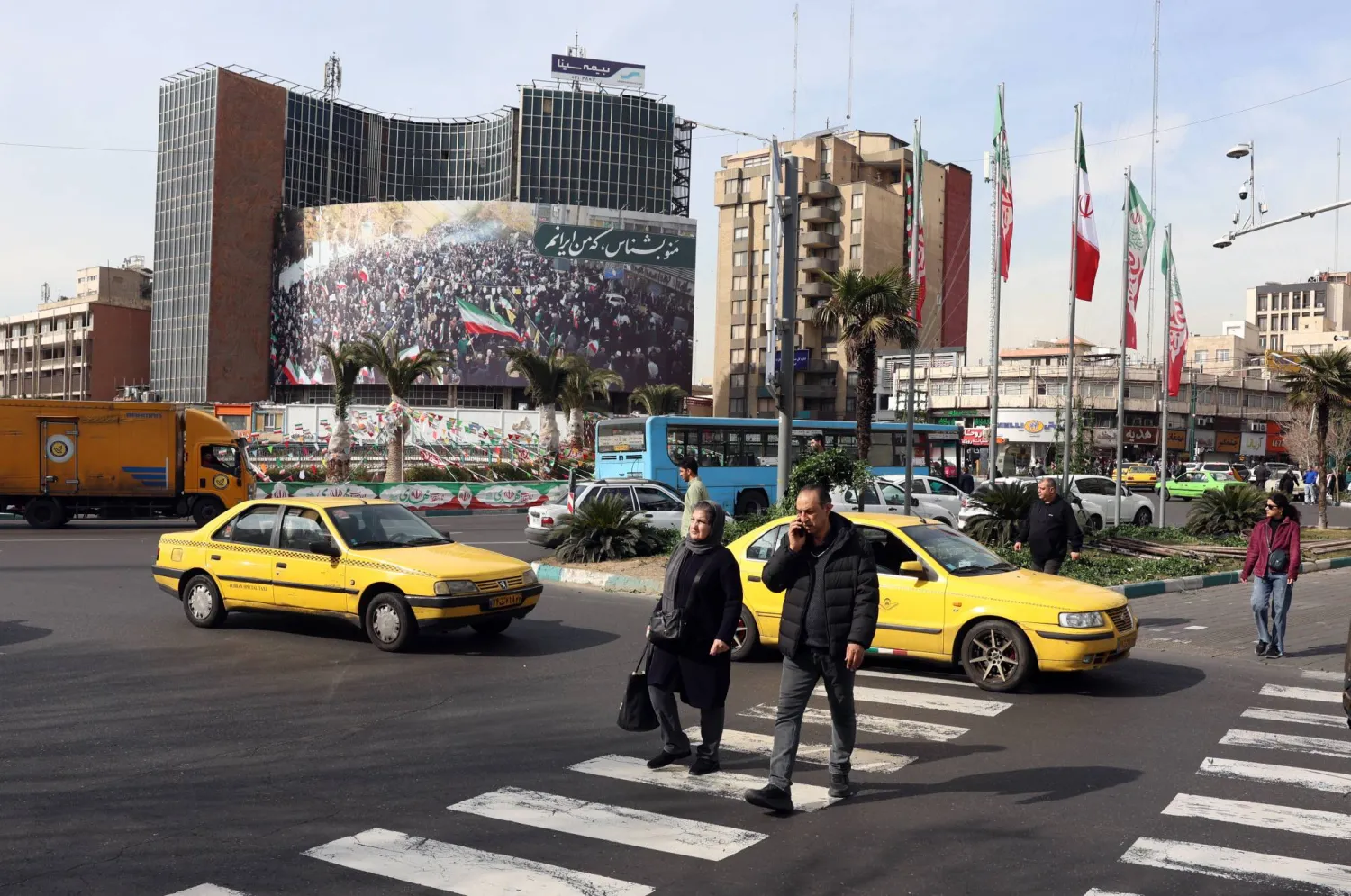
 Iranians walk in a street in Tehran, Iran, 02 February 2026. (EPA)
Iranians walk in a street in Tehran, Iran, 02 February 2026. (EPA)
TT

Iran President Orders Talks with US as Trump Hopeful of Deal

 Iranians walk in a street in Tehran, Iran, 02 February 2026. (EPA)
Iranians walk in a street in Tehran, Iran, 02 February 2026. (EPA)

Iranian President Masoud Pezeshkian has ordered the start of nuclear talks with the United States, local media said Monday, after US leader Donald Trump said he was hopeful of a deal to avert military action against the country. 

Following the Iranian authorities' deadly response to anti-government protests that peaked last month, Trump has threatened military action and ordered the dispatch of an aircraft carrier group to the Middle East. 

Trump has maintained he is hopeful of making a deal and Tehran has also insisted it wants diplomacy, while vowing an unbridled response to any aggression. 

"President Pezeshkian has ordered the opening of talks with the United States" on Iran's nuclear program, the Fars news agency reported on Monday, citing an unnamed government source. The report was also carried by the government newspaper Iran and the reformist daily Shargh. 

US news site Axios cited two unnamed sources saying Iranian Foreign Minister Abbas Araghchi was expected to meet with US envoy Steve Witkoff on Friday in Istanbul to discuss a possible deal on the nuclear file. 

Trump had warned "time is running out" for Iran to reach a deal on its nuclear program, which the West believes is aimed at making an atomic bomb, a claim Tehran has repeatedly denied. 

In an interview Sunday with CNN, Araghchi said, "President Trump said no nuclear weapons, and we fully agree. We fully agree with that. That could be a very good deal," adding that, "in return, we expect sanctions lifting". 

Iran foreign ministry spokesman Esmaeil Baqaei said earlier Monday Tehran was working on a method and framework for negotiations that would be ready in the coming days, with messages between the two sides relayed through regional players. 

- 'Police the world' - 

Türkiye has led a diplomatic push to defuse tensions, with Araghchi visiting Istanbul last week and speaking with other regional counterparts, including in Egypt and Jordan. 

Jordan's top diplomat, Ayman Safadi, on Monday assured Araghchi the kingdom would "not be a battleground in any regional conflict or a launching pad for any military action against Iran". 

Iranian authorities, including supreme leader Ali Khamenei, have warned any US attack would trigger a "regional war". 

In Tehran, pensioner Ali Hamidi told AFP he was a veteran and "not afraid of war", but that "America should mind its own business, why does it want to police the world?" 

But, the 68-year-old added, "Iranian officials are also at fault for not providing for the people. The economic troubles are back-breaking... The officials should do something tangible, not just talk." 

The protests were sparked in late December by economic strain and exploded in size and intensity over several days in early January. 

Authorities have said the protests were "riots" inflamed by its arch foes the United States and Israel, with Khamenei likening them to a "coup" attempt. 

- Ambassadors summoned - 

Tehran has acknowledged thousands of deaths during the protests, and on Sunday the presidency published the names of 2,986 people out of the 3,117 whom authorities said were killed in the unrest. 

Authorities insist most were members of the security forces and innocent bystanders, attributing the violence to "terrorist acts". 

US-based Human Rights Activists News Agency said it has confirmed 6,842 deaths, mostly protesters killed by security forces, with rights groups warning the figure is likely far higher. 

Young Iranian Selina, who would not give her full name, travelled to Iraqi Kurdistan seeking some relief from "living in fear". 

"It's not safe for us" in Iran, the 25-year-old told AFP. 

"We don't even dare to go out after 6:00 pm because soldiers are everywhere." 

The crackdown prompted the European Union to list the Iranian Revolutionary Guard Corps (IRGC) as a terrorist organization, with Iranian lawmakers retaliating on Sunday by slapping the same designation on European armies. 

The EU also issued fresh sanctions on Iranian officials, including the interior minister, a move echoed on Monday by Britain, which announced sanctions on 10 individuals over the "brutality against protesters". 

Baqaei said Monday the foreign ministry had summoned all the EU member state ambassadors in Tehran over the designation, and that other responses were to come. 

Iranian state television also announced four foreigners had been arrested in Tehran for "participation in riots", without specifying their nationalities. 

Authorities have continued to announce arrests, with rights groups estimating at least 40,000 people have been detained over the protests. 


France Criticizes ‘Demagogic’ Move by Israel to Ban Hard-Left Leader Melenchon

 09 November 2026, France, Paris: France's Foreign Minister Jean-Noel Barrot, speaks during a G7 foreign ministers' meeting in Paris. (dpa)
09 November 2026, France, Paris: France's Foreign Minister Jean-Noel Barrot, speaks during a G7 foreign ministers' meeting in Paris. (dpa)
TT

France Criticizes ‘Demagogic’ Move by Israel to Ban Hard-Left Leader Melenchon

 09 November 2026, France, Paris: France's Foreign Minister Jean-Noel Barrot, speaks during a G7 foreign ministers' meeting in Paris. (dpa)
09 November 2026, France, Paris: France's Foreign Minister Jean-Noel Barrot, speaks during a G7 foreign ministers' meeting in Paris. (dpa)

France has ‌criticized as "demagogic" a decision by Israel to ban French hard-left presidential candidate Jean-Luc Melenchonand another leading figure in his France Unbowed (La France Insoumise) party from entering the country.

Israel's Foreign Ministry said on Thursday it would bar Melenchon and Mathilde Panot, the party’s parliamentary group chair, over "the extreme anti-Israel stance of La France Insoumise party and the outrageous statements made by ‌its leaders."

"This demagogic ‌decision, coming from a ‌government ⁠that has repeatedly violated international ⁠law, plays into the hands of those who, like La France Insoumise, thrive on exploiting the Israeli-Palestinian conflict," Foreign Minister Jean-Noel Barrot said on X.

"France will continue to work tirelessly toward a two-state solution and the ⁠peaceful coexistence of the Israeli and ‌Palestinian peoples,” he ‌said.

The Israeli Foreign Ministry said in a ‌statement on Thursday that both Melenchon and ‌Panot had made statements spreading "blood libels" against Israel, and that Melenchon had called for French ships to escort illegal flotillas to Gaza.

"Israel will respond ‌firmly to those who seek to harm it and will not allow ⁠individuals ⁠who act against Israel and incite against its citizens to enter the country," it said.

Melenchon told Franceinfo radio: "I am banned from entering a territory I did not ask to enter...I regret that the Israeli government is pursuing me like this."

In a campaign speech last Saturday, Melenchon made clear that, if he were elected president, French vessels would accompany activists hoping to force aid into the Gaza Strip.


UN Hails Progress in Ebola Response, Cites Insecurity as Biggest Challenge

Congolese workers wearing personal protective equipment (PPE) walk outside the Ebola Treatment Center at the Bunia General Referral Hospital following a resurgence of Ebola involving the Bundibugyo strain, in Bunia, Ituri province, the Democratic Republic of Congo, November 2, 2026. (Reuters)
TT

UN Hails Progress in Ebola Response, Cites Insecurity as Biggest Challenge

Congolese workers wearing personal protective equipment (PPE) walk outside the Ebola Treatment Center at the Bunia General Referral Hospital following a resurgence of Ebola involving the Bundibugyo strain, in Bunia, Ituri province, the Democratic Republic of Congo, November 2, 2026. (Reuters)

UN health officials on Friday hailed progress in the Ebola response six months after the outbreak first prompted global concerns, but cautioned that the disease continues to spread to more remote and dangerous parts of Congo.

With the number of confirmed cases now surpassing 11,000, the outbreak is the second-worst for Ebola on record and ‌has spread to parts ‌of east, central and ‌west ⁠Africa.

Flagged by health ⁠authorities in mid-May, the outbreak is driven by the rare Bundibugyo species of the virus, for which there are no approved treatments or vaccines.

"We do see encouraging signs," said Chikwe Ihekweazu, head of ⁠the World Health Organization's Health Emergencies Program, ‌citing falling ‌cases in former hotspots like Bunia in eastern Democratic ‌Republic of Congo.

“But what we have ‌seen now is the emergence of cases in more rural and more difficult-to-reach areas ... The biggest challenge the response faces right now ‌is the rising insecurity," he said, citing WHO data showing 80 attacks ⁠on health ⁠sites and workers so far.

French medical charity Médecins Sans Frontières has been more downbeat on the Ebola response, saying that supplies are missing and the virus is still spreading out of control.

Julien Harneis, the UN's special Ebola coordinator, said in response to the criticism: "The area of operation is vast, just unimaginable vast...But 80% of the time, and across this vast area, we're able to operate."


Five Facts About APEC with Trump, Putin and Xi Set to Attend

Workers install signage for the upcoming Asia-Pacific Economic Cooperation (APEC) China 2026 summit on the wall of a building in Shenzhen, China's Guangdong province on November 12, 2026. (AFP)
TT

Five Facts About APEC with Trump, Putin and Xi Set to Attend

Workers install signage for the upcoming Asia-Pacific Economic Cooperation (APEC) China 2026 summit on the wall of a building in Shenzhen, China's Guangdong province on November 12, 2026. (AFP)

Attention will focus next week ‌on a summit of US, Chinese and Russian leaders set for the 21-member gathering of the Asia-Pacific Economic Cooperation (APEC) forum in China's southern technology hub of Shenzhen.

WHAT IS APEC?

Founded as an informal 12-member dialogue effort in 1989 in the Australian capital of Canberra, it has become the region's premier economic forum to foster ties on advancing growth, trade and investment.

Accounting for about 62% of global GDP and roughly half of global trade, the grouping of "member economies" rather than nations allows participation by Chinese-ruled Hong Kong and democratically governed Taiwan, which Beijing claims as its own territory.

It does not include India, the world's most populous nation, however.

APEC operates on non-binding commitments reached strictly by consensus, with commitments undertaken on a voluntary basis.

The APEC Economic Leaders' Meeting is set for November 18 and 19, preceded by an annual summit of CEOs on November 17-18.

WHY SHENZHEN?

China is ‌hosting the summit ‌for the third time, after events in the commercial hub of Shanghai ‌in ⁠2001 and the ⁠capital, Beijing, in 2014.

Both domestic and international reasons govern the choice of Shenzhen, adjacent to the financial center of Hong Kong, said Chim Lee, senior analyst at the Economist Intelligence Unit.

As part of China's Greater Bay Area home to Hong Kong and Macau, which Beijing seeks to establish as a global hub for technology and innovation, the city offers a platform to showcase China's vision for development and trade.

It also highlights Shenzhen's resilience to geopolitical turbulence, Lee added.

The city is the base of several leading Chinese auto and tech giants, such as BYD, ⁠Huawei and Tencent .

WHO WILL BE THERE?

China has said President Xi Jinping ‌will chair the leaders' meeting and deliver remarks. US President Donald ‌Trump, Russian President Vladimir Putin and Philippine President Ferdinand Marcos Jr. are among those expected.

The leaders of Canada, Australia, Mexico ‌and Indonesia are also due to attend, along with those of Malaysia, South Korea and Vietnam among ‌Asia-Pacific nations.

Taiwan has designated Stan Shih, founder of Acer, as its envoy.

WHAT TO WATCH AND KEY STICKING POINTS

Middle East Instability: The economic ripple effects of conflict, such as risks to energy security, trade flows, supply chains and inflation are ‌major concerns expected to figure in talks.

Tripartite Dynamics: All eyes are on the possible meeting of Chinese, Russian and US leaders. China is hesitant to ⁠engage in talks on nuclear ⁠disarmament, as it has fewer such weapons than the other two, analysts said.

The US and Russia will also be keen to discuss the Ukraine war, but not necessarily China, they said.

China-US Relations: A key focus to see if ties can stay stable. Both sides are falling short on commitments to an extended trade truce, analysts said. Rare earth supplies, artificial intelligence and tariffs are also likely to figure on the agenda, with US arms sales to Taiwan closely watched.

China's ties with Japan and the Philippines: Strains in Japan and China ties have persisted since Prime Minister Sanae Takaichi angered Beijing in November 2025 by suggesting that Japan could deploy its military if a Chinese move against neighboring Taiwan also threatened its territory.

China-Philippines relations will likewise be closely watched amid continuing tension in the disputed waterway of the South China Sea.

WHO ARE APEC'S MEMBERS?

These are Australia, Brunei, Canada, Chile, China, Hong Kong, Indonesia, Japan, South Korea, Malaysia, Mexico, New Zealand, Papua New Guinea, Peru, the Philippines, Russia, Singapore, Taiwan, Thailand, the United States and Vietnam.