


Ukraine, Russia, US to Start Second Day of War Talks

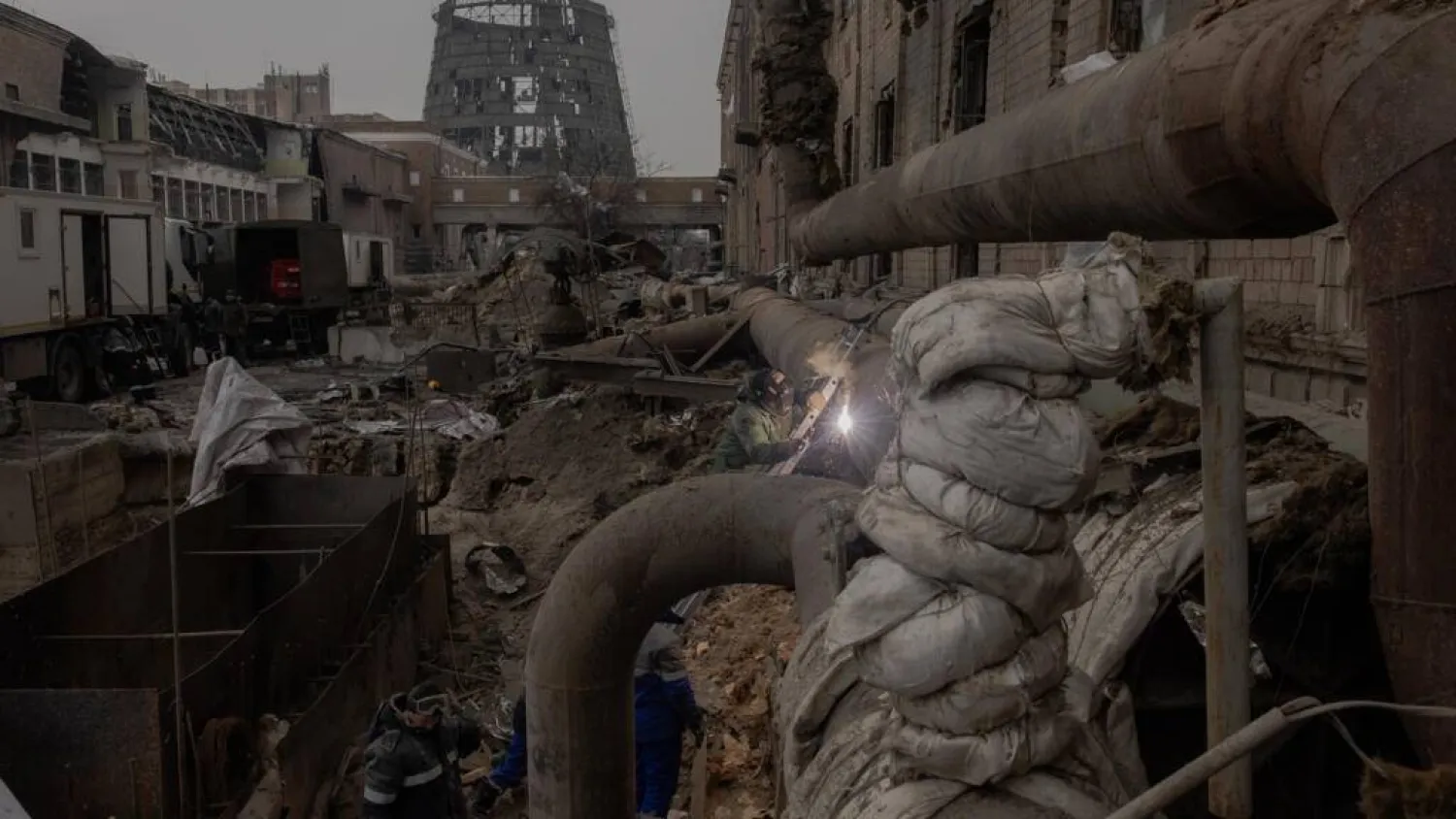
Employees repair sections of the Darnytska combined heat and power plant damaged by Russian air strikes in Kyiv, on February 4, 2026, during the Russian invasion of Ukraine. Roman PILIPEY / AFP
TT

Ukraine, Russia, US to Start Second Day of War Talks

Employees repair sections of the Darnytska combined heat and power plant damaged by Russian air strikes in Kyiv, on February 4, 2026, during the Russian invasion of Ukraine. Roman PILIPEY / AFP

Ukraine, Russia and the United States will start a second day of talks in Abu Dhabi on Thursday, seeking to end Moscow's nearly four-year invasion.

The US-mediated talks are the latest chapter in the so far unsuccessful diplomatic effort to halt the war triggered by Russia's full-scale offensive in February 2022.

A first day of trilateral talks in the Emirati capital on Wednesday concluded with Kyiv describing the negotiations as "substantive and productive", though there was no apparent breakthrough.

The conflict is Europe's deadliest since World War II, with hundreds of thousands killed, millions forced to flee their homes and much of eastern and southern Ukraine left decimated.

Underscoring the human toll, Ukrainian President Volodymyr Zelensky said on Wednesday that 55,000 of his country's troops had been killed, a rare assessment of battlefield losses by either side.

Russia has also stepped up strikes on Ukraine's power infrastructure, leaving many people, including residents of the capital Kyiv, without power and shivering through temperatures as low as minus 20C in recent days.

Ukraine's top negotiator Rustem Umerov said "concrete steps and practical solutions" had been discussed during the first day of the talks.

But the Kremlin repeated its hardline demand that Kyiv must give in, with spokesman Dmitry Peskov telling reporters the fighting would persist "until the Kyiv regime makes the appropriate decisions".

The main sticking point in the negotiations is the long-term fate of territory in eastern Ukraine.

Moscow is demanding that Kyiv pull its troops out of swathes of the Donbas, including heavily fortified cities atop vast natural resources, as a precondition of any deal.

It also wants international recognition that land seized in the invasion belongs to Russia.

Kyiv has said the conflict should be frozen along the current front line and has rejected a pull-back of forces.

Trilateral negotiations, which were first held January 23 and 24 in Abu Dhabi, are the most public sign of progress so far in US President Donald Trump's push to negotiate an end to the war.

His envoy Steve Witkoff and son-in-law Jared Kushner have been sent to try to corral the sides into an agreement.

In Ukraine, foreign ministry spokesman Georgiy Tykhy said of the second round of talks that Kyiv was "interested in finding out what the Russians and Americans really want".

Putin 'only scared of Trump'

Zelensky said the US president's role would be crucial, telling French television in an interview broadcast Wednesday that "Putin is only scared of Trump".

Trump could use economic sanctions against Russia or transfer weapons to Ukraine to "maintain this pressure on Putin", Zelensky said, but added that Kyiv would not compromise on sovereignty.

Russia occupies around 20 percent of Ukraine. It claims the Lugansk, Kherson and Zaporizhzhia regions as its own, and holds pockets of territory in at least three other Ukrainian regions in the east.

Kyiv still controls around one-fifth of the Donetsk region. It has warned that ceding ground will embolden Moscow, and that it will not sign a deal that fails to deter Russia from invading again.


Mojtaba Khamenei Says Closure of Strait of Hormuz Should be Used as 'Leverage'

(FILES) In this picture obtained from Iran's ISNA news agency, Mojtaba Khamenei (C), son of Iran's supreme leader Ayatollah Ali Khamenei, walks along a street in Tehran on May 31, 2019. (Photo by Hamid FOROUTAN / ISNA / AFP)
TT

Mojtaba Khamenei Says Closure of Strait of Hormuz Should be Used as 'Leverage'

(FILES) In this picture obtained from Iran's ISNA news agency, Mojtaba Khamenei (C), son of Iran's supreme leader Ayatollah Ali Khamenei, walks along a street in Tehran on May 31, 2019. (Photo by Hamid FOROUTAN / ISNA / AFP)

Iran’s Supreme Leader Mojtaba Khamenei issued his first statement on the war on Thursday, saying that the leverage of closing the Strait of Hormuz should be used.

Khamenei called on people in Gulf countries to “shut down” US bases, saying promised US protection is “nothing more than a lie.”

Khamenei did not appear on camera. Israeli intelligence assessed that he was likely wounded in the war’s opening salvo, which he said also killed his wife, one of his sisters, his niece and his father, Supreme Leader Ali Khamenei.

US President Donald Trump has promised to “finish the job,” even as Iran is “virtually destroyed.” The first week of the war cost the United States $11.3 billion, according to the Pentagon.

“One point I must emphasize is that, in any case, we will obtain compensation from the enemy,” Khamenei said.

“If it refuses, we will take from its assets to the extent we deem appropriate, and if that is not possible, we will destroy its assets to the same extent.”


Russia Condemns Trump Comments on 'Takeover' of Cuba

US President Donald Trump greets Russian President Vladimir Putin, Aug. 15, 2025, at Joint Base Elmendorf-Richardson, Alaska. (AP Photo/Julia Demaree Nikhinson, File)
TT

Russia Condemns Trump Comments on 'Takeover' of Cuba

US President Donald Trump greets Russian President Vladimir Putin, Aug. 15, 2025, at Joint Base Elmendorf-Richardson, Alaska. (AP Photo/Julia Demaree Nikhinson, File)

Russia condemned on Thursday what it called blackmail and threats by US President Donald Trump to initiate a "takeover" of Cuba, a traditional ally of Moscow.

Russian Foreign Ministry spokeswoman Maria Zakharova said Moscow would provide all possible political and diplomatic support to Cuba and called for a diplomatic solution to the tensions with Washington, Reuters reported.

Trump said on Monday that Cuba was in "deep trouble" and that US Secretary of State Marco Rubio was dealing with the issue, which may or may not be a "friendly takeover."


Trump Says Stopping a Nuclear Iran More Important than Oil Prices

US President Donald Trump talks to the media upon his arrival at Joint Base Andrews, Maryland, US, March 11, 2026.  REUTERS/Kevin Lamarque
US President Donald Trump talks to the media upon his arrival at Joint Base Andrews, Maryland, US, March 11, 2026. REUTERS/Kevin Lamarque
TT

Trump Says Stopping a Nuclear Iran More Important than Oil Prices

US President Donald Trump talks to the media upon his arrival at Joint Base Andrews, Maryland, US, March 11, 2026.  REUTERS/Kevin Lamarque
US President Donald Trump talks to the media upon his arrival at Joint Base Andrews, Maryland, US, March 11, 2026. REUTERS/Kevin Lamarque

US President Donald Trump on Thursday said that stopping Iran from getting nuclear weapons was more important to him than controlling oil prices, Reuters reported.

"The United States is the largest Oil Producer in the World, by far, so when oil prices go up, we make a lot of money. BUT, of far greater interest and importance to me, as President, is stopping an evil Empire, Iran, from having Nuclear Weapons, and destroying the Middle East and, indeed, the World," said Trump in a post on his Truth Social platform.
