


Iran Says Talks with US in Oman Were ‘Good Start’, Will Continue

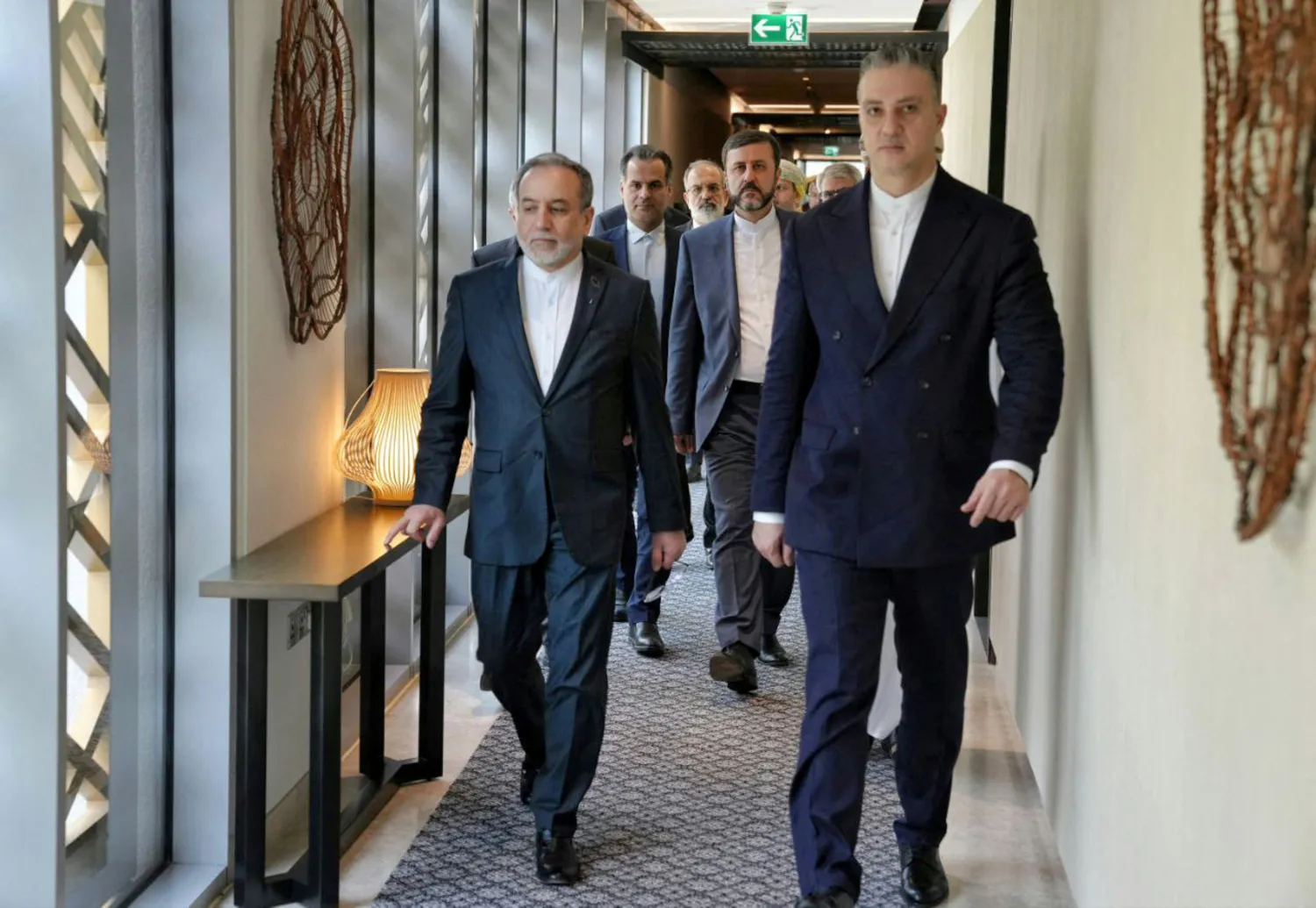
Iranian Foreign Minister Abbas Araqchi and his accompanying delegation depart for the site of the talks in Muscat, Oman, February 6, 2026. Iranian Foreign Ministry/WANA (West Asia News Agency)/ Handout via Reuters
TT

Iran Says Talks with US in Oman Were ‘Good Start’, Will Continue

Iranian Foreign Minister Abbas Araqchi and his accompanying delegation depart for the site of the talks in Muscat, Oman, February 6, 2026. Iranian Foreign Ministry/WANA (West Asia News Agency)/ Handout via Reuters

Iran’s top diplomat said on Friday that nuclear talks with the US mediated by Oman were off to a “good start” and set to continue, in remarks that could help allay concern that failure to reach a deal might nudge the Middle East closer to war. 

But Foreign Minister Abbas Araqchi said after the talks in the Omani capital Muscat that "any dialogue requires refraining from threats and pressure. (Tehran) only discusses its nuclear issue ... We do not discuss any other issue with the US." 

While both sides have indicated readiness to revive diplomacy over Tehran's long-running nuclear dispute with the West, Washington wanted to expand the talks to cover Iran's ballistic missiles, support for armed groups around the region and "treatment of their own people", US Secretary of State Marco Rubio said on Wednesday. 

Iranian officials have repeatedly ruled out putting Iran's missiles - one of the largest such arsenals in the Middle East - up for discussion, and ‌have said Tehran ‌wants recognition of its right to enrich uranium. 

For Washington, carrying out enrichment - a possible ‌pathway to ⁠nuclear bombs - inside ‌Iran is a red line. Tehran has long denied any intent to weaponize nuclear fuel production. 

"It was a good start to the negotiations. And there is an understanding on continuing the talks. Coordination on how to proceed will be decided in the capitals," Araqchi told Iranian state TV. "If this process continues, I think we will reach a good framework for an understanding." 

TALKS WERE 'VERY SERIOUS', SAYS OMAN 

Mediator Badr al-Busaidi, Oman's foreign minister, said the talks had been "very serious", with results to be considered carefully in Tehran and Washington. The goal was to reconvene in due course. 

Iran’s clerical leadership remains deeply worried that Trump may still carry out his threats to strike after a ⁠US naval buildup in seas in the region. 

"The lack of trust is a huge challenge during the talks and it should be overcome," Araqchi said. 

Last June the ‌US struck Iranian nuclear targets, joining in the final stages of a 12-day ‍Israeli bombing campaign. Tehran has since said it has halted uranium ‍enrichment activity. 

The naval buildup, which Trump has called a massive “armada”, has followed a bloody government crackdown on nationwide protests ‍in Iran last month, heightening tensions between Washington and Tehran. 

Trump has warned that "bad things" will probably happen if a deal cannot be reached, ratcheting up pressure on the country in a standoff that has led to mutual threats of air strikes. 

World powers and regional states fear a breakdown in the negotiations would ignite another conflict between the US and Iran that could spill over to the rest of the oil-rich region. 

Iran has vowed a harsh response to any strike and has cautioned regional countries that host US bases that they could be in the firing line if they were involved in an attack. 

Negotiators in Oman ⁠will have to navigate Iran's red line on discussing its missile program to reach a deal and avert future military action. Tehran has flatly ruled out talks on its "defense capabilities, including missiles and their range". 

In a show of defiance, Iranian state TV said hours before the talks that “one of the country’s most advanced long-range ballistic missiles, the Khorramshahr-4,” had been deployed at one of the Revolutionary Guards’ vast underground “missile cities”. 

However, Tehran is willing to show "flexibility" on uranium enrichment, including by handing over 400 kg of highly enriched uranium - refined closer to bomb-grade - and accepting zero enrichment under a consortium arrangement as a solution, Iranian officials told Reuters last week. 

Iran also demands the lifting of US sanctions, reimposed since 2018 when Trump, during his first term in the White House, ditched Iran's 2015 nuclear deal with six world powers. 

The United States, its European allies and Israel accuse Tehran of using its nuclear energy program as a veil for efforts to develop the capability to produce atomic bombs. Iran says its nuclear program is for peaceful purposes only. 

Israel has likened the danger of ‌Iran's missiles to its nuclear program. Prime Minister Benjamin Netanyahu said in January that Iran's "attempt to build atomic weapons" and "20,000 ballistic missiles" were like "two lumps of cancer". 


Mojtaba Khamenei Says Closure of Strait of Hormuz Should be Used as 'Leverage'

(FILES) In this picture obtained from Iran's ISNA news agency, Mojtaba Khamenei (C), son of Iran's supreme leader Ayatollah Ali Khamenei, walks along a street in Tehran on May 31, 2019. (Photo by Hamid FOROUTAN / ISNA / AFP)
TT

Mojtaba Khamenei Says Closure of Strait of Hormuz Should be Used as 'Leverage'

(FILES) In this picture obtained from Iran's ISNA news agency, Mojtaba Khamenei (C), son of Iran's supreme leader Ayatollah Ali Khamenei, walks along a street in Tehran on May 31, 2019. (Photo by Hamid FOROUTAN / ISNA / AFP)

Iran’s Supreme Leader Mojtaba Khamenei issued his first statement on the war on Thursday, saying that the leverage of closing the Strait of Hormuz should be used.

Khamenei called on people in Gulf countries to “shut down” US bases, saying promised US protection is “nothing more than a lie.”

Khamenei did not appear on camera. Israeli intelligence assessed that he was likely wounded in the war’s opening salvo, which he said also killed his wife, one of his sisters, his niece and his father, Supreme Leader Ali Khamenei.

US President Donald Trump has promised to “finish the job,” even as Iran is “virtually destroyed.” The first week of the war cost the United States $11.3 billion, according to the Pentagon.

“One point I must emphasize is that, in any case, we will obtain compensation from the enemy,” Khamenei said.

“If it refuses, we will take from its assets to the extent we deem appropriate, and if that is not possible, we will destroy its assets to the same extent.”


Russia Condemns Trump Comments on 'Takeover' of Cuba

US President Donald Trump greets Russian President Vladimir Putin, Aug. 15, 2025, at Joint Base Elmendorf-Richardson, Alaska. (AP Photo/Julia Demaree Nikhinson, File)
TT

Russia Condemns Trump Comments on 'Takeover' of Cuba

US President Donald Trump greets Russian President Vladimir Putin, Aug. 15, 2025, at Joint Base Elmendorf-Richardson, Alaska. (AP Photo/Julia Demaree Nikhinson, File)

Russia condemned on Thursday what it called blackmail and threats by US President Donald Trump to initiate a "takeover" of Cuba, a traditional ally of Moscow.

Russian Foreign Ministry spokeswoman Maria Zakharova said Moscow would provide all possible political and diplomatic support to Cuba and called for a diplomatic solution to the tensions with Washington, Reuters reported.

Trump said on Monday that Cuba was in "deep trouble" and that US Secretary of State Marco Rubio was dealing with the issue, which may or may not be a "friendly takeover."


Trump Says Stopping a Nuclear Iran More Important than Oil Prices

US President Donald Trump talks to the media upon his arrival at Joint Base Andrews, Maryland, US, March 11, 2026.  REUTERS/Kevin Lamarque
US President Donald Trump talks to the media upon his arrival at Joint Base Andrews, Maryland, US, March 11, 2026. REUTERS/Kevin Lamarque
TT

Trump Says Stopping a Nuclear Iran More Important than Oil Prices

US President Donald Trump talks to the media upon his arrival at Joint Base Andrews, Maryland, US, March 11, 2026.  REUTERS/Kevin Lamarque
US President Donald Trump talks to the media upon his arrival at Joint Base Andrews, Maryland, US, March 11, 2026. REUTERS/Kevin Lamarque

US President Donald Trump on Thursday said that stopping Iran from getting nuclear weapons was more important to him than controlling oil prices, Reuters reported.

"The United States is the largest Oil Producer in the World, by far, so when oil prices go up, we make a lot of money. BUT, of far greater interest and importance to me, as President, is stopping an evil Empire, Iran, from having Nuclear Weapons, and destroying the Middle East and, indeed, the World," said Trump in a post on his Truth Social platform.
