

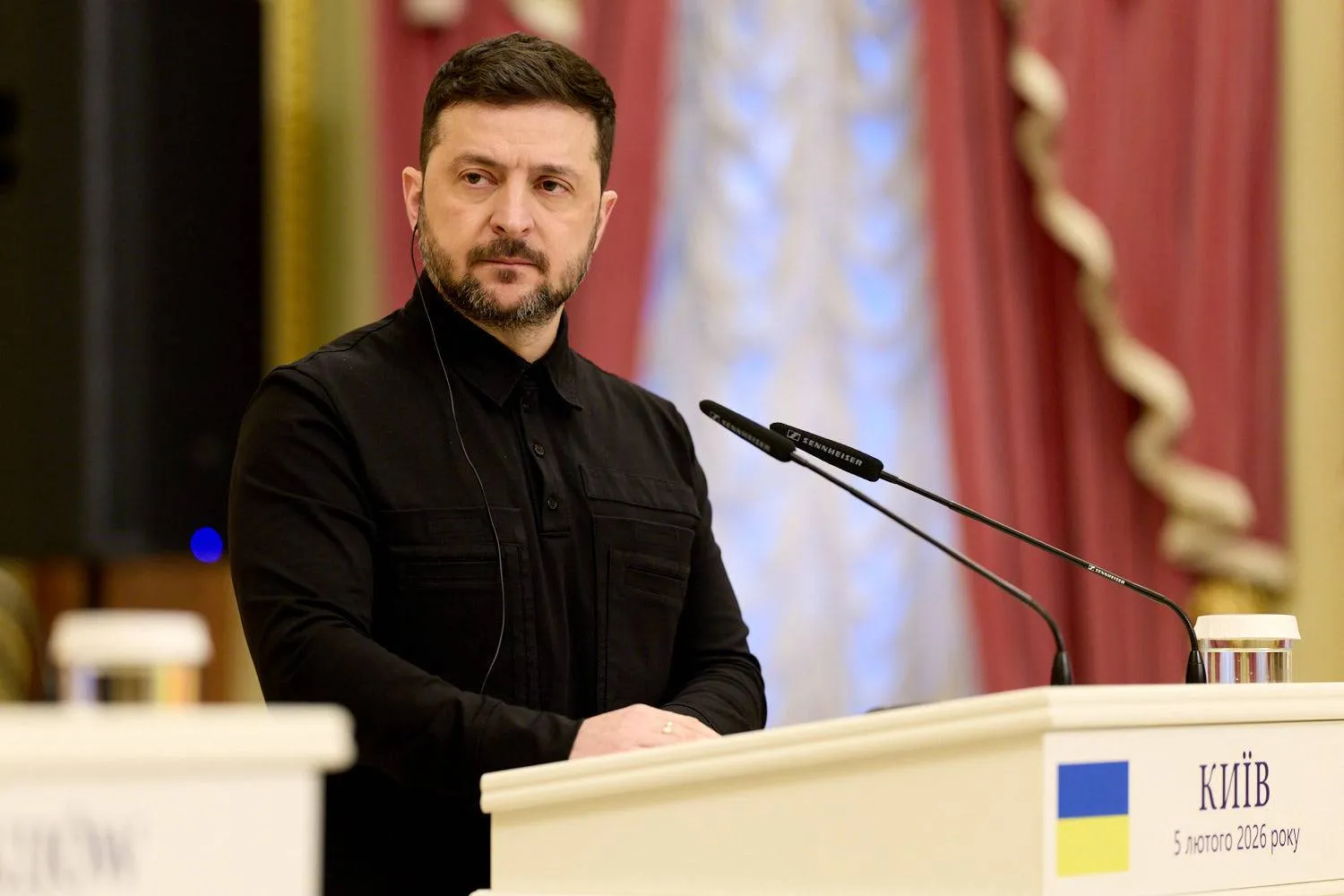

Zelenskyy Says US Gave Ukraine and Russia a June Deadline to Reach Agreement to End War

05 February 2026, Ukraine, Kiev: Ukrainian President Volodymyr Zelenskyy speaks during a press conference with Polish Prime Minister Donald Tusk after their meeting. (Ukrainian Presidency/dpa)
TT

Zelenskyy Says US Gave Ukraine and Russia a June Deadline to Reach Agreement to End War

05 February 2026, Ukraine, Kiev: Ukrainian President Volodymyr Zelenskyy speaks during a press conference with Polish Prime Minister Donald Tusk after their meeting. (Ukrainian Presidency/dpa)

The US has given Ukraine and Russia a June deadline to reach a deal to end the nearly four‑year war, President Volodymyr Zelenskyy told reporters, as Russian strikes on energy infrastructure forced nuclear power plants to cut output on Saturday.

If the June deadline is not met, the Trump administration will likely put pressure on both sides to meet it, he added.

“The Americans are proposing the parties end the war by the beginning of this summer and will probably put pressure on the parties precisely according to this schedule,” Zelenskyy said, speaking to reporters on Friday. Zelenskyy’s comments were embargoed until Saturday morning.

“And they say that they want to do everything by June. And they will do everything to end the war. And they want a clear schedule of all events,” he said.

He said the US proposed holding the next round of trilateral talks next week in their country for the first time, likely in Miami, Zelenskyy said. “We confirmed our participation,” he added.

Zelenskyy said Russia presented the US with a $12 trillion economic proposal — which he dubbed the “Dmitriev package” after Russian envoy Kirill Dmitriev. Bilateral economic deals with the US form part of the broader negotiating process.

Russian strikes on Ukrainian energy infrastructure continued with over 400 drones and about 40 missiles launched overnight Saturday, Zelenskyy said in a post on X. Targets included the energy grid, generation facilities and distribution networks.

Ukrenergo, the state energy transmission operator, said the attack was the second mass strike on energy infrastructure since the start of the year, forcing nuclear power plants to reduce output. Eight facilities in eight regions came under attack, it said in a statement.

“As a result of missile strikes on key high-voltage substations that ensured the output of nuclear power units, all nuclear power plants in the territories under control were forced to reduce their load,” the statement said.

It said the power deficit in the country has increased “significantly” as a result of the attacks forcing an extension of hourly power outages in all regions of Ukraine.

The latest deadline follows US-brokered trilateral talks in Abu Dhabi that produced no breakthrough as the warring parties cling to mutually exclusive demands. Russia is pressing Ukraine to withdraw from the Donbas, where fighting remains intense — a condition Kyiv says it will never accept.

“Difficult issues remained difficult. Ukraine once again confirmed its positions on the Donbas issue. ‘We stand where we stand’ is the fairest and most reliable model for a ceasefire today, in our opinion,” Zelenskyy said. He reiterated that the most challenging topics would be reserved for a trilateral meeting between leaders.

Zelenskyy said no common ground was reached on managing the Russian‑held Zaporizhzhia nuclear plant and expressed skepticism about a US proposal to turn the Donbas region, coveted by Russia, into a free economic zone as a compromise.

“I do not know whether this can be implemented, because when we talked about a free economic zone, we had different views on it,” he said.

He said in the last round of talks the negotiators discussed how a ceasefire would be technically monitored. He added that the US has reaffirmed it would play a role in that process.

Repeated Russian aerial assaults have in recent months focused on Ukraine’s power grid, causing blackouts and disrupting the heating and water supply for families during a bitterly cold winter, putting more pressure on Kyiv.

Zelenskyy said the US again proposed a ceasefire banning strikes on energy infrastructure. Ukraine is ready to observe such a pause if Russia commits; but he added that when Moscow previously agreed to a one-week pause suggested by the US, it was violated after just four days.



Iran Reportedly Rebuilding Military Industrial Base Faster Than Expected

FILE PHOTO: People drive past an anti-US billboard depicting US President Donald Trump and the Strait of Hormuz, in Tehran, Iran, May 17, 2026. Majid Asgaripour/WANA (West Asia News Agency) via REUTERS
TT

Iran Reportedly Rebuilding Military Industrial Base Faster Than Expected

FILE PHOTO: People drive past an anti-US billboard depicting US President Donald Trump and the Strait of Hormuz, in Tehran, Iran, May 17, 2026. Majid Asgaripour/WANA (West Asia News Agency) via REUTERS

Iran has already restarted some of its drone production during the six-week ceasefire that began in early April, CNN reported on Thursday, citing two sources familiar with US intelligence ⁠assessments.

US intelligence indicates ⁠Iran’s military is rebuilding much faster than initially estimated, the report added, ⁠citing four sources.

US President Donald Trump on Wednesday said the United States was ready to proceed with further attacks on Tehran ⁠if Iran ⁠did not agree to a peace deal, but suggested Washington could wait a few days to "get the right answers."

While the time to restart production of different weapons components varies, some US intelligence estimates indicate Iran could fully reconstitute its drone attack capability in as soon as six months, one of the sources, a US official, told CNN.

“The Iranians have exceeded all timelines the IC had for reconstitution,” the US official said.

Iran has been able to rebuild much faster than expected due to a combination of factors, ranging from support it is receiving from Russia and China to the fact that the US and Israel did not inflict as much damage as the two countries had hoped, one of the sources told CNN.

For example, China has continued to provide Iran with components during the conflict that can be used to build missiles, two sources familiar with US intelligence assessments told CNN, though that has likely been curtailed by the ongoing US blockade.

Israeli Prime Minister Benjamin Netanyahu told CBS last week that China is giving Iran “components of missile manufacturing” but declined to elaborate further.


Netanyahu's Coalition Alliances with Religious Parties Put His Reelection at Risk

Ultra-Orthodox Jewish men attend a rally against Army recruitment in Jerusalem, June 30, 2024. (AP Photo/Mahmoud Illean)
TT

Netanyahu's Coalition Alliances with Religious Parties Put His Reelection at Risk

Ultra-Orthodox Jewish men attend a rally against Army recruitment in Jerusalem, June 30, 2024. (AP Photo/Mahmoud Illean)

Israeli Prime Minister Benjamin Netanyahu has remained in power for most of the past 17 years due in part to a tight alliance with ultra-Orthodox religious parties.

But that alliance is tearing apart his governing coalition and proving to be another major liability for the long-serving Israeli leader as the country heads to elections later this year. The Oct. 7, 2023, attack — and the inconclusive wars that have followed — are also weighing on him.

After 2 1/2 years of active fighting in multiple countries, much of it involving reservists, many Israelis are tired of a longstanding system that has allowed ultra-Orthodox men to skip military service. That anger has spread to Netanyahu’s own base, The Associated Press said.

The ultra-Orthodox are meanwhile furious at his failure to legalize their exemptions. They withdrew their support for the coalition two weeks ago, leading to an initial vote to dissolve parliament, known as the Knesset, on Wednesday.

That set in motion a process that could move elections up from October to September.

Here’s a closer look.

The clock is ticking Netanyahu is still trying to pass a bill that would legalize the exemptions and fulfill a promise to his religious partners, but that appears to be a long shot given the strident opposition of many within his own coalition.

Deputy Foreign Minister Sharren Haskel, who served for three years in a combat unit and is a vocal supporter of Netanyahu, said she was among at least seven members of the coalition who will not support the draft bill, rendering it impassable.

“The ultra-Orthodox are trying to extort us. It’s immoral. It’s not fair,” said Haskel, who wore her military uniform at the dissolution vote on Wednesday to highlight her opposition and highlight her own service.

Two major ultra-Orthodox parties deserted Netanyahu earlier this month after he told them he did not expect to be able to pass the exemptions bill. That left his coalition without a parliamentary majority, and is one of the main reasons for the bill to dissolve the Knesset.

“He made a promise to his most loyal allies in the coalition, and he could not deliver, he kept postponing,” said Shmuel Rosner, a senior fellow at the Jewish People Policy Institute, a Jerusalem think tank.

Yitzhak Pindrus, a lawmaker from one of the factions, told The Associated Press on Tuesday that it has no plans to return to the coalition.

“We need the draft bill,” he said.

The ultra-Orthodox can make or break Netanyahu's coalition Israel's political landscape is highly fragmented, and no one party has ever won a majority in the 120-member Knesset.

Instead, parties must build alliances to cobble together a majority, which often involves bargaining that gives smaller parties outsized influence.

The ultra-Orthodox currently have 18 seats in the Knesset, a similar number to previous years, but have long been indispensable to Netanyahu. In exchange for his support for government subsidies and the draft exemptions, they have stood by him through regional crises and longstanding corruption allegations.

Netanyahu has long relied on “automatic support” from the ultra-Orthodox, said Gilad Malach, an expert on the ultra-Orthodox at the Israel Democracy Institute, a research group in Jerusalem.

That support helped Netanyahu remain in power through the worst attack in Israel’s history.

The coalition, which also includes ultra-nationalist parties, “was much more stable than I ever imagined,” said Rosner. “Maybe it's because they realized in a new election, they're going to get defeated, and that's why they stuck together.”

Imploding the coalition from within If Netanyahu somehow passes some form of the draft exemption bill, it could dramatically alter the electoral map. It would push large sectors of the population, who have previously supported Netanyahu but are buckling under hundreds of days of reserve duty, to vote for rival parties that promise equal service, Malach said.

Netanyahu appears to stand little chance of remaining prime minister after October's elections without ultra-Orthodox support. And he is probably their only hope of a bill that would avoid mandatory enlistment coming up for discussion in the next government.

But sticking with the ultra-Orthodox risks harming Netanyahu's standing with the broader public, leaving him in a bind as the country heads toward elections.

Why the ultra-Orthodox reject military service Most Jewish men are required to serve nearly three years of military service, followed by years of reserve duty. Jewish women serve two mandatory years.

Each year, roughly 13,000 ultra-Orthodox men reach the conscription age of 18, but less than 10% enlist, according to a parliamentary committee.

Faced with a severe shortages of soldiers, the military is looking to extend the period of mandatory service.

The ultra-Orthodox, who make up roughly 13% of Israeli society and are the fastest growing sector, have traditionally received exemptions if they are studying full-time in religious seminaries. The exemptions date back to the birth of the state in 1948, when a small number of students sought to revive the Jewish scholarship system after it was decimated by the Holocaust.

Those exemptions — and the government stipends many seminary students receive up to the age of 26 — have infuriated many Israelis. Israel is currently maintaining a simultaneous military presence in Gaza, Lebanon, and Syria, in addition to fighting a war with Iran, which has stretched its robust military to the breaking point.

The Supreme Court said the exemptions were illegal in 2017, but repeated extensions and government delay tactics have left them in place.

Among Israel’s Jewish majority, mandatory military service is largely seen as a melting pot and rite of passage. Many in the insular ultra-Orthodox community fear that military service would expose young people to secular influences.


Pakistan Army Chief Due in Iran as Trump Says Talks on 'Borderline'

TOPSHOT - A woman walks past mockups of Iranian missiles along Valiasr Square in Tehran on April 6, 2026.  (Photo by ATTA KENARE / AFP) /
TOPSHOT - A woman walks past mockups of Iranian missiles along Valiasr Square in Tehran on April 6, 2026. (Photo by ATTA KENARE / AFP) /
TT

Pakistan Army Chief Due in Iran as Trump Says Talks on 'Borderline'

TOPSHOT - A woman walks past mockups of Iranian missiles along Valiasr Square in Tehran on April 6, 2026.  (Photo by ATTA KENARE / AFP) /
TOPSHOT - A woman walks past mockups of Iranian missiles along Valiasr Square in Tehran on April 6, 2026. (Photo by ATTA KENARE / AFP) /

Pakistan's army chief was due in Iran Thursday, Iranian media reported, with Islamabad mediating as Iran examines a new US proposal to end the Middle East war.

The reported visit by Field Marshal Asim Munir, a powerful figure with a growing role in Pakistan's foreign relations, comes a day after President Donald Trump warned that negotiations to end the war were on the "borderline" between a deal and renewed strikes.

A ceasefire on April 8 halted the war launched weeks earlier by the US and Israel, but negotiation efforts have so far failed to yield a lasting peace agreement, AFP said.

A war of words has taken the place of open conflict but the impasse continues to weigh on the world economy, leaving everyone from investors to farmers in a painful state of uncertainty.

On Thursday, Iran's ISNA news agency said Munir's visit was aimed at continuing "talks and consultations" with Iranian authorities, without providing details. Other Iranian media carried the same report.

Pakistan hosted in April the only direct negotiations between US and Iranian officials to take place since February 28, the day the war began.

Munir was at the center of the action during that round of talks, greeting both delegations on their arrival and displaying remarkable bonhomie with US Vice President JD Vance.

But the talks ultimately failed, with Iran accusing the US of making "excessive demands".

Since then, the two sides have sent to each other multiple proposals, with the threat of renewed war looming all along.

"It's right on the borderline, believe me," Trump told reporters Wednesday. "If we don't get the right answers, it goes very quickly. We're all ready to go."

He said a deal could come "very quickly" or "in a few days", but warned Tehran would have to provide "100 percent good answers".

- 'Forceful response' -

Tehran's chief negotiator Mohammad Bagher Ghalibaf on Wednesday accused Washington of seeking to restart the war, while warning of a "forceful response" if Iran is attacked.

"The enemy's movements, both overt and clandestine, show that despite economic and political pressure, it has not abandoned its military objectives and is seeking to start a new war," Ghalibaf said.

Iran's foreign ministry spokesman Esmaeil Baqaei said the Iranian republic was examining points received from Washington, while repeating Tehran's demands for the release of its assets frozen abroad and an end to a US naval blockade.

Trump is under political pressure at home as energy costs rise.

The ceasefire halted the fighting but has not reopened the Strait of Hormuz, the vital waterway that normally carries about a fifth of the world's oil and liquefied natural gas.

The future of Hormuz remains a key sticking point in the negotiations, with fears growing that the global economy will feel more pain as pre-war oil stockpiles run down.

Iran imposed the blockade of Hormuz as part of its retaliation in the war, allowing only a trickle of vessels through in recent weeks while introducing a toll system.

Hormuz also carries around a third of global fertilizer shipments, raising concerns of higher food prices and shortages if the closure drags on.

The UN Food and Agriculture Organization said the closure could trigger "a severe global food price crisis" and a "systemic agrifood shock".

Cautious hope rippled through financial markets on Thursday, with crude prices edging up around 0.5 percent. On Wednesday oil had fallen more than five percent, while US stocks rose.

Analysts warned that investors remained wary after weeks of false starts in the negotiations.