


Prime Minister Takaichi’s Party Wins a Supermajority in Japan's Lower House

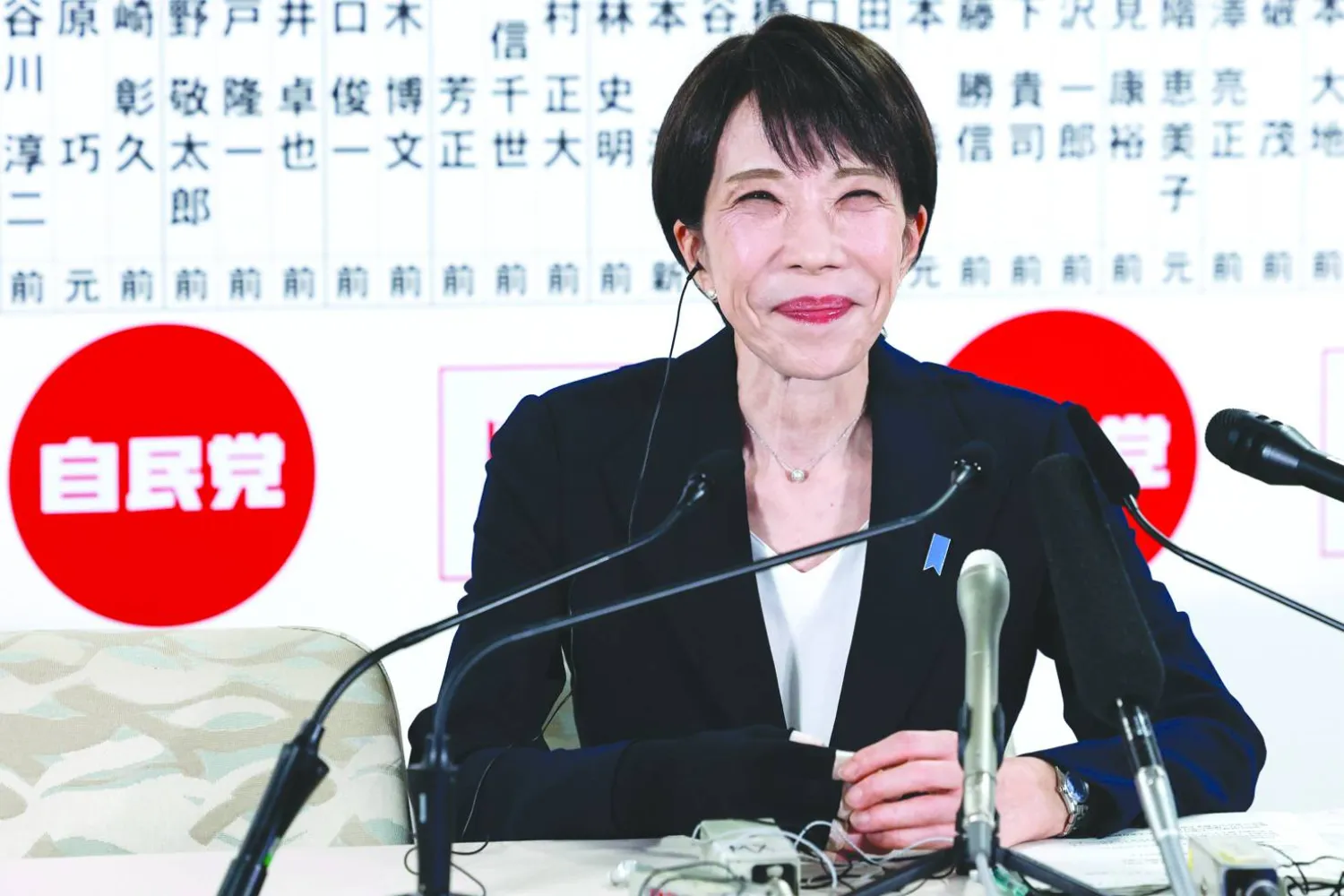
TOPSHOT - Japan's Prime Minister and President of the Liberal Democratic Party (LDP) Sanae Takaichi reacts as she speaks with media on the House of Representatives election day at the LDP headquarters in Tokyo on February 8, 2026. (Photo by Kim Kyung-Hoon / POOL / AFP)
TT

Prime Minister Takaichi’s Party Wins a Supermajority in Japan's Lower House

TOPSHOT - Japan's Prime Minister and President of the Liberal Democratic Party (LDP) Sanae Takaichi reacts as she speaks with media on the House of Representatives election day at the LDP headquarters in Tokyo on February 8, 2026. (Photo by Kim Kyung-Hoon / POOL / AFP)

Japanese Prime Minister Sanae Takaichi 's governing party secured a two-thirds supermajority in parliamentary elections, Japanese media reported, citing preliminary results. The landslide victory was due, in large part, to the extraordinary popularity of Japan's first female prime minister, and allows her to pursue a significant conservative shift in Japan’s security, immigration and other policies.

Takaichi, in a televised interview with public television network NHK following her victory, said she will emphasize policies meant to make Japan strong and prosperous, The Associated Press said.

NHK, citing vote count results, said Takaichi’s Liberal Democratic Party, or LDP, alone secured 316 seats by early Monday, comfortably surpassing a 261-seat absolute majority in the 465-member lower house, the more powerful of Japan's two-chamber parliament. That marks a record since the party's foundation in 1955 and surpasses the previous record of 300 seats won in 1986 by late Prime Minister Yasuhiro Nakasone.

With 36 seats won by its new ally, Japan Innovation Party, Takaichi's ruling coalition has won 352 seats.

A smiling Takaichi placed a big red ribbon above each winner’s name on a signboard at the LDP's headquarters, as accompanying party executives applauded.

Despite the lack of a majority in the upper house, the huge jump from the preelection share in the superior lower house would allow Takaichi to make progress on a right-wing agenda that aims to boost Japan’s economy and military capabilities as tensions grow with China and she tries to nurture ties with the United States.

Takaichi said she would try to gain support from the opposition while firmly pushing forward with her policy goals.

“I will be flexible,” she said.

Takaichi is popular, but the LDP, which has ruled Japan for most of the last seven decades, has struggled with funding and religious scandals in recent years. She called Sunday’s early election after only three months in office, hoping to turn that around while her popularity is high.

Popular leader

The ultraconservative Takaichi, who took office as Japan’s first female leader in October, pledged to “work, work, work,” and her style, which is seen as both playful and tough, has resonated with younger fans who say they weren't previously interested in politics.

The opposition, despite the formation of a new centrist alliance and a rising far-right, was too splintered to be a real challenger. The new opposition alliance of LDP’s former coalition partner, Buddhist-backed dovish Komeito, and the liberal-leaning Constitutional Democratic Party of Japan, is projected to sink to half of their combined preelection share of 167 seats.

Takaichi was betting with this election that her LDP party, together with its new partner, the JIP, would secure a majority.

Trump in a post on his Truth Social platform Sunday congratulated Takaichi "on a LANDSLIDE Victory in today’s very important Vote. She is a highly respected and very popular Leader. Sanae’s bold and wise decision to call for an Election paid off big time.”

Akihito Iwatake, a 53-year-old office worker, said he welcomed the big win by the LDP because he felt the party went too liberal in the past few years. “With Takaichi shifting things more toward the conservative side, I think that brought this positive result,” he said.

Takaichi's policies

The LDP's right-wing partner, JIP leader Hirofumi Yoshimura, has said his party will serve as an “accelerator” for Takaichi's push to conservative policies.

Japan has recently seen far-right populists gain ground, such as the anti-globalist and surging nationalist party Sanseito. Exit polls projected a big gain for Sanseito.

The first major task for Takaichi when the lower house reconvenes in mid-February is to work on a budget bill, delayed by the election, to fund economic measures that address rising costs and sluggish wages.

Takaichi has pledged to revise security and defense policies by December to bolster Japan’s offensive military capabilities, lifting a ban on weapons exports and moving further away from the country’s postwar pacifist principles.

She has been pushing for tougher policies on foreigners, anti-espionage and other measures that resonate with a far-right audience, but ones that experts say could undermine civil rights.

Takaichi also wants to increase defense spending in response to US President Donald Trump’s pressure for Japan to loosen its purse strings.

She now has time to work on these policies, without an election until 2028.

Divisive policies

Though Takaichi said that she's seeking to win support for policies seen as divisive in Japan, she largely avoided discussing ways to fund soaring military spending, how to fix diplomatic tension with China and other issues.

Despite her rightward shift, Takaichi is expected to maintain good relations with South Korea, given shared worries about threats from North Korea and China. But Seoul would worry about a Japanese attempt to revise the country's pacifist constitution or to further build up its military because of Japan's wartime past, said Leif-Eric Easley, professor of international studies at Ewha Womans University in Seoul.

In her campaign speeches, Takaichi enthusiastically talked about the need for government spending to fund “crisis management investment and growth,” such as measures to strengthen economic security, technology and other industries. Takaichi also seeks to push tougher measures on immigration, including stricter requirements for foreign property owners and a cap on foreign residents.

Sunday's election “underscores a problematic trend in Japanese politics in which political survival takes priority over substantive policy outcomes,” said Masato Kamikubo, a Ritsumeikan University politics professor. “Whenever the government attempts necessary but unpopular reforms ... the next election looms.”



Iranian Official Says Kharg Oil Exports 'Normal', after US Strikes

A satellite image of Iran's Kharg Island (AFP)
TT

Iranian Official Says Kharg Oil Exports 'Normal', after US Strikes

A satellite image of Iran's Kharg Island (AFP)

Oil export operations from Iran's Kharg island in the Gulf were proceeding as normal Saturday after US strikes on the crude export hub which caused no casualties, a regional official said.

Activities of oil companies "at this export terminal are continuing as normal", said Ehsan Jahaniyan, deputy governor of Iran's southern Bushehr province, quoted by the IRNA news agency.

The Fars news agency, citing sources on the island, earlier reported there had been no damage to oil facilities after President Donald Trump said US strikes had destroyed only military targets, AFP reported.

Trump had threatened to target oil infrastructure on the island, a crucial hub for Iran, if Tehran continues to block the strategic Strait of Hormuz.

Iran has, in turn, threatened to target US-linked oil infrastructure.

Deputy governor Jahaniyan said that after the attacks "daily life and routine activities of the residents are also fully maintained."

The attack "did not cause any casualties among military personnel, company employees, or residents of Kharg island, he added.

According to Fars, the US operation "tried to damage the army's defenses, the Joshan naval base, the airport control tower and the helicopter hangar of the Iran Continental Shelf Oil Company."

Kharg Island, a scrubby stretch of land in the northern Gulf around 30 kilometres (19 miles) off the Iranian mainland, handles roughly 90 percent of Iran's crude exports.


Four Killed in Russian Air Attack on Ukraine

Four Killed in Russian Air Attack on Ukraine
TT

Four Killed in Russian Air Attack on Ukraine

Four Killed in Russian Air Attack on Ukraine

Russia hammered Ukraine with missiles and drones overnight, killing four people and causing damage across five regions of the country, Ukrainian officials said on Saturday.

The main target was energy infrastructure outside the capital Kyiv, President Volodymyr Zelenskiy said, adding that residential buildings, schools and businesses were also damaged, Reuters reported.

He said the Sumy, Kharkiv, Dnipro and Mykolaiv regions were also targeted in an attack that included around 430 drones and 68 missiles, most of which were downed by air defences.

Saturday's strikes come as the spiraling Iran conflict has distracted international attention from a US-backed peace push in the four-year war, which Kyiv says Moscow has no interest in ending.

"Russia will try to exploit the war in the Middle East to cause even greater destruction here in Europe, in Ukraine," Zelenskiy wrote on X.

He repeated his call for Kyiv's partners to boost production of critical air-defence weapons, stocks of which have been diminishing as the US and its allies in the Gulf have fended off Iranian strikes.

Russia's winter attacks on Ukraine have left swathes of major cities without power or heating, part of a campaign to weaken resolve as Moscow's troops press a battlefield offensive and demand Kyiv cede more territory in the east.

Ukraine's forces have targeted Russian strategic infrastructure such as oil refineries, depots and terminals in long-range strikes.

Ukraine's Energy Ministry said on Saturday that consumers in six regions were without electricity after the overnight strikes and Russian shelling of frontline areas.

"There's no way Russia will stop," said local resident Natalia Fetko, 57, whose building was damaged in the strike. "Nothing is enough for them."

All four deaths occurred in the Kyiv region, where 15 people were also wounded and damage recorded in four districts, according to regional military administrator Mykola Kalashnyk.

Saturday's attack also prompted NATO member Poland to scramble jets to protect its airspace, but no violations were observed, Warsaw's military said.


Son of Ousted Shah Says Ready for Iran Transition 'Under My Leadership'

Smoke rises following an explosion during a protest marking the annual al-Quds Day (Jerusalem Day) on the last Friday of the holy month of Ramadan, amid the US-Israeli conflict with Iran, in Tehran, Iran, March 13, 2026.- Reuters
TT

Son of Ousted Shah Says Ready for Iran Transition 'Under My Leadership'

Smoke rises following an explosion during a protest marking the annual al-Quds Day (Jerusalem Day) on the last Friday of the holy month of Ramadan, amid the US-Israeli conflict with Iran, in Tehran, Iran, March 13, 2026.- Reuters

The exiled son of Iran's last shah who was ousted by the 1979 revolution said on Saturday he was ready to lead a transition "as soon as the Islamic Republic falls".

In a message on his social media channels, US-based Reza Pahlavi said he had already been working to select individuals both inside and outside Iran to serve on what he called a "Transitional System".

Pahlavi leads one of several opposition movements based outside Iran but his prominence grew after January protests against the clerical system, with some demonstrators calling for a return of the monarchy, according to AFP.

Longstanding supreme leader Ali Khamenei was killed on February 28 in US-Israeli airstrikes but after a fortnight of war the clerical system remains in place even if his successor, his son Mojtaba, has yet to make a public appearance.

Pahlavi said that Saeed Ghasseminejad, senior Iran and financial economics advisor at the US-based think tank Foundation for Defense of Democracies (FDD), which is staunchly critical of the Islamic republic, had been leading the process to select members of a transitional body.

"Capable individuals both inside and outside the country have been identified and evaluated to lead various sections of the Transitional System," he said

"The Transitional System, under my leadership, will be ready to assume governance of the country as soon as the Islamic Republic falls, and in the shortest possible time, establish order, security, freedom, and the conditions for Iran's prosperity and flourishing," he added.

In a boost to Pahlavi, vast pro-monarchy rallies took place in February in Munich and several cities in North America in the biggest yet such show of support.

But he has notably also failed to win recognition from US President Donald Trump, who has never officially met with Pahlavi and repeatedly expressed scepticism over his ability to lead Iran.

"They talk about the son of the shah, they talk about other people, but (he) hasn't been there in many years," Trump said this week.

Pahlavi was undergoing air force training in the US when his father Mohammad Reza Pahlavi was ousted and never returned to the country.

Trump has repeatedly referred to Venezuela, where in January US forces captured president Nicolas Maduro, with Washington now working with his former deputy Delcy Rodriguez.

But it remains unclear how such a scenario could play out in Iran.

"I like the idea of internal because it works well, I think we have proven that so far in Venezuela," Trump said.