


Iran President Says Will Not ‘Give in to Excessive Demands’ 

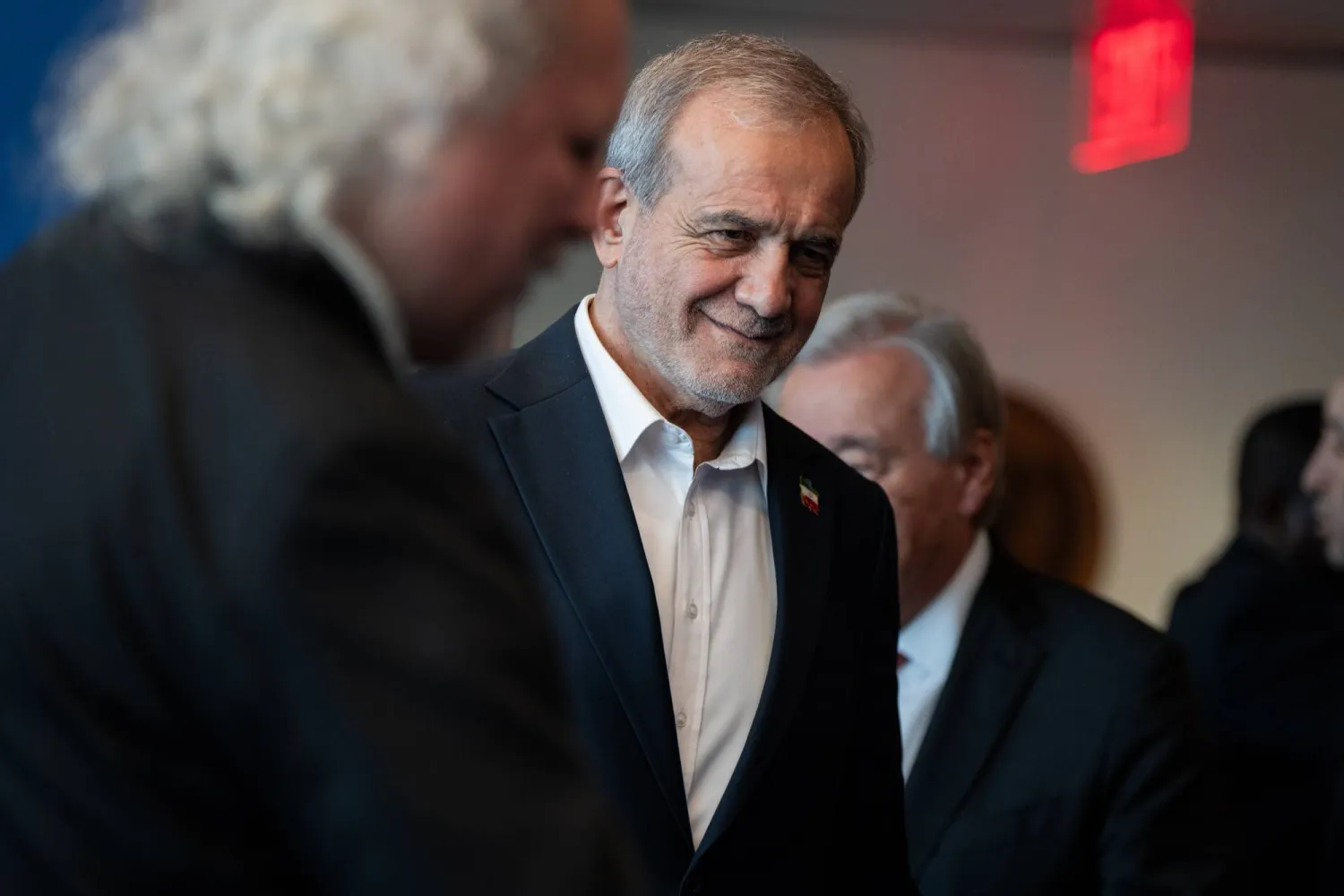
Masoud Pezeshkian, the President of Iran, attends the United Nations General Assembly at United Nations headquarters, on Sept. 25, 2025. (AP)
TT

Iran President Says Will Not ‘Give in to Excessive Demands’ 

Masoud Pezeshkian, the President of Iran, attends the United Nations General Assembly at United Nations headquarters, on Sept. 25, 2025. (AP)

Iranian President Masoud Pezeshkian said Wednesday that his country would "not yield to excessive demands" on its nuclear program, after Tehran resumed talks with the United States.

"Our country, Iran, will not yield to their excessive demands," he said in a speech at Azadi Square in the capital for the 47th anniversary of Iran's revolution.

"Our Iran will not yield in the face of aggression, but we are continuing dialogue with all our strength with neighboring countries in order to establish peace and tranquility in the region."

Iran marked the revolution anniversary as the country’s theocracy remains under pressure, both from US President Donald Trump who suggested sending another aircraft carrier group to the Middle East and a public angrily denouncing Tehran's bloody crackdown on nationwide protests.

The commemoration represented a spit-screen view of life in Iran, with state television showing hundreds of thousands of people across the country attending pro-government rallies, which included the burning of American flags and cries of “Death to America!”

A top Iranian security official traveled Qatar on Wednesday after earlier visiting Oman, which has mediated this latest round of negotiations. Just before the official's arrival, Qatar's ruling emir received a phone call from Trump.

In his speech, Pezeshkian also insisted that his nation was “not seeking nuclear weapons. ... and are ready for any kind of verification.” However, the United Nations’ nuclear watchdog — the International Atomic Energy Agency — has been unable for months to inspect and verify Iran’s nuclear stockpile.

“The high wall of mistrust that the United States and Europe have created through their past statements and actions does not allow these talks to reach a conclusion,” Pezeshkian said.

Tehran’s missile capabilities are a red line and “non-negotiable,” said Ali Shamkhani, adviser to Iran's supreme leader said at the commemoration. 

Commemoration overshadowed by crackdown

On Iranian state TV, authorities broadcast images of people taking to the streets across the country Wednesday to support the theocracy and its 86-year-old Supreme Leader Ali Khamenei.

But on Tuesday night, as government-sponsored fireworks lit the darkened sky, witnesses heard shouts from people’s homes in the Iranian capital, Tehran, of “Death to the dictator!”

In the streets Wednesday, people waved images of Khamenei and Khomeini, the founder of the Islamic Republic, alongside Iranian and Palestinian flags. Some chanted “Death to America!” and “Death to Israel!” Others criticized Iran's exiled crown prince, Reza Pahlavi, who had been calling for anti-government protests.

“I am here to say we don’t stop supporting our leader and our country as the Americans and Israelis are increasingly threatening" us, said Reza Jedi, a 43-year-old participant.

Among Iran's 85 million people, there is a hard-line element of support for Iran's theocracy, including members of the country's powerful paramilitary Revolutionary Guard, which crucially put down the protests last month in a bloody suppression that killed thousands and saw tens of thousands detained, according to activists.

Also, many Iranians often take part in pro-theocracy demonstrations as they are government employees or turn up to enjoy the carnival atmosphere of a government-sponsored holiday. Iran has 2.5 million government employees, with a fifth in Tehran alone.

While not directly addressing the bloodshed by authorities, Pezeshkian acknowledged the crackdown that began in earnest on Jan. 8 had “caused great sorrow.”

“We are ashamed before the people, and we are obligated to assist all those who were harmed in these incidents,” he said. “We are not seeking confrontation with the people.”

However, he also criticized what he described as “Western propaganda” over the crackdown.

One man sadly watched the commemoration from a sidewalk in Tehran, not taking part.

“I regularly participated in the rally in past years,” said the man, who spoke on condition of anonymity for fear of reprisal. “But how can I do that now as the streets' asphalt were bloodied last month?”

Larijani in Qatar

As the commemoration took place, senior Iranian security official Ali Larijani left Oman for Qatar, a Mideast nation that hosts a major US military installation and one that Iran attacked in June after the US bombed Iranian nuclear sites during the 12-day Iran-Israel war.

The state-run Qatar News Agency reported that Emir Sheikh Tamim bin Hamad Al Thani spoke with Trump about “the current situation in the region and international efforts aimed at de-escalation and strengthening regional security and peace,” without elaborating.

Speaking to the Russian state channel RT, Iranian Foreign Minister Abbas Araghchi said Tehran still does “not have full trust for the Americans.”

“Last time we negotiated, last June we were in the middle of negotiation then they decided to attack us and that was a very very bad experience for us,” he said. “We need to make sure that that scenario is not repeated and this is mostly up to America.”

Despite that concern, Araghchi said it could be possible “to come to a better deal than Obama,” referencing the 2015 nuclear deal with world powers Iran reached when former US President Barack Obama was in office. Trump in his first term unilaterally withdrew America from the accord.



Israel PM’s Wife Shares Conspiracy Theory About Opposition Figure

Israel's Prime Minister Benjamin Netanyahu (L) and his wife Sara Netanyahu stand during a welcome ceremony for India's Prime Minister Narendra Modi at the Ben Gurion airport near Tel Aviv on February 25, 2026. (AFP)
TT

Israel PM’s Wife Shares Conspiracy Theory About Opposition Figure

Israel's Prime Minister Benjamin Netanyahu (L) and his wife Sara Netanyahu stand during a welcome ceremony for India's Prime Minister Narendra Modi at the Ben Gurion airport near Tel Aviv on February 25, 2026. (AFP)

Sara Netanyahu, the wife of the Israeli prime minister, has claimed an opposition figure was aware of the plan for Hamas's October 7, 2023 attack before it happened.

Her remarks, which triggered outrage across Israel's opposition, highlight the country's deep political polarization ahead of close-fought elections to be held on October 27.

In a television interview broadcast on Monday evening, Sara Netanyahu lashed out at Yair Golan, the former deputy military chief of staff who heads Israel's center-left Democrats party.

She suggested Golan was "already dressed and ready" at dawn on October 7, 2023, "while others knew nothing, including the prime minister".

Sara Netanyahu's interview was broadcast on Israel's Channel 14, which is close to the government. The comments triggered swift outrage from the opposition.

Golan's party said it strongly condemned the "vile and deceitful" remarks.

"Spreading conspiracies against Major General Yair Golan, and smearing his heroism on October 7, is crossing a red line that borders on insanity," it wrote on X.

Gadi Eisenkot, a former army chief who has emerged as the frontrunner to challenge Netanyahu, slammed the "mad conspiracy of betrayal" spread by the prime minister's wife.

In a post on X, he said the comments were "intended only to stoke hatred and perpetuate Netanyahu's rule".

Sara Netanyahu's accusations reflect recurrent conspiracy theories among a part of the Israeli political class.

According to a poll conducted for Channel 13 in August, 40 percent of Israelis, and 63 percent of voters for the current right-wing coalition, believe that internal treason led to the October 7 attack -- the deadliest day in Israel's history.

Netanyahu, Israel's longest-serving prime minister who has billed himself as the guarantor of the country's safety, has deflected blame for the attack, saying that security officials should have woken him from his sleep.

Hamas's attack on Israel resulted in the deaths of 1,221 people, according to an AFP tally based on official Israeli figures. Fighters also took 251 hostages -- 44 of them already dead -- into Gaza.

Israel responded with a massive offensive in Gaza that has killed at least 73,454 people, according to the Palestinian territory's health ministry, which operates under Hamas authority and whose figures are considered reliable by the United Nations.


Türkiye Unveils Mechanism for PKK Weapons Handover Ahead of Reintegration

Thousands of PKK members are waiting to return to Türkiye following the implementation of a law allowing for their integration. (Reuters)
TT

Türkiye Unveils Mechanism for PKK Weapons Handover Ahead of Reintegration

Thousands of PKK members are waiting to return to Türkiye following the implementation of a law allowing for their integration. (Reuters)

Turkish sources have revealed the creation of a mechanism to disarm the Kurdistan Workers’ Party (PKK), involving coordination among Ankara, Baghdad, Erbil and Sulaimaniyah, as part of preparations to implement the Law on Strengthening National Solidarity and Social Integration, passed by Türkiye’s parliament on Aug. 10.

The mechanism, coordinated by Türkiye’s National Intelligence Organization (MIT), is intended to complete the PKK’s disarmament, a prerequisite for implementing the legislation, known as the “framework law” for the “Peace and Democratic Society Process,” or what the state calls the “Terror-Free Türkiye” process.

The initiative is based on the PKK’s dissolution and disarmament, followed by the suspension of trials and prosecutions of its members - excluding its leadership - and allowing them to return and reintegrate into Turkish society.

Four-way mechanism

The pro-government Hurriyet newspaper reported Monday that PKK members would surrender their weapons to authorities in Erbil or Sulaimaniyah, or to Iraq’s central government in Baghdad. The weapons would be inventoried, while MIT would retain the relevant records.

The evacuation of PKK camps, hideouts and shelters will also be monitored, beginning in the Haftanin and Gara areas of northern Iraq.

Once all sites have been evacuated and the group’s cadres fully disbanded, MIT will submit a report to Türkiye’s National Security Council, which will then issue a decision declaring the PKK’s presence ended.

Once it is confirmed that the group has ceased all illegal activities - not only in Iraq and Syria but also in Europe - its members will be allowed to return.

The exception will be about 230 senior figures based in the Qandil Mountains, who are expected to remain in a secure area in Sulaimaniyah.

The cases of PKK members imprisoned in Türkiye will also begin to be reviewed.

MIT chief Ibrahim Kalin visited Iraq in July, holding meetings in Baghdad, Erbil, Sulaimaniyah and Kirkuk focused on security and intelligence cooperation, regional stability and the PKK’s dissolution and disarmament.

Return and reintegration

Between 7,000 and 8,000 PKK members, mostly from Iraq and Syria, are expected to return after the integration of the Syrian Democratic Forces (SDF) into Syrian state institutions is completed. Some of the roughly 80,000 PKK sympathizers in Europe are also expected to be allowed to return.

Hurriyet columnist Nedim Sener wrote that Sinjar and Makhmur would be the next stage. Some 2,200 PKK members in Sinjar are expected to join the Iraqi army, while about 8,000 civilians at the Makhmur camp in northern Iraq - mainly Turkish families displaced there - are expected to return to Türkiye.

Tulay Hatimogullari, co-chair of the pro-Kurdish Peoples’ Equality and Democracy Party (DEM Party), said the “Peace and Democratic Society Process,” which has been under way for two years, had reached a “historic turning point.”

The process formally began when imprisoned PKK leader Abdullah Ocalan called on the group to dissolve itself, lay down its arms and pursue politics through democratic and legal channels.

Speaking at a party gathering in the western city of Izmir, Hatimogullari described the framework law as the first legislation of its kind in a century to benefit the Kurdish people.

She said it could lead to the release of about 4,000 political prisoners and the return of exiled politicians.

PKK death toll

The PKK has, for the first time, disclosed the total number of its militants killed during its armed campaign.

Murat Karayilan, regarded as the PKK’s de facto commander in the Qandil Mountains, put the figure at about 27,000, including those killed in operations against Türkiye, clashes in Sinjar and Turkish military operations in northern Syria.

Responding to criticism that the identities of those killed had not yet been disclosed, Karayilan acknowledged shortcomings and said the organization was also critical of itself, expressing hope that the families would understand.

Some Turkish estimates put the overall death toll from the decades-long conflict at more than 40,000 on both sides. President Recep Tayyip Erdogan recently said Türkiye had also incurred losses of $2.3 trillion in combating PKK activities.


‘Massive’ Russian Missile, Drone Attack on Kyiv Kills 8

People walk on a field as smoke rises at the site of a Russian strike near Kyiv, Ukraine, 31 August 2026, amid the Russian invasion. (EPA)
TT

‘Massive’ Russian Missile, Drone Attack on Kyiv Kills 8

People walk on a field as smoke rises at the site of a Russian strike near Kyiv, Ukraine, 31 August 2026, amid the Russian invasion. (EPA)

A "massive" Russian attack killed at least eight people in Kyiv overnight, including seven at a railways depot, officials said Tuesday, as Moscow pressed its air campaign on the Ukrainian capital and surrounding areas.

The strikes came as children were set to return to school after summer holidays and as authorities tightened security measures following weeks of intensified Russian attacks on the capital.

Kyiv Mayor Vitali Klitschko said eight people were killed and five wounded, including two children, in the overnight bombardment, which included ballistic missiles and drones.

Oleksandr Pertsovskyi, chief executive of Ukrainian Railways, said a missile hit a railway depot and other railway facilities in Kyiv.

"The ballistic strike took the lives of 7 people, 6 of whom were our employees," he said, adding that another railway worker had been hospitalized.

Pertsovskyi said the attack caused "extensive destruction", including the complete destruction of a workshop, while fires continued to burn at some sites.

One person was killed in strikes in Boryspil, east of Kyiv, regional officials said.

Russia's defense ministry said its forces had carried out a "massive strike" using long-range weapons and attack drones.

It said the attack targeted military-industrial and fuel and energy facilities in Kyiv and the surrounding region.

The ministry also said it had struck infrastructure in the southern Odesa region and the ports of Odesa and Chornomorsk.

"Kyiv region came under a massive attack by Russian missiles and strike drones tonight," Kyiv regional military administration chief Tymur Tkachenko said on Telegram.

AFP journalists in the capital heard around a dozen loud explosions and saw flashes in sky early Tuesday moments after the air force warned of incoming ballistic missiles.

The Ukrainian air force had warned that the threat of "ballistic weapons and other means of attack against Kyiv and the region remains in effect", and urged residents to remain in shelters.

Ukrainian children return to school on Tuesday, and the Kyiv regional military administration has warned there must be no large events in areas with a high level of risk.

Kyiv and its surrounding areas have come under sustained pressure from Russian drone attacks in recent weeks, with jet-powered drones adding to the threat and triggering as many as a dozen air-raid alerts a day.

One weekend attack on an ammunition depot killed 38 people in the capital's suburbs.

Both sides have escalated long-range strikes in recent months, targeting infrastructure such as warehouses, businesses, and oil and port facilities, as well as ships, increasing civilian casualties.

Ukraine faces a shortage of interceptor missiles, particularly US-made Patriot systems used against ballistic threats.