


Interpol Backroom Warriors Fight Cyber Criminals 'Weaponizing' AI

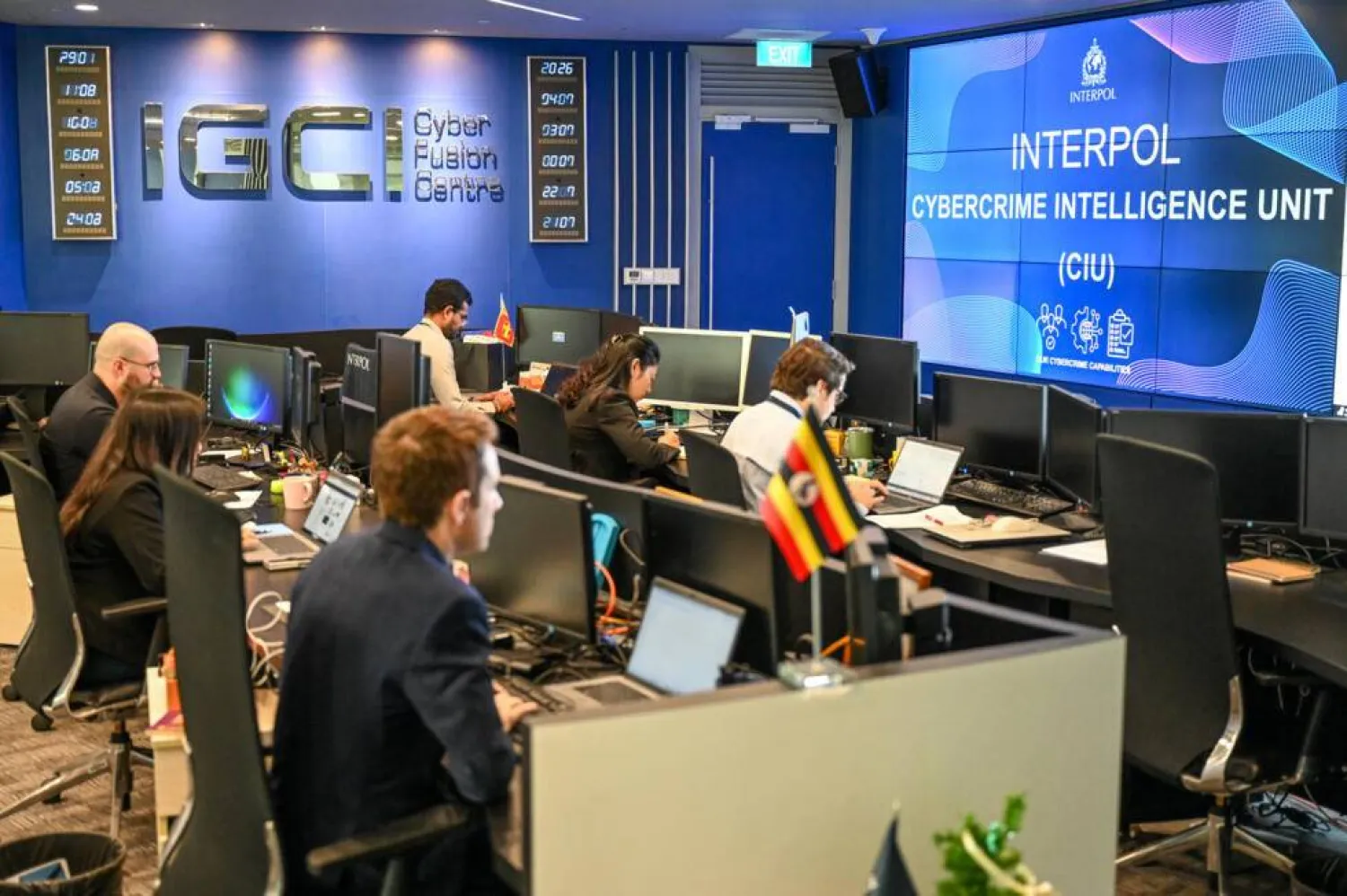
AFP was granted a look inside the global organization's multi-pronged cybercrime facility, where specialists pore through massive amounts of data. Roslan RAHMAN / AFP
TT

Interpol Backroom Warriors Fight Cyber Criminals 'Weaponizing' AI

AFP was granted a look inside the global organization's multi-pronged cybercrime facility, where specialists pore through massive amounts of data. Roslan RAHMAN / AFP

From perfectly spelled phishing emails to fake videos of government officials, artificial intelligence is changing the game for Interpol's cat-and-mouse fight against cybercrime at its high-tech war rooms in Singapore.

Their foe: crime syndicates, structured like multinational firms, which are exploiting the fast-evolving technology to target individuals, states and corporations for billions of dollars.

"I consider the weaponization of AI by cybercriminals... as the biggest threat we're seeing," Neal Jetton, Interpol's Singapore-based director of cybercrime, told AFP.

"They are using it in whatever way they can," added Jetton, who is seconded to Interpol from the US Secret Service, the federal agency in charge of presidential protection.

AFP was granted a look inside the global organization's multi-pronged cybercrime facility, where specialists pore through massive amounts of data in a bid to prevent the next big ransomware attack or impersonation scam.

Jetton said the "sheer volume" of cyber attacks worries him the most.

"It's going to only expand, and so you just need to get the word out to people," so they understand "how often they're going to be targeted", he said.

AI technology is allowing criminals around the world to create sophisticated voice and video copies of well-known figures to endorse scam investments, and helping make dodgy online messages appear more genuine.

Jetton warned that even low-skilled criminals can purchase ready-made hacking and scamming tools on the dark web -- and anyone with a smartphone can be a target.

- 'Black market' -

The facility is part of the Interpol Global Complex for Innovation, not far from the Singapore Botanic Gardens.

It is the organization's second headquarters after Lyon in France, and houses the Cyber Fusion Center, a nerve center for sharing intelligence of online threats among 196 members.

Another office in the complex studies emerging online threats, while a digital forensics lab extracts and analyses data from electronic devices like laptops, phones and even cars.

A command-and-coordination center, like a mini space mission control with staff facing big screens, monitors global developments in real time during Asian hours.

Intelligence analysts scrutinize millions of data points -- from web addresses and malware variants to hacker code names -- that could provide leads in active investigations.

Christian Heggen, coordinator of the Cyber Intelligence Unit, said they are up against a "large ecosystem of cyber criminals" who use "a number of different attack vectors".

"They get quite creative. It's a whole black market of spying and selling stolen data, buying and selling malware. We have to understand that ecosystem," he said.

To strengthen its capabilities, Interpol partners with private firms in finance, cybersecurity and cryptocurrency analysis.

"It's always a cat-and-mouse game, always continually developing. That's why a department like this is quite important, because we can provide the latest intelligence and information," Heggen said.

- 'AI has no soul' -

Last year, Interpol's cybercrime directorate coordinated "Operation Secure" in Asia, which saw 26 countries work together to dismantle more than 20,000 malicious IP addresses and domains linked to syndicates to steal data.

Another anti-cybercrime operation across Africa, called "Operation Serengeti 2.0" coordinated from Singapore, saw authorities arrest 1,209 cybercriminals who targeted nearly 88,000 victims. More than $97 million was recovered and 11,432 malicious infrastructures were dismantled.

Jetton said Interpol supported the crackdown on the online scam centers in Southeast Asia through intelligence-sharing and resource development.

The Innovation Center's head, Toshinobu Yasuhira, a Japanese officer seconded from the National Police Agency, said advances in deepfake technology have become a growing concern, but one of his deeper worries lies ahead: AI acting beyond human control.

"Should we arrest people who program the AI, or who utilize AI, or should we arrest the AI itself?" he said in an interview.

"It's kind of very difficult because AI doesn't have any soul, heart."

Paulo Noronha, a digital forensics expert from Brazil's Federal Police, demonstrated some of the lab's high-tech tools designed to keep investigators a step ahead.

Experts at the lab are working on the further use of virtual reality, augmented reality and quantum technology against cybercriminals.
"It's up to us to stay ahead of criminals," he said. "That's why we have systems like these."

For Jetton and his colleagues, the fight rarely enters the public eye, but is vital to global security.

"We try to be as confidential as we can," one intelligence analyst said.

"We're providing key support for operations and investigations around the world."


Fighting Reaches Outskirts of Ukraine’s Stronghold Kostiantynivka

 This photograph shows a barbed wire defense line running across a field at an undisclosed location in the Kharkiv region, eastern Ukraine, on May 1, 2026, amid the Russian invasion of Ukraine. (AFP)
This photograph shows a barbed wire defense line running across a field at an undisclosed location in the Kharkiv region, eastern Ukraine, on May 1, 2026, amid the Russian invasion of Ukraine. (AFP)
TT

Fighting Reaches Outskirts of Ukraine’s Stronghold Kostiantynivka

 This photograph shows a barbed wire defense line running across a field at an undisclosed location in the Kharkiv region, eastern Ukraine, on May 1, 2026, amid the Russian invasion of Ukraine. (AFP)
This photograph shows a barbed wire defense line running across a field at an undisclosed location in the Kharkiv region, eastern Ukraine, on May 1, 2026, amid the Russian invasion of Ukraine. (AFP)

Russian troops are ‌inching towards the city of Kostiantynivka in Ukraine's eastern Donetsk region, trying to establish a foothold close to a heavily defended area, Ukraine's top army official said on Saturday.

Kostiantynivka, along with other cities, forms a so-called fortress belt in the country's east - an area well-fortified by the Ukrainian military.

"We are repelling the Russian occupiers' persistent attempts to gain a foothold in the outskirts of Kostiantynivka using infiltration tactics. Counter-sabotage measures are going on in the ‌city," Oleksandr Syrskyi, ‌Ukraine's army chief, said on the Telegram ‌app.

A ⁠Ukrainian battlefield mapping ⁠project called DeepState shows Russian troops control an area around only one kilometer (0.6 mile) from the city's southern outskirts.

Small chunks of Kostiantynivka in the southeast are marked as a grey zone, meaning neither Ukraine nor Russia has full control over them.

Russia's defense ministry said on ⁠Wednesday its forces had taken control of ‌Novodmytrivka, just north of Kostiantynivka. Moscow's ‌top general Valery Gerasimov said in April that troops were ‌advancing in the north and south of the ‌city.

Syrskyi said that Russian offensive attempts had risen noticeably in April. Since Monday, Russian troops have carried out 83 assaults in this sector using small infantry groups, he added.

Russia demands that ‌Ukraine pull back from areas in the Donetsk and neighboring Luhansk regions that it ⁠failed to capture ⁠in its four-year full-scale war. US-brokered peace talks stalled over the issue as Ukrainian officials say Kyiv will not cede land it still controls.

For the past few years, Russian troops have not managed to capture any big city agglomerations in Ukraine, inching forward and taking control over small settlements, mostly in Ukraine's east.

The small city of Pokrovsk, whose more than 60,000 pre-war population mostly fled, was the most significant gain in the past year. It took Moscow's troops months to advance, and Kyiv says it still has some positions in the city.


Report: Explosion of Bombs Left Over from Strikes Kill 14 Iranian Revolutionary Guard Members

Smoke billows from an Israeli strike on Tehran. (Reuters file)
TT

Report: Explosion of Bombs Left Over from Strikes Kill 14 Iranian Revolutionary Guard Members

Smoke billows from an Israeli strike on Tehran. (Reuters file)

An explosion of leftover bombs from strikes during the war against Iran killed 14 members of the Revolutionary Guard, Iranian media reported Friday.

A report by the Nournews website, believed to be close to Iran’s security, said the explosion happened near the northern city of Zanjan, which is northwest of Tehran.

It was the largest number of Revolutionary Guard members reported to be killed since the ceasefire began on April 7.

The report said the ammunition included cluster bombs and air mines dropped during the fighting.


US, Philippines Deploy Anti-Ship Missile System in Batanes Near Taiwan for War Games

 A vehicle used for the Navy-Marine Expeditionary Ship Interdiction System (NMESIS), stands during joint Philippine-US military exercises in Basco, Batanes province, Philippines, May 2, 2026. (Reuters)
A vehicle used for the Navy-Marine Expeditionary Ship Interdiction System (NMESIS), stands during joint Philippine-US military exercises in Basco, Batanes province, Philippines, May 2, 2026. (Reuters)
TT

US, Philippines Deploy Anti-Ship Missile System in Batanes Near Taiwan for War Games

 A vehicle used for the Navy-Marine Expeditionary Ship Interdiction System (NMESIS), stands during joint Philippine-US military exercises in Basco, Batanes province, Philippines, May 2, 2026. (Reuters)
A vehicle used for the Navy-Marine Expeditionary Ship Interdiction System (NMESIS), stands during joint Philippine-US military exercises in Basco, Batanes province, Philippines, May 2, 2026. (Reuters)

Philippine and US forces on Saturday showcased the NMESIS anti-ship missile system in Batanes province, near Taiwan, during annual war games, as tensions simmer over the self-governed island that China views as its own territory.

The Philippines' northernmost province, with about 20,000 residents, sits around 100 miles south of Taiwan, along the Luzon Strait, a strategic corridor on the frontline of the great power competition between the US and China for dominance in the Asia-Pacific region.

"Training out here in Batanes allows us a different environment than what we're normally allowed to operate in," said US Staff Sergeant Darren Gibbs.

"So it gives us unique opportunities to actually utilize the system and train within our capabilities, and it offers experiences we don't normally get offered in our day-to-day training."

Gibbs said the NMESIS is designed for remote operation, and that "the purpose of this system is for it to be ‌fully autonomous, for us ‌not to require a driver or passenger inside the vehicle itself."

"We will tell it ‌where ⁠to go and ⁠then we program what it needs to do," he said.

The NMESIS, a highly mobile coastal anti-ship missile system designed to target surface vessels from land-based positions at ranges of about 185 km (115 miles), was flown into Batanes on a US C-130 transport aircraft, and positioned in the capital Basco, which has one of the island province's two small runways.

Francisco Lorenzo, Philippine exercise director, told Reuters that deployment of US weapons such as the NMESIS to Batanes was part of efforts to test operational feasibility in remote locations. The NMESIS was also deployed to Batanes in last year's war games.

"It is part of training so ⁠as to test the feasibility or rehearse their deployment there when need arises," Lorenzo ‌said. One of the objectives of the Balikatan, as the annual "shoulder-to-shoulder" drills ‌of US and Philippine forces are called, is to practice "defense of our territory with our allies", he said.

The NMESIS would not ‌be used in live exercise operations and was brought to Batanes only for deployment rehearsal and simulation support during ‌the war games.

He said the system would be withdrawn from Batanes once the drills were finished. The US also deployed its Typhon missile system to the Philippines in 2024 for use in joint exercises.

Beijing routinely criticizes the deployment of US weapons in the Philippines, saying it heightens regional tension.

Security analyst Chester Cabalza, founder and president of the Manila-based think tank International Development and Security Cooperation, told ‌Reuters "the NMESIS can spark a powder keg for Beijing and asymmetric deterrence for Manila and Taipei in the Bashi Channel along the Luzon Strait."

The system can be ⁠airlifted and deployed to ⁠any coastline in the Philippine archipelago within hours, Cabalza said, and its placement in Batanes is likely viewed by Beijing as part of the "US-led encirclement" of China.

WAR GAMES INVOLVE 17,000 TROOPS

Philippine and US forces also carried out maritime strike drills in Itbayat, a Batanes municipality about 155 km from Taiwan and the northernmost part of the country.

More than 17,000 troops are taking part in this year's war games, including about 10,000 from the US, even as Washington remains heavily engaged in the Middle East.

China recently intensified its activities in the South China Sea and the Taiwan Strait, increasing its naval presence around Taiwan and sending an aircraft carrier through the strait. It also put up a barrier this month at the mouth of the Scarborough Shoal, according to satellite images reviewed by Reuters.

Philippine President Ferdinand Marcos Jr has said Filipinos working and living in Taiwan would have to be evacuated in the event of war over the self-governed island and that would "drag the Philippines kicking and screaming into the conflict."

Philippine Defense Secretary Gilberto Teodoro said in an April 28 interview with Reuters that Manila has a contingency plan to evacuate Filipinos in Taiwan if conflict erupts but gave no further details.
