Australia Unveils Initial US$2.8 Billion for New Nuclear Subs Facility

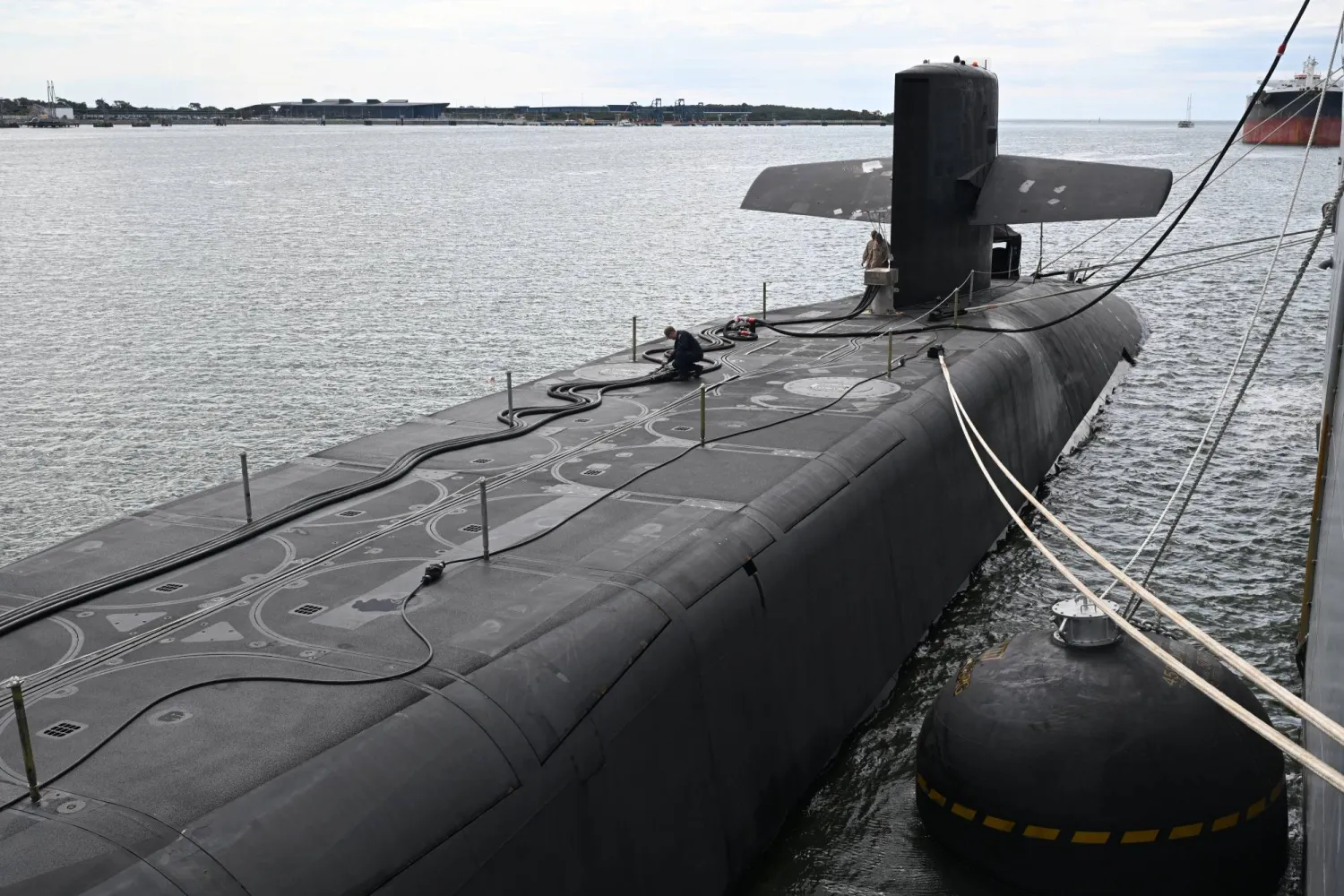
The USS Ohio docks in Brisbane, the first Ohio-class submarine to dock at the Port of Brisbane, Australia, 30 July 2025. EPA/DARREN ENGLAND
TT

Australia Unveils Initial US$2.8 Billion for New Nuclear Subs Facility

The USS Ohio docks in Brisbane, the first Ohio-class submarine to dock at the Port of Brisbane, Australia, 30 July 2025. EPA/DARREN ENGLAND

Australia unveiled AU$3.9 billion (US$2.8 billion) in spending on Sunday as a "down payment" on a new facility to build nuclear submarines under the tripartite AUKUS security pact with Britain and the United States.
The AUKUS pact aims to arm Australia with a fleet of cutting-edge submarines from the United States and would provide for cooperation in developing an array of warfare technologies, reported AFP.
The submarines, the sale of which will begin in 2032, lie at the heart of Australia's strategy of improving its long-range strike capabilities in the Pacific, particularly against China.
The deal could cost Canberra up to US$235 billion over the next 30 years, and also includes the technology to build its own vessels in the future.
Defense minister Richard Marles said the facility in Osborne, near the southern city of Adelaide, would be at the heart of that.
In the long term, an estimated AU$30 billion is expected to be spent on the facility.
"The transformation underway at Osborne shows Australia is on track to deliver the sovereign capability to build our nuclear-powered submarines for decades to come," he said.
The investment in the Submarine Construction Yard "is critical to delivering Australia's conventionally-armed, nuclear-powered submarines", Prime Minister Anthony Albanese said in a statement.
"We are accelerating AUKUS opportunities to secure Australia's future defense capability and create lasting prosperity and jobs for the state," he added.
In September, Canberra also revealed a US$8 billion investment to be spent over a decade to transform a shipbuilding and maintenance precinct in Perth, Western Australia, into facilities for a future fleet of nuclear-powered submarines.
Australia had a major bust-up with France in 2021 when it cancelled a multi-billion-dollar deal to buy a fleet of diesel-powered submarines from Paris and went with the AUKUS program instead.
The pact was thrown into doubt last June when Washington said it was launching a review into whether it aligned with President Donald Trump's "America First" agenda.
In December, the Pentagon said it had cleared that hurdle and that Trump had ordered it "full steam ahead".



Blast Lightly Damages Jewish School in Amsterdam

Police officers stand outside a Jewish school following an explosion that caused minor damages, in Amsterdam, Netherlands, March 14, 2026. REUTERS/Piroschka van de Wouw
TT

Blast Lightly Damages Jewish School in Amsterdam

Police officers stand outside a Jewish school following an explosion that caused minor damages, in Amsterdam, Netherlands, March 14, 2026. REUTERS/Piroschka van de Wouw

An explosion lightly damaged a Jewish school in Amsterdam early on Saturday, in what the city's mayor described as "a deliberate attack against the Jewish community".

The explosion at the school in an upscale residential neighborhood on the south side of Amsterdam damaged a rainpipe and charred an outer wall, and caused no injuries.

Mayor Femke Halsema said the incident ⁠was taken very seriously, ⁠and would lead to increased security at Jewish institutions.

"This is a cowardly act of aggression against the Jewish community," Halsema said.

"Jewish people in Amsterdam are increasingly confronted with antisemitism. This is unacceptable."

The school is the ⁠only one specifically for orthodox Jews in the Netherlands, and is largely fenced off by a pointed, metal outer wall due to earlier threats.

Security at synagogues and Jewish institutions in the Dutch capital had already been heightened after an overnight arson attack at a synagogue in the center of Rotterdam on Friday.

In neighboring Belgium, an explosion caused a ⁠fire ⁠at a synagogue in Liege on Monday.

Dutch Prime Minister Rob Jetten called the attack in Amsterdam "horrible" and said it understandably caused "fear and anger" in the Jewish community.

"The safety of Jewish institutions has our full attention," he said in a post on X.

Concerns about possible attacks against Jewish communities around the world have risen following US and Israeli attacks on Iran and a subsequent response from Tehran.

On Thursday, a man rammed his car into a synagogue on the outskirts of Detroit, Michigan, sparking a blaze.

The suspect, identified as 41-year-old Ayman Mohamad Ghazali, died Friday from a "self-inflicted gunshot wound to the head," an FBI official told reporters.

Media reports have indicated his relatives were killed in Israeli strikes on Lebanon in recent days.


Trump Says Iran 'Totally Defeated'

US President Donald Trump steps off Air Force One as he arrives at Palm Beach International Airport in West Palm Beach, Florida on March 13, 2026. (Photo by SAUL LOEB / AFP)
TT

Trump Says Iran 'Totally Defeated'

US President Donald Trump steps off Air Force One as he arrives at Palm Beach International Airport in West Palm Beach, Florida on March 13, 2026. (Photo by SAUL LOEB / AFP)

US President Donald Trump said Friday that Iran has been "totally defeated" in the US-Israeli military campaign against the country and wanted a deal he would not accept, despite Iranian officials pledging to continue the fight.

"The Fake News Media hates to report how well the United States Military has done against Iran, which is totally defeated and wants a deal - But not a deal that I would accept!" Trump wrote on his Truth Social platform, without elaborating.

Trump's comments came after he said that Washington had heavily bombed military targets on Iran's oil hub Kharg Island and the US Navy would soon begin escorting tankers through the Strait of Hormuz.

But as the US strikes on Iran persisted, Tehran launched a new wave of drone and missile attacks on Israel.

Iran's top diplomat said this week that talks remain off the table and attacks would continue for as long as necessary.

"I don't think talking with the Americans would be on our agenda anymore," Iran's Foreign Minister Abbas Araghchi told PBS News this week, adding Tehran had a "very bitter experience" during previous negotiations with the US.

Iran's semi-official Fars news agency reported, citing sources, that more than 15 explosions were heard on Kharg during the US attacks. The sources said air defenses, a naval base and airport facilities were hit, but there was no damage to oil infrastructure.

Iran also claimed success in shooting down five drones over its airspace, bringing to 114 the total US and Israeli drones it has downed ⁠during the war, Iranian state TV reported on Saturday.

On Friday, the Israeli military said its air force had struck more than 200 targets in western and central Iran over the past day, including ballistic missile launchers, air-defense systems and weapons production sites.


NKorea Fires About 10 Missiles Toward Sea During US-SKorea Drills

US soldiers from the 2nd Infantry Division/ROK-US Combined Division, conducts a combined exercise (maneuvering, wet gap crossing) with South Korean soldiers from the Lightning Brigade, Capital Mechanized Infantry Division and 7th Engineer Brigade, as part of the Freedom Shield 26 exercise, in Yeoncheon, Gyeonggi province, South Korea, 14 March 2026. EPA/JEON HEON-KYUN
TT

NKorea Fires About 10 Missiles Toward Sea During US-SKorea Drills

US soldiers from the 2nd Infantry Division/ROK-US Combined Division, conducts a combined exercise (maneuvering, wet gap crossing) with South Korean soldiers from the Lightning Brigade, Capital Mechanized Infantry Division and 7th Engineer Brigade, as part of the Freedom Shield 26 exercise, in Yeoncheon, Gyeonggi province, South Korea, 14 March 2026. EPA/JEON HEON-KYUN

North Korea on Saturday fired about 10 ballistic missiles toward the eastern sea, South Korea’s military said, staging its own show of force as the rival South conducts a joint military exercise with the United States.

South Korea’s Joint Chiefs of Staff said the missiles were fired from an area in Sunan, the site of Pyongyang’s international airport, and flew about 350 kilometers (220 miles).

Japanese Defense Minister Shinjiro Koizumi said the weapons landed outside the country’s exclusive economic zone and that there were no reports of damage to planes or ships.

The South’s Joint Chiefs said the military has stepped up surveillance and is maintaining readiness against possible additional launches while closely sharing information with the US and Japan.

The launches came as the US and South Korean militaries conduct their annual springtime exercises involving thousands of troops while the Trump administration also wages an escalating war in the Middle East.

The war has raised concerns about potential security lapses in South Korea, as local media — citing security camera footage and other images — have speculated that the US is relocating some missile defense assets stationed in the country to support operations against Iran.

When asked by The Associated Press this week whether US Forces Korea was moving interceptor missiles from its Terminal High Altitude Area Defense, or THAAD, system in Seongju to the Middle East, South Korean President Lee Jae Myung’s office said it could not confirm details about US military operations.

The office said the potential relocation of US military assets would not affect the allies’ defense posture against nuclear-armed North Korea, while also citing South Korea’s conventional military strength. It earlier gave a similar response to reports about the possible relocation of Patriot missile defense systems from South Korea.

The launches came hours after South Korean Prime Minister Kim Min-seok, Seoul’s No. 2 official after Lee, met US President Donald Trump in Washington and expressed hope for renewed diplomacy between Washington and Pyongyang. Lee seeks improved inter-Korean relations, and some of his top officials have said Trump’s expected visit to China, starting March 31, may create an opening with Pyongyang.

But Saturday’s launches appeared to dim such hopes, signaling defiance by Pyongyang, which in recent months has hardened its stance toward Seoul and urged Washington to drop denuclearization demands as a precondition for talks.