
Netanyahu Says US Deal with Iran Must Dismantle Nuclear Infrastructure

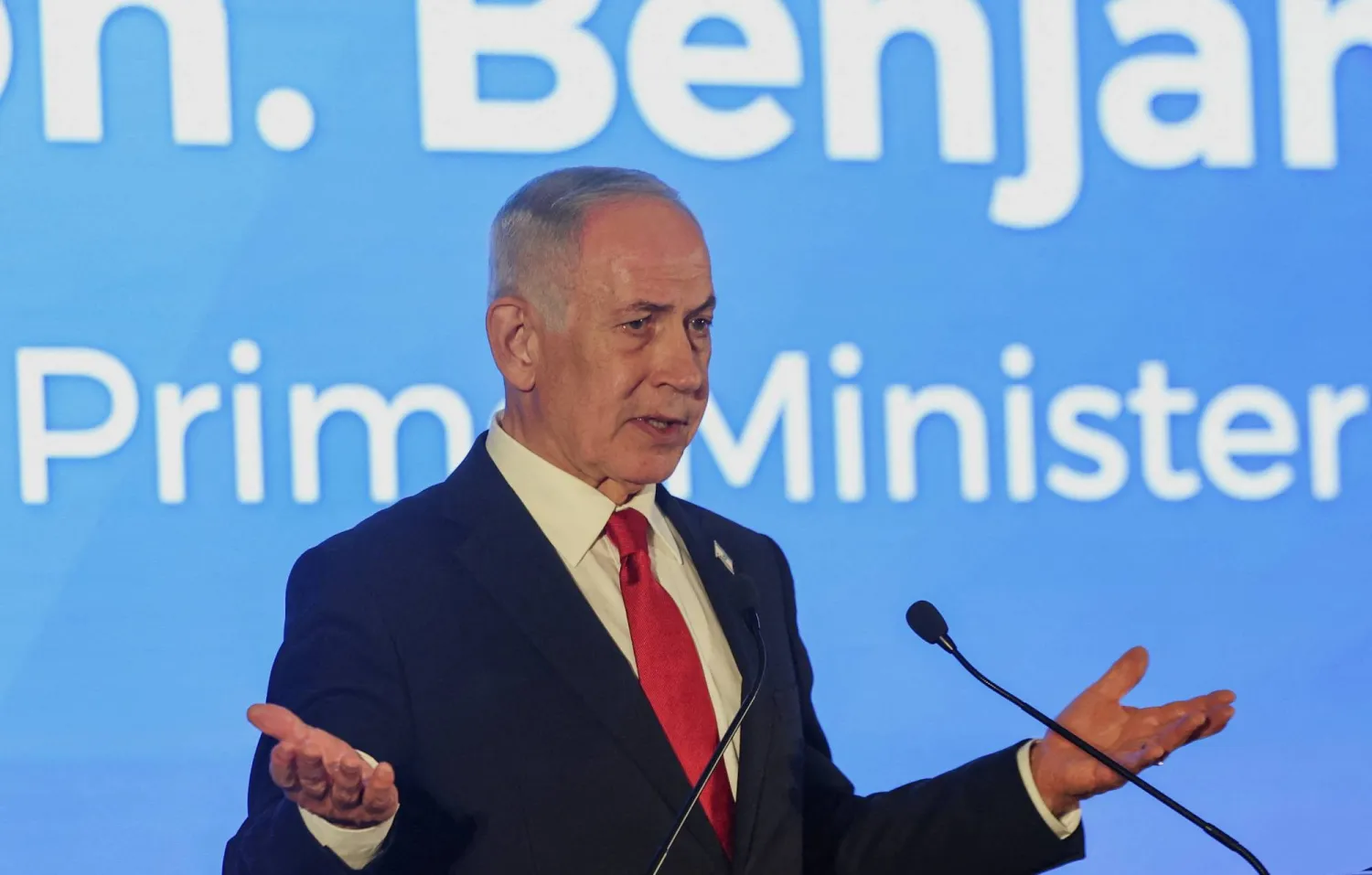
 Israeli Prime Minister Benjamin Netanyahu gestures as he speaks during the Conference of Presidents of Major American Jewish Organizations, in Jerusalem, February 15, 2026. (Reuters)
Israeli Prime Minister Benjamin Netanyahu gestures as he speaks during the Conference of Presidents of Major American Jewish Organizations, in Jerusalem, February 15, 2026. (Reuters)
TT

Netanyahu Says US Deal with Iran Must Dismantle Nuclear Infrastructure

 Israeli Prime Minister Benjamin Netanyahu gestures as he speaks during the Conference of Presidents of Major American Jewish Organizations, in Jerusalem, February 15, 2026. (Reuters)
Israeli Prime Minister Benjamin Netanyahu gestures as he speaks during the Conference of Presidents of Major American Jewish Organizations, in Jerusalem, February 15, 2026. (Reuters)

Israeli Prime Minister Benjamin Netanyahu said on Sunday he told US President Donald Trump last week that any US deal with Iran must include the dismantling of Iran's nuclear infrastructure, not just stopping the enrichment process.

Speaking at the annual Conference of Presidents of Major American Jewish Organizations, Netanyahu also said Israel still needs to "complete the job" of destroying all tunnels in Gaza. Israel, he said, has already dismantled 150 km (93 miles) of an estimated 500 km.

A second round of ‌talks between ‌the US and Iran are slated for this ‌week. ⁠Iran is pursuing ⁠a nuclear agreement with the US that delivers economic benefits for both sides, an Iranian diplomat was reported as saying on Sunday.

Netanyahu said he is skeptical of a deal, but it must include enriched material leaving Iran. "There shall be no enrichment capability - not stopping the enrichment process, but dismantling ⁠the equipment and the infrastructure that allows ‌you to enrich in the ‌first place," he said.

Iran and the US renewed negotiations earlier this month ‌to tackle their decades-long dispute over Tehran's nuclear program ‌and avert a new military confrontation. The US has dispatched a second aircraft carrier to the region and is preparing for the possibility of a sustained military campaign if the talks do ‌not succeed, US officials have told Reuters.

Netanyahu also said that he aimed to end ⁠US military aid ⁠to Israel within the next 10 years, after the current 10-year deal of receiving $3.8 billion a year - which is largely spent in the United States on equipment - ends in 2028.

Due to a thriving economy, "we can afford to phase out the financial component of the military aid that we're receiving, and I propose a 10-year draw down to zero. Now, in the three years that remain in the present memorandum of understanding and another seven years draw it down to zero," Netanyahu said.

"We want to move with the United States from aid to partnership," he said.


Trump Says Iran Cannot 'Blackmail Us' with Strait of Hormuz

US President Donald Trump ( AFP)
TT

Trump Says Iran Cannot 'Blackmail Us' with Strait of Hormuz

US President Donald Trump ( AFP)

US President Donald Trump on Saturday warned Iran not to "blackmail" Washington with its flip-flopping on the fate of the Strait of Hormuz, after Tehran declared the strategic waterway once again closed.

"We're talking to them. They wanted to close up the strait again -- you know, as they've been doing for years -- and they can't blackmail us," Trump said at a White House event.

Trump said there would be "some information" about Iran later in the day, adding: "We're taking a tough stand."

Iran's military on Saturday declared the strait, through which about one-fifth of the world's crude and liquefied natural gas normally passes, was once again closed, a day after saying it was open.

Tehran said it was responding to a continued US blockade of Iranian ports, calling it a violation of their ceasefire, while Supreme Leader Mojtaba Khamenei said Iran's navy was ready to inflict "new bitter defeats" on its enemies.

Shipping sources said at least two vessels reported coming under fire while trying to transit the waterway. In Mumbai, an Indian government source said India summoned Iran's ambassador after an Indian-flagged vessel carrying crude oil was attacked while trying to cross the Strait.

Tehran’s renewed tough messaging injected fresh uncertainty around the Iran conflict, raising the risk that oil and gas shipments through the strait could remain disrupted just as Washington weighs whether to extend the fragile ceasefire.

Maritime security and shipping sources said some merchant vessels received radio messages from Iran’s navy saying no ships were allowed through the waterway, reversing signs earlier on Saturday that traffic might resume.

At least two vessels reported being hit by gunfire as they attempted to cross the strait, the sources said.


No Date Set for Next Round of Iran-US Talks, Says Iran Deputy FM

Iranian Deputy Foreign Minister Saeed Khatibzadeh speaks to reporters as he attends Antalya Diplomacy Forum in Antalya, Türkiye, April 18, 2026. REUTERS/Umit Bektas
TT

No Date Set for Next Round of Iran-US Talks, Says Iran Deputy FM

Iranian Deputy Foreign Minister Saeed Khatibzadeh speaks to reporters as he attends Antalya Diplomacy Forum in Antalya, Türkiye, April 18, 2026. REUTERS/Umit Bektas

No date has been set for the next round of Iran-US peace talks brokered by Pakistan following the failure of an initial round, Iran's deputy foreign minister said on Saturday.

"Until we agree on the framework, we cannot set a date," Saeed Khatibzadeh told journalists on the sidelines of an annual diplomatic forum in Türkiye's southern Antalya province.

"We hope that as soon as we can finalise that, then we can move on to the next step".

Khatibzadeh said both sides were currently focused on finalizing a framework of understanding before proceeding with further negotiations.

"We do not want to enter into any negotiation or meeting that is destined to fail and could serve as a pretext for another round of escalation," he said.

"I can assure you that Iran is very much committed to diplomacy".

Pakistan's powerful military chief and prime minister concluded separate visits aimed at ending the Iran war, with Field Marshal Asim Munir leaving Tehran and premier Shehbaz Sharif headed home from Türkiye.

Munir met Iran's top leadership and peace negotiators during a three-day visit to Tehran, a Pakistani military statement said.

Egypt and Pakistan were working "very hard" as mediators to bring about "a final agreement between the United States and Iran", Egypt's foreign minister told journalists at the Antalya Diplomacy Forum.

Egypt and Türkiye has joined diplomatic efforts with Pakistan to help secure a ceasefire in the conflict.

"We hope to do so (reach an agreement) in the coming days," Badr Abdelatty said, noting that "not only us in the region, but the whole world is suffering from the continuation of this war".

"We are pushing very hard in order to move forward," he said.

Iran dismissed US threats of fresh military action, with the senior Iranian official saying that Washington's statements were inconsistent.

"The American side tweets a lot, talks a lot. Sometimes confusing, sometimes, you know, contradictory," Khatibzadeh said, referring to US President Donald Trump and his frequent social media posts.

"It is up to the American people to decide whether these statements are consistent and in accordance with international law," he added.

Khatibzadeh said Iran's position was clear and vowed resistance to pressure from Washington.

"What we are going to do is quite clear. We will defend heroically and patriotically (our country) ... as the oldest civilisation on earth," he said.

The deputy minister also rejected US accusations that Iran was threatening freedom of navigation in the Strait of Hormuz, a critical route for global oil shipments, after Iran's military again declared the waterway closed.

"Americans cannot impose their will to do a siege over Iran while Iran, with good intention, is trying to facilitate safe passage through the Strait of Hormuz," Khatibzadeh said.

He said Iran had announced safe passage for commercial vessels for the duration of Israel-Lebanon ceasefire, provided there was prior coordination with Iranian maritime authorities.

However, Khatibzadeh accused Washington of attempting to "sabotage" those efforts.

"If ceasefire terms are violated and Americans do not honor their commitments, there will be repercussions for them," he said.


France Blames Hezbollah for French Peacekeeper's Death in Lebanon

FILED - 08 August 2025, France, Paris: The French flag, also known as the tricolor, flies against a blue sky in central Paris. Photo: Rachel Sommer/dpa
TT

France Blames Hezbollah for French Peacekeeper's Death in Lebanon

FILED - 08 August 2025, France, Paris: The French flag, also known as the tricolor, flies against a blue sky in central Paris. Photo: Rachel Sommer/dpa

A French soldier was killed and three others wounded in an attack Saturday on UN peacekeepers in Lebanon that appeared to have been carried out by Hezbollah, French President Emmanuel Macron said.

"Everything points to Hezbollah being responsible for this attack," he said on X, urging Lebanese authorities to arrest the perpetrators.

Macron urged Lebanon's leaders to "guarantee the security of UNIFIL soldiers" in calls with the country's president and prime minister, the Elysee said, AFP reported.

The fighting in Lebanon -- one of the fronts in the Middle East war -- has seen the United Nations Interim Force in Lebanon (UNIFIL) deployed there repeatedly targeted, by both Israeli and Hezbollah forces.

The peacekeeper killed, identified as staff sergeant Florian Montorio, was caught in an "ambush" as his unit headed to a UNIFIL outpost and he died from a "direct gunshot", France's armed forces minister Catherine Vautrin said on X.

She said the outpost they had been heading to had been "cut off for several days by combat in the area".

The ambush was carried out "by an armed group at very close range", she said.

Vautrin added that Montorio was "picked up by his comrades under fire" but they were unable to resuscitate him.

UNIFIL patrols in south Lebanon near the Israeli border where Israel and Hezbollah have been fighting since last month after the Iran-backed militant group drew Lebanon into the Middle East war with rocket fire at Israel in support of its backer Iran.

Three Indonesian peacekeepers were killed last month, with a preliminary UN investigation finding one was killed by Israeli tank fire, while the two others were killed by an improvised explosive device likely planted by Hezbollah.

Other UNIFIL peacekeepers have also been wounded since the war erupted, and in April, Israeli soldiers destroyed surveillance cameras in UNIFIL's headquarters, the peacekeeping body said.

Last week, an Israeli tank twice rammed peacekeeping vehicles, causing damage but no injuries, according to UNIFIL.

United Nations peacekeepers have served as a buffer between Lebanon and Israel for decades, but their mandate concludes at the end of this year.