


Iran Says US ‘More Realistic’ on Nuclear Issue, as Guards Begin Drills in Hormuz Strait

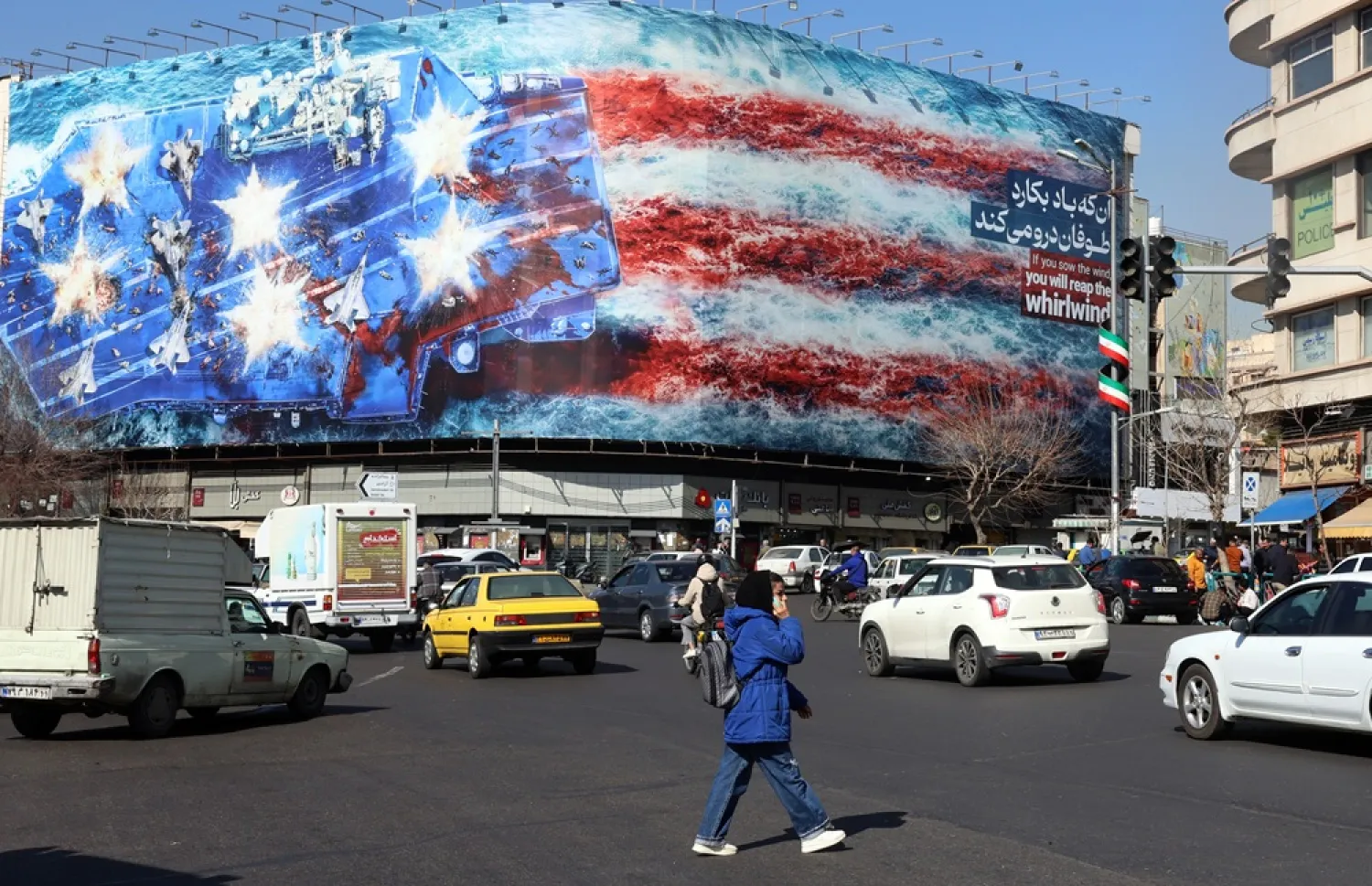
Iranians walk past an anti-US billboard at Enqelab Square in Tehran, Iran, 16 February 2026. (EPA)
TT

Iran Says US ‘More Realistic’ on Nuclear Issue, as Guards Begin Drills in Hormuz Strait

Iranians walk past an anti-US billboard at Enqelab Square in Tehran, Iran, 16 February 2026. (EPA)

Iran said on Monday that the United States' position on Iran's nuclear program "has moved towards a more realistic one", a day ahead of a second round of US-Iranian talks in Geneva. 

Tehran's foreign minister arrived in Geneva for the new round of indirect negotiations with the US, as the Revolutionary Guards began military drills in the Strait of Hormuz, a vital shipping lane for oil and gas. 

The two sides recently resumed indirect talks, mediated by Oman, after US President Donald Trump repeatedly threatened military action against Iran over a deadly crackdown on protesters last month. 

A previous attempt at negotiations collapsed when Israel launched surprise strikes on Iran, beginning a 12-day war that Washington briefly joined to bomb Iranian nuclear sites. 

"A cautious assessment is that, from the discussions that have taken place in Muscat to date, at least what we have been told is that the US position on the Iranian nuclear issue has moved towards a more realistic one," said foreign ministry spokesman Esmaeil Baqaei, the official IRNA news agency reported. 

According to Tehran, talks mediated by Oman will be held on Tuesday in Switzerland. 

Washington has previously pushed for other topics to be discussed including Iran's ballistic missiles and support for armed groups in the region. 

The war games being conducted by the Guards, the ideological arm of the military, aim to prepare it for "potential security and military threats" in the strait, Iranian state TV said. 

Iranian politicians have repeatedly threatened to block the strait, a strategic waterway through which about 20 percent of global oil passes, as both sides ramp up pressure with talks set to resume. 

US Secretary of State Marco Rubio told reporters on Monday "we're hopeful there's a deal". 

"The president always prefers peaceful outcomes and negotiated outcomes to things." 

Meanwhile, Iran's top diplomat, Abbas Araghchi, wrote on X that he was meeting in Geneva with the head of the International Atomic Energy Agency, Rafael Grossi, "for deep technical discussion". 

Grossi later confirmed the meeting on X, calling the conversation with Araghchi "in-depth" ahead of Tuesday's "important negotiations". 

- Protest crackdown - 

Araghchi is also set to hold talks with his Swiss and Omani counterparts as well as other international officials, Iran's foreign ministry said. 

"I am in Geneva with real ideas to achieve a fair and equitable deal. What is not on the table: submission before threats," Araghchi added on X. 

Washington has dispatched Middle East envoy Steve Witkoff and President Donald Trump's son-in-law Jared Kushner, the White House confirmed on Sunday. 

The latest talks follow repeated threats from Trump of military action against Tehran, first over Iran's deadly crackdown on anti-government protests, and then more recently over the country's nuclear program. 

The West fears the program is aimed at making a bomb, which Tehran denies. 

On Friday, Trump said a change of government in Iran would be the "best thing that could happen", as he sent a second aircraft carrier to the Middle East to ratchet up military pressure. 

His remarks came before demonstrations outside Iran against its clerical authorities swept a number of cities including in the US over the weekend. 

Iranians inside the country have also defied the deadly crackdown on protests last month and continued to shout slogans against the authorities from their windows. 

- 'Viable' deal - 

Iran's deputy foreign minister told the BBC that Tehran would consider compromises on its uranium stockpile if Washington lifts sanctions that have crippled the country's economy. 

"If we see the sincerity on their (American) part, I am sure we will be on a road to have an agreement," said Majid Takht-Ravanchi. 

Israeli Prime Minister Benjamin Netanyahu said on Sunday that any deal must involve the removal of all enriched uranium from Iran as well as Tehran's ability to enrich more. 

The whereabouts of Iran's stockpile of around 400 kilograms of uranium enriched to 60 percent remains unknown, with inspectors having last seen it in June. 


Iran, US Race to Find Crew Member of Crashed American Fighter Jet

A US Air Force F-16 Fighting Falcon aircraft refuels from a KC-135 Stratotanker aircraft during a mission supporting Operation Epic Fury during the Iran war at an undisclosed location, April 2, 2026.  US Air Force/Handout via REUTERS
A US Air Force F-16 Fighting Falcon aircraft refuels from a KC-135 Stratotanker aircraft during a mission supporting Operation Epic Fury during the Iran war at an undisclosed location, April 2, 2026. US Air Force/Handout via REUTERS
TT

Iran, US Race to Find Crew Member of Crashed American Fighter Jet

A US Air Force F-16 Fighting Falcon aircraft refuels from a KC-135 Stratotanker aircraft during a mission supporting Operation Epic Fury during the Iran war at an undisclosed location, April 2, 2026.  US Air Force/Handout via REUTERS
A US Air Force F-16 Fighting Falcon aircraft refuels from a KC-135 Stratotanker aircraft during a mission supporting Operation Epic Fury during the Iran war at an undisclosed location, April 2, 2026. US Air Force/Handout via REUTERS

Iranian and American forces raced each other Saturday to recover a crew member from the first US fighter jet to go down inside Iran since the start of the war.

Tehran said it had shot down the F-15 warplane and US media reported United States special forces had rescued one of its two crew members, with the other was still missing.

Iran's military also said it downed a US A-10 ground attack aircraft in the Gulf, with US media saying the pilot of that plane was rescued, reported AFP.

The war erupted more than a month ago with US-Israeli strikes on Iran that killed supreme leader Ali Khamenei, triggering retaliation that spread the conflict throughout the Middle East, convulsing the global economy and impacting millions of people worldwide.

US Central Command did not immediately respond to a request for comment on the loss of the F-15, but White House Press Secretary Karoline Leavitt said: "The president has been briefed."

President Donald Trump told NBC the F-15 loss would not affect negotiations with Iran, saying: "No, not at all. No, it's war."

On Saturday, there were fresh strikes on Israel, Lebanon and Iran, as well as on Gulf states.

An AFP journalist saw a thick haze of grey smoke covering Tehran's skyline after hearing several blasts over the capital. It was not immediately clear what had been targeted.

- 'Valuable reward' -

A spokesperson for the Iranian military's central operational command earlier said "an American hostile fighter jet in central Iranian airspace was struck and destroyed by the IRGC Aerospace Force's advanced air defense system".

"The jet was completely obliterated, and further searches are ongoing."

An Iranian television reporter on a local official channel said anyone who captured a crew member alive would "receive a valuable reward".

Retired US brigadier general Houston Cantwell, who has 400 hours of combat flight experience, said a pilot's training would likely kick in before he or she parachutes to the ground.

"My priority would be, first of all, concealment, because I don't want to be captured," he told AFP.

Mohammad Ghalibaf, the speaker of Iran's parliament, mocked the Trump administration.

He wrote on X: "After defeating Iran 37 times in a row, this brilliant no-strategy war they started has now been downgraded from 'regime change' to 'Hey! Can anyone find our pilots? Please?'

"Wow. What incredible progress. Absolute geniuses."


Explosion Hits Pro-Israel Center in the Netherlands

Rotterdam Police officers. (Getty Images/AFP)
TT

Explosion Hits Pro-Israel Center in the Netherlands

Rotterdam Police officers. (Getty Images/AFP)

A blast hit a pro-Israeli center in the Netherlands, police said Saturday, adding it caused minimal damage and no injuries.

A police spokeswoman told AFP no one was inside the site run by Christians for Israel, a non-profit, in the central city of Nijkerk when the explosion went off outside its gate late on Friday.

An investigation was ongoing.

The incident comes after a string of similar night-time attacks on Jewish sites in the Netherlands and neighboring Belgium in recent weeks that has heightened concerns in the wake of the war in the Middle East.


Iran Says Strike Hit Close to Its Bushehr Nuclear Facility, Killing a Guard and Damaging a Building

Iran's Bushehr nuclear reactor (Reuters)
TT

Iran Says Strike Hit Close to Its Bushehr Nuclear Facility, Killing a Guard and Damaging a Building

Iran's Bushehr nuclear reactor (Reuters)

Iran’s atomic agency says an airstrike has hit near its Bushehr nuclear facility, killing a security guard and damaging a support building. It is the fourth time the facility has been targeted during the war.

The agency announced Saturday’s attack on social media.

The US AP’s military pressed ahead Saturday in a frantic search for a missing pilot after Iran shot down an American warplane, as Iran called on people to turn the pilot in, promising a reward.

The plane, identified by Iran as a US F-15E Strike Eagle, was one of two attacked on Friday, with one service member rescued and at least one missing. It was the first time the United States lost aircraft in Iranian territory during the war, now in its sixth week, and could mark a new turning point in the campaign.

The conflict, launched by the US and Israel on Feb. 28, has rippled across the region. It has so far killed thousands, upended global markets, cut off key shipping routes, spiked fuel prices and shows no signs of slowing as Iran responds to US and Israeli airstrikes with attacks across the region.
