


Iran Foreign Minister Says Progress Made in Nuclear Talks with US in Geneva

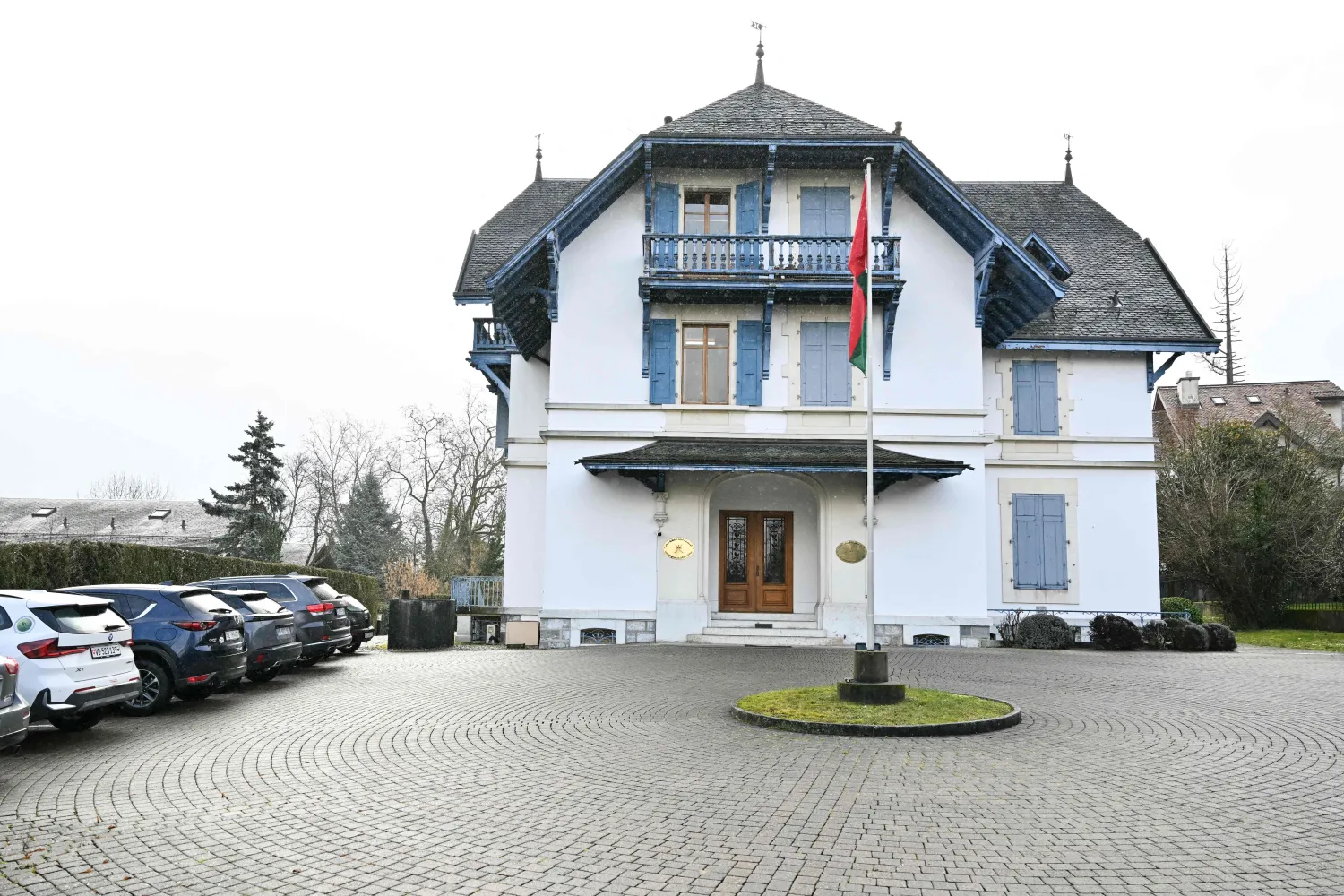
This photograph shows the Omani consulate general ahead of indirect nuclear talks between the United States and Iran in Geneva on February 17, 2026. (AFP)
TT

Iran Foreign Minister Says Progress Made in Nuclear Talks with US in Geneva

This photograph shows the Omani consulate general ahead of indirect nuclear talks between the United States and Iran in Geneva on February 17, 2026. (AFP)

Iran and the United States reached an understanding on Tuesday on main "guiding principles" in talks aimed at resolving their longstanding nuclear dispute, but that does not mean a deal is imminent, Iranian Foreign Minister Abbas Araqchi said. 

Oil futures fell and the benchmark Brent crude contract tumbled more than 1% after Araqchi's comments, which helped ease fears of conflict in the region, where the US has deployed a battle force to press Tehran for concessions. 

"Different ideas have been presented, these ideas have been seriously discussed, ultimately we've been able to reach a general agreement on some guiding principles," Araqchi told Iranian media after the talks concluded in Geneva. 

BOTH SIDES HAVE 'CLEAR NEXT STEPS' 

The indirect discussions between US Special Envoy Steve Witkoff and US President Donald Trump's son-in-law Jared Kushner, alongside Araqchi, were mediated by Oman. The White House did not respond to emailed questions about the meeting. 

Oman's Foreign Minister Badr al-Busaidi said in a post on X "much work is yet to be done" but Iran and the US were leaving with "clear ‌next steps" . 

Just as ‌talks began on Tuesday, Iranian state media said Iran would temporarily shut part of the Strait ‌of ⁠Hormuz, a vital global ⁠oil supply route, due to "security precautions" while Iran's elite Revolutionary Guards conducted military drills there. 

Tehran has in the past threatened to shut down the strait to commercial shipping if it is attacked, a move that would choke off a fifth of global oil flows and drive up crude prices. 

Responding to comments by Trump that "regime change" in Iran might be the best course, the country's Supreme Leader Ali Khamenei, 86, warned that any US attempts to depose his government would fail. 

"The US President says their army is the world's strongest, but the strongest army in the world can sometimes be slapped so hard it cannot get up," he said, in comments published by Iranian media. 

Speaking at a disarmament conference in Geneva after the talks, Araqchi said ⁠that a "new window of opportunity" had opened and that he hoped discussions would lead to a "sustainable" solution ‌that ensured the full recognition of Iran's legitimate rights. 

Earlier, Trump said he himself would ‌be involved "indirectly" in the Geneva talks and that he believed Tehran wanted to make a deal. 

"I don't think they want the consequences of not making ‌a deal," Trump told reporters aboard Air Force One on Monday. "We could have had a deal instead of sending the B-2s in ‌to knock out their nuclear potential. And we had to send the B-2s." 

The US joined Israel last June in bombing Iranian nuclear facilities. The US and Israel believe Iran aspires to build a nuclear weapon that could threaten Israel's existence. Iran says its nuclear program is purely peaceful, even though it has enriched uranium far beyond the purity needed for power generation, and close to what is required for a bomb. 

IRAN SAYS IT WILL ONLY DISCUSS NUCLEAR PROGRAM 

Since those ‌strikes, Iran's Islamic rulers have been weakened by street protests, suppressed at a cost of thousands of lives, against a cost-of-living crisis driven in part by international sanctions that have strangled Iran's oil ⁠income. 

Washington has sought to expand ⁠the scope of talks to non-nuclear issues such as Iran's missile stockpile. Tehran says it is willing only to discuss curbs on its nuclear program - in exchange for sanctions relief - and that it will not give up uranium enrichment completely or discuss its missile program. 

Khamenei reiterated Iran's position that its large missile stockpile is non-negotiable and missile type and range have nothing to do with the United States. 

A senior Iranian official told Reuters on Tuesday the success of the Geneva talks hinged on the US not making unrealistic demands and on its seriousness on lifting the crippling sanctions on Iran. 

US B-2 BOMBERS STRUCK NUCLEAR TARGETS 

Tehran and Washington were scheduled to hold a sixth round of talks in June last year when Washington's ally Israel launched a bombing campaign against Iran, and was then joined by US B-2 bombers that struck nuclear targets. Tehran has since said it has halted uranium enrichment activity. 

Iran has joined the nuclear Non-Proliferation Treaty, which guarantees countries the right to pursue civilian nuclear power in return for requiring them to forgo atomic weapons and cooperate with the UN nuclear watchdog, the International Atomic Energy Agency. 

Israel, which has not signed the NPT, neither confirms nor denies having nuclear weapons, under a decades-old ambiguity policy designed to deter surrounding enemies. Scholars believe it does. 


Independent UN Body Condemns ‘Vicious Attacks’ on UN Expert on Palestinian Rights

United Nations (UN) Special Rapporteur on the occupied Palestinian territories Francesca Albanese looks on at the end of a press conference on the human rights situation in Gaza in Geneva on September 15, 2025. (AFP)
TT

Independent UN Body Condemns ‘Vicious Attacks’ on UN Expert on Palestinian Rights

United Nations (UN) Special Rapporteur on the occupied Palestinian territories Francesca Albanese looks on at the end of a press conference on the human rights situation in Gaza in Geneva on September 15, 2025. (AFP)

An ‌independent United Nations body on Tuesday condemned what it described as vicious attacks based on disinformation by several European ministers against the organization's special rapporteur for Palestine, Francesca Albanese.

In the past week several European countries, including Germany, France and Italy, called for Albanese’s resignation over her alleged criticism of Israel. Albanese, an Italian lawyer, denies making the remarks.

On Friday, the Czech Republic's Foreign Minister Petr Macinka quoted Albanese on X as having called Israel a "common enemy of humanity", and he ‌also called for ‌her resignation.

A transcript of Albanese's remarks ‌made ⁠in Doha on ⁠February 7 seen by Reuters did not characterize Israel in this way, although she has consistently criticized the country in the past over the Gaza conflict.

The UN Coordination Committee - a body of six independent experts which coordinates and facilitates the work of Special Rapporteurs - accused European ministers of relying on "manufactured ⁠facts".

"Instead of demanding Ms. Albanese's resignation ‌for performing her mandate...these government representatives ‌should join forces to hold accountable, including before the International Criminal Court, ‌leaders and officials accused of committing war crimes and ‌crimes against humanity in Gaza," the Committee said.

It said the pressure exerted on Albanese was part of an increasing trend of politically motivated and malicious attacks against independent human rights experts, UN officials ‌and judges of international courts.

US President Donald Trump's administration imposed sanctions on Albanese after she wrote ⁠letters ⁠to US companies accusing them of contributing to gross human rights violations by Israel in Gaza and the West Bank.

UN experts are commissioned by the Geneva-based Human Rights Council to monitor and document specific human rights crises but are independent of the organization itself.

There is no precedent for removing a special rapporteur during their term, although diplomats said that states on the 47-member council could in theory propose a motion to do so.

However, they said strong support for Palestinian rights within the body means that such a motion was unlikely to pass.


US Plans to Deploy More Missile Launchers to the Philippines Despite China’s Alarm 

A US M142 High Mobility Artillery Rocket System (HIMARS) fires a missile during a Combined Joint Littoral Live Fire Exercise at the joint military exercise called "Balikatan", Tagalog for shoulder-to-shoulder in a Naval station in Zambales province, northern Philippines on Wednesday, April 26, 2023. (AP)
TT

US Plans to Deploy More Missile Launchers to the Philippines Despite China’s Alarm 

A US M142 High Mobility Artillery Rocket System (HIMARS) fires a missile during a Combined Joint Littoral Live Fire Exercise at the joint military exercise called "Balikatan", Tagalog for shoulder-to-shoulder in a Naval station in Zambales province, northern Philippines on Wednesday, April 26, 2023. (AP)

The United States plans to deploy more high-tech missile systems to the Philippines to help deter aggression in the South China Sea, where the treaty allies on Tuesday condemned what they called China’s "illegal, coercive, aggressive, and deceptive activities."

Beijing has repeatedly expressed alarm over the installation in the northern Philippines of a US mid-range missile system called the Typhon in 2024 and of an anti-ship missile launcher last year. It said the US weapons were aimed at containing China’s rise and warned that these were a threat to regional stability.

China has asked the Philippines to withdraw the missile launchers from its territory, but officials led by President Ferdinand Marcos Jr. have rejected the demand.

US and Philippine officials held annual talks Monday in Manila on broadening security, political and economic engagements and boosting collaboration with regional security allies.

The US and the Philippines outlined in a joint statement Tuesday specific defense and security plans for this year, including joint military exercises, Washington's support to help modernize the Philippine military and efforts "to increase deployments of US cutting-edge missile and unmanned systems to the Philippines."

The longtime allies "underscored their support for preserving freedom of navigation and overflight, unimpeded lawful commerce and other lawful uses of the sea for all nations," the statement said.

"Both sides condemned China’s illegal, coercive, aggressive and deceptive activities in the South China Sea, recognizing their adverse effects on regional peace and stability and the economies of the Indo-Pacific and beyond," it added.

Confrontations between Chinese and Philippine coast guard forces have spiked in the disputed waters in recent years. Vietnam, Malaysia, Brunei and Taiwan are also involved in the territorial standoffs.

Neither side elaborated on the planned missile deployments but Philippine ambassador to Washington, Jose Manuel Romualdez, who took part in Monday’s talks, said US and Filipino defense officials discussed the possible deployment this year of "upgraded" types of US missile launchers that the Philippines may eventually decide to purchase.

"It’s a kind of system that’s really very sophisticated and will be deployed here in the hope that, down the road, we will be able to get our own," Romualdez told The Associated Press.

The Typhon missile system that the US Army deployed to the main northern Philippine region of Luzon in April 2024 and an anti-missile launcher called the Navy Marine Expeditionary Ship Interdiction System that was deployed in April last year also to Luzon have remained in the Philippines, Romualdez said.

During joint drills, US forces have exhibited the missile systems to batches of Filipino forces to familiarize them with the weapons’ capabilities and usage, military officials said.

Romualdez said the US missile deployments to the Philippines did not aim to antagonize any country.

"It’s purely for deterrence," he said. "Every time the Chinese show any kind of aggression, it only strengthens our resolve to have these types."

The Typhon missile launchers, a land-based weapon, can fire the Standard Missile-6 and the Tomahawk Land Attack Missile. Tomahawk missiles can travel over 1,000 miles (1,600 kilometers), which places China within their target range, from the northern Philippine region of Luzon.

Last year, the US Marines deployed the anti-ship missile launcher, the Navy Marine Expeditionary Ship Interdiction System, to Batan island in the northernmost Philippine province of Batanes, which faces the Bashi Channel just south of Taiwan.

The sea passage is a critical trade and military route that the US and Chinese militaries have tried to gain strategic control of.


France's Macron Eyes Fighter Jet Deal in India

France's President Emmanuel Macron (C-R) and his wife Brigitte Macron (C) are welcomed by India's officials upon their arrival in Mumbai on February 17, 2026. (Photo by Ludovic MARIN / AFP)
TT

France's Macron Eyes Fighter Jet Deal in India

France's President Emmanuel Macron (C-R) and his wife Brigitte Macron (C) are welcomed by India's officials upon their arrival in Mumbai on February 17, 2026. (Photo by Ludovic MARIN / AFP)

French President Emmanuel Macron will meet Indian Prime Minister Narendra Modi in Mumbai on Tuesday, as he begins a three-day visit to India focused on artificial intelligence cooperation and a potential multibillion dollar fighter jet deal.

France is seeking to expand its military partnership with New Delhi, with discussions expected on a possible contract for 114 additional French Dassault Rafale fighter jets, said AFP.

Modi, in a statement on social media addressed to his "dear friend" Macron, after he began his trip with his wife Brigitte in India's financial capital, said he looked forward to "advancing our bilateral ties to new heights".

Modi, who will meet Macron later on Tuesday afternoon, said he was "confident that our discussions will further strengthen cooperation".

Macron, on his fourth visit to India since taking office in 2017, began on Tuesday with a program including honoring the victims of the 2008 Mumbai attacks, and meeting Bollywood film stars, including Shabana Azmi and Manoj Bajpayee.

He also called Modi his "dear friend", in post on X, saying they will "go even further" in cooperation.

The visit follows New Delhi's confirmation last week that it intends to place a major order for Rafale jets, as well as the signing of a landmark free trade agreement between India and the European Union in January.

Macron will travel to New Delhi for an artificial intelligence summit on Wednesday and Thursday.

- 'Contract of the century' -

New Delhi has sought over the past decade to reduce its dependence on Russia, its traditional main supplier of military equipment, turning to other countries while also pushing for more domestic production.

An Indian defense ministry statement last week said the proposed purchase of Rafale jets had been cleared -- with "the majority" of them to be manufactured in India.

Christophe Jaffrelot, an India specialist at Sciences Po Center for International Studies in Paris, described the potential EUR30 billion ($35 billion) deal for 114 Rafales as the "contract of the century".

If finalized, the jets would add to the 62 Rafales that India has already purchased.

The French presidency has voiced optimism that what it calls a "historic" agreement could be reached.

- 'Good chemistry' -

Modi and Macron will also inaugurate on Tuesday, via videoconference, India's first helicopter final assembly line, a joint venture between India's Tata Group and Airbus.

The facility in Vemagal, in the southern state of Karnataka near the tech hub of Bengaluru, will manufacture the Airbus H125, the company's best-selling single-engine helicopter.

France has emerged as one of India's most important defense and economic partners in the last decade.

"Through this visit, we seek to further strengthen cooperation" with India, and to "diversify" France's economic and trade partnerships, Macron's office said.

India, the world's most populous country with 1.4 billion people, is on track to become the fourth-largest economy globally.

This week's talks are also expected to address global economic uncertainty triggered by tariff policies under US President Donald Trump, as well as China's influence in the region.

Bilateral trade between France and India, driven largely by defense and aerospace -- India's commercial fleet includes a substantial number of Airbus aircraft -- stands at around EUR15 billion ($18 billion) annually.

French foreign direct investment in India totals nearly EUR13 billion ($15 billion).

The two leaders will also be keen to nurture close personal ties.

"There is apparently a good chemistry, a good personal rapport," Jaffrelot said.

One sensitive issue remains Ukraine: India has not condemned Russia's 2022 invasion and has continued buying oil from Moscow.

US President Donald Trump has said India had committed to halting the purchases, though that has not been formally confirmed by New Delhi.

"If the Indians stop buying Russian oil, they won't be blamed for abstaining at the UN," Jaffrelot added.
