Iranians Chant Slogans Against Supreme Leader at Memorials for Slain Protesters

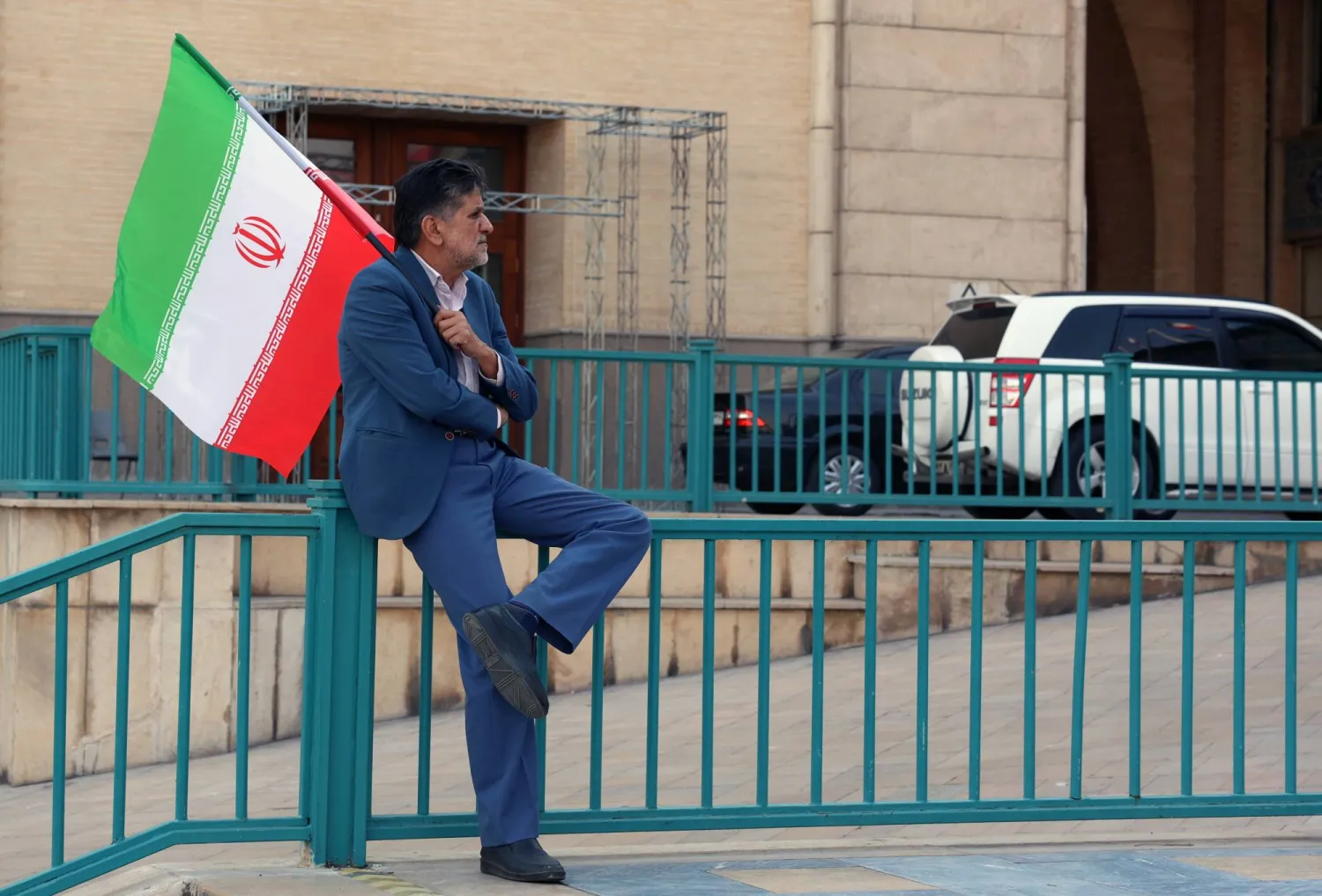
An Iranian man holds the Iranian national flag during a memorial ceremony for those killed in anti-government protests earlier last month, at the Mosalla mosque in Tehran, Iran, 17 February 2026. (EPA)
TT

Iranians Chant Slogans Against Supreme Leader at Memorials for Slain Protesters

An Iranian man holds the Iranian national flag during a memorial ceremony for those killed in anti-government protests earlier last month, at the Mosalla mosque in Tehran, Iran, 17 February 2026. (EPA)

Iranians shouted slogans against Supreme Leader Ali Khamenei on Tuesday as they gathered to commemorate protesters killed in a crackdown on nationwide demonstrations that rights groups said left thousands dead, according to videos verified by AFP.

The country's clerical authorities also staged a commemoration in the capital Tehran to mark the 40th day since the deaths at the peak of the protests on January 8 and 9.

Officials acknowledge more than 3,000 people died during the unrest, but attribute the violence to "terrorist acts", while rights groups say many more thousands of people were killed, shot dead by security forces in a violent crackdown.

The protests, sparked by anger over the rising cost of living before exploding in size and anti-government fervor, subsided after the crackdown, but in recent days Iranians have chanted slogans from the relative safety of homes and rooftops at night.

On Tuesday, videos verified by AFP showed crowds gathering at memorials for some of those killed again shouting slogans against the theocratic government in place since the 1979 revolution.

In videos geolocated by AFP shared on social media, a crowd in Abadan in western Iran holds up flowers and commemorative photos of a young man as they shout "death to Khamenei" and "long live the shah", in support of the ousted monarchy.

Another video from the same city shows people running in panic from the sounds of shots, though it wasn't immediately clear if they were from live fire.

In the northeastern city of Mashhad a crowd in the street chanted, "One person killed, thousands have his back", another verified video showed.

Gatherings also took place in other parts of the country, according to videos shared by rights groups.

- Official commemorations -

At the government-organized memorial in Tehran crowds carried Iranian flags and portraits of those killed as nationalist songs played and chants of "Death to America" and "Death to Israel" echoed through the Khomeini Grand Mosalla mosque.

Iranian President Masoud Pezeshkian attended a similar event at the Imam Reza shrine in Mashhad.

Authorities have accused sworn enemies the United States and Israel of fueling "foreign-instigated riots", saying they hijacked peaceful protests with killings and vandalism.

Senior officials, including First Vice President Mohammad Reza Aref and Revolutionary Guards commander Esmail Qaani, attended the ceremony.

"Those who supported rioters and terrorists are criminals and will face the consequences," Qaani said, according to Tasnim news agency.

International organizations have said evidence shows Iranian security forces targeted protesters with live fire under the cover of an internet blackout.

The US-based Human Rights Activists News Agency (HRANA) has recorded more than 7,000 killings in the crackdown, the vast majority protesters, though rights groups warn the toll is likely far higher.

More than 53,500 people have been arrested in the ongoing crackdown, HRANA added, with rights groups warning protesters could face execution.

Tuesday's gatherings coincided with a second round of nuclear negotiations between Iran and the United States in Geneva, amid heightened tensions after Washington deployed an aircraft carrier group to the Middle East following Iran's crackdown on the protests.


Trump Says Iran War Should End 'Soon', Both Sides May Meet at Weekend

16 April 2026, US, Washington: US President Donald Trump speaks to the media before boarding Marine One from the South Lawn of the White House, for the start of a trip to Las Vegas and Phoenix. Photo: Andrew Leyden/ZUMA Press Wire/dpa
TT

Trump Says Iran War Should End 'Soon', Both Sides May Meet at Weekend

16 April 2026, US, Washington: US President Donald Trump speaks to the media before boarding Marine One from the South Lawn of the White House, for the start of a trip to Las Vegas and Phoenix. Photo: Andrew Leyden/ZUMA Press Wire/dpa

US President Donald Trump expressed confidence that an agreement could soon be reached to end the Iran war and urged the Tehran-aligned Hezbollah group to hold its fire as a 10-day truce went into effect between Lebanon and Israel.

Trump said the next meeting between the United States and Iran could take place at the weekend and an extension of a two-week ceasefire was possible, but may not be needed as Tehran wanted a deal.

"We're going to see what happens. But I think we're very close to making a deal with Iran," he told reporters outside the White House, adding if an agreement was reached and signed in the Pakistani capital Islamabad, he may go there for the occasion.

Hours later while in Las Vegas, Trump went further, saying the war "should be ending pretty soon".

The war with Iran has been unpopular in the United States and has left Trump with a political headache just months before a crucial midterm election at home, Reuters said.

The US-Israeli attack on Iran that started on February 28 has triggered the worst oil price shock in history and led to an International Monetary Fund downgrade of its outlook for the global economy and a warning that prolonged conflict could push the world to the brink of recession.

A Pakistani source involved in mediating between the US and Iran said on Friday there was progress in backdoor diplomacy and that an upcoming meeting between the ‌two sides could result in ‌the signing of an agreement.

The two sides would first sign a memorandum of understanding followed by a comprehensive agreement within ‌60 days, ⁠the source said.

"Detailed agreement ⁠comes later. Both sides are agreeing in principle. And technical bits come later," the source said, speaking on condition of anonymity.

A diplomatic source said the key Pakistani mediator, army chief Field Marshal Asim Munir, had been holding talks in Tehran since Wednesday and had made a breakthrough on "sticky issues".

OIL PRICE FALLS ON DEAL HOPES

Oil prices fell in early trade on Friday and Asian stocks headed for a second week of strong gains on optimism the Middle East conflict could be nearing an end, even though the critical Strait of Hormuz, an artery for a fifth of the world's oil and gas supply, remains effectively closed.

The MSCI's broadest index of Asia-Pacific shares outside Japan was down 0.8% as investors locked in profits after a blistering rally this month, with the index close to its highest since the Iran war broke out.

Japan's Nikkei slipped 1% after hitting a record high on Thursday and almost all stock markets were back to pre-war levels.

Brent crude futures declined to $98.17 a barrel at 0434 GMT while US ⁠West Texas Intermediate crude futures fell to $93.47 a barrel, trimming gains from the previous session.

France and Britain will chair a meeting on ‌Friday of around 40 countries aimed at signaling to the United States that some of its closest allies, many chided by ‌Trump for failing to act, are ready to help restore freedom of navigation in the Strait of Hormuz once conditions allow.

Iran has largely closed the strait to ships other than its own and Washington this ‌week imposed a blockade on ships entering or leaving Iranian ports. Analysts said the blockade could prevent roughly 2 million barrels per day of Iranian crude from reaching its primary ‌buyer China.

Only a trickle of vessels have passed through the strait since the war started, compared to an average 130-plus each day before the conflict.

HOPES FOR 'MEANINGFUL TALKS'

The ceasefire in Lebanon went into effect on Thursday and Trump said he had spoken to Israeli Prime Minister Benjamin Netanyahu and Lebanese counterpart Joseph Aoun and planned to invite them to the White House for "meaningful talks" that could happen over the next week or two.

Iran has insisted that any peace deal should also cover the fighting in Lebanon. The ceasefire was part of an understanding reached with the US and mediated by Pakistan, Iranian media reported, citing a foreign ministry ‌spokesperson.

"May have been a historic day for Lebanon. Good things are happening!!!" Trump said on social media late on Thursday.

In an earlier post, he urged Hezbollah to respect the ceasefire.

"I hope Hezbollah acts nicely and well during this important period of time. It ⁠will be an GREAT moment for them if ⁠they do. No more killing. Must finally have PEACE!" he said.

Conflict between Israel and the Iran-backed Hezbollah in Lebanon was reignited by the US-Israeli war with Iran. Hezbollah opened fire in support of Tehran on March 2, prompting an Israeli offensive in Lebanon that authorities say has killed 2,000 people, 15 months after their last major conflict.

Celebratory gunfire rang out across parts of Beirut as the clock struck midnight on Thursday to mark the start of the truce and witnesses heard explosions from rockets fired in celebration, prompting a safety warning and threat of arrests from the Lebanese Army.

But the pause in hostilities remained fragile, with the army early on Friday reporting that Israel had already violated the ceasefire with intermittent shelling of several southern Lebanese villages.

There was no immediate comment from the Israeli military, which had said earlier that its forces remained deployed in the area, in what a spokesperson said was in response to continued Hezbollah militant activity.

Hezbollah released a lengthy statement on its military operations against Israel throughout Thursday, which listed its last attack as being 10 minutes before the ceasefire took effect.

The truce was "essential, urgently needed and a demand shared by all," senior Hezbollah official Bilal Lakkiss told NBC News ahead of the start of the ceasefire, but said the group would not comply with Israel’s demand that it disarm "except within a framework tied to a broader national security vision".

NUCLEAR AMBITIONS A STICKING POINT

Tehran's nuclear ambitions were a sticking point at talks in Islamabad last weekend, where the US proposed a 20-year suspension of all nuclear activity by Iran. Tehran suggested a halt of three to five years, according to people familiar with the proposals.

Trump on Thursday said Iran had offered not to possess nuclear weapons for more than 20 years.

Iran has demanded that international sanctions be lifted and Washington has pressed for any highly enriched uranium to be removed from Iran.

Two Iranian sources said there were signs of a compromise on the HEU stockpile, with Tehran considering shipping part of it out of the country.


Senate Republicans Again Block Bid to Limit Trump’s Iran War Powers

Senate Majority Leader John Thune speaks at a news conference at the Capitol on September 5, 2025 (AP)
 
Senate Majority Leader John Thune speaks at a news conference at the Capitol on September 5, 2025 (AP)  
TT

Senate Republicans Again Block Bid to Limit Trump’s Iran War Powers

Senate Majority Leader John Thune speaks at a news conference at the Capitol on September 5, 2025 (AP)
 
Senate Majority Leader John Thune speaks at a news conference at the Capitol on September 5, 2025 (AP)  

Washington: Robert Jimison, Megan Mineiro

Senate Republicans on Wednesday blocked the latest Democratic-led effort to curb President Trump’s authority to wage war on Iran, as a fragile ceasefire frays, dueling blockades choke traffic through the Strait of Hormuz and failed talks leave the next phase of the conflict uncertain.

The move to take up the measure failed on a vote of 52 to 47. It fell largely along party lines, with Republicans and a single Democrat, Senator John Fetterman of Pennsylvania, opposed and Democrats joined by a lone Republican, Senator Rand Paul of Kentucky, in favor.

Fourth Trial

It was the fourth time in recent weeks that Democrats have tried and failed to force Congress to reassert its war powers as the conflict, now stretching into its second month, continues. The repeated defeats underscore the durability of Republican backing for Trump, as his allies on Capitol Hill have foregone oversight of the war and repeatedly sought to avoid placing meaningful constraints on his authority.

Still, in the run-up to the vote, some GOP lawmakers suggested that their patience was wearing thin as the conflict drags on, its economic fallout reverberates among their constituents, and the president’s bellicose statements intensify.

“I hope that we are arriving at an exit strategy here to bring this to a close to preserve our security interests and bring down the cost of gasoline,” Senator Josh Hawley of Missouri said of the war, now in its seventh week.

Other Republicans said the administration should do more to lay out its objectives and plan for the conflict. They expressed a fervent desire to see it end promptly.

60-Day Mission

Senator Mike Rounds of South Dakota said that should the president expect Congress to support continuing the conflict beyond 60 days — the initial window that the law gives a president to deploy armed forces into hostilities without congressional approval — officials from the administration should “come in and give us a full description of it and sell the point and the plan.”

The statutory deadline for Trump to either pull out US troops or request a 30-day extension would fall on May 1. Senator Bill Hagerty, Republican of Tennessee, on Tuesday appeared to suggest that such an extension would not be necessary.

“This is going to be over soon,” he said.

While home during a two-week recess, some Republicans said they had heard concerns from their constituents about the conflict, which has sent oil prices above $100 per barrel, natural gas costs rising more than 80% and fertilizer prices surging, raising costs for farmers.

Wednesday’s vote was forced by Senator Tammy Duckworth, Democrat of Illinois, who argued that the war was the latest demonstration of the president reneging on promises he made during his 2024 campaign.

“It’s clear that none of this is making America safer, bringing prices down or ending wars like he promised,” Duckworth said in a statement ahead of the vote. “Americans are sick and tired of being lied to, and Republicans cannot continue to sit by and abdicate their responsibilities as Trump continues to spiral out of control at the expense of our national security.”

Democrats’ Bet

Democrats hope that mounting Republican frustration will eventually pull the party asunder, yielding enough defections for a handful to join them in delivering a rebuke of the president.

“I have not seen, in a long time, the level of frustration,” Senator Chuck Schumer, Democrat of New York and the minority leader, said in an interview last week. “There’s always been Republican frustration with Trump, but the frustration is sort of peaking.”

Senator Tommy Tuberville, Republican of Alabama, said he held events across his state in recent weeks and fielded questions from voters about the war. He said his response to concerned constituents was: “We just have to wait and see.”

Tuberville, who voted against the resolution, said: “I think we need to let the president of the United States handle this.”

In a recent address providing an update on the war, Trump said his administration was “on track to complete all of America’s military objectives shortly, very shortly.” He added that “we’re going to hit them extremely hard over the next two to three weeks.”

The United States and Iran have since agreed to a two-week ceasefire, while diplomatic talks between the two nations took place but ended with no resolution. Tensions have also risen as the United States has placed a blockade of vessels using Iran’s ports.

During that crucial period, Congress was out of session.

Now back in Washington, many Democrats and some Republicans have begun to press for additional information.

Hawley said that senators who do not sit on the Armed Services and Foreign Relations Committees — which have received a series of confidential briefings since the war began — have been kept in the dark, noting that he and others “have not been briefed since the first week of March.”

“I would welcome more,” Hawley added.

The New York Times


Macron, Starmer Rally Allies to Mull Hormuz Mission

The leaders of Germany, Britain and France are expected to be present. Stefan Rousseau / POOL/AFP
TT

Macron, Starmer Rally Allies to Mull Hormuz Mission

The leaders of Germany, Britain and France are expected to be present. Stefan Rousseau / POOL/AFP

French President Emmanuel Macron and UK Prime Minister Keir Starmer on Friday chair a meeting of allies to consider sending a multinational force to ensure security and free-flowing trade in the Strait of Hormuz once the current conflict between Iran and the US and Israel ends.

Iran imposed the blockade on the critical shipping bottleneck as soon as the US and Israel launched the war against the Iranian republic on February 28, leading to a surge in global energy prices. Even with a shaky ceasefire in place, the US is now imposing its own blockade on Iranian ports.

European leaders are now worried that if the blockade continues, consumers will feel the effects through higher inflation, food shortages and flight cancellations as jet fuel runs out, reported AFP.

The leaders joining Starmer and Macron from 1200 GMT for the meeting -- which will mostly be held via video -- are due to call for a return to full freedom of navigation and address the economic consequences of the blockade.

But they will also "prepare the deployment, when conditions are met, of a strictly defensive multinational military mission, in order to ensure freedom of navigation," according to the invitation sent by the Elysee which was seen by AFP.

Officials have emphasized that such a force would only be deployed when the war came to an end. Macron and Starmer have also led efforts to create a European force to support Ukraine, which again would only be deployed when the war against Russia ends.

Starmer is expected to tell the meeting that "the unconditional and immediate reopening" of the strait "is a global responsibility", his Downing Street office said in a statement.

Starmer is to say both he and Macron have a clear commitment "to establish a multinational initiative to protect freedom of navigation" to reassure commercial shipping and support mine clearance operations, it added.

A French presidential official, asking not to be named, said allies needed to be sure "we have an Iranian commitment not to fire on passing ships and a US commitment not to block any ships leaving or entering the Strait of Hormuz."

- 'Major consequences' -

The meeting, which is set to gather some 30 leaders of European countries but also Asian and Middle Eastern nations mainly by video conference, is also a chance for Europe to display its capacities after having largely been sidelined by the US in diplomatic efforts to end the war.

Key EU players German Chancellor Friedrich Merz and Italian Prime Minister Giorgia Meloni will be attending in person, their offices confirmed.

The talks according to the Elysee will involve "non belligerent countries" meaning that neither Iran, Israel nor the United States will be involved.

"The blockade of the Strait of Hormuz has major consequences for the global economy, and therefore for the daily lives of French citizens and French businesses," France's Foreign Minister Jean-Noel Barrot said on Thursday.

Downing Street said planning is already underway for a "combined military effort as soon as conditions allow". Military chiefs are due to meet next week for further discussions at the UK's military command headquarters in Northwood outside London, it added.

According to the French presidency, the meeting will also address concerns over the more than 20,000 seafarers aboard the hundreds of ships which have been trapped by the blockade.

"What we want to do is build a credible proposal which is essentially a third way between the maximum pressure previously practiced by the United States on Iran and the resumption of war," said the French presidential official.

Merz, whose country was initially reluctant to be involved in any mission for Ukraine, said Berlin was "willing in principle to take part" but cautioned that "we are still very far from that".

He also added the leaders would discuss the involvement of the United States. But the French presidential official said Washington -- as a belligerent power in the conflict -- should not be involved in this mission.