


Iranian Students Chant Anti-Government Slogans, as US Threats Loom

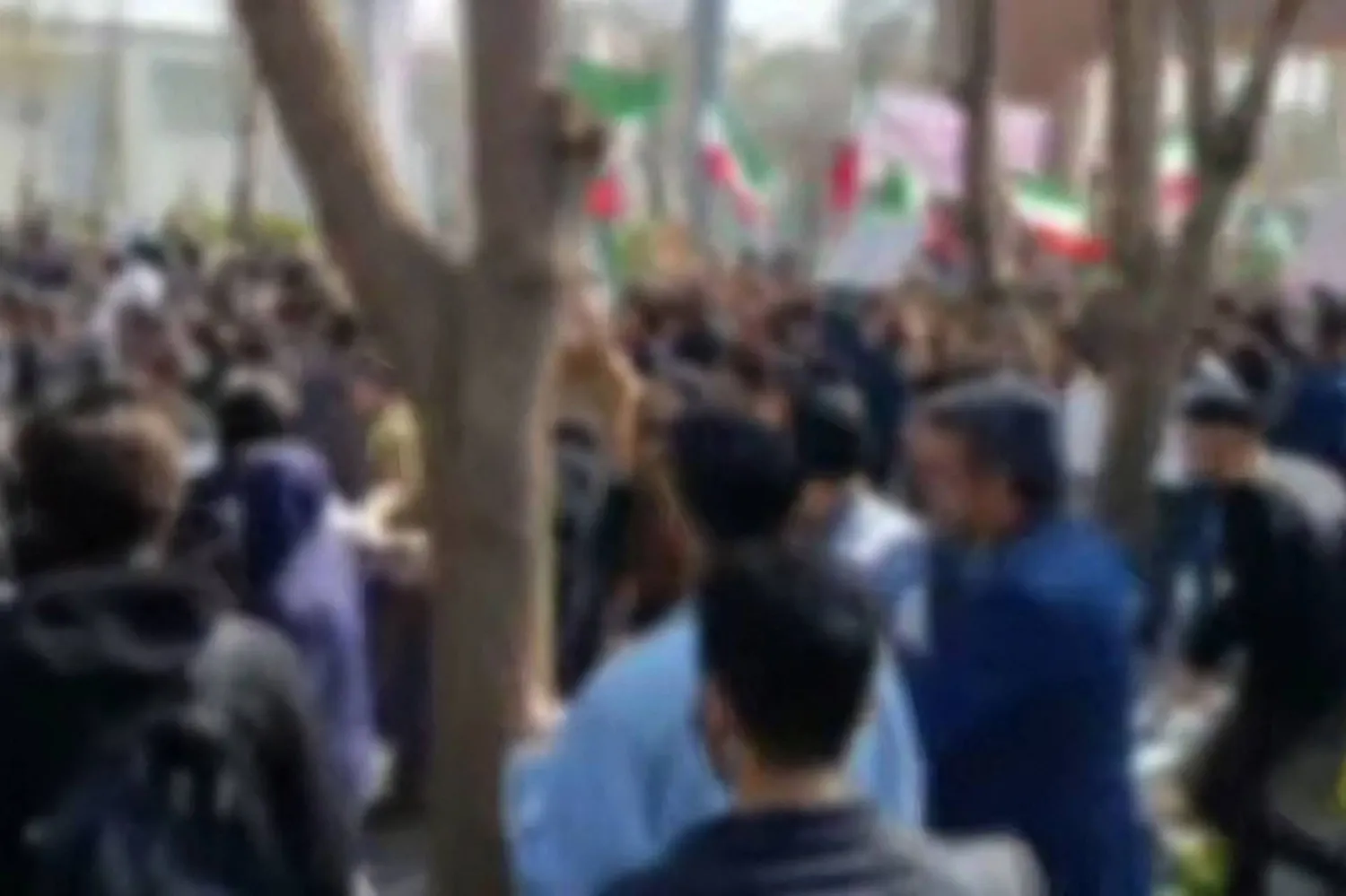
This video grab taken from UGC images posted on social media and verified by AFPTV teams in Paris on February 21, 2026, shows Iranians clashing near the Department of Aerospace Engineering of Sharif University in Tehran. (UGC / AFP)
TT

Iranian Students Chant Anti-Government Slogans, as US Threats Loom

This video grab taken from UGC images posted on social media and verified by AFPTV teams in Paris on February 21, 2026, shows Iranians clashing near the Department of Aerospace Engineering of Sharif University in Tehran. (UGC / AFP)

Iranian students chanted anti-government slogans and scuffled with counter-protesters on Saturday in the latest display of anger at the country's clerical leaders, who also face a US military build-up aimed at pressuring them into a nuclear deal.

The gatherings at universities, which were reported by both local and diaspora media outlets, followed a mass protest movement that was met with a government crackdown last month that left thousands dead.

The crackdown had prompted US President Donald Trump to threaten to intervene militarily, though the focus of his threats eventually shifted to Iran's nuclear program, which Western governments fear is aimed at producing a bomb.

The US and Iran recently resumed Oman-mediated talks aimed at securing a deal, but Washington has simultaneously increased its military presence in the region, dispatching two aircraft carriers, jets and weaponry to back its warnings.

Videos geolocated by AFP to Tehran's top engineering university showed fights breaking out in a crowd on Saturday as people shouted "bi sharaf", or "disgraceful" in Farsi.

Footage posted by the Persian-language TV channel Iran International, which is based outside the country, also showed a large crowd chanting anti-government slogans at Sharif University of Technology.

Iranians had reprised their protest slogans earlier this week to mark the 40th day since thousands of people were killed as a wave of demonstrations was peaking on January 8 and 9.

They gathered again at several universities in the capital on Saturday, local media reported.

The unrest first broke out in December over prolonged financial strain, but exploded into mass anti-government demonstrations that were suppressed in a violent crackdown by security forces.

The clerical authorities acknowledge more than 3,000 deaths, but say the violence was caused by "terrorist acts" fueled by Iran's enemies.

The US-based Human Rights Activists News Agency (HRANA), however, has recorded more than 7,000 killings in the crackdown, the vast majority protesters, though the toll may be far higher.

Iranian authorities had initially acknowledged the legitimacy of the protesters' economic demands, but as the movement took on an overtly anti-government tone, they accused archenemies the United States and Israel of whipping up "riots".

Local news outlet Fars said that what was supposed to be a "silent and peaceful sit-in" on Saturday of students commemorating those killed was disrupted by people chanting slogans including "death to the dictator" -- a reference to Iran's supreme leader.

A video posted by Fars showed a group chanting and waving Iranian flags facing off with a crowd wearing masks and being held back by men in suits.

Both groups were holding what appeared to be memorial photographs.

- Talks and threats -

Ever since the initial wave of protests, the United States and Iran have been trading threats of military action.

Trump sent the aircraft carrier USS Abraham Lincoln to the region, accompanied by a flotilla of 12 support ships, while a second carrier group attached to the USS Gerald R Ford is en route to the area via the Mediterranean.

The US has also redeployed dozens of other warplanes to the Middle East -- where it maintains several bases -- while boosting its land-based air defenses.

The build-up is aimed at pressuring Iran's authorities to cut a deal on the country's nuclear program, even as the two sides have pursued talks on the subject.

Iranian Foreign Minister Abbas Araghchi told US media this week that following the latest round of negotiations in Geneva, Iran would be submitting a draft proposal for an agreement, saying "in the next two, three days, that would be ready".

Araghchi also said the "US side has not asked for zero enrichment" of uranium, contradicting statements from American officials.

Trump had suggested on Thursday that "bad things" would happen if Tehran did not strike a deal within 10 days, a period which he subsequently extended to 15.

Iran denies it is trying to produce nuclear weapons and says its program is peaceful, but insists on its right to enrich uranium for civilian purposes.

The US media outlet Axios reported this week, citing an unnamed senior US official, that the US was prepared to consider a proposed deal that only permitted "small, token enrichment".

A previous round of nuclear diplomacy between the US and Iran last year was interrupted by Israel's surprise bombing campaign against country.

The United States ultimately joined its ally, striking key nuclear facilities before declaring a ceasefire.



Iranian Official Says Kharg Oil Exports 'Normal', after US Strikes

A satellite image of Iran's Kharg Island (AFP)
TT

Iranian Official Says Kharg Oil Exports 'Normal', after US Strikes

A satellite image of Iran's Kharg Island (AFP)

Oil export operations from Iran's Kharg island in the Gulf were proceeding as normal Saturday after US strikes on the crude export hub which caused no casualties, a regional official said.

Activities of oil companies "at this export terminal are continuing as normal", said Ehsan Jahaniyan, deputy governor of Iran's southern Bushehr province, quoted by the IRNA news agency.

The Fars news agency, citing sources on the island, earlier reported there had been no damage to oil facilities after President Donald Trump said US strikes had destroyed only military targets, AFP reported.

Trump had threatened to target oil infrastructure on the island, a crucial hub for Iran, if Tehran continues to block the strategic Strait of Hormuz.

Iran has, in turn, threatened to target US-linked oil infrastructure.

Deputy governor Jahaniyan said that after the attacks "daily life and routine activities of the residents are also fully maintained."

The attack "did not cause any casualties among military personnel, company employees, or residents of Kharg island, he added.

According to Fars, the US operation "tried to damage the army's defenses, the Joshan naval base, the airport control tower and the helicopter hangar of the Iran Continental Shelf Oil Company."

Kharg Island, a scrubby stretch of land in the northern Gulf around 30 kilometres (19 miles) off the Iranian mainland, handles roughly 90 percent of Iran's crude exports.


Four Killed in Russian Air Attack on Ukraine

Four Killed in Russian Air Attack on Ukraine
TT

Four Killed in Russian Air Attack on Ukraine

Four Killed in Russian Air Attack on Ukraine

Russia hammered Ukraine with missiles and drones overnight, killing four people and causing damage across five regions of the country, Ukrainian officials said on Saturday.

The main target was energy infrastructure outside the capital Kyiv, President Volodymyr Zelenskiy said, adding that residential buildings, schools and businesses were also damaged, Reuters reported.

He said the Sumy, Kharkiv, Dnipro and Mykolaiv regions were also targeted in an attack that included around 430 drones and 68 missiles, most of which were downed by air defences.

Saturday's strikes come as the spiraling Iran conflict has distracted international attention from a US-backed peace push in the four-year war, which Kyiv says Moscow has no interest in ending.

"Russia will try to exploit the war in the Middle East to cause even greater destruction here in Europe, in Ukraine," Zelenskiy wrote on X.

He repeated his call for Kyiv's partners to boost production of critical air-defence weapons, stocks of which have been diminishing as the US and its allies in the Gulf have fended off Iranian strikes.

Russia's winter attacks on Ukraine have left swathes of major cities without power or heating, part of a campaign to weaken resolve as Moscow's troops press a battlefield offensive and demand Kyiv cede more territory in the east.

Ukraine's forces have targeted Russian strategic infrastructure such as oil refineries, depots and terminals in long-range strikes.

Ukraine's Energy Ministry said on Saturday that consumers in six regions were without electricity after the overnight strikes and Russian shelling of frontline areas.

"There's no way Russia will stop," said local resident Natalia Fetko, 57, whose building was damaged in the strike. "Nothing is enough for them."

All four deaths occurred in the Kyiv region, where 15 people were also wounded and damage recorded in four districts, according to regional military administrator Mykola Kalashnyk.

Saturday's attack also prompted NATO member Poland to scramble jets to protect its airspace, but no violations were observed, Warsaw's military said.


Son of Ousted Shah Says Ready for Iran Transition 'Under My Leadership'

Smoke rises following an explosion during a protest marking the annual al-Quds Day (Jerusalem Day) on the last Friday of the holy month of Ramadan, amid the US-Israeli conflict with Iran, in Tehran, Iran, March 13, 2026.- Reuters
TT

Son of Ousted Shah Says Ready for Iran Transition 'Under My Leadership'

Smoke rises following an explosion during a protest marking the annual al-Quds Day (Jerusalem Day) on the last Friday of the holy month of Ramadan, amid the US-Israeli conflict with Iran, in Tehran, Iran, March 13, 2026.- Reuters

The exiled son of Iran's last shah who was ousted by the 1979 revolution said on Saturday he was ready to lead a transition "as soon as the Islamic Republic falls".

In a message on his social media channels, US-based Reza Pahlavi said he had already been working to select individuals both inside and outside Iran to serve on what he called a "Transitional System".

Pahlavi leads one of several opposition movements based outside Iran but his prominence grew after January protests against the clerical system, with some demonstrators calling for a return of the monarchy, according to AFP.

Longstanding supreme leader Ali Khamenei was killed on February 28 in US-Israeli airstrikes but after a fortnight of war the clerical system remains in place even if his successor, his son Mojtaba, has yet to make a public appearance.

Pahlavi said that Saeed Ghasseminejad, senior Iran and financial economics advisor at the US-based think tank Foundation for Defense of Democracies (FDD), which is staunchly critical of the Islamic republic, had been leading the process to select members of a transitional body.

"Capable individuals both inside and outside the country have been identified and evaluated to lead various sections of the Transitional System," he said

"The Transitional System, under my leadership, will be ready to assume governance of the country as soon as the Islamic Republic falls, and in the shortest possible time, establish order, security, freedom, and the conditions for Iran's prosperity and flourishing," he added.

In a boost to Pahlavi, vast pro-monarchy rallies took place in February in Munich and several cities in North America in the biggest yet such show of support.

But he has notably also failed to win recognition from US President Donald Trump, who has never officially met with Pahlavi and repeatedly expressed scepticism over his ability to lead Iran.

"They talk about the son of the shah, they talk about other people, but (he) hasn't been there in many years," Trump said this week.

Pahlavi was undergoing air force training in the US when his father Mohammad Reza Pahlavi was ousted and never returned to the country.

Trump has repeatedly referred to Venezuela, where in January US forces captured president Nicolas Maduro, with Washington now working with his former deputy Delcy Rodriguez.

But it remains unclear how such a scenario could play out in Iran.

"I like the idea of internal because it works well, I think we have proven that so far in Venezuela," Trump said.