


Will Trump Accept a ‘Token’ Nuclear Enrichment in Iran?

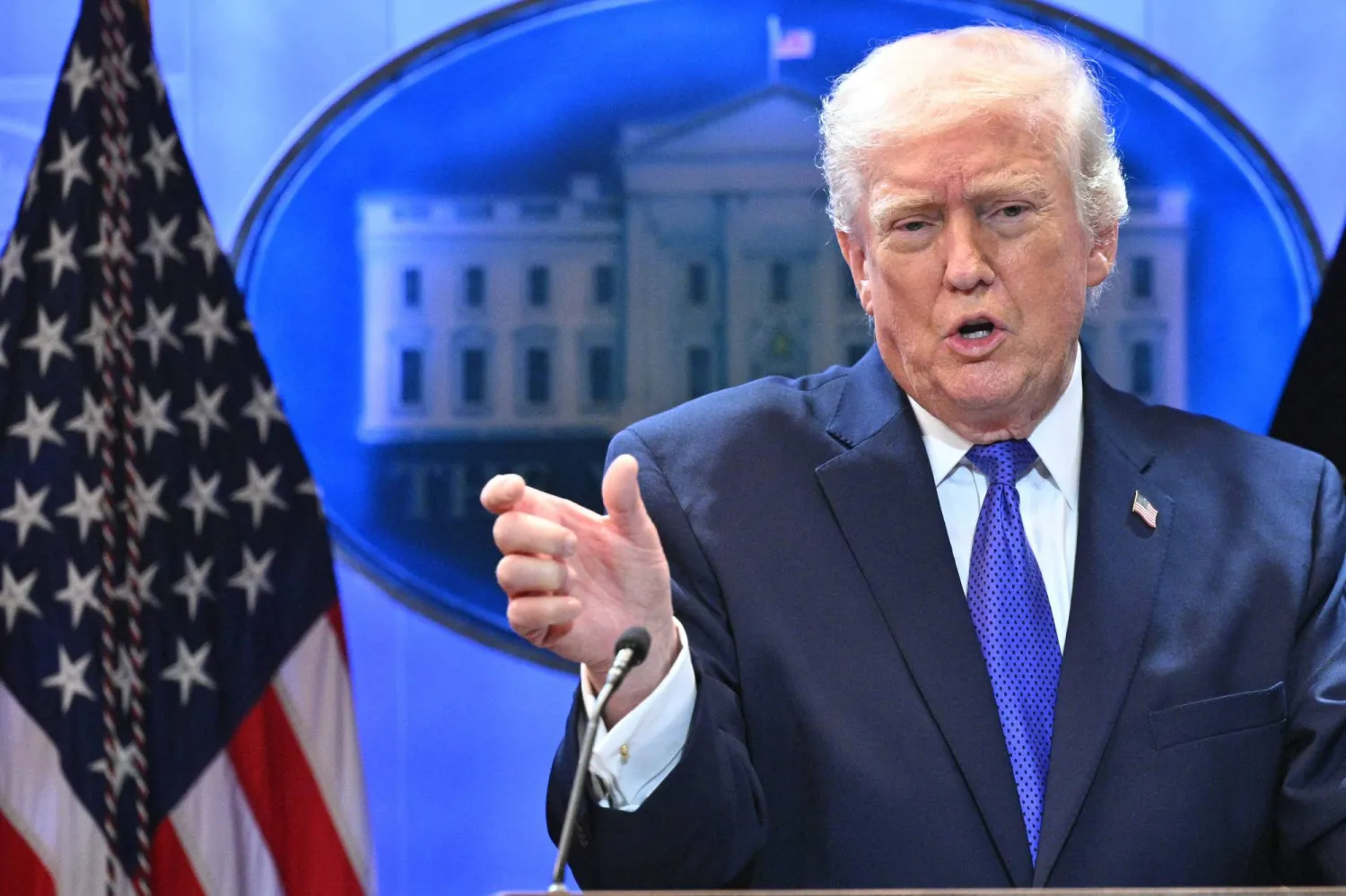
(FILES) US President Donald Trump speaks during a press conference in the Brady Press Briefing Room of the White House in Washington, DC, on February 20, 2026. (Photo by Mandel NGAN / AFP)
TT

Will Trump Accept a ‘Token’ Nuclear Enrichment in Iran?

(FILES) US President Donald Trump speaks during a press conference in the Brady Press Briefing Room of the White House in Washington, DC, on February 20, 2026. (Photo by Mandel NGAN / AFP)

The Trump administration is prepared to consider a proposal that allows Iran “token” nuclear enrichment if it leaves no possible path to a bomb, a senior US official told Axios on Saturday.

This suggests there could be an opening, if only a small one, between the red lines set by the US and Iran for a deal to constrain Iran's nuclear capabilities and prevent war, according to Axios.

The report published this week said that after the Geneva talks, US President Donald Trump's envoys Steve Witkoff and Jared Kushner asked Iranian Foreign Minister Abbas Araghchi to produce a detailed proposal addressing all the US concerns regarding Iran's nuclear program.

A senior US official said Witkoff and Kushner told Araghchi that Trump's position was “zero enrichment” on Iranian soil.

But the official said that if the proposal includes “small, token enrichment,” and if the Iranians offer detailed proof that it poses no threat, the US will study it.
Another senior Trump adviser said: “Trump is keeping his options open. He could decide on an attack at any moment.”

Pezeshkian: We Will Not Bow Our Heads

Meanwhile, Iranian ⁠President Masoud Pezeshkian said on Saturday that his country would not bow its ⁠head to pressure from world powers.

“World powers are lining up to force us to bow our heads... but we will not bow our heads despite all the problems that they are creating for us,” Pezeshkian said in a speech carried live by ⁠state TV.

But a senior US official told Axios that “Trump will be ready to accept a deal that would be substantive and that he can sell politically at home. If the Iranians want to prevent an attack they should give us an offer we can't refuse. The Iranians keep missing the window. If they play games there won't be a lot of patience.”

At the same time, Trump has been presented with military options that involve directly targeting the supreme leader.

The Trump adviser said the Pentagon had presented the US President with numerous options.

“They have something for every scenario. One scenario takes out the ayatollah and his son and the mullahs,” the adviser said, referring to Supreme Leader Ali Khamenei and his son Mojtaba, who is seen as a potential successor. “What the president chooses no one knows. I don't think he knows.”

A second source confirmed a plan to kill Khamenei and his son was floated to Trump several weeks ago.

Another senior Trump adviser said: “Trump is keeping his options open. He could decide on an attack at any moment.”

Zero Enrichment

In return, a senior US official said Witkoff and Kushner told Araghchi that Trump's position was “zero enrichment” on Iranian soil. But the official said that if the proposal includes “small, token enrichment,” and if the Iranians offer detailed proof that it poses no threat, the US will study it.

A source familiar with the talks told Axios that regional mediators told Iran and the US in recent days that any deal must enable both sides to claim victory and, if possible, also be something that Gulf countries can accept.

With the region bracing for war, the US official insisted that Washington would wait for Iran's proposal before deciding how to proceed, and whether there will be another round of talks.

CBS News quoted US officials as saying on Wednesday that Iran had floated the idea of pausing uranium enrichment for a specified period of time, possibly one to three years or five years, while some said this period covered the remainder of Trump's years in the White House.

For his part, Araghchi said on Friday that “Washington has not asked Tehran to permanently suspend uranium enrichment,” adding Tehran had not offered the US a temporary suspension of its uranium enrichment.

Iran's foreign minister said he expected to have a draft counterproposal ready within days following nuclear talks with the United States this ⁠week, while Trump said he was considering limited military strikes.

Two US officials told Reuters that US military planning on Iran had reached an advanced stage, with options including targeting individuals as part of an attack and even pursuing leadership change in Tehran, if ordered by Trump.

Araghchi said after indirect discussions in Geneva this week with Witkoff and Kushner that the sides had reached an understanding on main “guiding principles,” but that did not mean a deal was ⁠imminent.

The foreign minister, in an interview on MS NOW, said he had a draft counterproposal that could be ready in the next two or three days for top Iranian officials to review, with more US-Iran talks possible in a week or so.



Türkiye Says Third Ballistic Missile from Iran Shot Down

 This handout photograph taken and released on March 9, 2026, by Turkish news agency DHA (Demiroren News Agency) shows part of a second Iranian ballistic missile destroyed by NATO in Turkish airspace. (Photo by Handout / DHA (Demiroren News Agency) / AFP)
This handout photograph taken and released on March 9, 2026, by Turkish news agency DHA (Demiroren News Agency) shows part of a second Iranian ballistic missile destroyed by NATO in Turkish airspace. (Photo by Handout / DHA (Demiroren News Agency) / AFP)
TT

Türkiye Says Third Ballistic Missile from Iran Shot Down

 This handout photograph taken and released on March 9, 2026, by Turkish news agency DHA (Demiroren News Agency) shows part of a second Iranian ballistic missile destroyed by NATO in Turkish airspace. (Photo by Handout / DHA (Demiroren News Agency) / AFP)
This handout photograph taken and released on March 9, 2026, by Turkish news agency DHA (Demiroren News Agency) shows part of a second Iranian ballistic missile destroyed by NATO in Turkish airspace. (Photo by Handout / DHA (Demiroren News Agency) / AFP)

Türkiye’s defense ministry on Friday said a ballistic missile from Iran had been shot down in Turkish airspace by NATO forces in the third such incident of the Middle East war. 

"A ballistic munition launched from Iran and entering Turkish airspace was neutralized by NATO air and missile defense assets deployed in the eastern Mediterranean," a ministry statement said. 

Hours earlier, sirens wailed at Türkiye’s southern Incirlik airbase, a key NATO facility where US troops are stationed, state news agency Anadolu reported. 

Local media also reported sirens in Batman, 600 kilometers (370 miles) further east. 

NATO air defenses shot down a first ballistic missile fired from Iran on March 4, with a second intercepted on Monday. 

Residents of the southern city of Adana, next to Incirlik, were woken by sirens at 3:25 am (0025 GMT) and several posted footage of a fast-moving object that appeared to be on fire, the Ekonomim business news website reported. 

Separately, sirens sounded in Batman around 4:00 am, with reporters saying the alarm appeared to be coming from a military drone base next to the city's airport. 

Monday's incident prompted Washington to close its consulate in Adana and urge all US citizens to leave southeastern Türkiye. 

Iranian President Masoud Pezeshkian denied the missile had been fired from Iran in a phone call to Türkiye’s Recep Tayyip Erdogan. 

Since the US-Israeli war on Iran started on February 28, Tehran has retaliated with strikes across the Middle East. 

Incirlik is an important NATO facility used by US troops for decades, but which also hosts military personnel from Spain and Poland, its website says. 

US troops are also stationed at Kurecik, a base in the central Malatya province, where they man an early-warning radar system NATO describes as a "key element" of its missile shield that can detect Iranian missile launches. 

Although Ankara has categorically denied radar data has ever been used to help Israel, its presence has rattled Tehran. 

On Tuesday, Türkiye said a Patriot missile defense system was being deployed in Malatya just days after NATO moved to strengthen its "alliance-wide ballistic missile defense posture". 


Russia Says It Doesn't See Iran Crisis Reducing US Interest in Ukraine Peace Talks

FILE PHOTO: Kremlin spokesman Dmitry Peskov attends a meeting of Russian President Vladimir Putin with Palestinian President Mahmoud Abbas at the Kremlin in Moscow, Russia, January 22, 2026. REUTERS/Ramil Sitdikov/Pool/File Photo
TT

Russia Says It Doesn't See Iran Crisis Reducing US Interest in Ukraine Peace Talks

FILE PHOTO: Kremlin spokesman Dmitry Peskov attends a meeting of Russian President Vladimir Putin with Palestinian President Mahmoud Abbas at the Kremlin in Moscow, Russia, January 22, 2026. REUTERS/Ramil Sitdikov/Pool/File Photo

Russia is not concerned at this point that the Iran crisis will reduce US interest in mediating ‌peace talks ‌on Ukraine, ‌Kremlin ⁠spokesman Dmitry Peskov said ⁠on Friday.

"No, there are no such concerns at ⁠this time; our ‌contacts with ‌our American ‌counterparts provide ‌no grounds for such doubts," Peskov told reporters in ‌response to a question.

Russia is ⁠expecting ⁠a new round of negotiations, but has nothing to announce yet on the timing, he said.


Islamic Nations D-8 Summit Postponed Due to Middle East War

People gather at the site of an airstrike, amid the US-Israeli conflict with Iran, in Tehran, Iran, March 12, 2026. (Reuters)
TT

Islamic Nations D-8 Summit Postponed Due to Middle East War

People gather at the site of an airstrike, amid the US-Israeli conflict with Iran, in Tehran, Iran, March 12, 2026. (Reuters)

An April summit of the D-8 bloc of Muslim-majority developed countries that includes Iran has been postponed due to the war in the Middle East, host Indonesia said Friday.

No new date was announced for the meeting that was to have stretched over four days, culminating in a leaders' summit on April 15.

Fresh strikes rocked Iran and several Gulf countries Friday as Israel and Iran unleashed a new wave of attacks in a war that has ignited the Middle East and threatens to torpedo the world economy.

Apart from Iran and Indonesia, the D-8 Organization for Economic Cooperation also includes Azerbaijan, Bangladesh, Egypt, Malaysia, Nigeria, Pakistan and Türkiye.

Referring to "developments since February 28" when the US-Israeli attacks on Iran started, Indonesian foreign ministry official Tri Tharyat said it was decided to hold the D-8 meeting at a later date.

"It is regrettable that there are still no visible signs of de-escalation," he told reporters in Jakarta.

"Last night, the foreign minister signed a letter addressed to his counterparts announcing the postponement of the D-8 summit," added Tri.