


Iran Pushes Back Against Trump Ahead of Geneva Talks in Face of Major US Military Deployment 

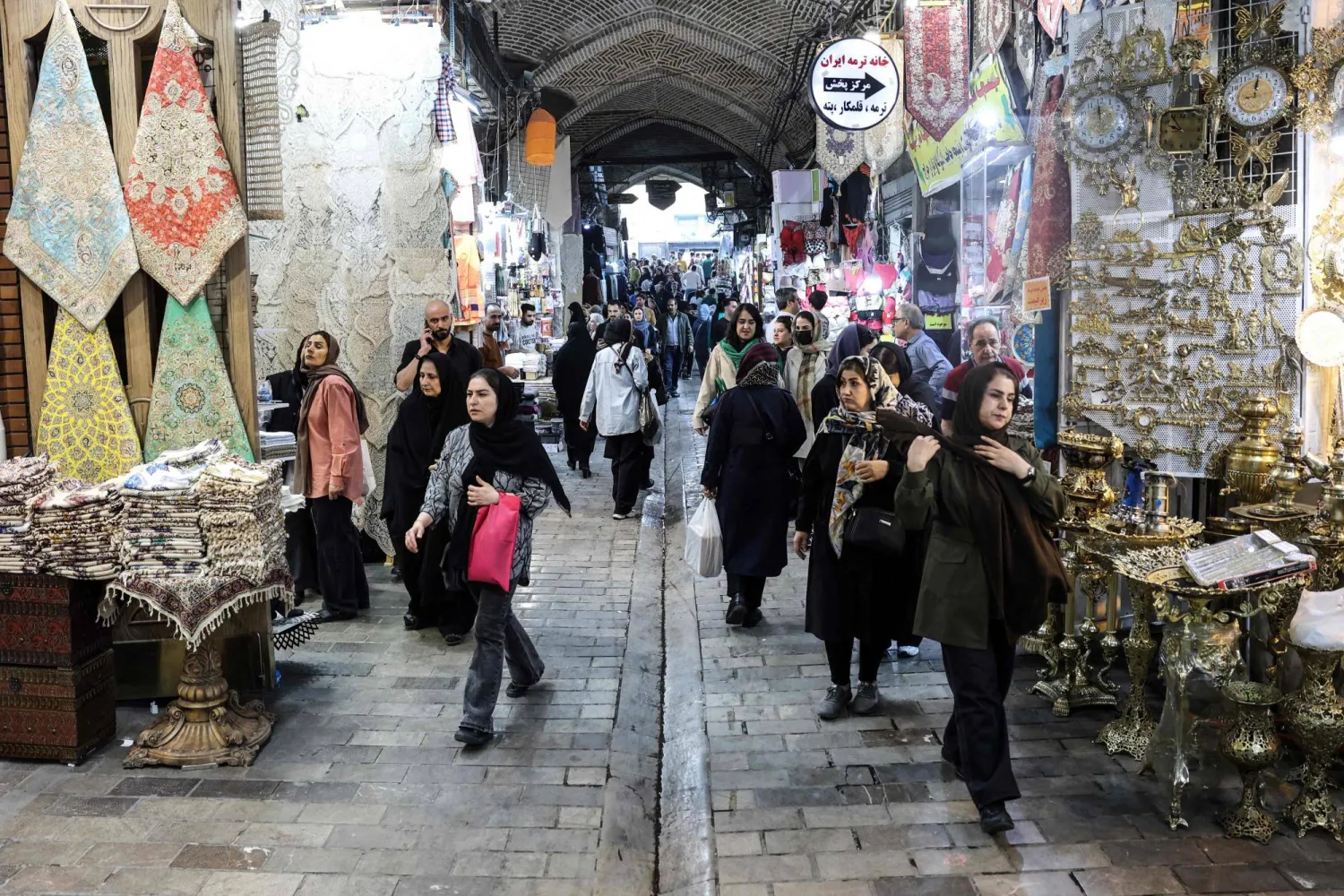
Iranians walk through Tehran's Grand Bazaar on February 24, 2026. (AFP)
TT

Iran Pushes Back Against Trump Ahead of Geneva Talks in Face of Major US Military Deployment 

Iranians walk through Tehran's Grand Bazaar on February 24, 2026. (AFP)

Iran pushed back Wednesday against US President Donald Trump's pressure tactics ahead of critical talks in Geneva over Tehran's nuclear program, alternating between calling his remarks “big lies” to saying negotiations may yield an agreement through “honorable diplomacy.” 

The remarks by two Iranian officials ahead of Thursday's talks come as America has assembled its biggest deployment of aircraft and warships to the Middle East in decades, part of Trump's efforts to get a deal while Iran struggles at home with growing dissent following nationwide protests last month. 

If the negotiations fail, Trump repeatedly has threatened to attack Iran — something regional countries nations fear could spiral into a new regional war as the embers of the yearslong Israel-Hamas war still smolder. Already, Iran has said all US military bases in the Middle East would be considered legitimate targets. 

Iran responds to Trump's State of the Union speech 

Trump on Tuesday night in the US gave his annual State of the Union speech, touching on Iran and the nuclear negotiations. 

“They’ve already developed missiles that can threaten Europe and our bases overseas, and they’re working to build missiles that will soon reach the United States of America,” Trump said. “They were warned to make no future attempts to rebuild their weapons program, and in particular nuclear weapons, yet they continue. They’re starting it all over.” 

Satellite photos earlier analyzed by the AP showed Iran beginning to rebuild its missile production sites and doing some work at the three nuclear sites attacked by the US in June.  

Iran long has maintained its nuclear program is peaceful. The West and the International Atomic Energy Agency say Iran had a nuclear weapons program until 2003. It had been enriching uranium up to 60% purity before the June attack — a short, technical step away from weapons-grade levels of 90%. 

Responding to Trump, Iranian Foreign Ministry spokesman Esmail Baghaei sought to compare him to Joseph Goebbels, Adolf Hitler’s propaganda minister. He accused Trump and his administration of conducting a “disinformation & misinformation campaign” against Iran. 

“Whatever they’re alleging in regards to Iran’s nuclear program, Iran’s ballistic missiles, and the number of casualties during January’s unrest is simply the repetition of ‘big lies,’” Baghaei wrote on X. 

Trump said in his speech at least 32,000 people were killed in the protests, which is at the further end of estimates offered by activists for the death toll. The US-based Human Rights Activist News Agency has so far counted more than 7,000 dead and believes the death toll is far higher. Iran’s government, which long has downplayed death tolls in other unrest, offered its only toll on Jan. 21, saying 3,117 people were killed. 

Mohammad Bagher Qalibaf, Iran's parliament speaker, separately said the US could either try diplomacy or face Iran's wrath. 

“If you choose the table of diplomacy — a diplomacy in which the dignity of the Iranian nation and mutual interests are respected — we will also be at that table," Qalibaf said, according to the semiofficial Student News Network, a media outlet believed to be close to the all-volunteer Basij force of Iran's paramilitary Revolutionary Guard. 

“But if you decide to repeat past experiences through deception, lies, flawed analysis and false information, and launch an attack in the midst of negotiations, you will undoubtedly taste the firm blow of the Iranian nation and the country’s defensive forces.” 

Talks hang in balance 

Iran and the US are due to meet Thursday in Geneva, their third round of talks under the mediation of Oman, long an interlocutor between Tehran and the West. 

If the talks fail, uncertainty hangs over the timing of any possible attack, as well as its mission and goals. 

The US has not made clear the aims of possible military action. If the goal is to pressure Iran to make concessions in nuclear negotiations, it’s not clear whether limited strikes will work. If the goal is to remove Iran’s leaders, that will likely commit the US to a more massive, longer military campaign. There has been no public sign of planning for what would come next, including the potential for chaos in Iran. 

The status of Iran’s nuclear program is another mystery. Trump earlier said American strikes “obliterated” it. Now, dismantling whatever remains of the program appears to be back on the administration’s agenda. IAEA inspectors have not been allowed to inspect those sites and verify what remains. 

There is also uncertainty about what any military action could mean for the wider region. Tehran could retaliate against Israel. Oil prices have risen in recent days in part due to those concerns. 


Mojtaba Khamenei Says Closure of Strait of Hormuz Should be Used as 'Leverage'

(FILES) In this picture obtained from Iran's ISNA news agency, Mojtaba Khamenei (C), son of Iran's supreme leader Ayatollah Ali Khamenei, walks along a street in Tehran on May 31, 2019. (Photo by Hamid FOROUTAN / ISNA / AFP)
TT

Mojtaba Khamenei Says Closure of Strait of Hormuz Should be Used as 'Leverage'

(FILES) In this picture obtained from Iran's ISNA news agency, Mojtaba Khamenei (C), son of Iran's supreme leader Ayatollah Ali Khamenei, walks along a street in Tehran on May 31, 2019. (Photo by Hamid FOROUTAN / ISNA / AFP)

Iran’s Supreme Leader Mojtaba Khamenei issued his first statement on the war on Thursday, saying that the leverage of closing the Strait of Hormuz should be used.

Khamenei called on people in Gulf countries to “shut down” US bases, saying promised US protection is “nothing more than a lie.”

Khamenei did not appear on camera. Israeli intelligence assessed that he was likely wounded in the war’s opening salvo, which he said also killed his wife, one of his sisters, his niece and his father, Supreme Leader Ali Khamenei.

US President Donald Trump has promised to “finish the job,” even as Iran is “virtually destroyed.” The first week of the war cost the United States $11.3 billion, according to the Pentagon.

“One point I must emphasize is that, in any case, we will obtain compensation from the enemy,” Khamenei said.

“If it refuses, we will take from its assets to the extent we deem appropriate, and if that is not possible, we will destroy its assets to the same extent.”


Russia Condemns Trump Comments on 'Takeover' of Cuba

US President Donald Trump greets Russian President Vladimir Putin, Aug. 15, 2025, at Joint Base Elmendorf-Richardson, Alaska. (AP Photo/Julia Demaree Nikhinson, File)
TT

Russia Condemns Trump Comments on 'Takeover' of Cuba

US President Donald Trump greets Russian President Vladimir Putin, Aug. 15, 2025, at Joint Base Elmendorf-Richardson, Alaska. (AP Photo/Julia Demaree Nikhinson, File)

Russia condemned on Thursday what it called blackmail and threats by US President Donald Trump to initiate a "takeover" of Cuba, a traditional ally of Moscow.

Russian Foreign Ministry spokeswoman Maria Zakharova said Moscow would provide all possible political and diplomatic support to Cuba and called for a diplomatic solution to the tensions with Washington, Reuters reported.

Trump said on Monday that Cuba was in "deep trouble" and that US Secretary of State Marco Rubio was dealing with the issue, which may or may not be a "friendly takeover."


Trump Says Stopping a Nuclear Iran More Important than Oil Prices

US President Donald Trump talks to the media upon his arrival at Joint Base Andrews, Maryland, US, March 11, 2026.  REUTERS/Kevin Lamarque
US President Donald Trump talks to the media upon his arrival at Joint Base Andrews, Maryland, US, March 11, 2026. REUTERS/Kevin Lamarque
TT

Trump Says Stopping a Nuclear Iran More Important than Oil Prices

US President Donald Trump talks to the media upon his arrival at Joint Base Andrews, Maryland, US, March 11, 2026.  REUTERS/Kevin Lamarque
US President Donald Trump talks to the media upon his arrival at Joint Base Andrews, Maryland, US, March 11, 2026. REUTERS/Kevin Lamarque

US President Donald Trump on Thursday said that stopping Iran from getting nuclear weapons was more important to him than controlling oil prices, Reuters reported.

"The United States is the largest Oil Producer in the World, by far, so when oil prices go up, we make a lot of money. BUT, of far greater interest and importance to me, as President, is stopping an evil Empire, Iran, from having Nuclear Weapons, and destroying the Middle East and, indeed, the World," said Trump in a post on his Truth Social platform.
