


Crimes Against Humanity Complaint Filed in Switzerland against Iran Deputy Minister

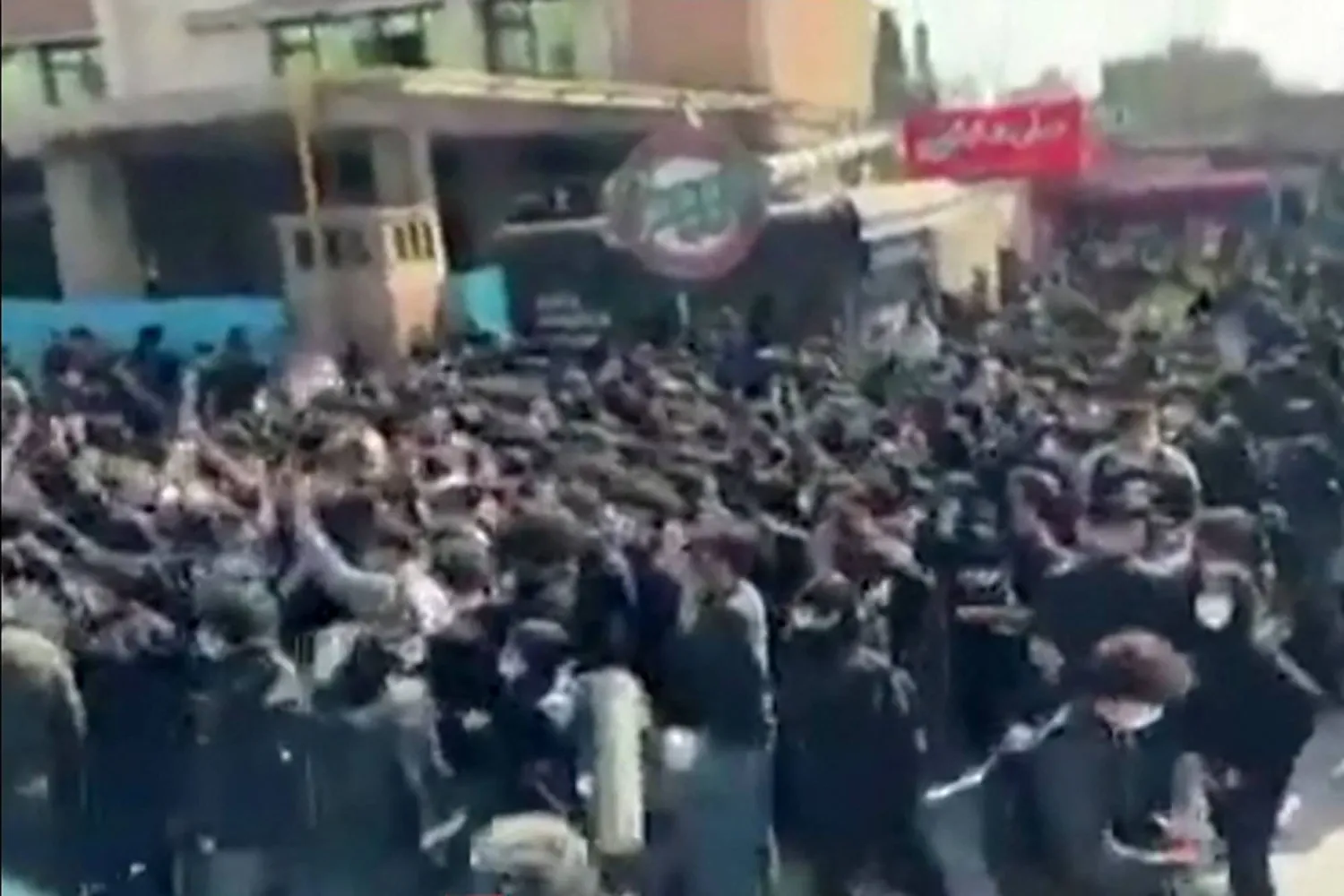
 Iranian students chanted anti-government slogans at rallies for people killed during a recent wave of demonstrations, local and diaspora media reported February 21, 2026, as groups protesting the clerical leadership faced off with others voicing support for the government. (Photo by UGC / AFP)
Iranian students chanted anti-government slogans at rallies for people killed during a recent wave of demonstrations, local and diaspora media reported February 21, 2026, as groups protesting the clerical leadership faced off with others voicing support for the government. (Photo by UGC / AFP)
TT

Crimes Against Humanity Complaint Filed in Switzerland against Iran Deputy Minister

 Iranian students chanted anti-government slogans at rallies for people killed during a recent wave of demonstrations, local and diaspora media reported February 21, 2026, as groups protesting the clerical leadership faced off with others voicing support for the government. (Photo by UGC / AFP)
Iranian students chanted anti-government slogans at rallies for people killed during a recent wave of demonstrations, local and diaspora media reported February 21, 2026, as groups protesting the clerical leadership faced off with others voicing support for the government. (Photo by UGC / AFP)

A complaint has been filed in Switzerland accusing Iranian deputy foreign minister Kazem Gharibabadi of crimes against humanity linked to anti-government protests in his country in recent years, lawyers said Thursday.

The complaint, filed by an Iranian-Swiss citizen, said Gharibabadi "may have committed serious crimes contrary to international law" linked to protests over the death in custody of a woman, Mahsa Amini, the lawyers told AFP, demanding the arrest of the deputy minister who has been in Geneva this week.

It suggested he could be "a co-perpetrator or, at the very least, that his responsibility could be engaged due to his position as a hierarchical superior at the time of the events".

"We expect the Swiss authorities to arrest the accused as soon as possible," said the lawyers William Bourdon and Philippine Vaganay, both French nationals.

"There is no other option," they said in a statement sent to AFP.

"This obligation to arrest him is imperative under both Swiss and international law; otherwise, the fight against impunity for those responsible for the most serious crimes is a pipe dream."

- Universal jurisdiction -

Swiss judicial authorities confirmed to AFP that the office of the country's attorney general had received the complaint, which was "currently being reviewed according to standard procedure".

"The filing of a criminal complaint does not necessarily mean that criminal proceedings have been initiated," they said in an email.

The complaint was filed under the principle of universal jurisdiction, which allows countries to prosecute alleged crimes against humanity, war crimes and genocide regardless of where they were committed.

Gharibabadi has this week been in Geneva, where he on Monday addressed the United Nations Human Rights Council and the Conference on Disarmament.

It was unclear if he remained on Thursday in the Swiss city, where Iran was taking part in high-stakes indirect nuclear talks with the United States.

The complaint is linked to Iran's brutal crackdown on protests that erupted in the country after the 2022 death in custody of Amini, a 22-year-old Iranian Kurd who had been arrested for allegedly violating the strict dress rule for women based on Islamic sharia law.

It charged that Gharibabadi "could be held responsible" for having "participated in and covered up acts of murder, physical and sexual violence, arbitrary detention, inhuman or degrading treatment and violations of fundamental rights" during the crackdown.

The complaint highlighted that Gharibabadi at the time was a high-ranking official in Iran's judiciary, with command over those "who implemented the deadly policy, which led to arbitrary detention, violence, acts of torture and murder", as well as "execution of civilians".

- 'Extremely serious crimes' -

"His high-ranking position within the Iranian security apparatus and his role in the uprisings that followed the death of Masha Amini and continue to this day leave no doubt as to his criminal responsibility," Bourdon and Vaganay said in their statement.

The complaint, which relies heavily on a 2024 UN fact-finding mission report, also charged that Gharibabadi had clearly not taken "all the necessary and reasonable measures within his power to prevent or suppress these acts".

On the contrary, the complaint maintained that his public statements at the time "clearly reveal a fierce determination to cover up extremely serious crimes committed under his command".

It pointed for instance to a statement delivered before the United Nations in November 2022, in which it said he "clearly justified the massacres taking place", referring to demonstrators as US-backed "rioters" who "brutally attacked security forces".

Those statements suggest "he was fully aware of the serious crimes committed", the complaint said.

The text insisted on the need for Switzerland to take action in the case.

"One of the only ways to end the impunity currently enjoyed by the Iranian authorities lies in the exercise by third-party states of their universal jurisdiction over human rights violations," it said.



Russia Says Preparing ‘Massive Strikes’ on Ukraine’s Energy Sector

A view of the destruction after a Russian attack struck a warehouse, followed by an explosion, in the village of Myla, Kyiv region, Ukraine, Saturday, Aug. 29, 2026. (AP)
TT

Russia Says Preparing ‘Massive Strikes’ on Ukraine’s Energy Sector

A view of the destruction after a Russian attack struck a warehouse, followed by an explosion, in the village of Myla, Kyiv region, Ukraine, Saturday, Aug. 29, 2026. (AP)

Russia's defense ministry on Sunday said it was gearing up for large-scale attacks on Ukraine's energy infrastructure in a tit-for-tat response to strikes by Kyiv.

"Russian forces have begun preparations for massive strikes against facilities in Ukraine's energy sector in response to the ongoing attacks by the Kyiv regime on civilian infrastructure and on Russia's oil and energy complex," it said on Telegram.

Last winter, Moscow repeatedly hit Ukrainian power plants, devastating the country's energy sector and plunging millions of people into cold and darkness in sub-zero temperatures.

Both sides have for several months escalated long-range strikes, targeting infrastructure such as warehouses, businesses, oil and port facilities, as well as ships, increasing civilian casualties.

On Sunday, the Russian army claimed to have struck a plant in Kyiv producing asbestos and cement whose warehouses, it said, were used to store explosives, as well as a manufacturer of drones and munitions.

On Saturday, a Russian strike on an ammunition depot in the suburbs of the Ukrainian capital triggered a huge explosion and killed at least 37 people.

Ukraine for its part attacked an oil refinery with drones in northwestern Russia, causing a fire, according to the local authorities.


Trump Cannot Deport Students for Criticizing Israel, Judge Rules

Students walk through the Stanford University campus, March 14, 2019, in Santa Clara, Calif. (AP)
TT

Trump Cannot Deport Students for Criticizing Israel, Judge Rules

Students walk through the Stanford University campus, March 14, 2019, in Santa Clara, Calif. (AP)

Citing the importance of the First Amendment, a federal judge in California says the US government is unconstitutionally silencing critics of Israel's war in Gaza and others as part of the Trump administration’s quest to deport noncitizens who it says disrupted college campuses while expressing their views.

Judge Noël Wise, in a ruling Friday, delivered a victory for The Stanford Daily, the student newspaper at Stanford University, which has said some international students were afraid to speak out because of the deportation threat.

“Freedom of speech is illusory if we are only ‘free’ to express complementary views about the government and its leaders,” the judge wrote.

The decision largely piggybacks on findings from nearly a year ago by a US district judge in Boston, who ruled that the Trump administration violated the Constitution when it targeted people who are not citizens for deportation solely for supporting Palestinians and criticizing Israel.

Wise wrote that the freedoms of speech and the press are “foundational to America’s enduring democracy.” The judge cited free-speech and vagueness flaws that violate the First Amendment and Fifth Amendment as she struck down portions of the provisions that the federal government follows regarding deportations.

Wise cited retaliation in March 2025 by US immigration authorities against people who engaged in speech supporting the Palestinians and against Israel's actions, which a growing number of experts, including those commissioned by a UN body, have said amount to genocide. The judge also cited retaliation against people who were critical of Charlie Kirk after the Turning Point USA co-founder was assassinated last September.

“Tomorrow, or perhaps even today, targets may include anyone in the United States who exercises their freedom of speech to simply express opinions the government does not like,” the judge in San Jose said.

“This downward spiral is antithetical to our Constitution that recognizes our right to speak freely,” she added. “Here you can simultaneously hate the content of a person’s speech and love the country that cherishes the freedom to allow it. Zealous protection of our Constitutional right to free speech is a provocative demonstration of our country’s powerful lack of fear.”

The Justice Department did not respond Saturday to a message seeking comment on the decision.

George Porteous, the editor-in-chief of The Stanford Daily, responded to the ruling by saying on X: “The reporters in our newsroom shouldn’t have to fear that writing a story will result in their deportation. Today’s victory means they won’t have to.”

Conor Fitzpatrick, an attorney with the Foundation for Individual Rights and Expression, which brought the lawsuit, praised the ruling.

“In America, free speech doesn’t just belong to the people who say things the government agrees with,” Fitzpatrick said in a release.

In her decision, Wise said it was clear that the government's tactics has had an effect on college campuses.

“The government has offered a chilling message regarding protected speech — speak out against Israel or in support of Palestinians and we will revoke your visa and deport you. Behave. Noncitizen students heard the warning and heeded. And, as the idiom goes, the silence is deafening,” the judge wrote.

At The Stanford Daily, lawfully present noncitizens at the paper have quit, withheld articles, refused assignments, requested articles be taken down, and asked for anonymity due to fear of adverse immigration consequences, Wise noted.

She said noncitizens have the same First Amendment rights as citizens and yet were left to guess what the US foreign policy was at any given moment and on any given subject.

“This is an incomprehensible standard,” she said. “While the Court understands that the government has been granted considerable discretion on foreign policy and immigration matters, that discretion must nevertheless still ensure that ordinary people can understand what the law permits and prohibits.”

Wise added: “Our Constitutional right to freedom of speech guarantees people the right to express — through their words, actions, or assembly — opinions that may be repugnant, views that run counter to prevailing political norms, or beliefs that otherwise challenge the country’s domestic or foreign policy, military engagement, or war.”


No Dutch Investigation into Mladic’s Death, Says Tribunal

The flag of Bosnia and Herzegovina among graves at the memorial cemetery where the victims of the Srebrenica genocide are buried, following the death of Bosnian Serb Ratko Mladic, former general convicted of Bosnia genocide, in Potocari, Bosnia and Herzegovina, August 28, 2026. (Reuters)
TT

No Dutch Investigation into Mladic’s Death, Says Tribunal

The flag of Bosnia and Herzegovina among graves at the memorial cemetery where the victims of the Srebrenica genocide are buried, following the death of Bosnian Serb Ratko Mladic, former general convicted of Bosnia genocide, in Potocari, Bosnia and Herzegovina, August 28, 2026. (Reuters)

A UN court said Saturday evening that Dutch authorities would not be conducting a criminal investigation into the death of Ratko Mladic, the convicted Bosnian Serb war criminal.

Mladic, serving life in prison in The Hague for genocide and war crimes committed during the 1992-1995 Bosnian war, died in hospital on Thursday, having suffered several strokes in recent months.

His age has always been a matter of dispute. He claimed to have been born in March 1943, but the tribunal listed his birth year as 1942 -- local media widely reported that he'd died at the age of 84.

The International Residual Mechanism for Criminal Tribunals Mechanism said the Dutch authorities had carried out the procedures required by national law.

On Friday, they had decided "that no criminal investigation would be opened and that they would not be conducting an autopsy", the statement added.

The Mechanism said it had also appointed a judge, Iain Bonomy, to conduct a separate investigation into Mladic's death. That inquiry was still ongoing and details, for the moment, were confidential, it added.

On Monday, days before Mladic's death, the Serbian authorities had called for his release on health grounds for treatment in Serbia.

In May, the Mechanism had already rejected a request from his family for Mladic's release.

Mladic, who was arrested in Serbia in 2011, had the verdict against him confirmed on appeal in 2021.

One of the crimes ascribed to him was the July 1995 massacre of approximately 8,000 Bosnian men and boys in the eastern Srebrenica region -- the worst such atrocity in Europe since WWII.

The Mechanism's role is to carry out the residual duties of the UN tribunals based in The Hague, including the International Criminal Tribunal for the former Yugoslavia, which convicted Mladic.