


New Gallup Poll Shows How Americans’ Sympathies Have Shifted in Palestinian-Israeli Conflict 

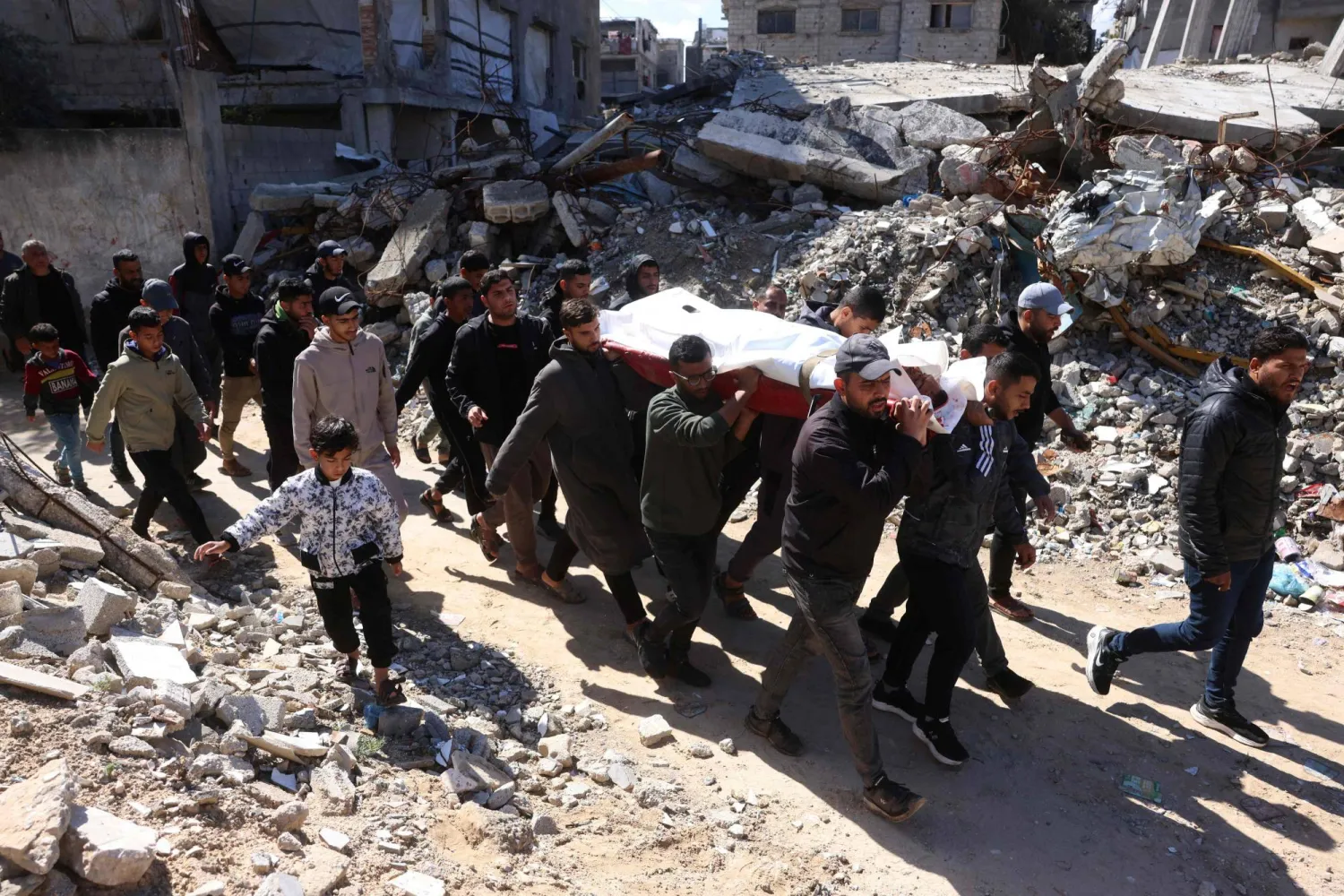
Palestinian men carry the body of a person killed in an Israeli military strike, as they maneuver past the debris of building destroyed by the Israeli military, during their funeral in Khan Younis, in the southern Gaza Strip on February 27, 2026. (AFP)
TT

New Gallup Poll Shows How Americans’ Sympathies Have Shifted in Palestinian-Israeli Conflict 

Palestinian men carry the body of a person killed in an Israeli military strike, as they maneuver past the debris of building destroyed by the Israeli military, during their funeral in Khan Younis, in the southern Gaza Strip on February 27, 2026. (AFP)

American sympathies in the Middle East have shifted dramatically toward the Palestinians, according to new Gallup polling, after decades of overwhelming support for the Israelis.

That shift accelerated during the war in Gaza. Three years ago, 54% of Americans sympathized more with the Israelis, compared to 31% for the Palestinians.

Now, their support is about evenly balanced, with 41% saying their sympathies lie more with the Palestinians, and only 36% saying the same about the Israelis.

The numbers reflect how support for Israel has become deeply contentious in the US, with profound implications for American politics and foreign policy. The changing sentiment has been largely driven by Democrats, who are now much more likely to sympathize with Palestinians. US assistance to Israel has been a major dividing line in the party’s primaries this year.

Gallup’s data indicates that the shift was already happening before Hamas attacked Israel on Oct. 7, 2023, then increased during Israel’s subsequent military operations in Gaza. The polling has a margin of error of plus or minus 4 percentage points, meaning sentiment toward Israelis and Palestinians are roughly even.

“It’s the first time they have reached parity, which is really quite striking,” said Benedict Vigers, a senior global news writer at Gallup. “In not many years, that very significant gap in public opinion has now completely closed.”

Democrats and independents

About two-thirds of Democrats now say their concerns lie more with the Palestinians, while only about 2 in 10 sympathize more with the Israelis. As recently as 2016, the picture looked very different: About half of Democrats sympathized more with the Israelis and only about one-quarter sympathized with the Palestinians.

The shift began even before the Israel-Hamas war turned the issue into a flash point within the Democratic Party. Palestinian fighters killed around 1,200 people, mostly civilians, in the initial attack and took another 251 hostage, but the Israeli response has been widely seen as disproportionate, with Gaza health officials reporting more than 72,000 Palestinians killed, nearly half of them women and children, and wide swaths of the territory reduced to rubble.

Many progressive politicians and activists now describe Israel’s actions in the war as genocide — a charge Israel vehemently denies.

Democrats have expressed greater sympathy for the Palestinians than the Israelis since 2023 — in a Gallup poll that was conducted before the Oct. 7 attacks — but Gallup’s surveys show their support in the conflict has been tilting toward the Palestinians and away from the Israelis since around 2017.

Some of that early decline in sympathy appeared to be tied to disapproval of the right-leaning Israeli leader, Prime Minister Benjamin Netanyahu, whose favorability in the US fell nearly 15 percentage points between 2017 and 2024, according to separate Gallup polling.

Netanyahu clashed with former President Barack Obama in the last year of his administration, then forged a warmer relationship with President Donald Trump, who delivered several victories to Netanyahu in his first term, including recognizing Jerusalem as the capital of Israel and Israel’s sovereignty over the Golan Heights. Trump also persuaded three Arab countries to establish commercial and diplomatic ties with Israel. The closeness between Trump and Netanyahu has continued into Trump’s second term.

The conflict between the Israelis and Palestinians was a point of tension for Democrats during President Joe Biden’s administration, as well as during the 2024 presidential election.

An AP-NORC poll conducted toward the end of 2023, just a few months into the war in Gaza, found that Democrats were sharply divided on whether the US was too supportive of Israel, and another AP-NORC poll from 2024 found that Democratic voters were more likely to say the Israeli government held “a lot” of responsibility for the war’s escalation.

Democrats’ sympathy for the Palestinians intensified as the war progressed, Gallup’s polling shows, and independents’ views also shifted. This year, independents expressed more sympathy for the Palestinians than the Israelis for the first time in Gallup’s trend. About 4 in 10 independents are more sympathetic toward the Palestinians. That’s compared to about 3 in 10 for the Israelis, a new low.

Most Republicans continue to side with Israel — about 7 in 10 say they are more sympathetic to the Israelis — but that is a slight downtick from about 8 in 10 before the start of the war. Some figures in the Republicans’ isolationist “America First” wing are also increasingly questioning traditional US support for Israel.

Generational gaps

Younger adults — those 18 to 34 in this poll — are also increasingly sympathetic toward the Palestinians, according to the Gallup survey.

Younger Americans’ sympathies have been shifting toward the Palestinians since around 2020, and reached a new high this year. About half of 18- to 34-year-olds say they have more sympathy for the Palestinians, compared to about a quarter who say that about the Israelis.

Student protests against the Israel-Hamas war appeared on college campuses around the country during the war, asking colleges to cut investments supporting Israel.

But the shift is only “partly a generational story,” according to Vigers.

The new poll also found for the first time that middle-aged Americans, those 35 to 54, expressed more sympathy for the Palestinians than the Israelis — a reversal from last year. And while Americans over 55 are more sympathetic toward Israel, that gap is narrowing, too.

“With adults over 55, they are more sympathetic to Israelis, but it’s as low as it’s been since 2005,” Vigers said.

Palestinian state

About 6 in 10 US adults, 57%, favor the establishment of an independent Palestinian state in the West Bank and the Gaza Strip, according to the new polling. That’s not significantly different from recent years, as at least half of US adults have supported an independent Palestinian state since 2020.

Vigers notes that “party polarization is at or near its record high” on this question, even though it hasn’t been sharply increasing year over year.

In the last few years, there’s been an uptick among Democrats and independents in support for the two-state solution. Now, about three-quarters of Democrats and roughly 6 in 10 independents say they support an independent Palestinian state. Only about one-third of Republicans say the same.

The opinions of the people who would be directly affected by a two-state solution are quite different. Only about 3 in 10 Israelis living in Israel and Palestinians living in the West Bank and east Jerusalem said they supported a two-state solution in which an independent Palestinian state existed alongside Israel, according to the Gallup World Poll conducted in 2025.

“On the ground, in the region, far fewer Israelis and Palestinians tell us that they are in favor of the two-state solution than Americans when asked a very similar question,” Vigers said. “There is that interesting sort of disconnect between the region itself and Americans’ views toward it.”



UN Security Council to Meet on Saturday on Iran Conflict

President Donald Trump shakes hands with Israel's Prime Minister Benjamin Netanyahu at the end of a news conference at Mar-a-Lago, Dec. 29, 2025, in Palm Beach, Fla. (AP Photo/Alex Brandon, File)
TT

UN Security Council to Meet on Saturday on Iran Conflict

President Donald Trump shakes hands with Israel's Prime Minister Benjamin Netanyahu at the end of a news conference at Mar-a-Lago, Dec. 29, 2025, in Palm Beach, Fla. (AP Photo/Alex Brandon, File)

The UN Security Council will meet on Saturday after the United States and Israel launched strikes on Iran, plunging the Middle East into a new conflict.

UN diplomats said the 15-member body would meet at 4 p.m. local time in New York (2100 GMT). The meeting will be chaired by Britain, which holds the monthly council presidency.

Russia's UN mission said Russia and China requested an emergency meeting "in connection with the unprovoked act of armed aggression by the United States and Israel against the Islamic Republic of Iran."

It said the meeting was also called for by France, Bahrain, and Colombia.

"During the Security Council meeting, we will demand from the United States and Israel to immediately cease their illegal and escalatory actions and embark on a path toward a political and diplomatic settlement," the Russian statement said.

A UN diplomat said UN Secretary-General Antonio Guterres plans to speak at the Security Council session, Reuters reported.

Earlier on Saturday, Guterres issued a statement condemning military escalation in the Middle East and saying that the "use of force by the United States and Israel against Iran, and the subsequent retaliation by Iran across the region, undermine international peace and security."

"I call for an immediate cessation of hostilities and de-escalation. Failing to do so risks a wider regional conflict with grave consequences for civilians and regional stability. I strongly encourage all parties to return immediately to the negotiating table," Guterres said.


Khamenei is Alive, Iran Interested in De-escalation, Says Foreign Minister

The Iranian flag waves in front of the International Atomic Energy Agency (IAEA) headquarters, before the beginning of a board of governors meeting, amid the coronavirus disease (COVID-19) outbreak in Vienna, Austria, March 1, 2021. (Reuters)
TT

Khamenei is Alive, Iran Interested in De-escalation, Says Foreign Minister

The Iranian flag waves in front of the International Atomic Energy Agency (IAEA) headquarters, before the beginning of a board of governors meeting, amid the coronavirus disease (COVID-19) outbreak in Vienna, Austria, March 1, 2021. (Reuters)

Iran's foreign minister said the country's supreme leader was alive, along with all high-ranking officials, after Israel and the United States launched strikes across the country on Saturday.

Foreign Minister Abbas Araghchi told NBC News that supreme leader Ayatollah Ali Khamenei was alive "as far as I know", in an interview from Tehran with the US outlet, adding that "all high ranking officials are alive", AFP reported.

Araghchi said he had been in contact with Gulf states and "explained for them that we have no intention to attack them but we are actually attacking the American bases in the act of self defense".

He added that while there was no communication with Washington now, "if Americans wants to talk to us. They know how they can contact me. We are certainly interested for de-escalation".


Trump Warns Some Americans May Die amid US Strikes in Iran

US President Donald Trump speaks to the media on the South Lawn of the White House before boarding Marine One helicopter bound for Corpus Christi, Texas (EPA)
TT

Trump Warns Some Americans May Die amid US Strikes in Iran

US President Donald Trump speaks to the media on the South Lawn of the White House before boarding Marine One helicopter bound for Corpus Christi, Texas (EPA)

US President Donald Trump said on Saturday there could be US casualties after he announced the United States began "major combat operations" in Iran.

The strikes, which Trump said were aimed at destroying Iranian missiles and annihilating its navy, follow repeated US-Israeli warnings that they would strike Iran again if it pressed ahead with its nuclear and ballistic missile programs.

"My administration has taken every possible step to minimize the risk to US personnel in the region. Even so, and I do not make this statement lightly, the Iranian regime seeks to kill," Trump said in a video shared on Truth Social, Reuters reported.

"The lives of courageous American heroes may be lost and we may have casualties, that often happens in war, but we're doing this, not for now. We're doing this for the future, and it is a noble mission."

The White House later said there were no confirmed plans for a further address to the nation by Trump, who arrived in Palm Beach, Florida, late on Friday.

The US military has named the operation "Epic Fury," the Pentagon said on X.

This is the second time the US has carried out strikes on Iran since Trump returned to the White House last year. The first was in June when Washington carried out a series of attacks on Iranian nuclear sites.

Saturday's strikes, unlike the first, are expected to be carried out over several days, a US official told Reuters.

Secretary of State Marco Rubio called top congressional leaders known as the "Gang of Eight" before the strike, said Representative Jim Himes of Connecticut, the top Democrat on the House of Representatives' Intelligence Committee.

"Everything I have heard from the Administration before and after these strikes on Iran confirms this is a war of choice with no strategic endgame," Himes said.

"As I expressed to Secretary Rubio when he briefed the Gang of Eight, military action in this region almost never ends well for the United States, and conflict with Iran can easily spiral and escalate in ways we cannot anticipate. It does not appear that Donald Trump has learned the lessons of history."

House Speaker Mike Johnson, also one of the Gang of Eight, said the group had been briefed in detail earlier this week that military action against Iran may be necessary.

Rubio had told the leaders during a briefing at the White House on Tuesday that the operation would likely move forward, but that there were diplomatic efforts to try and strike a deal with Tehran that could change Trump’s thinking, two sources familiar with the matter said.

Rubio notified the Gang of Eight on Friday night that the operation to attack Iran was likely to commence in the following hours but said Trump could still change his mind, the sources said.

In his video message, Trump told the members of the Islamic Revolutionary Guard Corps, Iran's elite armed forces, to lay down their weapons, promising that they would be granted immunity.

The other option, according to Trump, is "certain death."

Washington and Tehran held a series of talks in recent weeks about Iran's nuclear ambitions. The most recent one was held on Thursday with no deal.

"Iran refused, just as it has for decades and decades. They rejected every opportunity to renounce their nuclear ambitions, and we can't take it anymore," Trump said.

The president first floated the idea of strikes on Iran in January amid two-week-long nationwide protests, during which thousands of people were killed by authorities.

He said that the US would come to the rescue of protesters if Iranian officials were to shoot and kill them. Trump later encouraged the protesters to continue protesting, saying that help was on the way.

Trump mentioned the killing of protesters during his statement on the strikes, telling Iranians to take cover because bombs will drop "everywhere".

"When we are finished, take over your government. It will be yours to take. This will be probably your only chance for generations," he said.