


IAEA Says Unable to Verify Whether Iran Has Suspended All Uranium Enrichment

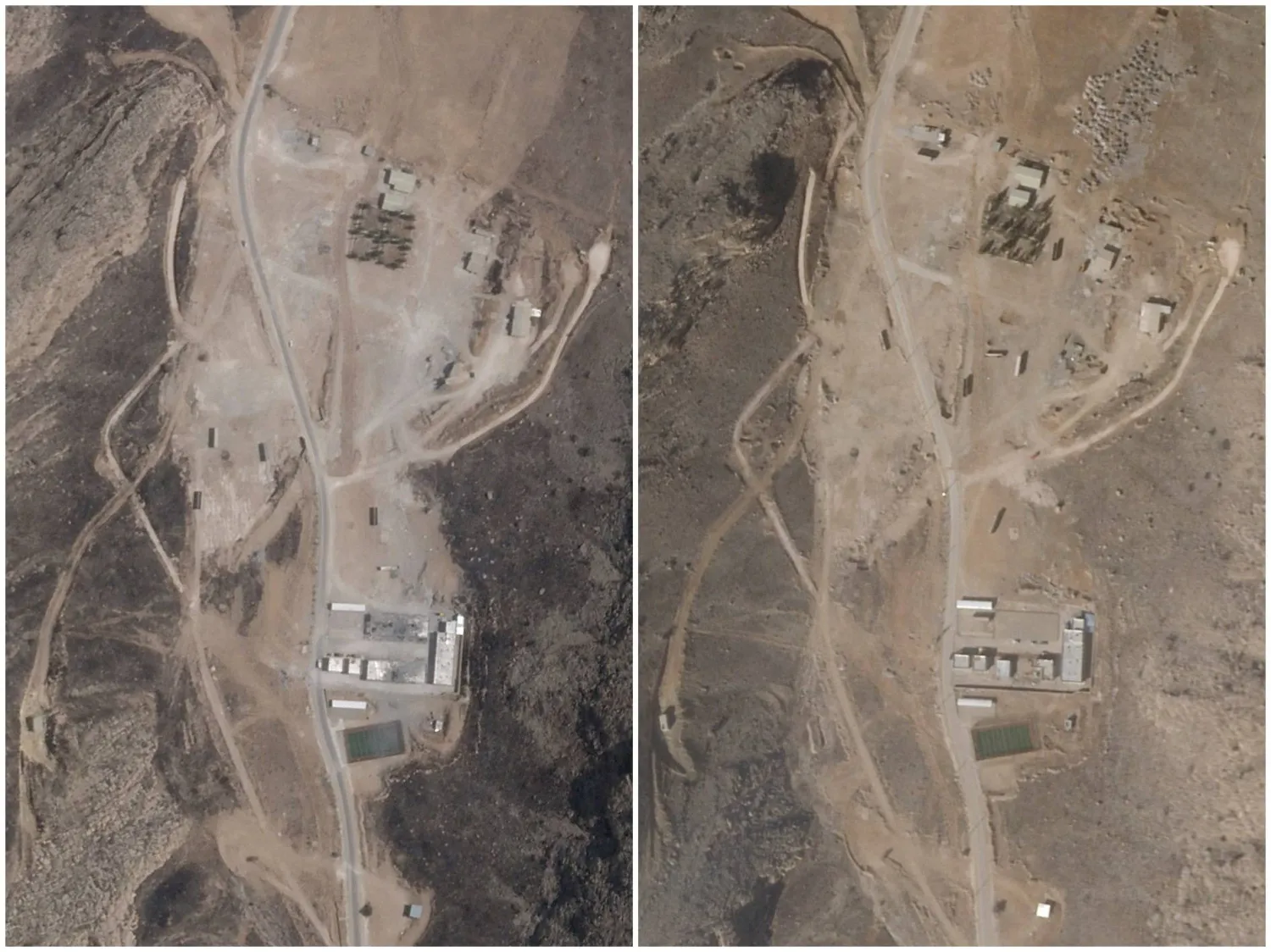
A combination picture of satellite images shows Shiraz South Missile Base in Shiraz South, Iran, before reconstruction, July 3, 2025 (LEFT), and after reconstruction and clearance efforts, January 30, 2026. Planet Labs PBC/Handout via REUTERS
TT

IAEA Says Unable to Verify Whether Iran Has Suspended All Uranium Enrichment

A combination picture of satellite images shows Shiraz South Missile Base in Shiraz South, Iran, before reconstruction, July 3, 2025 (LEFT), and after reconstruction and clearance efforts, January 30, 2026. Planet Labs PBC/Handout via REUTERS

Iran has not allowed the United Nations nuclear agency access to its nuclear facilities bombed by Iran and the United States during a 12-day war in June, according to a confidential report by the watchdog circulated to member states and seen Friday by The Associated Press.

The report from the International Atomic Energy Agency stressed that it “cannot verify whether Iran has suspended all enrichment-related activities,” or the “size of Iran’s uranium stockpile at the affected nuclear facilities.”

The IAEA report on Friday warned that due to the continued lack of access to any of Iran’s four declared enrichment facilities, the agency “cannot provide any information on the current size, composition or whereabouts of the stockpile of enriched uranium in Iran.”

The agency also said that Iran has not provided access to IAEA inspectors to the Isfahan Fuel Enrichment Plant since Iran first made available information about the new facility over eight months ago. The confidential report warned that therefore the agency does not know whether this facility “contains nuclear material or is operational.”

The report stressed that the “loss of continuity of knowledge over all previously declared nuclear material at affected facilities in Iran needs to be addressed with the utmost urgency.”

Iran has long insisted its program is peaceful, but the IAEA and Western nations say Tehran had an organized nuclear weapons program up until 2003.

The IAEA reported that Iran had informed the agency in a letter dated Feb. 2 that “the conditions resulting from acts of aggression and the continuation of threats have created a situation in which the normal implementation of safeguards is legally untenable and materially impracticable,” adding that it would be “inconsistent with Iran’s essential security considerations."

The confidential IAEA report also said Friday that Iran did provide access to its inspectors “to each of the unaffected nuclear facilities at least once since the military attacks of June 2025, with the exception of Karun Nuclear Power Plant, which is in the early stages of construction and does not contain nuclear material.”

Iran suspended all cooperation with the IAEA after the war with Israel. Iran is legally obliged to cooperate with the IAEA under the Treaty on the Non-Proliferation of Nuclear Weapons.

Highly enriched material should be verified regularly According to the IAEA, Iran maintains a stockpile of 440.9 kilograms (972 pounds) of uranium enriched up to 60% purity — a short, technical step away from weapons-grade levels of 90%.

That stockpile could allow Iran to build as many as 10 nuclear bombs, should it decide to weaponize its program, IAEA director general Rafael Grossi warned in a recent interview with the AP. He added that it doesn’t mean that Iran has such a weapon.

Such highly enriched nuclear material should normally be verified every month, according to the IAEA’s guidelines.

The IAEA also reported that it had observed, through the analysis of commercially available satellite imagery, “regular vehicular activity around the entrance to the tunnel complex at Isfahan.”

The facility in Isfahan, some 350 kilometers (215 miles) southeast of Tehran, was mainly known for producing the uranium gas that is fed into centrifuges to be spun and purified.

Both Israel and Iran struck the Isfahan site in June.

The IAEA also reported that through the analysis of commercially available satellite imagery, it has observed “activities being conducted at some of the affected nuclear facilities, including the enrichment facilities at Natanz and Fordow,” but it added that “without access to these facilities it is not possible for the Agency to confirm the nature and the purpose of the activities.”

The IAEA reported on Friday that Grossi attended negotiations between the US and Iran on Feb. 17 and Feb. 26 in Geneva at which he “provided advice on issues relevant to the verification of Iran’s nuclear program.” The report said that those negotiations are “ongoing."

The Trump administration has held three rounds of nuclear talks this year with Iran under Omani mediation. Thursday's talks in Geneva ended without a deal, leaving the danger of another Mideast war on the table as the US has gathered a massive fleet of aircraft and warships in the region.

Oman’s Foreign Minister Badr al-Busaidi, who mediated in the Geneva talks, said technical discussions involving lower-level representatives would continue next week in Vienna, the home of the IAEA. The agency is likely to be critical in any deal.

The US is seeking a deal to limit Iran’s nuclear program and ensure it does not develop nuclear weapons.

If the talks fail, uncertainty hangs over the timing of any possible attack, as well as its mission and goals.

Iran says it is not pursuing weapons and has so far resisted demands that it halt uranium enrichment on its soil or hand over its stockpile of highly enriched uranium.

Similar talks last year between the US and Iran about Iran’s nuclear program broke down after the start of the war in June. Before then, Iran had been enriching uranium up to 60% purity.


Explosion Hits Pro-Israel Center in the Netherlands

Rotterdam Police officers. (Getty Images/AFP)
TT

Explosion Hits Pro-Israel Center in the Netherlands

Rotterdam Police officers. (Getty Images/AFP)

A blast hit a pro-Israeli center in the Netherlands, police said Saturday, adding it caused minimal damage and no injuries.

A police spokeswoman told AFP no one was inside the site run by Christians for Israel, a non-profit, in the central city of Nijkerk when the explosion went off outside its gate late on Friday.

An investigation was ongoing.

The incident comes after a string of similar night-time attacks on Jewish sites in the Netherlands and neighboring Belgium in recent weeks that has heightened concerns in the wake of the war in the Middle East.


Iran Says Strike Hit Close to Its Bushehr Nuclear Facility, Killing a Guard and Damaging a Building

Iran's Bushehr nuclear reactor (Reuters)
TT

Iran Says Strike Hit Close to Its Bushehr Nuclear Facility, Killing a Guard and Damaging a Building

Iran's Bushehr nuclear reactor (Reuters)

Iran’s atomic agency says an airstrike has hit near its Bushehr nuclear facility, killing a security guard and damaging a support building. It is the fourth time the facility has been targeted during the war.

The agency announced Saturday’s attack on social media.

The US AP’s military pressed ahead Saturday in a frantic search for a missing pilot after Iran shot down an American warplane, as Iran called on people to turn the pilot in, promising a reward.

The plane, identified by Iran as a US F-15E Strike Eagle, was one of two attacked on Friday, with one service member rescued and at least one missing. It was the first time the United States lost aircraft in Iranian territory during the war, now in its sixth week, and could mark a new turning point in the campaign.

The conflict, launched by the US and Israel on Feb. 28, has rippled across the region. It has so far killed thousands, upended global markets, cut off key shipping routes, spiked fuel prices and shows no signs of slowing as Iran responds to US and Israeli airstrikes with attacks across the region.


Trump Seeks $152 Mn to Revive Alcatraz as Federal Prison

FILE PHOTO: A view of Alcatraz prison complex located on Alcatraz Island in San Francisco Bay near San Francisco, California, US July 17, 2025. REUTERS/Carlos Barria/File Photo
TT

Trump Seeks $152 Mn to Revive Alcatraz as Federal Prison

FILE PHOTO: A view of Alcatraz prison complex located on Alcatraz Island in San Francisco Bay near San Francisco, California, US July 17, 2025. REUTERS/Carlos Barria/File Photo

US President Donald Trump asked Congress on Friday for $152 million to begin rebuilding the notorious Alcatraz prison, pressing ahead with his vision to return the former island lockup to active use.

The funding request, included in the White House's proposed 2027 budget, would cover the first year of converting the San Francisco Bay site into what officials describe as a "state-of-the-art secure prison facility."

Trump has pushed for reopening Alcatraz since last year, portraying it as a symbol of a tougher approach to crime, said AFP.

In a social media post at the time, he called for a "substantially enlarged and rebuilt" facility to house the country's most dangerous offenders.

The proposal comes as part of a broader Justice Department budget that emphasizes prison investment and law enforcement, though such requests are ultimately subject to approval by Congress.

Political news outlet Axios, citing administration officials, reported that any "supermax" prison complex at the site would have to be built from scratch -- putting the total cost at somewhere around $2 billion.

Alcatraz, which opened as a federal penitentiary in 1934, was once considered among the most secure prisons in the United States due to its isolated island location and the strong currents surrounding it.

It held a relatively small number of prisoners, including high-profile inmates such as Al Capone.

The island fortress entered American cultural lore after a 1962 escape by three inmates, which became an inspiration for the film "Escape from Alcatraz" starring Clint Eastwood.

It was closed in 1963 after officials determined it was too costly to maintain.

According to the Federal Bureau of Prisons, operating expenses were nearly three times higher than at other federal facilities, largely because all supplies -- including fresh water -- had to be transported to the island.

Since the early 1970s, Alcatraz has been managed by the National Park Service as part of the Golden Gate National Recreation Area and has become one of San Francisco's most popular tourist attractions, drawing more than a million visitors annually.

The White House argues that rebuilding the site would help modernize the federal prison system and expand capacity for high-risk inmates.

But critics have questioned both the practicality and cost of the plan, noting that the island's infrastructure would likely require extensive reconstruction.

Feasibility studies have already been conducted by federal agencies to assess whether a modern correctional facility could be established on the site, though no final decision has been made.

Any move to proceed could face political resistance given competing budget priorities and the site's current status as a major tourism and historical landmark.
