


At Least 25 Killed at Pakistan's Pro-Iran Weekend Protests

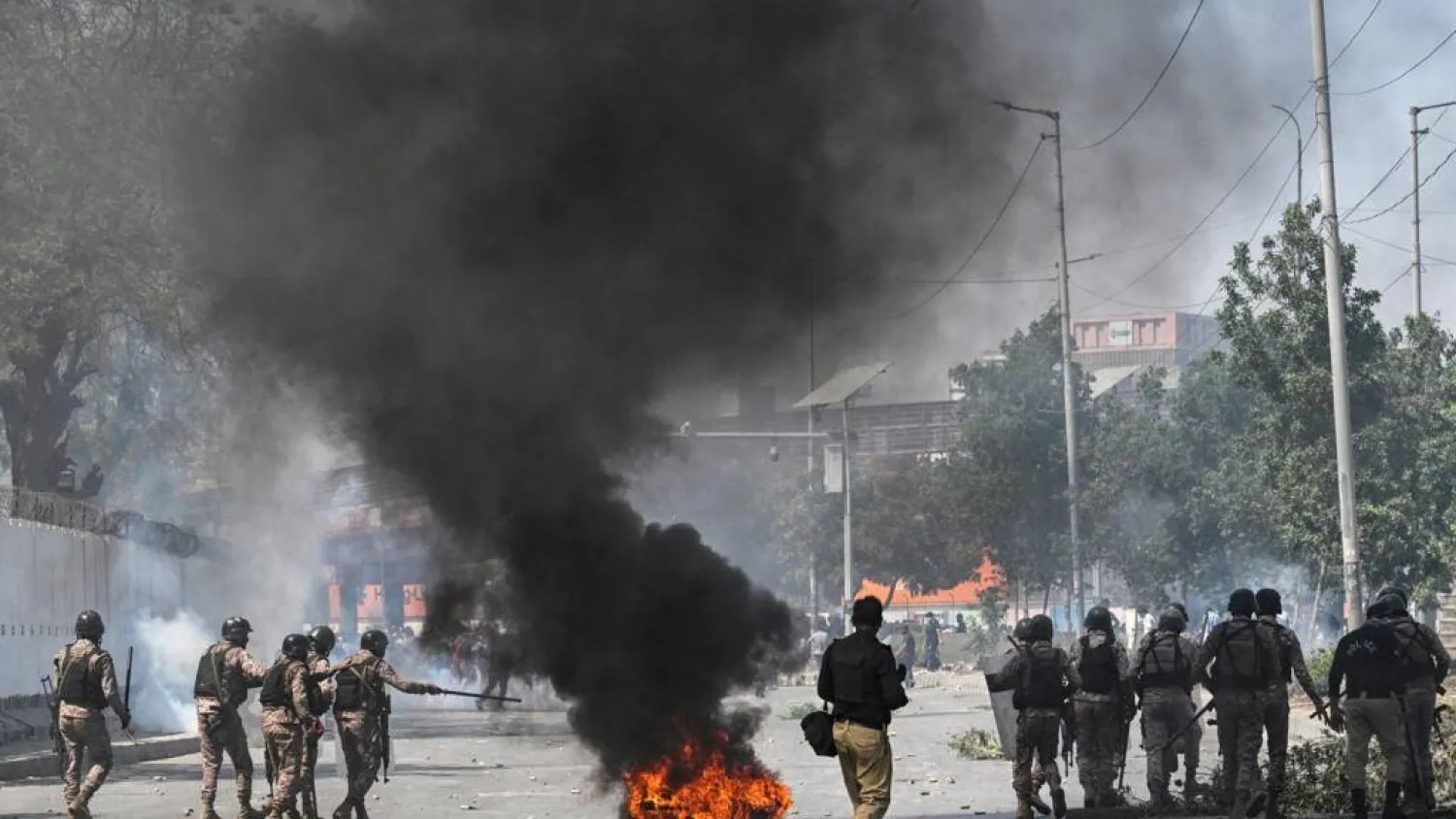
Security personnel fire tear gas as Shiite Muslims shout slogans during a protest outside the US consulate in Karachi after the death of Iran's supreme leader Ali Khamenei amid US-Israel strikes. Asif HASSAN / AFP
TT

At Least 25 Killed at Pakistan's Pro-Iran Weekend Protests

Security personnel fire tear gas as Shiite Muslims shout slogans during a protest outside the US consulate in Karachi after the death of Iran's supreme leader Ali Khamenei amid US-Israel strikes. Asif HASSAN / AFP

The death toll from Pakistan's violent weekend protests over the killing of Iran's supreme leader has reached at least 25, according to an AFP tally on Monday.

Demonstrations erupted in several major cities in Pakistan, including the southern megacity of Karachi where some protesters attempted to storm American diplomatic buildings.

An AFP journalist witnessed hundreds of pro-Iranian protesters trying to enter the United States consulate, prompting clashes with police.

At least 10 deaths were reported and over 70 were injured, the office of the Karachi police surgeon said, while a hospital toll seen by AFP listed nine people as having died from gunshot wounds.

In Pakistan's northern Gilgit-Baltistan region, at least 13 people were killed in clashes between protesters and police, officials said.

Seven people were killed in Gilgit, a rescue official said, while six others died in Skardu, a doctor told AFP on Monday.

Authorities have imposed a late-night curfew, which will remain in place until Wednesday in Gilgit and Skardu, where the army has been deployed on the streets.

Two more people were killed as thousands of people gathered in the streets of the capital, Islamabad, many holding photos of the late Iranian leader Ali Khamenei.

AFP journalists saw police firing tear gas to disperse crowds near the diplomatic enclave housing the US embassy on Sunday afternoon.

- 'Grief and sorrow' -

Israel and the United States launched their military operations on Iran early Saturday, quickly killing the long-ruling supreme leader and prompting outrage in neighboring Pakistan.

Pakistan's Prime Minister Shehbaz Sharif, who has close ties with both the United States and Iran, said on Sunday evening that the killing of Khamenei was a "violation" of international law.

"It is an age old convention that the Heads of State/Government should not be targeted," Sharif wrote on X.

The "people of Pakistan join the people of Iran in their hour of grief and sorrow and extend the most sincere condolences on the martyrdom" of Khamenei, he added.

At Sunday's Karachi protest, people chanted slogans against the United States, Israel and their allies.

"We don't need anything in Pakistan that is linked with the US," a protester, Sabir Hussain, told AFP.

Earlier a crowd of young people climbed over the main gate and gained access to the driveway of the consular building, smashing some windows.

Police fired tear gas at the protesters, who dispersed, the AFP journalist saw.

The embassies of the United States and Britain both urged citizens in Pakistan to be cautious in the country.



UN Agency: Transport of Dead Bodies Within Congo Risks Further Ebola Spread

FILE PHOTO: A health worker in personal protective equipment stands near displaced people waiting for the burial of suspected Ebola victims at the Kigonze displaced persons camp, one month after an outbreak was declared, in Bunia, eastern Democratic Republic of Congo, June 18, 2026. REUTERS/Gradel Muyisa Mumbere//File Photo/File Photo
TT

UN Agency: Transport of Dead Bodies Within Congo Risks Further Ebola Spread

FILE PHOTO: A health worker in personal protective equipment stands near displaced people waiting for the burial of suspected Ebola victims at the Kigonze displaced persons camp, one month after an outbreak was declared, in Bunia, eastern Democratic Republic of Congo, June 18, 2026. REUTERS/Gradel Muyisa Mumbere//File Photo/File Photo

The transport of Ebola victims' bodies between different areas of the Democratic Republic of Congo, often for funerals in their home communities, risks further spreading the virus, the UN migration agency said on Friday.

More than 2,000 Ebola cases and 700 deaths have been recorded in Congo and neighboring Uganda as of July 14, and around two-thirds of the deaths occurred outside clinics or ⁠hospitals, said the International ⁠Organization for Migration.

The often fatal viral disease spreads through direct contact with bodily fluids from infected people or animals, and causes symptoms that can include high fever, vomiting and internal and external bleeding. This ⁠particular epidemic is caused by the Bundibugyo strain of the virus.

Ebola remains highly infectious after death, making funeral practices a critical component of outbreak control.

"If we don't really manage the dead bodies well, if we don't engage the community ... then it means there will be more spread within the community," Reuters quoted Andrew Mbala from IOM as saying.

IOM officials said the ⁠transport ⁠of bodies across districts within Congo was a particular challenge as families seek to bury relatives in their home communities.

"There hasn't been any crossing of dead bodies to another country, but we have seen a lot of crossings of dead bodies within the country," said Mbala.

Such movement risks carrying the virus into new areas if bodies are not handled safely, the IOM warned.


China Warns of Reciprocal Countermeasures after US Shortens Foreign Journalist Visas

FILE PHOTO: A truck loaded with bicycles drives out of a collection area for shared bicycles near Beijing's Central Business District (CBD), China, July 6, 2026. REUTERS/Maxim Shemetov/File Photo/File Photo
TT

China Warns of Reciprocal Countermeasures after US Shortens Foreign Journalist Visas

FILE PHOTO: A truck loaded with bicycles drives out of a collection area for shared bicycles near Beijing's Central Business District (CBD), China, July 6, 2026. REUTERS/Maxim Shemetov/File Photo/File Photo

The Trump administration announced Thursday it will drastically shorten visas for foreign journalists in the US to 240 days, down from years, and cut those for Chinese journalists to only 90 days, raising concerns over press freedom in the United States and prompting China to warn of possible reciprocal countermeasures.

The rule announced by the Department of Homeland Security will do away with the “duration of status” system, which allows foreign journalists to stay and work in the United States as long as they meet eligibility requirements.

That will be replaced with a fixed period of time, though the visas may be extended.

The agency says it's necessary to better vet the visa holders. But advocates for foreign journalists oppose the change, saying the drastically shorter stay would severely restrict their ability to live and work in the States.

The even shorter visa rule for Chinese journalists, which does not include those from the “special administrative regions” of Hong Kong or Macao, is particularly harsh and could add tensions to the already fraught relations between Washington and Beijing, despite both leaders stating they intend to stabilize ties.

The decision comes at a time when President Donald Trump is targeting news organizations with multiple threats and legal actions at home and his administration is tightening immigration policies, though foreign journalists are not considered immigrants.

The rule will take effect 60 days after it’s published in the Federal Register. Congress can reject a rule, but it's extremely rare.

“We are outraged that the Trump administration has cruelly limited the duration of visas for foreign journalists from a period of up to five years to a fixed eight months,” the advocacy group Reporters with Borders said in a statement. “This change destroys international journalists’ ability to report from the US and makes it extremely difficult for international outlets to operate here at all.”

“The relentless cycle of visa renewals restricts press freedom, as journalists will feel compelled to avoid drawing the administration’s ire, lest their applications be rejected,” The Associated Press quoted it as saying.

The Committee to Protect Journalists released a statement calling the new visa policy “the behavior of a backsliding democracy, not the international vanguard of free speech.”

In proposing the change in August 2025, the federal agency said the rising number of foreign journalists in the US “poses a challenge” to its ability “to monitor and oversee these nonimmigrants while they are in the United States.”

It added that students and foreign visitors also will see their previous rule of “duration of status” replaced with fixed periods by the same decision.

By admitting them into the country for a fixed period, the Department of Homeland Security said it could better vet the visa holders to ensure their activities are permissible. The visas can be extended.

The first Trump administration sought to change the visa rules in 2020, but the proposal was withdrawn in 2021 when President Joe Biden took office.

But the White House then tightened visas for Chinese journalists to only 90 days, in response to the treatment of US journalists in China, including the expulsion of three Wall Street Journal reporters, as tensions flared up during the COVID-19 pandemic between the two countries.

The Biden administration later relaxed the rule, allowing stays to increase to up to a year.

When the Trump administration proposed to revive the 90-day rule last year, the Chinese Foreign Ministry said it opposed “the US’s discriminatory move targeting a specific country.”

China warns of reciprocal measures China's Foreign Ministry called the decision “discriminatory” and said it would affect the work of Chinese media in the US.

“China urges the US to immediately revoke its discriminatory policies targeting Chinese journalists and effectively safeguard their lawful rights and interests in the US,” said Foreign Ministry spokesperson Lin Jian at a daily briefing in Beijing.

He added that “China reserves the right to take reciprocal countermeasures.”


Russian Strikes Kill 4 in Ukraine as Zelenskyy’s Defense Shake-up Sparks Anger

 A resident looks at the destruction following a Russian missile attack in Odesa, Ukraine, Friday, July 17, 2026. (AP)
A resident looks at the destruction following a Russian missile attack in Odesa, Ukraine, Friday, July 17, 2026. (AP)
TT

Russian Strikes Kill 4 in Ukraine as Zelenskyy’s Defense Shake-up Sparks Anger

 A resident looks at the destruction following a Russian missile attack in Odesa, Ukraine, Friday, July 17, 2026. (AP)
A resident looks at the destruction following a Russian missile attack in Odesa, Ukraine, Friday, July 17, 2026. (AP)

Russian attacks on Ukraine overnight killed at least four civilians and wounded 20 other people, President Volodymyr Zelenskyy said, as he faces a political crisis after firing his popular defense minister.

Zelenskyy’s major reshuffle of his government on Thursday, which included the appointment of a new prime minister, unsettled the country’s military leadership and trigged a public outcry. It was an unwelcome difficulty after Ukraine has gained traction in its fight against Russia’s more than four-year-old invasion.

The surprise departure from the defense ministry of Mykhailo Fedorov, a youthful and popular member of the government, saw thousands of people demonstrate against his dismissal in cities across Ukraine on Thursday. Further street protests were expected on Friday.

Fedorov, 35, who was in the post for just six months, is widely seen as the driving force behind Ukraine’s swift and successful technological innovation and other measures, such as fighting military corruption, that have brought fresh hope in the war for Ukrainians.

Relations between Fedorov and Gen. Oleksandr Syrskyi, the commander of Ukraine’s armed forces who started his military career in the former Soviet Union, had broken down, according to Zelenskyy, and made Fedorov’s position untenable.

Zelenskyy said he had asked Maj. Gen. Yevhen Khmara, acting head of the state’s security service and a highly regarded special operations expert, to take over the defense minister’s duties.

Zelenskyy said late Thursday he would ask Parliament to formally approve Khmara’s appointment as defense minister, as required by law. That step could be held up by bureaucratic hurdles, however. Ukrainian law requires the defense minister to be a civilian, so a serving soldier or security service officer must leave active service before being formally appointed. Also, lawmakers will be on summer recess through mid-August.

Khmara has been in charge of the SBU security service since January. He had previously led the SBU’s elite Alpha special forces unit and is known for being an architect of Operation Spiderweb, one of Ukraine’s most spectacular attacks when it struck Russian air bases last year. He joined the Alpha unit in 2011 and became its commander in 2023 before being promoted to major general the following year.

Moscow’s response to its battlefield difficulties and Ukraine’s targeting of Russian oil facilities, which has caused severe fuel shortages, has focused in part on relentless strategic bombing of civilian areas of Ukraine.

Two people were killed and 10 others injured, including children, in an overnight Russian missile attack on Ukraine’s southern port city of Odesa, regional military administration head Oleh Kiper said. One of those killed was a woman who had been walking in a park with her children, who survived, he said.

In the Zaporizhzhia region, two people were killed and five more were injured in a strike, according to Zelenskyy. He said three people were injured as a result of Russian shelling in the northeastern Kharkiv region.

Officials said more people were injured in Russian strikes on five other regions of Ukraine.

Meanwhile, Russia’s Defense Ministry said that air defenses downed 243 Ukrainian drones overnight into Friday.

Three civilians were killed and seven others injured in Ukrainian drone attacks over the previous 24 hours, according to Vladimir Saldo, the Moscow-appointed head of the Russia-occupied part of Ukraine's Kherson region.