


Türkiye Says Making ‘Intense’ Efforts to End Middle East War

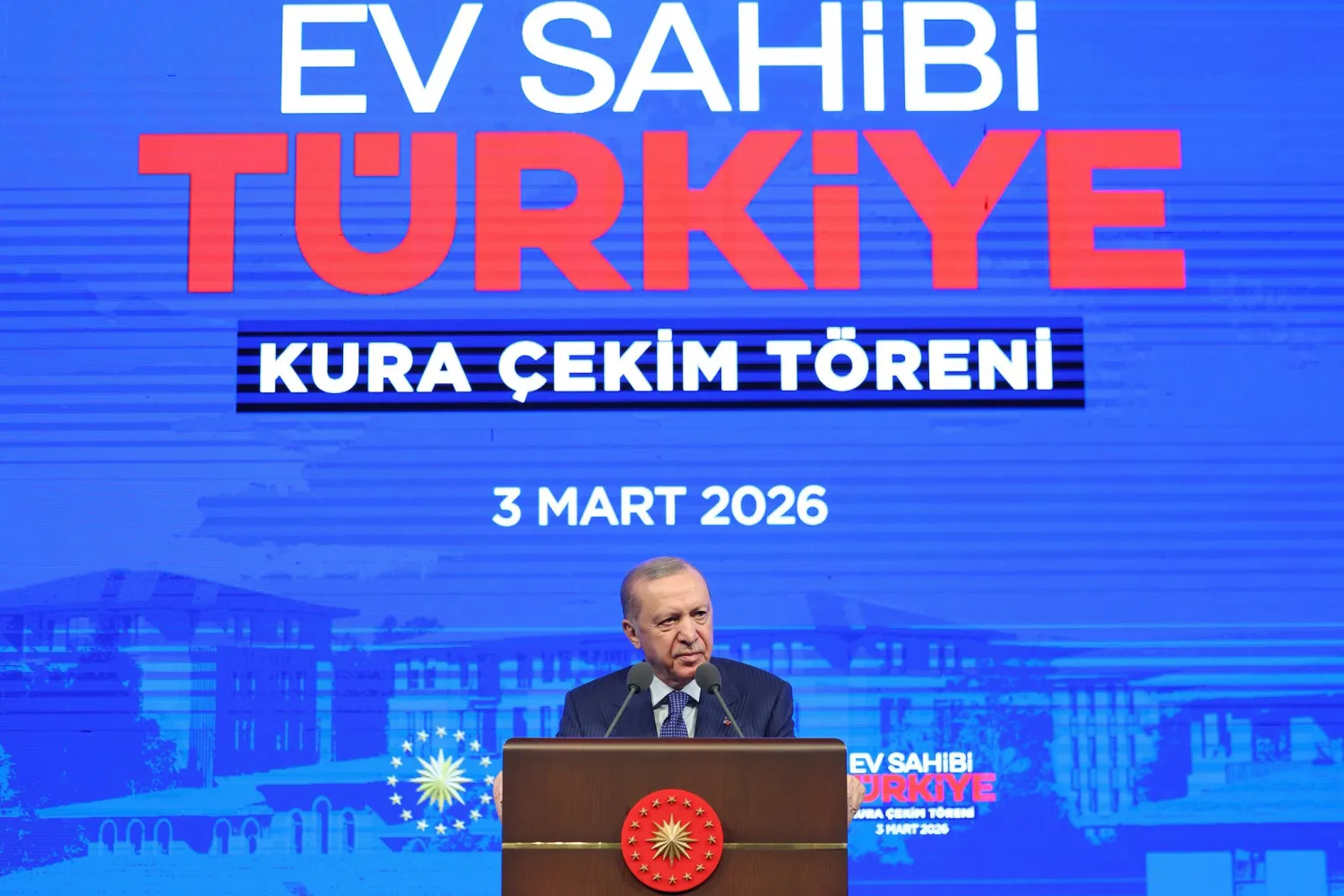
03 March 2026, Türkiye, Ankara: Türkiye’s President Recep Tayyip Erdogan speaks during the lottery ceremony for a social housing project in Ankara. (Turkish Presidency/dpa)
TT

Türkiye Says Making ‘Intense’ Efforts to End Middle East War

03 March 2026, Türkiye, Ankara: Türkiye’s President Recep Tayyip Erdogan speaks during the lottery ceremony for a social housing project in Ankara. (Turkish Presidency/dpa)

President Recep Tayyip Erdogan said Tuesday Türkiye was making "intense" diplomatic efforts to end the conflict roiling the Middle East, sparked by the Israeli-US strikes on Iran. 

"Attacks on Iran, and missile and kamikaze drone attacks (by Iran) on neighboring countries in the Gulf have fueled instability," he said in a televised address. 

"Through peace-oriented diplomacy, we are making intense efforts to resolve issues at the negotiating table," he added. 

Earlier, Foreign Minister Hakan Fidan met Washington's Syria envoy Tom Barrack, ministry sources said. 

He also spoke with his UK counterpart Yvette Cooper to discuss "the current security environment in the region", evaluating "in detail" the "diplomatic efforts that could be undertaken to end the hostilities and establish stability". 

He also discussed regional developments with Qatar's Prime Minister Sheikh Mohammed bin Abdulrahman Al Thani, with his Greek counterpart Giorgos Gerapetritis and with Nechirvan Barzani, president of Iraq's autonomous Kurdistan region. Fidan said Ankara was also in talks with Oman. 

The United States and Israel launched strikes against Iran on Saturday. The war quickly widened with Tehran striking Gulf states that host US bases and Israel attacking Iranian-backed Hezbollah targets in Lebanon.  

Türkiye, a NATO member and neighbor of Iran, had for weeks urged Washington and Tehran to reach an agreement during ‌their rounds of negotiations ‌over Iran's nuclear program and missile capabilities, warning ‌that ⁠the region could ⁠not handle any more destabilization.  

Fidan told members of Turkish media during a Ramadan fast-breaking dinner on Tuesday that Türkiye was "sensitively carrying out necessary initiatives with all our counterparts" to achieve peace in the region, and added it was critical to preserve the stability of Iran and the region.  

"There isn't a single-layered negotiation, there is a multi-layered negotiation," Fidan ⁠said, according to a transcript of his comments shared ‌on Tuesday.  

"We have been talking ‌to the Europeans for a few days... If you want peace, let's work ‌together. We are urging them to take action. The Gulf ‌nations are now facing a serious situation," he said.  

"We are talking to the Omani (foreign minister). Oman is also still trying to do something there. We are talking to the Americans," he said. 

Fidan warned ⁠against the ⁠conflict engulfing the whole region and affecting energy supplies. He added that the closure of the Hormuz Strait, where one-fifth of global oil trade skirts Iran's coast, could "push the United States to obtain a quick result".  

He said Iran was trying to "create costs" for the US and its partners by attacking Gulf states and energy infrastructure, but added that he didn't believe Tehran could obtain the desired result that way.  

"By bombing these places, Iran will say they should pressure the United States and end the war, but that doesn't seem like it will happen. I don't know how much Iran has left," he said, adding that Tehran could instead "bother" Israel with missile strikes. 


Trump Says He Ordered Strike on Iran Over Attack Fears

US President Donald Trump holds a bilateral meeting with German Chancellor Friedrich Merz (not pictured) in the Oval Office at the White House in Washington, DC, USA, 03 March 2026. (EPA)
TT

Trump Says He Ordered Strike on Iran Over Attack Fears

US President Donald Trump holds a bilateral meeting with German Chancellor Friedrich Merz (not pictured) in the Oval Office at the White House in Washington, DC, USA, 03 March 2026. (EPA)

President Donald Trump said on Tuesday he ordered US forces to join Israel's attack on Iran because he believed Iran was about to strike the United States, his latest explanation amid conflicting accounts from the administration of how the war started.

"I might have forced their (Israel’s) hand," Trump told reporters in the Oval Office as he met with German Chancellor Friedrich Merz. "We were having negotiations with these lunatics, and it was my opinion that they were going to attack first. If we didn't do it, they were going to attack first. I felt strongly about that."

Trump's comments about the run-up to the war were at odds with an ‌earlier account from ‌Secretary of State Marco Rubio, who told reporters on ‌Monday ⁠that the United ⁠States launched the attack because of fears that Iran would retaliate in response to planned Israeli action against Tehran.

"We knew that there was going to be an Israeli action, we knew that that would precipitate an attack against American forces, and we knew that if we didn’t preemptively go after them before they launched those attacks, we would suffer higher casualties," Rubio said.

Trump on Tuesday said he ⁠believed Iran was on the brink of launching attacks, presenting ‌no evidence to support his view, after US ‌negotiations with Iran last Thursday in Geneva. Iran had described those talks as positive ‌with more planned in the days ahead.

"It's something that had to be ‌done," Trump said, taking questions from reporters in a public setting for the first time since the US attacks began. He previously had discussed the attacks in two brief videos and one-on-one interviews with select journalists over the weekend but did not give a ‌televised address to the nation.

Trump also said on Tuesday he could live with higher oil prices for a period of ⁠time because ⁠it was more important to remove what he said was an imminent threat from Iran. Gasoline prices in the United States have jumped as a result of uncertainty about oil supplies with the conflict showing no signs of ending soon.

Trump described the war effort as successful thus far against many Iranian naval and air targets. "Just about everything has been knocked out," he said.

Iran has responded to the attack by firing missiles and drones at neighboring Arab states and strangling shipping through the Strait of Hormuz, a key waterway for energy trade.

But Trump predicted Tehran will eventually lose its capability to continue lobbing missiles due to a sustained assault against them.

"They've shot a lot of them, and we're knocking out a lot," he said.


Russian, Iranian Foreign Ministers Discuss US, Israeli Strikes on Iran

 Russia's Foreign Minister Sergei Lavrov speaks during a joint press conference with Brunei's Second Minister of Foreign Affairs after their talks at Zinaida Morozova's Mansion in Moscow on March 3, 2026. (AFP)
Russia's Foreign Minister Sergei Lavrov speaks during a joint press conference with Brunei's Second Minister of Foreign Affairs after their talks at Zinaida Morozova's Mansion in Moscow on March 3, 2026. (AFP)
TT

Russian, Iranian Foreign Ministers Discuss US, Israeli Strikes on Iran

 Russia's Foreign Minister Sergei Lavrov speaks during a joint press conference with Brunei's Second Minister of Foreign Affairs after their talks at Zinaida Morozova's Mansion in Moscow on March 3, 2026. (AFP)
Russia's Foreign Minister Sergei Lavrov speaks during a joint press conference with Brunei's Second Minister of Foreign Affairs after their talks at Zinaida Morozova's Mansion in Moscow on March 3, 2026. (AFP)

Russian Foreign Minister Sergei Lavrov spoke by phone on Tuesday with his Iranian counterpart Abbas ‌Araqchi, Russia's ‌Foreign Ministry ‌said.

The ⁠ministers discussed the ⁠development of the situation in the region "resulting from the ⁠unprovoked armed ‌aggression ‌by the United ‌States and ‌Israel against Iran," the ministry said.

Lavrov reiterated ‌Russia's call for de-escalation, rejected the ⁠use ⁠of force and urged a political and diplomatic resolution, saying Moscow stood ready to help.


Israel, US Strikes Hit Building of Body to Elect New Iran Supreme Leader

A plume of smoke rises following a US-Israeli military strike in Tehran, Iran, Tuesday, March 3, 2026. (AP)
TT

Israel, US Strikes Hit Building of Body to Elect New Iran Supreme Leader

A plume of smoke rises following a US-Israeli military strike in Tehran, Iran, Tuesday, March 3, 2026. (AP)

Israeli and US strikes on Tuesday hit the building of a body tasked with electing Iran's new supreme leader, local media reported.

Former leader Ali Khamenei was killed during a wave of US-Israeli attacks on Saturday.

"The American-Zionist criminals attacked the Assembly of Experts building in Qom," south of Tehran, according to the Tasnim news agency.

The assembly is tasked with appointing, supervising and potentially dismissing the supreme leader.

Local media showed footage of the building severely damaged in the strikes.

There was no information on any potential casualties.

The Mehr news agency reported that the building was no longer being used for meetings.

Tasnim reported that strikes had already targeted the main headquarters of the Assembly of Experts in Tehran on Monday.

Iran declared on Sunday the start of a transition process after confirming Khamenei's death.

The plans include the formation of an interim leadership council including the president, the head of the judiciary and a jurist from the Guardian Council, the body that oversees legislation and vets electoral candidates.

Also playing a central role is Iran's top security chief Ali Larijani.

The interim leadership council will lead the country while a permanent successor is found for the supreme leader.
