

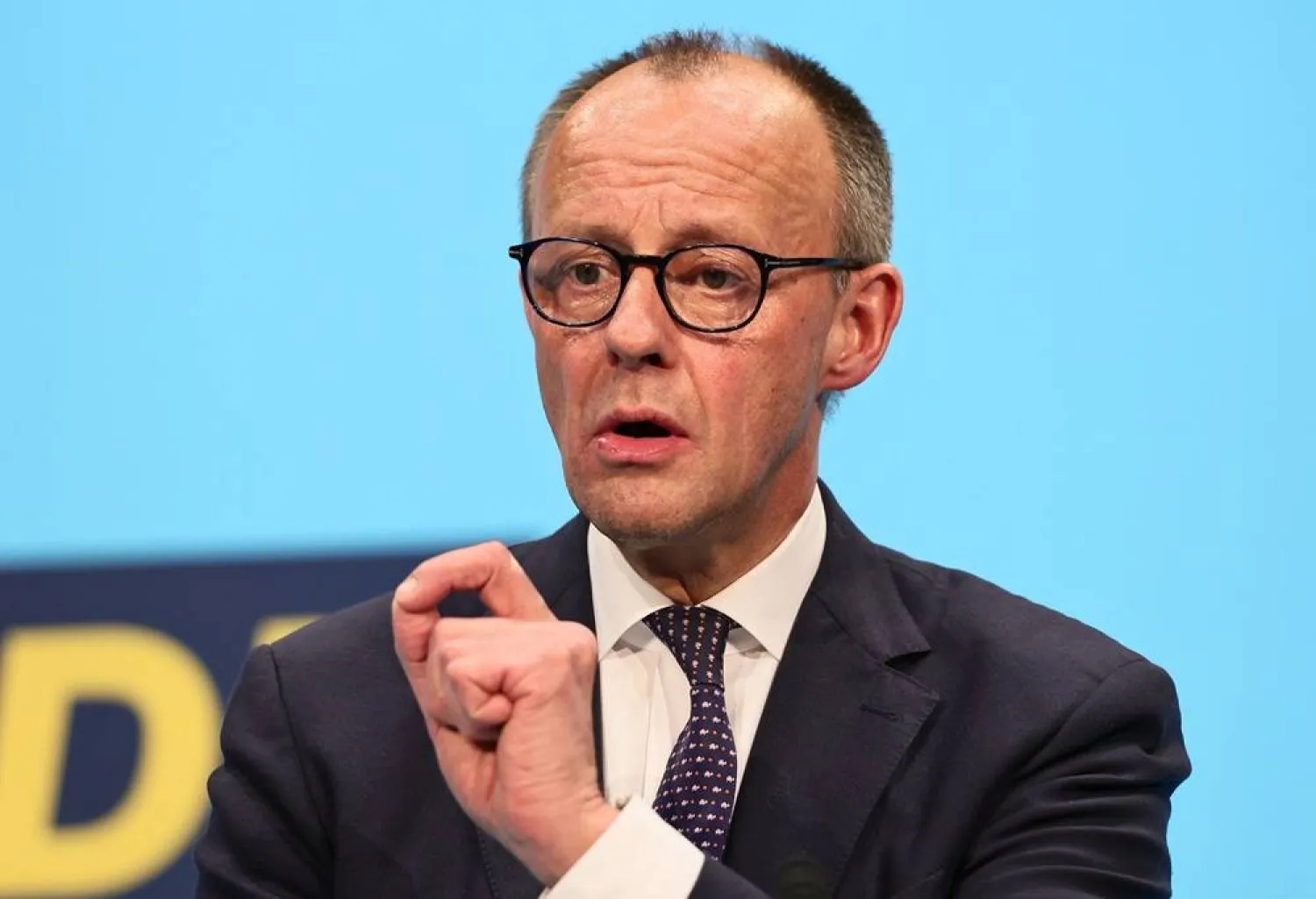

Merz Warns Against Iran State Collapse, Refugee Flows

German Chancellor Friedrich Merz delivers a speech during a campaign event of the Christian Democratic Union (CDU) party for the state election of Baden-Wuerttemberg in Stockach, Germany, 06 March 2026. (EPA)
TT

Merz Warns Against Iran State Collapse, Refugee Flows

German Chancellor Friedrich Merz delivers a speech during a campaign event of the Christian Democratic Union (CDU) party for the state election of Baden-Wuerttemberg in Stockach, Germany, 06 March 2026. (EPA)

German Chancellor Friedrich Merz said Friday the Middle East war must not lead to the collapse of the Iranian state, warning of the impact this would have on migration to Europe.

"An endless war is not in our interest. The same applies to a collapse of Iranian statehood or proxy conflicts fought on Iranian soil," he said in a statement.

"Such scenarios could have far-reaching consequences for Europe, including for security, energy supply and migration."

He added that "we share the goals of the United States and Israel regarding the Iranian nuclear and missile program, Tehran's threats against Israel, and its support for terrorism and proxies.

"The Iranian people have the right to freely decide their own destiny."

He warned against chaos, a point he also stressed speaking at a trade fair in Munich.

Germany and its European allies were "pushing hard for Iran's sovereignty to be preserved", he said there.

"We do not want to see a Syrian scenario here," he added.

"I am appealing both in Washington and in all talks with the Israeli government to create the conditions for this country to be stabilized as quickly as possible."

Merz said that "we naturally have a strong interest in this ourselves in order to avoid new waves of refugees from the region".

The United Nations refugee agency on Friday declared the Middle East war a major humanitarian emergency and insisted all fleeing civilians should be granted safe passage.

UNHCR said the war -- which began on Saturday when Israel and the United States launched strikes on Iran and has spread across the region since -- had already caused large numbers of people to flee their homes.

German Foreign Minister Johann Wadephul said Berlin would provide 100 million euros ($116 million) in humanitarian aid for Lebanon, which became engulfed in the war after the Iran-backed group Hezbollah on Monday fired missiles at Israel to avenge the death of Iranian supreme leader Ali Khamenei.

"We are currently seeing a new dynamic and a dramatic situation in Lebanon with many internally displaced persons, and we want to help throughout the region in order to provide assistance on the ground," Wadephul said.



Israel Army Says Iran Using Cluster Munitions

An Iranian missile with cluster munitions flies towards Israel, amid the US-Israeli conflict with Iran, in central Israel, March 5, 2026. (Reuters)
TT

Israel Army Says Iran Using Cluster Munitions

An Iranian missile with cluster munitions flies towards Israel, amid the US-Israeli conflict with Iran, in central Israel, March 5, 2026. (Reuters)

Israel's military Friday said that Iran had launched cluster bombs "multiple times" since the start of the war that began with a US-Israeli attack on the country last week.

"They (the Iranians) are using cluster munitions", military spokesman Lieutenant Colonel Nadav Shoshani said during a press briefing, without providing details on when and where those munitions were launched.

"They've used it multiple times, which is a war crime when it's directed towards civilians and we're tracking that situation," Shoshani added.

Neither Iran nor Israel are among more than a hundred countries that are party to the 2008 Convention on Cluster Munitions, which prohibits the use, transfer, production and storage of cluster bombs.

AFP footage from Thursday evening showed a swarm of flaming projectiles falling in the darkened sky over central Israel.

Police did not comment on the sighting, but a military expert who reviewed the footage for AFP identified them as a part of a cluster bomb.

Israel's police had said Wednesday that bomb disposal experts found evidence of cluster munitions after incoming missiles from Iran were detected.

Due to military censorship rules in place in Israel since the start of its war with Iran, impact sites are generally closed to the public including journalists until they are cleared of Iranian missile debris and unexploded ordnances.

Police on Friday also published a public service announcement in which one of its bomb disposal technicians explained the dangers of cluster bombs.

"During the current war, the home front is facing a variety of threats, whether missiles, UAVs (drones), or rockets. I will talk to you about a threat that is a bit less known, but no less dangerous: the cluster munition threat," the technician said in the video.

During Israel's 12-day war with Iran in June 2025, the NGO Amnesty International reported Tehran’s use of widely banned cluster munitions.

The organization had said it analyzed photos and videos showing cluster munitions that, according to media reports, struck inside the Gush Dan metropolitan area around Tel Aviv on June 19.

The southern city of Beersheva on June 20 and Rishon LeZion to the south of Tel Aviv on June 22 were also "struck with ordnance that left multiple impact craters consistent with the submunitions seen in Gush Dan", Amnesty said.

Cluster munitions explode in mid-air and scatter bomblets.

Some of them may not explode on impact and can cause casualties over time, particularly among children.


Zelensky Visits Frontline Donetsk Region in East Ukraine

This handout photograph taken and released by the Ukrainian Presidential Press Service on March 6, 2026, shows Ukrainian President Volodymyr Zelensky (C) posing for a photo with Ukrainian servicemen while visiting the command post of the 3rd Battalion of the 28th Separate Mechanized Brigade named after the Knights of the Winter Campaign near Druzhkivka, Donetsk region, amid the Russian invasion of Ukraine. (Handout / Ukrainian Presidential Press Service / AFP)
TT

Zelensky Visits Frontline Donetsk Region in East Ukraine

This handout photograph taken and released by the Ukrainian Presidential Press Service on March 6, 2026, shows Ukrainian President Volodymyr Zelensky (C) posing for a photo with Ukrainian servicemen while visiting the command post of the 3rd Battalion of the 28th Separate Mechanized Brigade named after the Knights of the Winter Campaign near Druzhkivka, Donetsk region, amid the Russian invasion of Ukraine. (Handout / Ukrainian Presidential Press Service / AFP)

Ukrainian President Volodymyr Zelensky visited the frontline region of Donetsk in east Ukraine, where his forces are fighting against a grinding Russian assault, he said Friday.

The visit comes as Ukraine seeks to strengthen its frontline defenses.

The Russian army recorded its slowest advance on the front in nearly two years in February, as Kyiv successfully pushed back in some areas, according to data from the Institute for the Study of War.

"The Russians are not abandoning the war, and here, in the Donetsk region, they are preparing an offensive for the spring," Zelensky said in a post on X.

"It is important that our positions are strong," he added.

He posted a video that appeared to show him in Druzhkivka -- a town that lies about 15 kilometers (nine miles) from the front with Russia's troops, which has come under regular Russian shelling.

During the visit he also handed out awards to soldiers, he said in a separate Facebook post.

"The stronger we are here, the stronger we are in the negotiation process," he said.

Zelensky has made frequent visits to the front since Russia invaded in February 2022.


Trump Says Only Iran’s ‘Unconditional Surrender’ Can End War

Smoke rises after an airstrike in central Tehran, Iran, 06 March 2026. (EPA)
TT

Trump Says Only Iran’s ‘Unconditional Surrender’ Can End War

Smoke rises after an airstrike in central Tehran, Iran, 06 March 2026. (EPA)

President Donald Trump said Friday that only Iran's "unconditional surrender" would bring an end to the Middle East war, as Tehran was rocked by some of the heaviest US-Israeli strikes of the spiraling, week-long conflict.

Now in its seventh day, the war has embroiled nations beyond the region, upended the world's energy and transport sectors, and brought chaos to even usually peaceful areas around the Gulf.

It has spread to Lebanon, whose prime minister warned of an impending humanitarian disaster as tens of thousands fled heavy Israeli strikes on Beirut's southern suburbs.

Trump, who has given varying reasons for starting the war that killed Iran's supreme leader Ali Khamenei last weekend, promised to help rebuild the country's economy if Tehran installed an "acceptable" new leader.

"There will be no deal with Iran except UNCONDITIONAL SURRENDER," Trump wrote on his Truth Social platform.

"MAKE IRAN GREAT AGAIN (MIGA!)," he added.

In Tehran, crowds of men and women dressed in black, some carrying Iranian flags, gathered for the first Friday prayers since the start of the war, online footage showed.

Several loud explosions sent clouds of black smoke into Tehran's sky, according to AFP journalists who described the day's strikes as the heaviest yet on the capital.

"It's really very scary," a Tehran businessman who gave his first name as Robert told AFP.

"Checkpoints have been put up in place in the city to prevent looting and ensure control," the 60-year-old said at the Armenian border with Iran.

- 'Additional surprises' -

Both Israel and the US warned on Friday they were escalating their attacks on Iran.

"We have additional surprises ahead which I do not intend to disclose," Israel's military chief Lieutenant General Eyal Zamir said.

According to Iran's health ministry, the US and Israeli strikes on the country have killed 926 people.

Iranian government spokeswoman Fatemeh Mohajerani said on Friday that 30 percent of the dead were children. AFP could not independently verify either toll.

Iran has launched missile and drone attacks at Israel and Gulf states since the war began, with AFP journalists in Tel Aviv reporting hearing several blasts on Friday.

In Israel, at least 10 people have been killed, according to first responders there.

The US military has reported the deaths of six of its personnel.

- 'We'll sleep on the road' -

The conflict has sucked in Israel's neighbor Lebanon after Tehran's proxy group Hezbollah launched missiles at Israel.

Israeli air strikes hit sites in Lebanon's south and east on Friday.

There has been widespread destruction in the southern Beirut suburbs, considered a Hezbollah stronghold and home to an estimated 600,000 to 800,000 people.

AFP correspondents on the ground saw scenes of panic on Thursday as residents massively fled after an unprecedented Israeli order to evacuate immediately if they wanted to save their lives.

Hundreds of families milled around on a Beirut beach, left with nowhere to go.

"We'll sleep on the road tonight and God alone knows what will happen to us," one man told AFP, declining to give his name.

Lebanon's Prime Minister Nawaf Salam warned that a "humanitarian disaster is looming" from the displacement.

On Friday, Hezbollah told Israeli residents to evacuate areas within five kilometers (three miles) of the Lebanese border.

The death toll in Lebanon rose to 217 on Friday, according to the country's health ministry.

Israel's army meanwhile said it had killed more than 70 Hezbollah militants.

AFP could not independently verify either toll.

Iraq, long a proxy battleground between the US and Iran, has also been dragged into the war. Drones struck an airport and two oil facilities in southern Iraq on Friday, a security official told AFP.

Earlier in the day, oil prices surged after Kurdish authorities in Iraq said crude production had been halted by a previous attack.

- 'Extraordinary mistake' -

The United Nations refugee agency said Friday it had declared the crisis a major humanitarian emergency, stressing the need for an immediate response.

The UN's rights chief also called for "impartial investigations" after Iran said a strike on a school that it blamed on the US and Israel killed more than 150 people.

Neither the US nor Israel has said it was behind the strike. US Secretary of State Marco Rubio said Monday that the Pentagon was investigating.

AFP has neither been able to access the site nor obtain independent confirmation of the toll.

The war has also come under increasing scrutiny in Europe, with Spanish Prime Minister Pedro Sanchez calling the US-Israeli strikes an "extraordinary mistake" and "not in accordance with international law".

European Union chiefs are scheduled to hold talks about the war on Monday.

The war has not spared the rich countries of the Gulf, formerly seen as a tourist hot spot and a rare Middle East safe haven.

Qatar intercepted a drone attack on a US air base on its territory early Friday, while Saudi Arabia shot down three drones east of its capital Riyadh.

Thirteen people, seven of them civilians, have been killed in Gulf countries since the war began, including an 11-year-old girl in Kuwait.

New explosions were heard in the Kuwaiti capital on Friday, an AFP journalist said.

The conflict has also expanded as far afield as the Sri Lankan coast, off of which a US submarine torpedoed an Iranian frigate, and Azerbaijan, which threatened retaliation after a drone hit an airport.

Nations have scrambled to repatriate holidaymakers in the Gulf caught up in the fighting, with air traffic severely limited as missiles and drones dominate the skies above the region.

The war has also hammered global markets and sent crude oil prices soaring by about a fifth in the week since it erupted, all but blocking shipping in the critical Strait of Hormuz.

A fire broke out on the latest ship to suffer an attack in the Strait on Friday, Iranian television reported.