
Europe Rallies Around Cyprus Days After the Iran War’s First Drone Attack on EU Territory

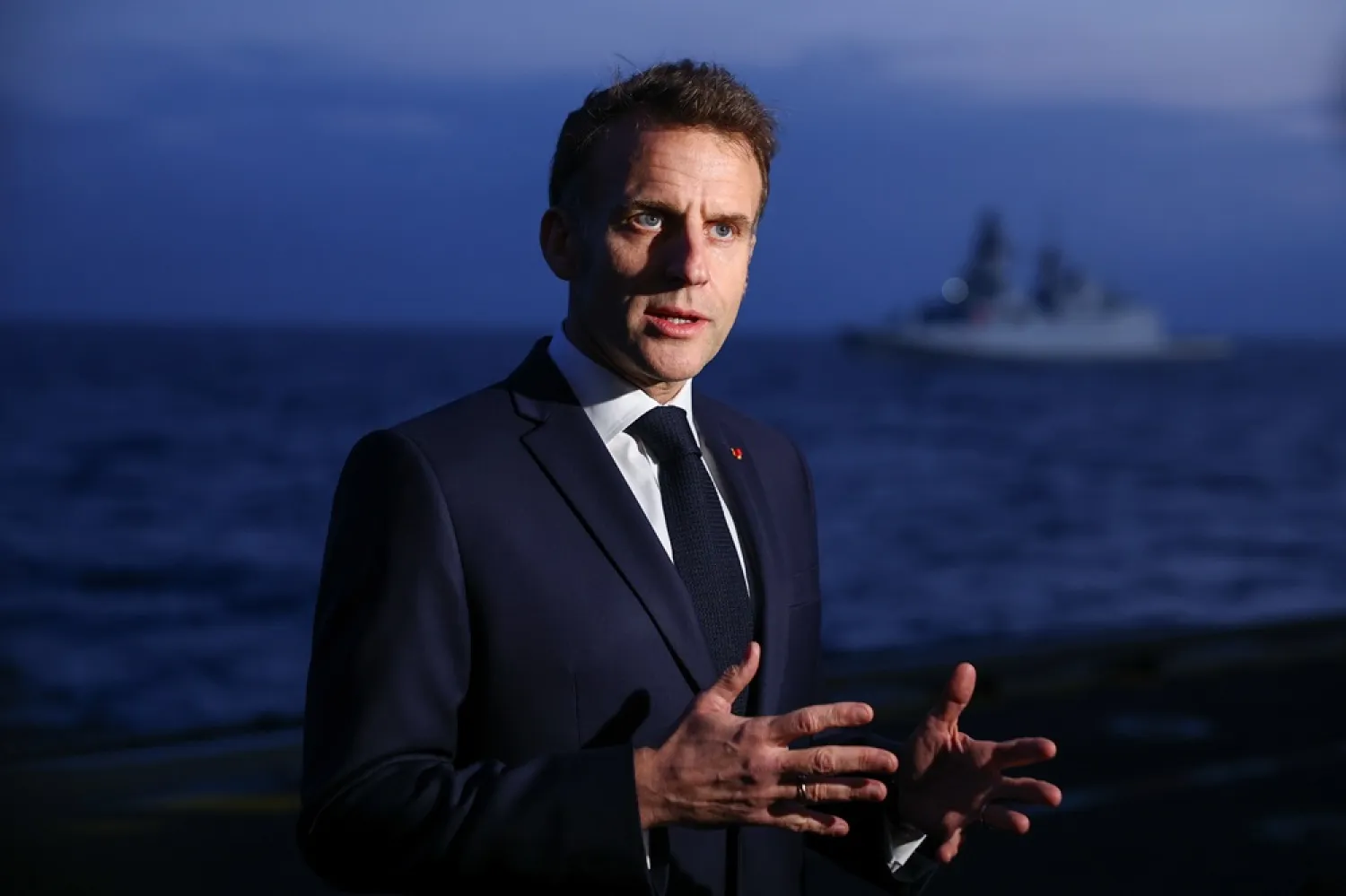
 French President Emmanuel Macron speaks to members of the media as he visits the French aircraft carrier Charles de Gaulle, during his visit to Cyprus, Monday March 9, 2026. (Gonzalo Fuentes/Pool Photo via AP)
French President Emmanuel Macron speaks to members of the media as he visits the French aircraft carrier Charles de Gaulle, during his visit to Cyprus, Monday March 9, 2026. (Gonzalo Fuentes/Pool Photo via AP)
TT

Europe Rallies Around Cyprus Days After the Iran War’s First Drone Attack on EU Territory

 French President Emmanuel Macron speaks to members of the media as he visits the French aircraft carrier Charles de Gaulle, during his visit to Cyprus, Monday March 9, 2026. (Gonzalo Fuentes/Pool Photo via AP)
French President Emmanuel Macron speaks to members of the media as he visits the French aircraft carrier Charles de Gaulle, during his visit to Cyprus, Monday March 9, 2026. (Gonzalo Fuentes/Pool Photo via AP)

French President Emmanuel Macron on Monday pledged to defend Cyprus and dispatch additional warships to the Eastern Mediterranean to strengthen allies' security in the region unsettled by the Iran war. 

Macron said he was visiting Cyprus primarily to show solidarity with the country, where a Shahed drone struck a British air base on the southern coast last week. It was the first drone attack of the war on European territory. 

"When Cyprus is attacked, it is Europe that is attacked," Macron said after talks with his Cypriot counterpart Nikos Christodoulides and Greek Prime Minister Kyriakos Mitsotakis at Cyprus' main air base near the southwestern town of Paphos. "We are bound to one another by strategic partnerships.” 

Macron had ordered the French frigate Languedoc to waters off Cyprus, a fellow European Union member, to bolster its anti-drone and anti-missile defenses. Last week, France also sent ground-based anti-drone and anti-missile defenses. 

Greece has dispatched four F-16 fighter planes to the Paphos air base, and its frigates Kimon and Psara are already patrolling off Cyprus, tasked with intercepting any missiles or drones. 

‘Unprecedented’ show of strength  

Macron said he would deploy eight warships, two helicopter carriers and the nuclear-powered aircraft carrier Charles de Gaulle, equipped with its 20 Rafale fighter jets, to the Eastern Mediterranean and the wider Middle East, calling France's move “unprecedented.” Cyprus and France signed a new strategic partnership in December. 

He briefly visited the French aircraft carrier off Crete, Greece. 

Macron also pointed to a French-led initiative in the works that will involve European and non-European nations helping to escort oil and gas tankers with the aim of gradually reopening the Strait of Hormuz off Iran “as soon as possible after the most intense phase of the conflict is over.” 

Cyprus' leader, Christodoulides, noted: “Our countries have the common belief that the European Union must engage more actively, more strategically and more coherently with the wider region as part of a comprehensive approach." 

The Greek prime minister stressed that any action is purely defensive in posture, adding that "we're not going to accept any part of European territory, like Cyprus, to be exposed to the slightest danger." 

EU leaders seek to contain Middle East conflict  

Macron has been involved in diplomatic talks seeking to avoid further escalation in the Middle East. On Sunday, he spoke to Iranian President Masoud Pezeshkian and urged him to stop strikes. 

Christodoulides has underscored that Cyprus won't take part in any military operation and remains focused on its regional humanitarian role that includes a maritime corridor sending aid to Gaza via the Israeli port of Ashdod. 

The Shahed drone on March 2 caused minor damage to a hangar at the RAF Akrotiri air base. No one was injured. Another two drones were intercepted by British Typhoon and F-35 warplanes that were scrambled from the air base shortly later that day. 

Cyprus officials confirmed last week that the Shahed originated from Lebanon and believe that it was launched by the Iranian-backed Hezbollah group. Hezbollah’s arsenal includes exploding drones, similar to the ones used by Iran. 

Lebanon’s Foreign Minister Youssef Raggi on Sunday condemned the drone attack, adding: “I called on our Cypriot friends not to confuse the Lebanese state with those acting outside its authority and legal framework." 

The Lebanese government has ordered its security agencies to crack down on non-state groups carrying out attacks. 

Macron said France is expending diplomatic capital to ensure a return to calm and to allow for the Lebanese armed forces to assert themselves as Israel pounds Hezbollah positions. 

“Our goal is simple, Hezbollah must cease all strikes from Lebanese territory, because it is putting all Lebanese people in danger,” Macron said, and urged Israel to cease its strikes in Lebanon. 


Hormuz Shipping Traffic Remains Below 10-day Average

FILED - 27 December 2011, ---, --: FILE PHOTO - A satellite picture provided by the National Aeronautics and Space Administration (NASA), shows the Arabian Gulf, the Strait of Hormuz, and the Gulf of Oman. Photo: -/The Visible Earth/NASA/dpa
TT

Hormuz Shipping Traffic Remains Below 10-day Average

FILED - 27 December 2011, ---, --: FILE PHOTO - A satellite picture provided by the National Aeronautics and Space Administration (NASA), shows the Arabian Gulf, the Strait of Hormuz, and the Gulf of Oman. Photo: -/The Visible Earth/NASA/dpa

Commodity vessel transits through the Strait of Hormuz fell to a single digit per day, preliminary shiptracking data showed on Monday, well below a 10-day average of 14.

On Saturday and Sunday, four vessels exited the Gulf through the strait, including a Handysize vessel sailing in ballast, a Handy vessel carrying LPG, a Supramax carrying fertilizer and a Suezmax laden with crude or condensate.

Ten vessels entered the Gulf, including a mini-bulker carrying minor bulk commodities, a Handymax carrying ⁠grain, a Panamax carrying ⁠metals and a Supramax carrying dry bulk cargo, the data showed, according to Reuters.

The figures exclude any vessels that might have crossed the strait with their Automatic Identification System transponders turned off to avoid detection.

A vessel was struck by an unknown projectile while transiting ⁠the Strait of Hormuz, the United Kingdom Maritime Trade Operations said early on Sunday.

It said the crew's status, damage assessment and environmental impact were unknown.

Before the Iran war started on February 28, the strait typically handled about ⁠125 ⁠large, commercial vessels per day, including tankers, gas carriers, bulkers and container vessels, accounting for some 20% of the world’s daily crude oil and liquefied natural gas supply.

A US blockade of Iran-related shipping has halted Iranian crude oil exports since it was reimposed in mid-July.

In the Bab el-Mandeb strait, 24 and 27 commodity vessels travelled through respectively on Saturday and Sunday, tracking data showed, compared with an average of around 27 ships over the last 10 days.


Trump Downplays Report China Gave Iran Intel before Deadly Strike on US Base

US President Donald Trump departs the Aras an Uachtarain in Dublin, Ireland, 12 September 2026. EPA/NEIL HALL
TT

Trump Downplays Report China Gave Iran Intel before Deadly Strike on US Base

US President Donald Trump departs the Aras an Uachtarain in Dublin, Ireland, 12 September 2026. EPA/NEIL HALL

US President Donald Trump on Sunday downplayed reports that Chinese entities supplied Tehran with satellite images of a military base in Jordan before and after an Iranian strike killed three US soldiers.

"You know, when they say that China spies on us, I say you're right, and we spy on them too," Trump told reporters aboard Air Force One a day after The Wall Street Journal reported Beijing's intelligence sharing.

"That's what we do. They basically do what we do," Trump said.

The incident could deepen tensions between Washington and Beijing ahead of a planned state visit by Chinese President Xi Jinping to the White House on September 24.

On July 17, Iran launched missile strikes on the Muwaffaq Salti Air Base in Jordan, which houses US forces. Three US Army soldiers were killed.

Unnamed American officials cited in the Journal's reporting did not name the Chinese entities involved and did not suggest that Beijing was directly to blame.

Chinese officials asked for proof of the transfer of satellite imagery when prodded by the US officials, and refused to acknowledge that Chinese companies were involved in providing Tehran with satellite images, the Journal reported late Friday.

Trump has warned Beijing not to sell weapons to Iran, and in May, Washington sanctioned three China-based satellite companies for enabling Iran's military operations.

China is a top economic partner of Iran, buying much of its oil output, and also an important diplomatic backer.

Still, Trump said of Xi on Sunday that "he's behaved reasonably well, and we behave reasonably well."

Asked if he would ever allow Chinese cars to be sold in the United States, Trump said "I haven't. I'm the one that kept them out. The tariffs kept them out."


Trump Says ‘Very Negative Forces’ Raising Exaggerated Concerns Over AI

 A message reading "AI artificial intelligence", a keyboard, and robot hands are seen in this illustration taken January 27, 2025. (Reuters)
A message reading "AI artificial intelligence", a keyboard, and robot hands are seen in this illustration taken January 27, 2025. (Reuters)
TT

Trump Says ‘Very Negative Forces’ Raising Exaggerated Concerns Over AI

 A message reading "AI artificial intelligence", a keyboard, and robot hands are seen in this illustration taken January 27, 2025. (Reuters)
A message reading "AI artificial intelligence", a keyboard, and robot hands are seen in this illustration taken January 27, 2025. (Reuters)

US President Donald Trump said on Sunday a lot of "very negative forces" are bringing things up about AI that won't happen and said that he wanted to make sure that the United States remains the industry leader.

"We're leading China in AI. We're the most sophisticated country in the world, and frankly I want to keep it that way because whoever wins AI wins," Trump, at ‌his Ireland ‌golf course, told reporters when asked if ‌the ⁠AI industry should ⁠slow down or be more regulated.

"We could put guardrails. We can do this and that. But I think you have a lot of very negative forces that are bringing it up that shouldn't be bringing it up and they're bringing up things that won't happen."

Trump has resisted ⁠stirring concerns about AI.

His latest comments ‌come after a week of ‌concerns in the United States after two Anthropic researchers issued ‌warnings that rapidly progressing artificial intelligence could lead to the ‌extinction of the human race in the not-too-distant future.

In his second term, Trump's administration has largely embraced AI firms. These AI leaders and other technology companies have also supported Trump's initiatives.

Yet, ‌the Pentagon earlier this year warned of risks from Anthropic's model.

After the researcher warnings, ⁠some AI ⁠CEOs are pushing for slowing advancement of the models.

Anthropic CEO Dario Amodei on Saturday outlined a three-step framework intended to pace development and create more time to manage its risks.

Jacob Coxon, one of the Anthropic researchers who resigned and then issued the warnings, pushed for the US to work with other countries to ensure pace.

"I feel we need international coordination, or else we risk running the same race with China, which could be equally dangerous," Coxon said on NBC's Meet the Press.