Türkiye Says US Patriot System Deployed to Boost Air Defense amid Iran War

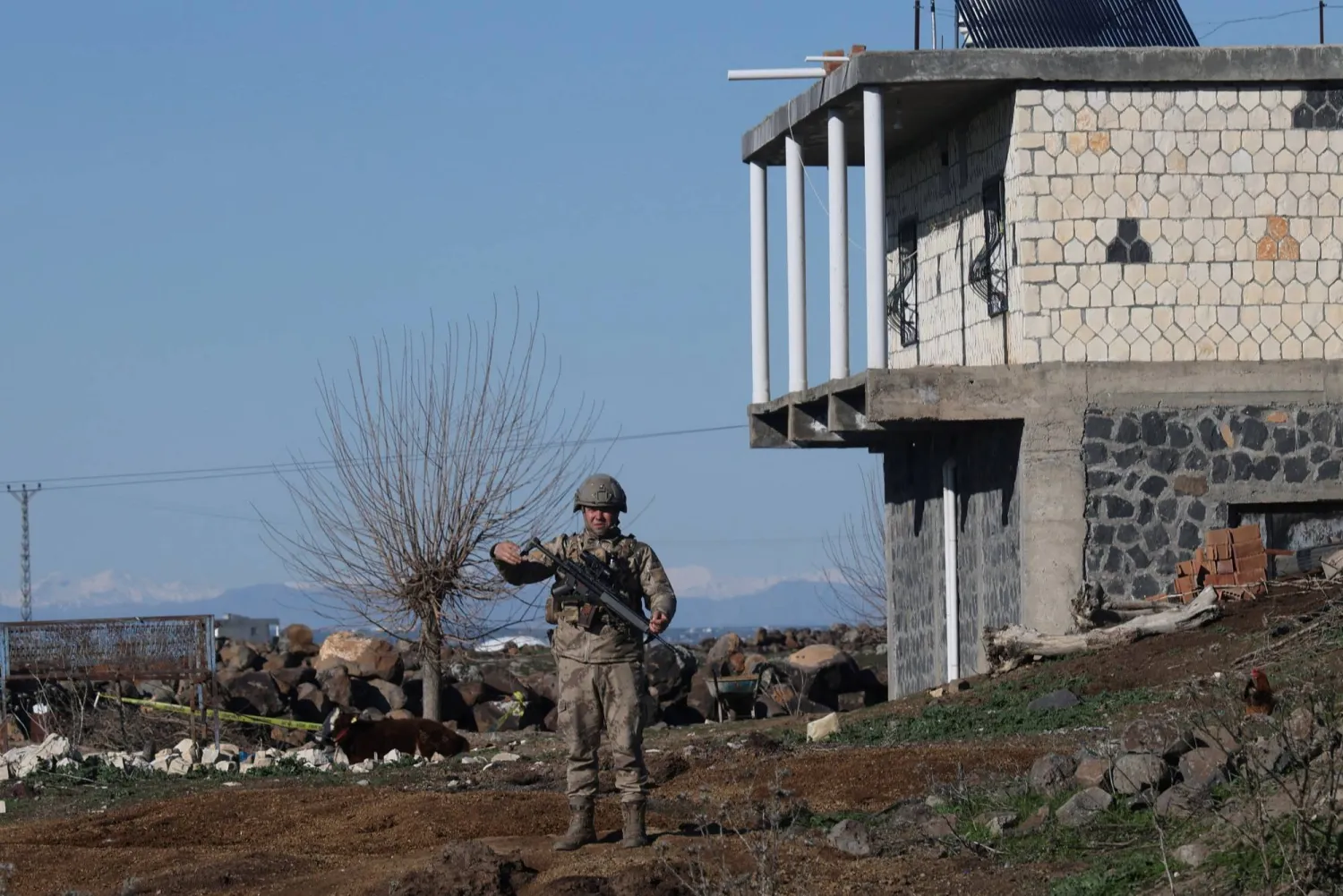
A Turkish soldier stands guard as army and security personnel search a field after a piece of ammunition fell following the interception of a missile launched from Iran by a NATO air defense system, in Diyarbakir, Türkiye, March 9, 2026. REUTERS/Sertac Kayar
TT

Türkiye Says US Patriot System Deployed to Boost Air Defense amid Iran War

A Turkish soldier stands guard as army and security personnel search a field after a piece of ammunition fell following the interception of a missile launched from Iran by a NATO air defense system, in Diyarbakir, Türkiye, March 9, 2026. REUTERS/Sertac Kayar

Türkiye said on Tuesday that a US Patriot air defense system was deployed to its southeast, near a NATO radar base, as part of steps by the alliance to boost air defenses in the face of missile threats from the Iran war.

It is being deployed to Malatya province, the location of the Kurecik NATO radar base, which provides vital data for the alliance ‌and helped ‌identify two Iranian ballistic missiles heading toward ‌ Türkiye ⁠over the last ⁠week, said Reuters.

Iran has said it is not at war with regional countries and denies explicitly targeting its neighbor Türkiye. Ankara has warned Tehran against firing any more missiles towards it and the two countries' presidents discussed the issue on Monday.

"In addition to ⁠the measures we take on a ‌national level, air and missile ‌defense measures by NATO have been increased. In that ‌framework, one Patriot System is being deployed to ‌Malatya to contribute to defending our air space," the defense ministry said.

It added that Türkiye would continue to evaluate regional developments and cooperate with NATO allies.

The deployment comes ‌amid reports that Washington is looking into redeploying its military assets, including Patriot ⁠systems, currently stationed ⁠in South Korea.

It was not immediately clear where the Patriot system or its batteries were being redeployed from.

Türkiye, an emerging leader in the global defense industry that has the alliance's second-largest army, lacks its own fully fledged air defenses despite development efforts, and has relied on NATO air defenses stationed in the eastern Mediterranean Sea in both missile incidents in the last week.

There is currently one Patriot system, from Spain, deployed in Türkiye as part of NATO defens es.


‘Thought They’d Never Be Caught’: The Strike That Killed Iran’s Ali Khamenei

An Iranian man rides a motorbike past a large-scale poster of late Iranian Supreme Leader Ali Khamenei displayed along a highway, in Tehran, Iran, 01 July 2026. (Reuters)
TT

‘Thought They’d Never Be Caught’: The Strike That Killed Iran’s Ali Khamenei

An Iranian man rides a motorbike past a large-scale poster of late Iranian Supreme Leader Ali Khamenei displayed along a highway, in Tehran, Iran, 01 July 2026. (Reuters)

On Saturday, February 28, Tehran residents were embarking on the working week during the Islamic holy month of Ramadan, nervously anticipating celebrations for the Iranian New Year against the background of diplomatic efforts to stave off war with the US and Israel.

That morning, there was also activity around and inside the main government complex in Tehran just off Pasteur Street in the heart of the capital, which housed the residence and offices of then supreme leader Ali Khamenei.

The morning rush was rocked as several explosions shook the area, with smoke seen rising from around the government complex, known locally as the beit-e rahbari (house of the leader).

"The State of Israel has launched a preemptive strike against Iran," the Israeli defense ministry announced.

For hours, uncertainty surrounded the fate of the man aged 86 who had ruled Iran for more than three and a half decades and had maintained a position of zero compromise with the United States as well as crushing dissent.

"Khamenei, one of the most evil people in History, is dead," US President Donald Trump wrote that night on Truth Social, saying he "was unable to avoid our Intelligence and Highly Sophisticated Tracking Systems".

Iranian officials initially insisted that Khamenei had survived. But on the morning of March 1 a state television announcer, his voice breaking with emotion, declared that the leader had been martyred during the holy month of Ramadan.

- 'Path of sacrifice' -

The New York Times subsequently reported that the CIA had been tracking Khamenei for months and had learned that a meeting of top Iranian officials would take place that Saturday morning at the leadership compound, with the leader present.

The intelligence was passed to Israel and, two hours and five minutes after the Israeli jets took off, at around 9:40 am Tehran time, the long-range missiles struck the compound, it said.

The attack took place in broad daylight, which is highly unusual for such a strike.

"They thought they would never be caught, because we never bomb during breakfast. But we bombed," Trump said during the G7 summit in France last month.

Khamenei was not the only top official killed, with a whole echelon of senior figures wiped out including Revolutionary Guards chief Mohammad Pakpour, Khamenei's military advisor Ali Shamkhani and defense minister Aziz Nasirzadeh.

His family was also not spared with a daughter, daughter-in-law, son-in-law and infant granddaughter also killed.

While his son Mojtaba Khamenei, a key figure for years in his father's office, lost his wife Zahra Haddad-Adel, he survived albeit with wounds according to Iranian officials. One week later he was named the new supreme leader but has yet to be seen in public.

Ali Khamenei had always taken major security precautions. He never left Iran as supreme leader and his speeches were rarely carried live on television or announced in advance. During Israel's 12-day war against Iran in June 2025, he had reportedly retreated to a bunker.

But in an apparent act of defiance, he had never disappeared totally from public view and on February 17 gave his final public speech in the northern city of Tabriz, saying the US wanted to "devour" Iran.

He urged people to stay calm and go about their business "without any worries".

Observers were startled that, given the risks, Ali Khamenei was present in the very center of Tehran on February 28 rather than in hiding elsewhere in the vast country.

- 'You wouldn't believe' -

But the attack also further revealed the startling US and Israeli intelligence penetration of Iran, a strategic weakness exposed in the 2025 war when Israel killed a succession of key figures in targeted strikes.

According to the Financial Times, road-surveillance cameras in Tehran including around the leadership compound had been hacked years ago by Israel, enabling the identification of guards, their routines and movements.

Trump said at the G7 that satellite surveillance meant that "if somebody walks in and he has got a badge with his name on it... they can tell the name, they can give you the serial number".

"We can see things, you wouldn't believe the quality of the stuff that we have. That's why we have been so successful."


France Sets Presidential Election Dates

File photo: A person casts their vote at a polling station in the Magenta district during the first round of France's crunch legislative elections in Noumea in the first constituency of the French Pacific territory of New Caledonia, on June 30, 2024. (AFP)
TT

France Sets Presidential Election Dates

File photo: A person casts their vote at a polling station in the Magenta district during the first round of France's crunch legislative elections in Noumea in the first constituency of the French Pacific territory of New Caledonia, on June 30, 2024. (AFP)

France will hold the first round of its next presidential election on April 18, 2027, with a run-off set ‌for May ‌2, the ‌government ⁠spokeswoman, Maud Bregeon, said ⁠on Wednesday following a cabinet meeting to officially approve the dates.

The race to ‌succeed ‌President Emmanuel Macron — ‌who cannot run ‌again after two terms — is shaping up as a ‌fragmented contest, with polls placing the ⁠far-right ⁠National Rally in a leading position, and a crowded field raising the prospect of a run-off dominated by political extremes, Reuters said.


US, Iran to Hold Indirect Talks After Exchanges of Fire

 A general view of the Doha skyline, Qatar, June 29, 2026. (Reuters)
A general view of the Doha skyline, Qatar, June 29, 2026. (Reuters)
TT

US, Iran to Hold Indirect Talks After Exchanges of Fire

 A general view of the Doha skyline, Qatar, June 29, 2026. (Reuters)
A general view of the Doha skyline, Qatar, June 29, 2026. (Reuters)

Iran and the United States are to hold indirect talks with mediators in Doha on Wednesday in a push to advance negotiations and quell tensions following exchanges of fire between the two sides.

Both have said they will send officials to discuss their memorandum of understanding aimed at ending the Middle East war, but Iran has insisted direct negotiations will not take place.

The foes would take part in "indirect technical talks on Wednesday in Doha with Qatari and Pakistani mediators", a diplomat with knowledge of the talks told AFP on condition of anonymity.

The discussions, being held at a lower level and focused on the details of the MOU, will "build on the progress made at the Lake Lucerne summit", the diplomat added.

The memorandum of understanding, brokered by Qatar and Pakistan, culminated in a summit last month in Lucerne, Switzerland.

It includes a 60-day ceasefire pausing the war that broke out with US-Israeli strikes in late February, as well as the reopening of the blockaded Strait of Hormuz and a timeframe for a final deal to permanently end the conflict and reach an agreement on Iran's nuclear program.

Iranian officials were set to travel to Doha on Wednesday but Tehran denied an earlier claim by US President Donald Trump that there would be direct talks.

- 'Implementation challenges' -

Iranian foreign ministry spokesman Esmaeil Baqaei said the Iranian delegation would be led by Deputy Foreign Minister Kazem Gharibabadi, but said the officials "have no plans for negotiations with the American side at any level over the coming days".

US envoys Jared Kushner and Steve Witkoff will not be taking part in the technical talks, the anonymous diplomat told AFP, after they met with Qatar's Prime Minister Sheikh Mohammed bin Abdulrahman Al Thani on Tuesday.

In a statement, Qatar's foreign ministry said the trio discussed "the ongoing talks between the United States of America and Iran within the framework of the memorandum of understanding", as well as developments in Lebanon.

Since the signing of the US-Iran deal on June 17, both sides have exchanged fire in the Gulf, with Tehran targeting a commercial ship it said had deviated from its approved route through the Strait of Hormuz.

US Central Command responded by saying it had attacked 10 Iranian military targets over the weekend.

Iran then hit back with strikes against Kuwait and Bahrain, which both condemned Tehran for the attacks.

Iran's chief negotiator Mohammad Bagher Ghalibaf said Tuesday in a televised interview that "when a war of this magnitude comes to an end... it is inevitable that there will be implementation challenges, incidents, and differences of opinion, especially where parties such as the Israeli regime are concerned".

- Relative quiet -

He said the Iranian delegation in Doha would be focused on the implementation of clauses in the deal related to the Strait of Hormuz and fighting in Lebanon.

"Naturally, Iran is committed to ensuring that the agreement is implemented, and the enemy, the United States and its ally -- must also fulfil their commitments," he said.

The exchanges of fire appear to have calmed in the days leading up to the talks in Qatar.

On the Lebanon front, fighting between Israel and Hezbollah has been relatively quiet.

Tehran has insisted any deal should include an end to the parallel conflict in Lebanon and a withdrawal of Israeli troops from its south, part of which they have occupied.

Ghalibaf also said Iran's oil exports had surged since the end of the US blockade on its ports, which Washington imposed in retaliation for Iran blocking shipping through Hormuz.

"From the day the blockade was lifted until today, we have exported more than 40 million barrels of oil," he told state television.

"By contrast, during the previous 50 to nearly 60 days, we were genuinely unable to export even a single barrel of oil."