Britain Working with Allies to Support Shipping through Strait of Hormuz

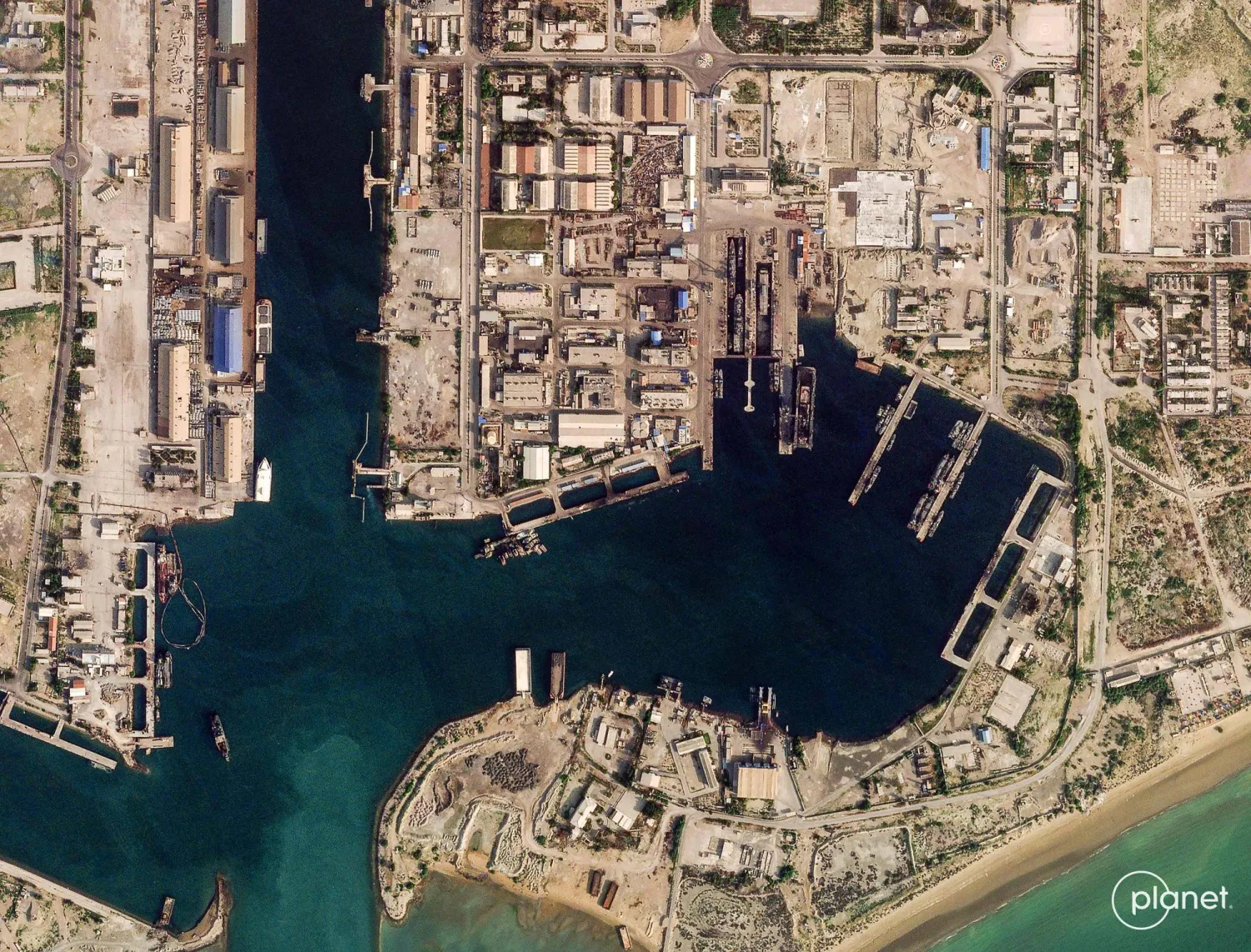
 This handout satellite image taken by 2026 Planet Labs PBC shows damage at the military harbour in Iran's southern port of Bandar Abbas along the Strait of Hormuz on March 4, 2026.  (Photo by 2026 Planet Labs PBC / AFP)
This handout satellite image taken by 2026 Planet Labs PBC shows damage at the military harbour in Iran's southern port of Bandar Abbas along the Strait of Hormuz on March 4, 2026. (Photo by 2026 Planet Labs PBC / AFP)
TT

Britain Working with Allies to Support Shipping through Strait of Hormuz

 This handout satellite image taken by 2026 Planet Labs PBC shows damage at the military harbour in Iran's southern port of Bandar Abbas along the Strait of Hormuz on March 4, 2026.  (Photo by 2026 Planet Labs PBC / AFP)
This handout satellite image taken by 2026 Planet Labs PBC shows damage at the military harbour in Iran's southern port of Bandar Abbas along the Strait of Hormuz on March 4, 2026. (Photo by 2026 Planet Labs PBC / AFP)

Britain is working with allies on a range of options to support commercial shipping through the Strait of Hormuz in the face of Iranian threats, Prime Minister Keir Starmer's spokesperson said on Tuesday as the US-Israeli war with Iran roils oil prices.

US President Donald Trump has said the war could end "soon" but also said the US could escalate its attacks if Iran sought to block tanker traffic through the Strait of Hormuz. After speaking to the leaders of Germany and Italy late on Monday, Downing Street said in a readout that they agreed on the "vital importance of freedom of navigation" through the Strait and "agreed to work closely together in the coming days in the face of Iranian threats."

"We're working with our allies on a range of options to support commercial shipping through the Strait as the threat picture develops," the spokesperson told reporters when asked about the readout.

Iran's Revolutionary Guards said on Tuesday they would not let any oil out of the Middle East until US and Israeli attacks cease. Starmer's spokesperson said Energy Secretary Ed Miliband had spoken to oil majors BP and Shell in the last few days, adding that the safety of their vessels was their primary concern.

He added that finance minister Rachel Reeves had liaised with Lloyd's of London to ensure there was "appropriate insurance cover available to operators" including cover for war, revolution and terrorism.

After meeting Reeves on Monday, the chairman of Lloyd's, Charles Roxburgh, said the insurance marketplace would work with Britain, the US and international partners on a "comprehensive response to the situation."

"In my meeting with (Reeves), I reiterated Lloyd’s confidence in our marine insurance market, which has remained open and continues to support international trade and shipping during this period of heightened risk," he said.


Israel Says Iran Hacked Security Cameras

People exercise on the beach in Tel Aviv, Israel, 10 March 2026. (EPA)
TT

Israel Says Iran Hacked Security Cameras

People exercise on the beach in Tel Aviv, Israel, 10 March 2026. (EPA)

Israel's cybersecurity directorate said it had identified "dozens of Iranian breaches into security cameras for espionage purposes" since the start of the war in the Middle East, urging the public to be vigilant.

"The directorate is working to alert hundreds of camera owners and calls on the public to change their passwords and update their software to prevent any security risk, whether national or personal," Cyber Israel wrote on X Monday.

Cyberattacks between Iran and Israel have been a frequent occurrence in recent years, as the two foes conducted a shadow war that culminated in open conflict last June and again on February 28.

In December 2025, former Israeli prime minister Naftali Bennett -- who is set to run against incumbent premier Benjamin Netanyahu in a general election this year -- said he had been the victim of a cyberattack targeting his Telegram account, after hackers claimed to have broken into his phone.

Private messages, videos and photographs said to be taken from Bennett's phone were published on a hacker site named after "Handala", a character symbolizing the Palestinian cause, and on an associated X account.

Iran-linked hackers have stepped up their operations in the region since strikes began on the country, an expert told AFP.

Israeli cybersecurity firm Check Point said in a report that since the launch of the US-Israeli offensive on February 28, it has seen hackers accessing surveillance cameras, which are widely used but often poorly secured.

The images were likely used to assess damage caused by the attacks or "to gather the necessary information" on "the habits (of targeted individuals) or locations to hit", Gil Messing, head of cyberintelligence at Check Point, told AFP.

The hackers "are part of (Iran's) army" and "are largely supported by the state", notably by the Revolutionary Guards and the ministry of intelligence and security, he added.

Last week, the Financial Times reported that Israel had hacked nearly all of Tehran's traffic cameras for years in preparation for the operation that killed Iran's supreme leader Ali Khamenei on the first day of the offensive.


Israeli Army Says Half of Iranian Missiles Have Cluster Munitions

An Iranian missile with cluster munitions flies toward Israel, amid the US-Israel conflict with Iran, as seen from Tel Aviv, Israel, March 9, 2026. (Reuters)
TT

Israeli Army Says Half of Iranian Missiles Have Cluster Munitions

An Iranian missile with cluster munitions flies toward Israel, amid the US-Israel conflict with Iran, as seen from Tel Aviv, Israel, March 9, 2026. (Reuters)

Israel's army estimated on Tuesday that around half of the missiles being fired at the country by Iran contained cluster munitions, posing an added danger to people on the ground.

"Approximately 50 percent of Iranian missiles fired toward Israel carry cluster warheads that disperse into smaller bombs in the air, creating additional falling debris hazards," a military official said, in comments shared by the defense ministry.

Cluster munitions explode in mid-air and scatter bomblets. Some of these submunitions do not explode on impact and can cause casualties over time, particularly among children.

"The radius of the impact is about ten kilometers. Although these contain less explosive material than a standard missile, the impact can still be lethal," the official said.

Two construction workers died from shrapnel wounds after missiles were fired at central Israel on Monday, with emergency workers at the site telling AFP the damage appeared to have been caused by a cluster munition.

Iran and Israel are not among the more than 100 countries that are party to the 2008 Convention on Cluster Munitions, which prohibits their use, transfer, production and storage.

Both have reportedly used the munitions in earlier conflicts.

During the 12-day war between Iran and Israel in June 2025, Amnesty International said Tehran used cluster munitions at least three times, based on analysis of photos and videos, as well as media reports.

In 2007, a US government investigation found that Israel had probably violated arms export agreements with Washington when it dropped US-made cluster bombs in Lebanon during its war with Hezbollah the previous year.


Israel Not Seeking Endless War with Iran, Foreign Minister Says

10 March 2026, Israel, Jerusalem: Israeli Foreign Minister Gideon Saar, attends a joint press conference with his German counterpart Johann Wadephul, at the Foreign Ministry in Tel Aviv. (dpa)
TT

Israel Not Seeking Endless War with Iran, Foreign Minister Says

10 March 2026, Israel, Jerusalem: Israeli Foreign Minister Gideon Saar, attends a joint press conference with his German counterpart Johann Wadephul, at the Foreign Ministry in Tel Aviv. (dpa)

Israel is not seeking an endless war with Iran and will coordinate with the United States on when to end the fighting, Foreign Minister Gideon Saar said on Tuesday, declining to publicly state a timeline for when the conflict could end.

The US-Israeli war with Iran, now in its 11th day, has engulfed the Middle East, with Iranian strikes hitting neighboring states, including the United Arab Emirates, ‌and Israel fighting ‌Hezbollah in Lebanon as well as striking Iran.

"We ‌will ⁠continue until the ⁠minute that we and our partners think that is appropriate to stop," Saar told journalists in Jerusalem alongside his German counterpart.

"We are not looking for an endless war," he said.

German Chancellor Friedrich Merz said earlier in Berlin that there was growing concern in Europe over the war and there appeared to be no plan to bring ⁠it to an end.

"We want to remove, for ‌the long-term, existential threats from Iran to ‌Israel," Saar said in response to a Reuters question on what victory ‌would look like to the government.

He described Iran's newly appointed ‌supreme leader Mojtaba Khamanei - son of Ali Khamenei who was killed by the Israeli military on the first day of the war - as an extremist.

Israel has said it aims to eliminate Iran's clerical rule by destroying ‌its nuclear and ballistic missile programs and creating conditions for Iranians to overthrow their rulers.

Saar said there ⁠was an ⁠opportunity to create conditions for Iranians to "regain their freedom," while acknowledging that it may not happen during the war and could come afterward.

"We must not miss this opportunity with partial results."

German Foreign Minister Johann Wadephul, the first senior foreign official to publicly visit Israel since the war began, said he was confident Israel and Washington were open to a diplomatic solution that could lead to an end to the war.

But any such solution would need to include agreements with Iran on its nuclear and missile programs, as well as its support for regional militias, terms that Wadephul said Tehran had made clear that it was not currently prepared to accept.