


UN Urges ‘Exemptions’ to Get Aid Through Strait of Hormuz

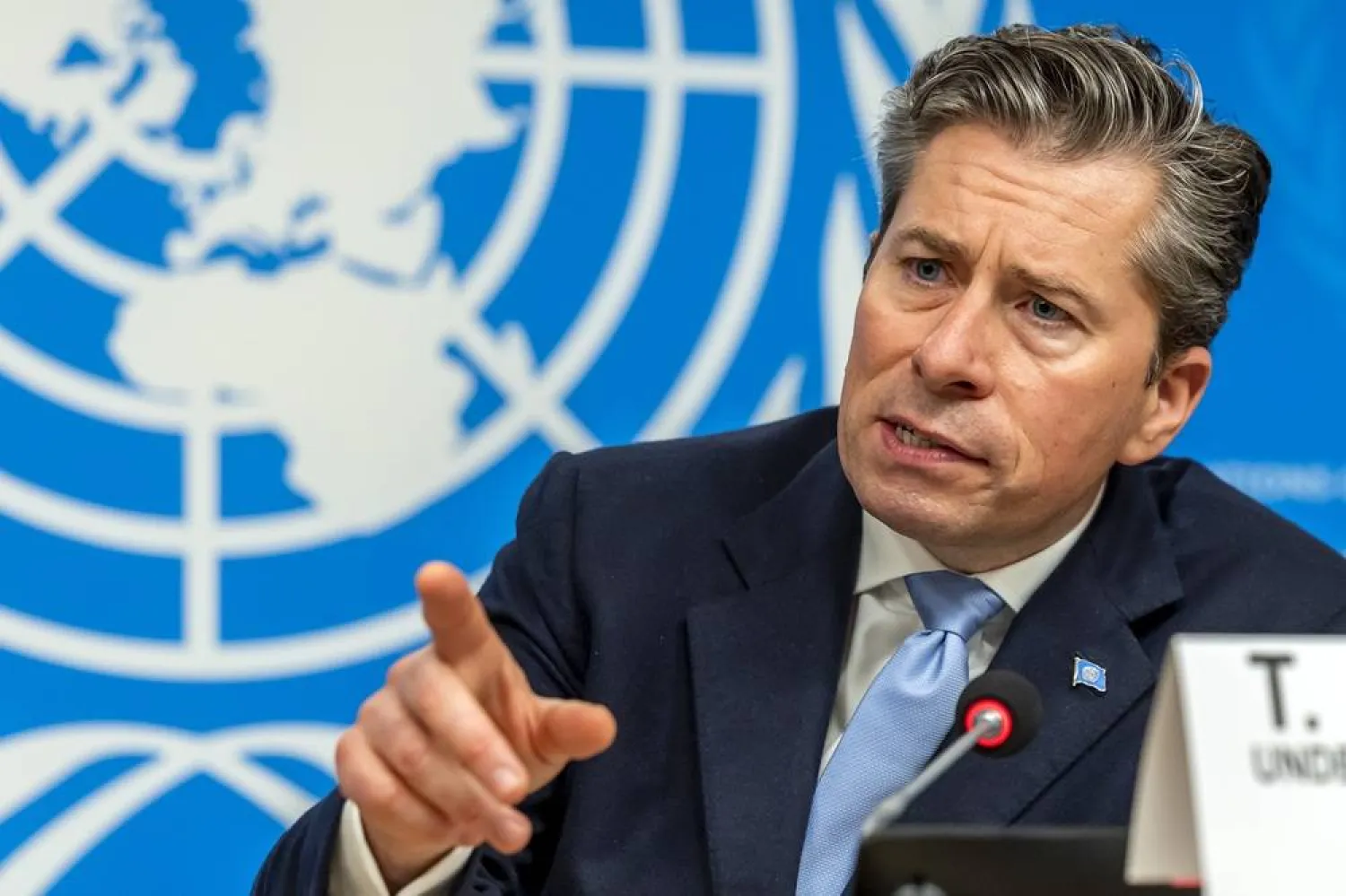
Tom Fletcher, Under-Secretary-General for Humanitarian Affairs and Emergency Relief Coordinator, gives an update on the hyper-prioritized plan of the 2026 Global Humanitarian Overview (GHO) to media during a press conference at the European headquarters of the United Nations in Geneva, Switzerland, 11 March 2026. (EPA)
TT

UN Urges ‘Exemptions’ to Get Aid Through Strait of Hormuz

Tom Fletcher, Under-Secretary-General for Humanitarian Affairs and Emergency Relief Coordinator, gives an update on the hyper-prioritized plan of the 2026 Global Humanitarian Overview (GHO) to media during a press conference at the European headquarters of the United Nations in Geneva, Switzerland, 11 March 2026. (EPA)

The United Nations aid chief warned Wednesday that the Middle East war was impacting aid routes and called for "exemptions" so humanitarian supplies could get through.

The war in the Middle East has effectively closed the Strait of Hormuz, while fuel supply disruptions are sending freight rates soaring.

UN aid chief Tom Fletcher warned that the escalating war and its impact on the strait was having "a direct impact on our humanitarian supplies, including going to areas of key need in sub-Saharan Africa".

"I'm worried that further escalation will damage other supply routes," he told reporters in Geneva, warning that the war was pushing up prices and driving "more people into greater need".

"We're appealing to all the parties to try and secure those routes, including the Strait of Hormuz, for our humanitarian traffic... so we can reach anyone, anywhere, on the basis of greatest need."

"We're living through a moment right now of grave peril," Fletcher said.

"We're seeing these crises escalate rapidly and increasingly collide in dangerous ways," he said, calling for "calmer heads to prevail".

The last two weeks of fighting are further confirmation that "we're living in a time of brutality, impunity and indifference", he said, cautioning that "the rules-based scaffolding meant to restrain the worst excesses of war is cracking".

"Human ingenuity is being applied to find ever more sinister ways to kill at scale, while civilians are subjected to ever more abject violence."

- 'Massive gap' -

The UN aid chief warned that such violence was taking a heavy toll at a time when humanitarians were already on their knees.

"We're seeing violence reverberate across borders, displacement, economic shocks, soaring humanitarian needs -- and we're seeing the consequences spread faster than we can respond," he said.

"Humanitarian action (is) overstretched, under sustained attack and under-resourced."

When Fletcher launched the UN's annual Global Humanitarian Appeal for 2026 last December, he requested $23 billion to help 87 million of the world's most vulnerable people, with a heavy focus on dire conflict situations like those in Gaza, Ukraine, Sudan, Haiti and Myanmar.

The amount and scope were dramatically reduced compared to recent years, as the UN strives to adapt to a new reality since US President Donald Trump returned to the White House in January 2025, slashing foreign aid.

The UN has stressed that its smaller appeal did not mean humanitarian needs have shrunk.

Fletcher voiced optimism Wednesday that the 2026 target could be reached, while acknowledging that "the needs are far greater" than the people the UN can reach.

The UN has already received $5 billion towards the 2026 plan, including $2 billion from the US, with additional pledges bringing the total to $8.7 billion, he said.

"So that's over a third of what we're looking to get this year for this plan, delivered in the first quarter," he said.

But, he warned, "we still face a massive gap".

"Without additional support, millions of people will die."

The towering humanitarian needs were all the more distressing when around $1 billion is being spent every day on the Middle East war, he said.

Just a day's worth of war funding "would allow us to save millions of lives", Fletcher insisted.



US Voices Hope on Iran Deal Progress Before Pakistan Army Chief Visit

Secretary of State Marco Rubio speaks to the press before boarding his plane at Homestead Air Reserve Base, Thursday, May 21, 2026. Julia Demaree Nikhinson/Pool via REUTERS
TT

US Voices Hope on Iran Deal Progress Before Pakistan Army Chief Visit

Secretary of State Marco Rubio speaks to the press before boarding his plane at Homestead Air Reserve Base, Thursday, May 21, 2026. Julia Demaree Nikhinson/Pool via REUTERS

US Secretary of State Marco Rubio voiced hope on Thursday of progress on ending the war with Iran, with mediator Pakistan's army chief due to arrive in Iran for talks.

The expected visit by Field Marshal Asim Munir, a powerful figure with a growing role in Pakistan's foreign relations, comes a day after US President Donald Trump warned that negotiations to end the war were on the "borderline" between a deal and renewed strikes.

"I believe the Pakistanis will be travelling to Tehran today. So hopefully that'll advance this further," Rubio told reporters on Thursday, according to Reuters.

A ceasefire on April 8 halted the war launched weeks earlier by the US and Israel, but negotiation efforts have so far failed to yield a lasting peace agreement.

A war of words has taken the place of open conflict but the impasse continues to weigh on the world economy, leaving everyone from investors to farmers in a painful state of uncertainty.

On Thursday, Iran's ISNA news agency said Munir's visit was aimed at continuing "talks and consultations" with Iranian authorities, without providing details. Other Iranian media carried the same report.

Pakistan hosted in April the only direct negotiations between US and Iranian officials to take place since February 28, the day the war began.

Munir was at the center of the action during that round of talks, greeting both delegations on their arrival and displaying remarkable bonhomie with US Vice President JD Vance.

But the talks ultimately failed, with Iran accusing the US of making "excessive demands".

Since then, the two sides have exchanged multiple proposals, with the threat of renewed war looming all along.

"It's right on the borderline, believe me," Trump told reporters Wednesday. "If we don't get the right answers, it goes very quickly. We're all ready to go."

He said a deal could come "very quickly" or "in a few days", but warned Tehran would have to provide "100 percent good answers".

Rubio also criticized NATO allies for their refusal to help Trump's war against Iran.

"He's not asking them to commit troops. He's not asking them to send their fighter jets in. But they refuse to do anything," he said.

"We were very upset about that."

Tehran's chief negotiator Mohammad Bagher Ghalibaf on Wednesday accused Washington of seeking to restart the war, warning of a "forceful response" if Iran were to be attacked.

"The enemy's movements, both overt and clandestine, show that despite economic and political pressure, it has not abandoned its military objectives and is seeking to start a new war," Ghalibaf said.

Iran's foreign ministry spokesman Esmaeil Baqaei said Iran was examining points received from Washington, while repeating Tehran's demands for the release of its assets frozen abroad and an end to a US naval blockade.

Trump is under political pressure at home as energy costs rise.

The ceasefire halted the fighting but has not reopened the Strait of Hormuz, the vital waterway that normally carries about a fifth of the world's oil and liquefied natural gas.

The future of Hormuz remains a key sticking point in the negotiations, with fears growing that the global economy will feel more pain as pre-war oil stockpiles run down.

Iran imposed the blockade of Hormuz as part of its retaliation in the war, allowing only a trickle of vessels through in recent weeks while introducing a toll system.


Trump Postpones Signing Order on AI Oversight

US President Donald Trump speaks during an event with Environmental Protection Agency Administrator Lee Zeldin in the Oval Office at the White House in Washington, DC, USA, 21 May 2026. EPA/AL DRAGO / POOL NEWS SERVICE OK
TT

Trump Postpones Signing Order on AI Oversight

US President Donald Trump speaks during an event with Environmental Protection Agency Administrator Lee Zeldin in the Oval Office at the White House in Washington, DC, USA, 21 May 2026. EPA/AL DRAGO / POOL NEWS SERVICE OK

US President Donald Trump on Thursday said he had postponed signing an executive order on AI because he "didn't like certain aspects of it."

Trump had planned to sign the order at a ceremony on Thursday afternoon attended by CEOs of AI companies.

The order would create a voluntary framework for AI developers to ⁠engage with the ⁠US government before the public release of covered models, two sources told Reuters on Wednesday.

The president also had planned to direct the US government to use the advanced models to improve the cybersecurity defenses of ⁠government systems, along with networks owned by sectors that are vital to the nation's economy, such as banks and hospitals, according to another source.

Concerns are growing across the US government and in the private sector about the cybersecurity risks posed by powerful new AI systems, including Anthropic’s Mythos.

Anthropic has warned that Mythos could supercharge complex cyberattacks, though cybersecurity experts ⁠told ⁠Reuters that fears of unfettered hacking are overstated.

The president's executive order, if implemented, could hurt the industry's profits if it slows the rollout of new models or prompts companies to change how they perform to address security concerns.

Trump, who spoke to reporters on Thursday in the Oval Office, did not say which parts of the order he didn't like.


Teen Among 3 Dead in Türkiye after Floods, Landslides Hit Southern Province

FILE - A Navy officer helps a woman cross a flooded street after heavy rain in Poza Rica, Veracruz state, Mexico, Oct. 12, 2025. (AP Photo/Felix Marquez, File)
TT

Teen Among 3 Dead in Türkiye after Floods, Landslides Hit Southern Province

FILE - A Navy officer helps a woman cross a flooded street after heavy rain in Poza Rica, Veracruz state, Mexico, Oct. 12, 2025. (AP Photo/Felix Marquez, File)

Three people have died during flooding in southern Türkiye on Thursday, officials said, as the Interior Ministry issued weather warnings for 15 of the country's 81 provinces.

Heavy rainfall in Hatay, the province most affected by a devastating earthquake in 2023, caused the Asi river, also known as the Orontes, to break its banks, submerging fields and villages. Roads and bridges were also washed away, The Associated Press reported.

Among the victims was a 15-year-old boy who died in a house that collapsed during a landslide in Antakya, the provincial capital, Hatay Gov. Mustafa Masatli said.

A 66-year-old man died when his car rolled into a ditch in Defne, while and another man, aged 62, was swept away in floodwaters in the Samandag district.

Masatli said the flooding had caused significant damage to agriculture across 2,900 hectares (7,166 acres) as disaster teams continued to assess the impact. Firefighters rescued many people by boat as residents bailed out their homes and tried to hold the waters at bay with makeshift barriers.