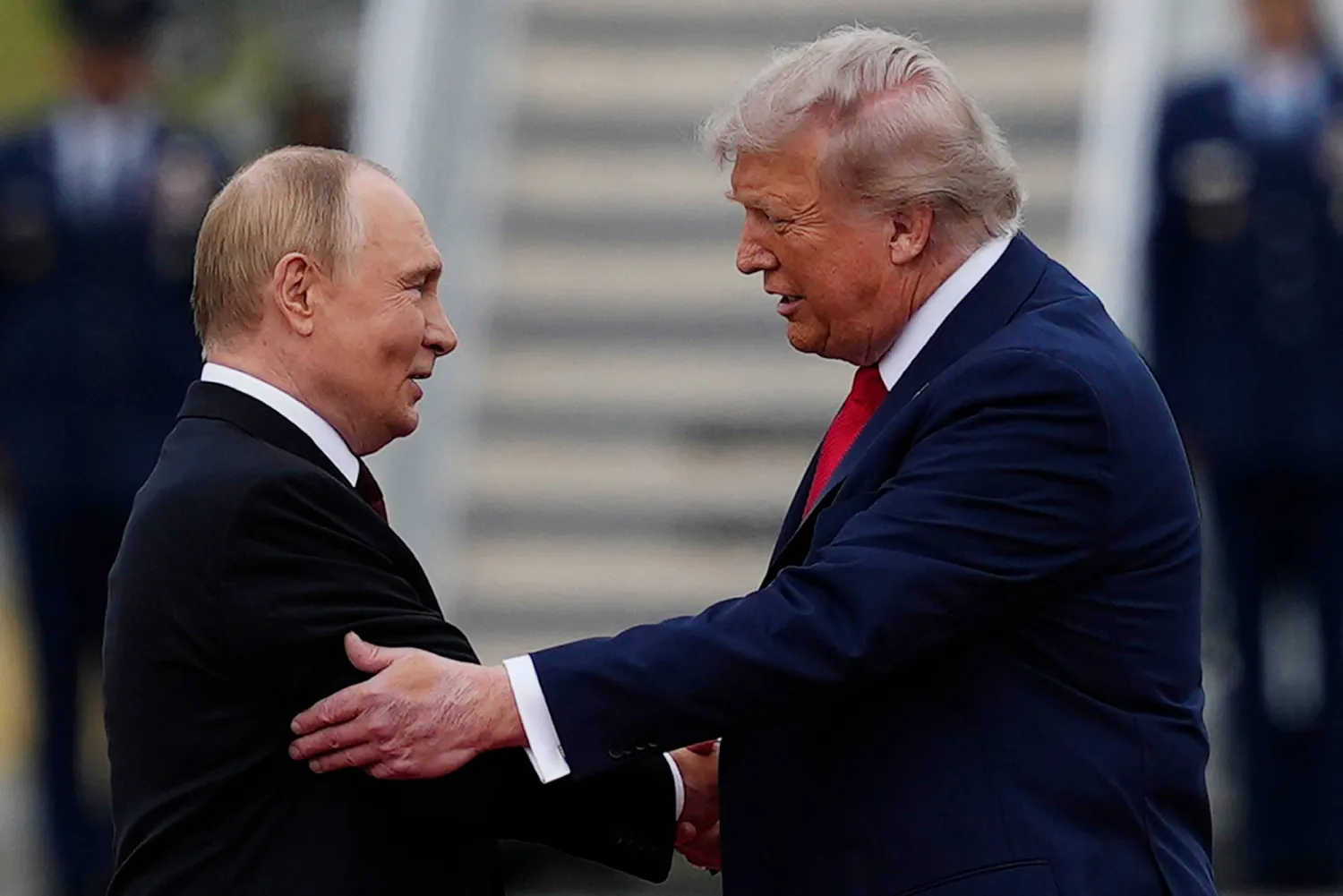
Russia Condemns Trump Comments on 'Takeover' of Cuba

US President Donald Trump greets Russian President Vladimir Putin, Aug. 15, 2025, at Joint Base Elmendorf-Richardson, Alaska. (AP Photo/Julia Demaree Nikhinson, File)
TT

Russia Condemns Trump Comments on 'Takeover' of Cuba

US President Donald Trump greets Russian President Vladimir Putin, Aug. 15, 2025, at Joint Base Elmendorf-Richardson, Alaska. (AP Photo/Julia Demaree Nikhinson, File)

Russia condemned on Thursday what it called blackmail and threats by US President Donald Trump to initiate a "takeover" of Cuba, a traditional ally of Moscow.

Russian Foreign Ministry spokeswoman Maria Zakharova said Moscow would provide all possible political and diplomatic support to Cuba and called for a diplomatic solution to the tensions with Washington, Reuters reported.

Trump said on Monday that Cuba was in "deep trouble" and that US Secretary of State Marco Rubio was dealing with the issue, which may or may not be a "friendly takeover."


UN Hails Progress in Ebola Response, Cites Insecurity as Biggest Challenge

Congolese workers wearing personal protective equipment (PPE) walk outside the Ebola Treatment Center at the Bunia General Referral Hospital following a resurgence of Ebola involving the Bundibugyo strain, in Bunia, Ituri province, the Democratic Republic of Congo, November 2, 2026. (Reuters)
TT

UN Hails Progress in Ebola Response, Cites Insecurity as Biggest Challenge

Congolese workers wearing personal protective equipment (PPE) walk outside the Ebola Treatment Center at the Bunia General Referral Hospital following a resurgence of Ebola involving the Bundibugyo strain, in Bunia, Ituri province, the Democratic Republic of Congo, November 2, 2026. (Reuters)

UN health officials on Friday hailed progress in the Ebola response six months after the outbreak first prompted global concerns, but cautioned that the disease continues to spread to more remote and dangerous parts of Congo.

With the number of confirmed cases now surpassing 11,000, the outbreak is the second-worst for Ebola on record and ‌has spread to parts ‌of east, central and ‌west ⁠Africa.

Flagged by health ⁠authorities in mid-May, the outbreak is driven by the rare Bundibugyo species of the virus, for which there are no approved treatments or vaccines.

"We do see encouraging signs," said Chikwe Ihekweazu, head of ⁠the World Health Organization's Health Emergencies Program, ‌citing falling ‌cases in former hotspots like Bunia in eastern Democratic ‌Republic of Congo.

“But what we have ‌seen now is the emergence of cases in more rural and more difficult-to-reach areas ... The biggest challenge the response faces right now ‌is the rising insecurity," he said, citing WHO data showing 80 attacks ⁠on health ⁠sites and workers so far.

French medical charity Médecins Sans Frontières has been more downbeat on the Ebola response, saying that supplies are missing and the virus is still spreading out of control.

Julien Harneis, the UN's special Ebola coordinator, said in response to the criticism: "The area of operation is vast, just unimaginable vast...But 80% of the time, and across this vast area, we're able to operate."


Five Facts About APEC with Trump, Putin and Xi Set to Attend

Workers install signage for the upcoming Asia-Pacific Economic Cooperation (APEC) China 2026 summit on the wall of a building in Shenzhen, China's Guangdong province on November 12, 2026. (AFP)
TT

Five Facts About APEC with Trump, Putin and Xi Set to Attend

Workers install signage for the upcoming Asia-Pacific Economic Cooperation (APEC) China 2026 summit on the wall of a building in Shenzhen, China's Guangdong province on November 12, 2026. (AFP)

Attention will focus next week ‌on a summit of US, Chinese and Russian leaders set for the 21-member gathering of the Asia-Pacific Economic Cooperation (APEC) forum in China's southern technology hub of Shenzhen.

WHAT IS APEC?

Founded as an informal 12-member dialogue effort in 1989 in the Australian capital of Canberra, it has become the region's premier economic forum to foster ties on advancing growth, trade and investment.

Accounting for about 62% of global GDP and roughly half of global trade, the grouping of "member economies" rather than nations allows participation by Chinese-ruled Hong Kong and democratically governed Taiwan, which Beijing claims as its own territory.

It does not include India, the world's most populous nation, however.

APEC operates on non-binding commitments reached strictly by consensus, with commitments undertaken on a voluntary basis.

The APEC Economic Leaders' Meeting is set for November 18 and 19, preceded by an annual summit of CEOs on November 17-18.

WHY SHENZHEN?

China is ‌hosting the summit ‌for the third time, after events in the commercial hub of Shanghai ‌in ⁠2001 and the ⁠capital, Beijing, in 2014.

Both domestic and international reasons govern the choice of Shenzhen, adjacent to the financial center of Hong Kong, said Chim Lee, senior analyst at the Economist Intelligence Unit.

As part of China's Greater Bay Area home to Hong Kong and Macau, which Beijing seeks to establish as a global hub for technology and innovation, the city offers a platform to showcase China's vision for development and trade.

It also highlights Shenzhen's resilience to geopolitical turbulence, Lee added.

The city is the base of several leading Chinese auto and tech giants, such as BYD, ⁠Huawei and Tencent .

WHO WILL BE THERE?

China has said President Xi Jinping ‌will chair the leaders' meeting and deliver remarks. US President Donald ‌Trump, Russian President Vladimir Putin and Philippine President Ferdinand Marcos Jr. are among those expected.

The leaders of Canada, Australia, Mexico ‌and Indonesia are also due to attend, along with those of Malaysia, South Korea and Vietnam among ‌Asia-Pacific nations.

Taiwan has designated Stan Shih, founder of Acer, as its envoy.

WHAT TO WATCH AND KEY STICKING POINTS

Middle East Instability: The economic ripple effects of conflict, such as risks to energy security, trade flows, supply chains and inflation are ‌major concerns expected to figure in talks.

Tripartite Dynamics: All eyes are on the possible meeting of Chinese, Russian and US leaders. China is hesitant to ⁠engage in talks on nuclear ⁠disarmament, as it has fewer such weapons than the other two, analysts said.

The US and Russia will also be keen to discuss the Ukraine war, but not necessarily China, they said.

China-US Relations: A key focus to see if ties can stay stable. Both sides are falling short on commitments to an extended trade truce, analysts said. Rare earth supplies, artificial intelligence and tariffs are also likely to figure on the agenda, with US arms sales to Taiwan closely watched.

China's ties with Japan and the Philippines: Strains in Japan and China ties have persisted since Prime Minister Sanae Takaichi angered Beijing in November 2025 by suggesting that Japan could deploy its military if a Chinese move against neighboring Taiwan also threatened its territory.

China-Philippines relations will likewise be closely watched amid continuing tension in the disputed waterway of the South China Sea.

WHO ARE APEC'S MEMBERS?

These are Australia, Brunei, Canada, Chile, China, Hong Kong, Indonesia, Japan, South Korea, Malaysia, Mexico, New Zealand, Papua New Guinea, Peru, the Philippines, Russia, Singapore, Taiwan, Thailand, the United States and Vietnam.



Takaichi to Attend APEC in First China Trip as PM

Japan’s Prime Minister Sanae Takaichi attends a ceremony for the exchange of signed documents at the Akasaka State Guest House in Tokyo, Japan, 09 November 2026. (EPA)
TT

Takaichi to Attend APEC in First China Trip as PM

Japan’s Prime Minister Sanae Takaichi attends a ceremony for the exchange of signed documents at the Akasaka State Guest House in Tokyo, Japan, 09 November 2026. (EPA)

Japan said Friday that Prime Minister Sanae Takaichi would visit China next week for the first time since she took office last year, attending an Asia-Pacific summit in Shenzhen.

The trip comes at a time of particularly fraught relations between the rival nations after Takaichi suggested in November last year that Japan may intervene in any attack on the island of Taiwan, which China claims as its territory.

"Prime Minister Takaichi is scheduled to visit the Philippines and China from November 16 to 19 to attend ASEAN-related summit meetings and the APEC summit," said deputy chief cabinet secretary Masanao Ozaki.

The visit to China will be her first since becoming prime minister in October last year.

Ozaki said that while at APEC, Takaichi will discuss issues such as "trade and investment, regional economic integration, economic and energy resilience, the digital economy... and present Japan's position on these matters".

But all eyes will be on any interaction with Chinese President Xi Jinping. Analysts say that a bilateral summit between the two leaders is very unlikely.

Multiple Japanese media reported that Tokyo had also asked Russia for a meeting with President Vladimir Putin at the gathering.

Relations between Tokyo and Moscow are at a low point after a Japanese journalist was arrested in Russia on spying allegations last month and assets belonging to Japan Tobacco were seized in the country.

Before the Shenzhen trip Takaichi will head to Manila for a meeting of the 11-nation Association of Southeast Asian Nations.

Ozaki said a Quad meeting -- including the leaders of Australia, India, Japan and the United States -- is being arranged on the sidelines of ASEAN.

China reacted furiously to Takaichi's comments on Taiwan, which came just weeks after she took office.

Beijing warned its citizens against travel to Japan and imposed trade restrictions that have reportedly led to big drops in supplies of vital rare earth minerals to Japanese firms.

Takaichi last month called China an "important neighbor" and pledged to build a stable relationship in a policy address.

But she added that Japan would also "firmly assert our country's positions" and "strongly call for responsible behavior".

While Beijing has refused to have ministerial talks with Takaichi's government, Xi sent a message of condolence to the family of former Japanese prime minister Yasuo Fukuda after he died last month, describing him "a longtime friend of the Chinese people".

In September, China's top diplomat Wang Yi said ties with Tokyo were "waiting to be normalized again" as he met former Japanese foreign minister Takeshi Iwaya, who was leading a trade delegation in Beijing.