


Afghanistan Accuses Pakistan of Targeting Homes in Airstrikes That Kill at Least 4 Civilians

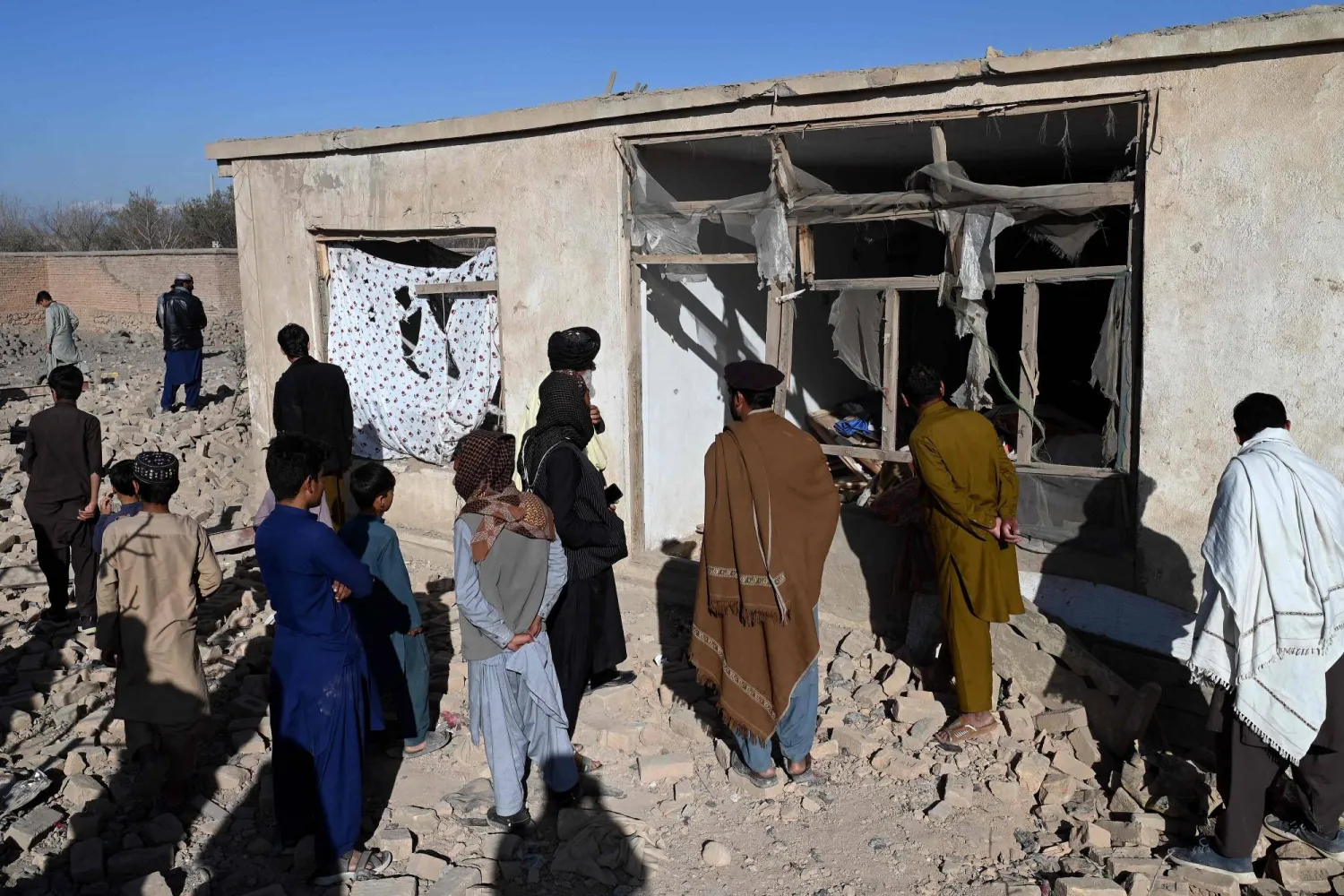
Afghans inspect a damaged house at the site of an overnight Pakistan airstrike, at a residential area in Pol-e-Charkhi on the outskirts of Kabul on March 13, 2026. (AFP)
TT

Afghanistan Accuses Pakistan of Targeting Homes in Airstrikes That Kill at Least 4 Civilians

Afghans inspect a damaged house at the site of an overnight Pakistan airstrike, at a residential area in Pol-e-Charkhi on the outskirts of Kabul on March 13, 2026. (AFP)

Afghanistan’s Taliban government early Friday accused Pakistan’s military of targeting homes in overnight airstrikes in Kabul and the southern province of Kandahar, saying at least four civilians were killed as fighting between the neighbors entered its third week.

Government spokesman Zabihullah Mujahid said on X that Pakistan’s aircraft also struck fuel depots belonging to the private airline Kam Air near Kandahar airport. “This company supplies fuel to civilian airlines as well as to United Nations aircraft,” he said.

Pakistan’s military and government did not immediately comment.

Pakistan and Afghanistan have been targeting each other’s military installations since late February, when Kabul said it struck Pakistani posts in response to Pakistani attacks along the border. Pakistan’s military has said its operations targeted the Pakistani Taliban and their support networks along the border, which Afghanistan has never formally recognized.

Both sides have claimed to inflict heavy losses in what has become their deadliest fighting in years, a confrontation Islamabad has described as an “open war” with Afghanistan.

In his posts on X, Mujahid claimed that Pakistani strikes hit multiple civilian sites and uninhabited locations in Afghanistan’s Paktia and Paktika provinces, as well as other areas. He said the attacks “will not go unanswered.”

Kabul police spokesman Khalid Zadran said at least four civilians, including children, were killed in the city and 15 others were injured.

The total number of casualties around Afghanistan was unclear.

The latest Pakistani strikes came a day after China’s special envoy, Yue Xiaoyong, arrived in Islamabad and met with his Pakistani counterpart, Mohammad Sadiq, following a visit to Kabul where he met Afghan government officials.

Sadiq, Pakistan’s special envoy for Afghanistan, wrote on X the previous day that he and Yue “discussed threats posed by terrorist groups such as TTP and ETIM (East Turkestan Islamic Movement) to Pakistan and China respectively” and agreed on the need for collective efforts to ensure lasting peace and stability.

Repeated calls from the international community for restraint have had little effect.

Pakistan has previously said its strikes along the border and inside Afghanistan are aimed solely at Khawarij, a phrase Islamabad uses for the outlawed Pakistani Taliban, also known as Tehrik-e-Taliban Pakistan, or TTP. Islamabad frequently accuses Afghanistan’s Taliban government of harboring the group, a charge Kabul denies.

Since the Afghan Taliban returned to power in 2021, the TTP has intensified attacks inside Pakistan and along the border. Islamabad says its military operations will continue until Kabul takes verifiable steps to curb the TTP and other militants operating from its territory.

The current clashes also ended a ceasefire brokered by Qatar and Türkiye in October, when the two neighbors again came close to war. The truce, signed in Qatar, was followed by six days of talks in Istanbul that produced an agreement to extend the ceasefire and hold a third round of negotiations in November.



Islamic Nations D-8 Summit Postponed Due to Middle East War

People gather at the site of an airstrike, amid the US-Israeli conflict with Iran, in Tehran, Iran, March 12, 2026. (Reuters)
TT

Islamic Nations D-8 Summit Postponed Due to Middle East War

People gather at the site of an airstrike, amid the US-Israeli conflict with Iran, in Tehran, Iran, March 12, 2026. (Reuters)

An April summit of the D-8 bloc of Muslim-majority developed countries that includes Iran has been postponed due to the war in the Middle East, host Indonesia said Friday.

No new date was announced for the meeting that was to have stretched over four days, culminating in a leaders' summit on April 15.

Fresh strikes rocked Iran and several Gulf countries Friday as Israel and Iran unleashed a new wave of attacks in a war that has ignited the Middle East and threatens to torpedo the world economy.

Apart from Iran and Indonesia, the D-8 Organization for Economic Cooperation also includes Azerbaijan, Bangladesh, Egypt, Malaysia, Nigeria, Pakistan and Türkiye.

Referring to "developments since February 28" when the US-Israeli attacks on Iran started, Indonesian foreign ministry official Tri Tharyat said it was decided to hold the D-8 meeting at a later date.

"It is regrettable that there are still no visible signs of de-escalation," he told reporters in Jakarta.

"Last night, the foreign minister signed a letter addressed to his counterparts announcing the postponement of the D-8 summit," added Tri.


US Braces for Potential Iranian Retaliatory Operations within its Borders

US President Donald Trump speaks with the media as Defense Secretary Pete Hegseth (R) and special envoy Steve Witkoff (C) look on aboard Air Force One during a flight from Dover, Delaware, to Miami, Florida, on March 7, 2026. (AFP)
TT

US Braces for Potential Iranian Retaliatory Operations within its Borders

US President Donald Trump speaks with the media as Defense Secretary Pete Hegseth (R) and special envoy Steve Witkoff (C) look on aboard Air Force One during a flight from Dover, Delaware, to Miami, Florida, on March 7, 2026. (AFP)

Fears have grown in the US that Tehran could activate “sleeper cells” or carry out unconventional retaliatory attacks on American soil as Washington and Tel Aviv continue their war against Iran.

President Donald Trump warned on Wednesday that his administration knows where the Iranian sleeper cells are and is monitoring all of their members. The statement appeared aimed both at reassuring the public and sending a warning to Iran.

Still, the tone contrasts with more cautious assessments from US security agencies, which say the threat remains potential rather than imminent or specific.

Security agencies on alert

Trump’s remarks followed earlier comments in which he said the situation was “under control” and that authorities were “watching everyone” of the suspected sleeper cells.

While the president sought to link the issue to immigration, security agencies have adopted a more measured approach. A US intelligence assessment issued after the killing of Iran’s Supreme Leader Ali Khamenei warned that Iran and its proxies could resort to selective attacks inside the United States, though large-scale assaults are considered less likely.

Officials see a higher probability of cyberattacks or smaller operations carried out by limited networks or sympathetic individuals.

The Department of Homeland Security has similarly assessed that Iran and its proxies could pose a threat through targeted attacks inside the United States.

Against that backdrop, Kash Patel, director of the Federal Bureau of Investigation, announced on Feb. 28 that the bureau had placed its counterterrorism and intelligence teams on “maximum alert.”

The move included mobilizing additional security resources and emphasizing that the FBI’s Joint Terrorism Task Forces nationwide are working around the clock to detect and disrupt potential threats. Such measures typically involve heightened surveillance of high-priority suspects, expanded use of confidential sources, reviews of technical intelligence tools and closer coordination between federal and local authorities.

Drone concerns in California

One development that drew attention in recent days was the disclosure of a confidential FBI bulletin circulated through the Los Angeles Joint Regional Intelligence Center before the outbreak of the war.

The notice warned that Iran might attempt to retaliate for US attacks by launching drones from ships at sea targeting California.

According to a security bulletin reviewed by Reuters, the FBI distributed the warning last month to law enforcement agencies, citing information collected in late February suggesting Iran could plan a surprise drone attack launched from a vessel offshore if Washington carried out strikes against it.

The bulletin, however, contained no specific information on timing or targets and described the scenario more as a potential ambition than a confirmed operational plan. It also said no further details were available regarding how such an attack might be carried out or who might be involved.

Details of the bulletin emerged publicly as the war, which began with US and Israeli strikes on Iran on Feb. 28, entered its twelfth day.

Vigilance but no imminent threat

California authorities sought to balance caution with reassurance. Governor Gavin Newsom said the state was aware of the warning and was coordinating closely with federal and local agencies while preparing for worst-case scenarios. He stressed that no credible or imminent threats had been identified.

Los Angeles Mayor Karen Bass and San Francisco Mayor Daniel Lurie delivered similar messages, saying no specific threat had been detected but that coordination with federal authorities was ongoing.

Local police departments across the state said they had been informed of a higher risk environment and urged residents to report suspicious activity.

Past incidents

Previous cases have heightened US concerns. In July 2021, the Justice Department revealed a plot linked to an Iranian intelligence network to kidnap journalist and activist Masih Alinejad from New York and forcibly take her to Iran.

In March 2025, a federal court convicted two leaders of an Eastern European organized crime network in a murder-for-hire scheme targeting Alinejad on behalf of actors linked to Iran’s Revolutionary Guard Corps.

They were sentenced in October that year to 25 years in prison each. Another defendant involved in surveilling Alinejad and planning her killing in New York was sentenced in January 2026 to 15 years in prison.


Turkish-Owned Ship Allowed to Pass Through Strait of Hormuz, Minister Says

A man walks along the shore as oil tankers and cargo ships line up in the Strait of Hormuz, seen from Khor Fakkan, United Arab Emirates, Wednesday, March 11, 2026. (AP)
TT

Turkish-Owned Ship Allowed to Pass Through Strait of Hormuz, Minister Says

A man walks along the shore as oil tankers and cargo ships line up in the Strait of Hormuz, seen from Khor Fakkan, United Arab Emirates, Wednesday, March 11, 2026. (AP)

A Turkish-owned ship that had been waiting near Iran was allowed to pass through the Strait of Hormuz after authorities received permission from Tehran, Turkish Transport and Infrastructure Minister Abdulkadir Uraloglu said. 

In comments to Turkish media on Thursday that were released on Friday, Uraloglu said Ankara had declared the highest-level security warning ‌for the strait ‌and continued contacts with Iranian ‌officials ⁠regarding the situation ⁠of the remaining 14 Turkish-owned vessels there. 

"Fifteen ships (with Turkish owners) were there; we obtained permission from the Iranian authorities for one of them, which had used an Iranian port, and it passed," Uraloglu said. 

The ministry said the ⁠ship that passed the strait was ‌the Rozana. It added ‌that Turkish-owned vessels had a total of 171 personnel ‌in the area. 

The US-Israeli war on Iran ‌has effectively shut the Strait of Hormuz, leaving tankers and other ships stranded, which has stoked concerns about global energy supply. 

Separately, the ministry said Turkish ‌Airlines and Ajet had cancelled flights to Iraq, Syria, Lebanon, Jordan, Doha, Dubai, ⁠Abu ⁠Dhabi, Kuwait, Bahrain and Dammam until March 19, while flights to Iran were cancelled until March 20. 

Pegasus Airlines cancelled flights to Kuwait, Bahrain, Doha, Amman, Beirut, Iraq, Dubai, Abu Dhabi, and Sharjah until March 23, while cancelling Iran flights until March 28, it added. 

Turkish Airlines has added flights to Oman, it said, adding that 76 flights had been diverted to Türkiye since the start of the war on February 28.