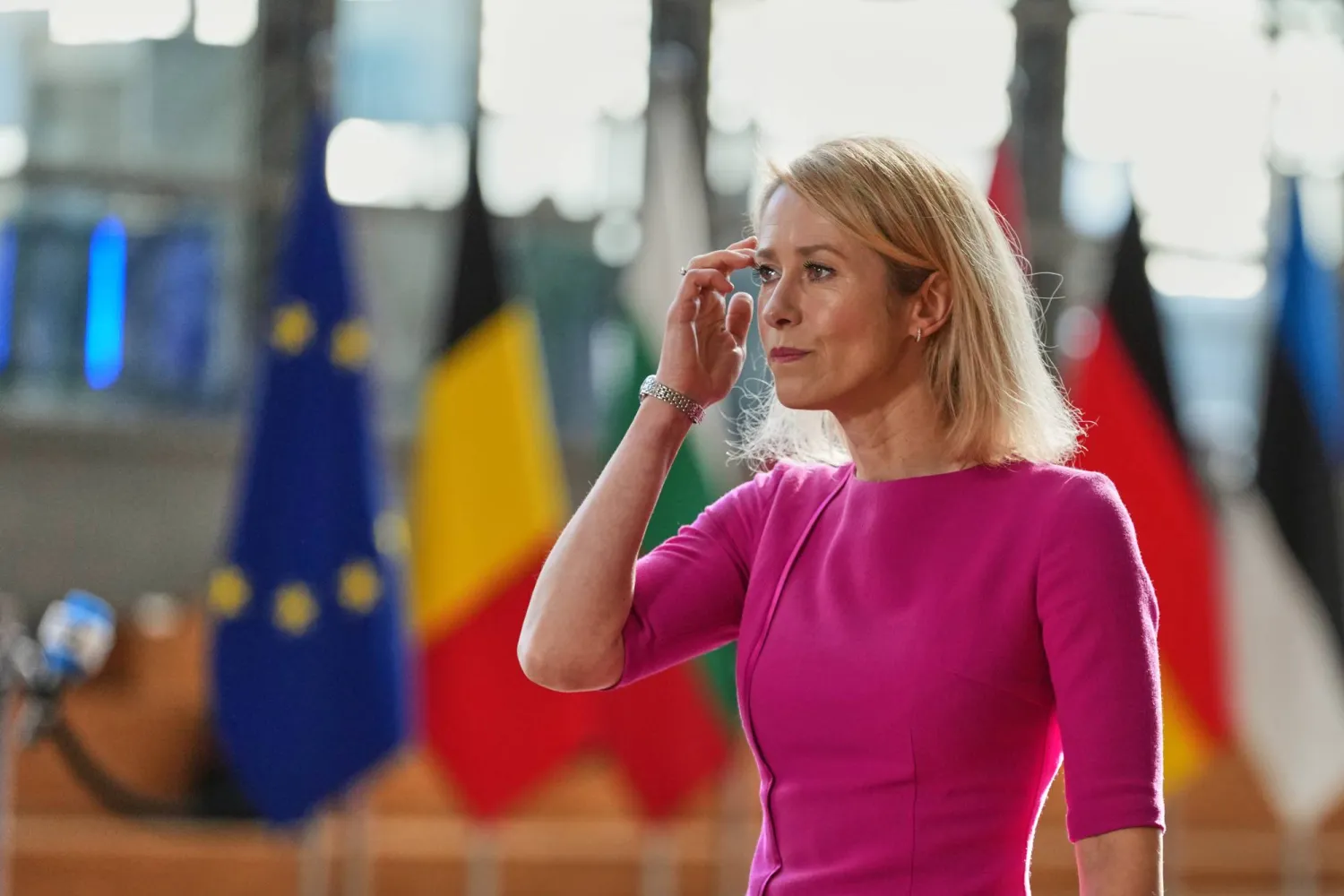
US Wants to 'Divide Europe', EU's Kallas Tells FT

European Union foreign policy chief Kaja Kallas arrives for a meeting of EU foreign ministers and representatives of the Gulf Cooperation Council at the European Council building in Brussels, Belgium, Thursday, March 5, 2026. (AP Photo/Virginia Mayo)
TT

US Wants to 'Divide Europe', EU's Kallas Tells FT

European Union foreign policy chief Kaja Kallas arrives for a meeting of EU foreign ministers and representatives of the Gulf Cooperation Council at the European Council building in Brussels, Belgium, Thursday, March 5, 2026. (AP Photo/Virginia Mayo)

European Union foreign policy chief Kaja Kallas said the US wants to "divide Europe" and doesn't "like the European Union" in an interview published by the Financial Times on Friday, after more than a year of turmoil in transatlantic relations.

"What I think is actually important for everybody to understand is that the US has been very clear that they ‌want to divide ‌Europe. They don't like the ‌European ⁠Union," Kallas told the ⁠FT.

US President Donald Trump has repeatedly targeted the European Union in his second term, imposing tariffs on member countries and others and talking about annexing Greenland - a move that could effectively end the NATO alliance.

This week, Trump's administration ⁠launched trade investigations into the EU and ‌other countries, including ‌China, India, Japan, South Korea and Mexico, over what ‌it said were unfair trade practices. Under the ‌investigation, the countries could face new tariffs by this summer, after the US Supreme Court tore down much of Trump's tariff program last month.

Kallas said ‌the United States' approach to the EU echoed tactics used by the bloc's ⁠adversaries, ⁠according to the FT.

EU countries should not be looking to deal with Trump bilaterally, she said, and instead should deal with him together, "because we are equal powers when we are together," the FT reported.

On defense, however, Kallas said the bloc needed "to buy from America because we don't have the assets or the possibilities or the capabilities that we need," adding that Europe needed to invest in its own defense industry.


China's Xi to Visit North Korea in Push for Deeper Ties

(FILES) This picture taken on September 4, 2025 and released from North Korea's official Korean Central News Agency (KCNA) on September 5, 2025 shows North Korean leader Kim Jong Un (L) shaking hands with Chinese President Xi Jinping in Beijing. STR / KCNA VIA KNS/AFP
TT

China's Xi to Visit North Korea in Push for Deeper Ties

(FILES) This picture taken on September 4, 2025 and released from North Korea's official Korean Central News Agency (KCNA) on September 5, 2025 shows North Korean leader Kim Jong Un (L) shaking hands with Chinese President Xi Jinping in Beijing. STR / KCNA VIA KNS/AFP

China said on Friday President Xi Jinping would visit North Korea on a two-day trip from June 8, his first in nearly seven years as Beijing looks to reassert ties with Pyongyang, its only formal treaty ally.

Beijing has worked to draw Pyongyang back into its fold after the COVID-19 pandemic froze exchanges and its leader, Kim Jong Un, deepened ties with Moscow by sending troops and weapons to support Russia's invasion of Ukraine, Reuters said.

"The message implicit from the Chinese side is ... ‌we are still the ‌principal actor when it comes to North Korea," said John ‌Delury, ⁠a senior fellow ⁠of the Asia Society. "One of the audiences is Russia."

Friday's announcement by the international department of the ruling Chinese Communist Party follows Xi's summits in Beijing last month with US President Donald Trump and Russian President Vladimir Putin.

Xi is visiting North Korea at the invitation of Kim, state news agency KCNA said.

Kim was a guest at a massive military parade in Beijing last September, travelling to the Chinese capital on his signature green ⁠armored train.

Passenger train services between the capitals resumed in March, after ‌a six-year suspension ushered in by the ‌pandemic, while Air China later restarted flights between them.

Bookings, however, have been limited to some ‌business travelers and exchange students, with Chinese tourists still excluded.

FIRST OVERSEAS TRIP THIS YEAR

Xi's ‌visit to Pyongyang will be his first overseas this year. The 72-year-old, who makes fewer trips abroad, last travelled internationally in late October to South Korea, where he also met Trump.

"At the symbolic level it is important for Xi to keep tabs on what's going on ‌in Pyongyang," said Delury, who said Xi visiting both Koreas within a year would be a "big win" for the peninsula.

"There's a ⁠kind of symmetry ⁠that the Chinese like to keep up" regarding the two Koreas, he added.

Trump, who met Kim three times in his first term, has previously said he would be open to meeting the North Korean leader again.

Since Xi became China's top leader in 2012, he has visited North Korea once, and its southern neighbor twice. He also visited Pyongyang in 2008 as vice president, meeting its then leader Kim Jong Il, the father of the current leader.

Kim called for an "exponential" expansion of Pyongyang's atomic arsenal this week when he visited a new factory to make nuclear material, KCNA said.

Experts have linked Kim's site visit to the impending meeting with Xi. Before his September visit to Beijing, Kim inspected plans for a new intercontinental ballistic missile, the "Hwasong-20".


Is Iran’s New Supreme Leader Taking up the Reins of Power?

An Iranian man holds up a portrait of Supreme Leader Mojtaba Khamenei during a rally in Tehran, Iran, 4 June 2026, amid a temporary ceasefire between Iran and the United States. (EPA)
TT

Is Iran’s New Supreme Leader Taking up the Reins of Power?

An Iranian man holds up a portrait of Supreme Leader Mojtaba Khamenei during a rally in Tehran, Iran, 4 June 2026, amid a temporary ceasefire between Iran and the United States. (EPA)

Iran's new supreme leader Mojtaba Khamenei has not been seen in public since being appointed, his health condition is a mystery, and it's unclear how much power he wields.

But over three months after his father and predecessor Ali Khamenei was killed in an air strike at the start of the US-Israeli war against Iran, there are signs he is alive and involved in government affairs.

US President Donald Trump said Wednesday that Khamenei was "involved, absolutely", while Secretary of State Marco Rubio said on Tuesday "there are indications out there that he is increasingly engaging at some level".

Inside Iran, President Masoud Pezeshkian and armed forces joint operational command chief General Ali Abdollah have reported meeting Mojtaba Khamenei, even if no images ever filtered out.

He has communicated through around a dozen written statements in his name, the latest of which -- a diatribe against the "malicious enemy" -- was read out on Thursday at a ceremony commemorating the 37th anniversary of the death of revolutionary founder Khomeini.

"Mojtaba, likely with the assistance of his office, probably plays a role overseeing the general direction of policy, including topline positions for negotiations with the US," said Farzan Sabet, an Iran expert at the Geneva Graduate Institute.

"But his level of personal engagement with policy is probably far below that of his father" due to the security situation and his health.

Multiple Iranian officials have confirmed Mojtaba Khamenei was wounded in a US-Israeli strike, although there have been contradictory accounts over the extent of his wounds and if they were sustained in the very same strike that killed his father.

"As the security condition normalizes, and his health improves, I would expect him to play a bigger role," Sabet added.

- 'Close to dominant players' -

"The role of Mojtaba Khamenei is unclear. It is very unlikely at this point that he has the degree of influence that his father used to have," Thomas Juneau, professor at the University of Ottawa told AFP.

But he added it "is also known that he is close to many of the dominant players today", including key figures in the Revolutionary Guards (IRGC) ideological army.

Juneau said that power appeared to be in the hands of an "informal committee" of IRGC commanders and a handful of senior politicians including parliament speaker Mohammed Bagher Ghalibaf, himself a former IRGC commander.

The latest of Khamenei's statements was read out on Thursday at the ceremony commemorating the death of Khomeini.

Like previous messages, it echoed the vociferously anti-American and anti-Israel rhetoric of his father, accusing the United States and Israel of trying to sow "division" among Iranians after suffering a "decisive blow" during the war.

But there was no surprise appearance by Mojtaba at the commemoration, an event his father had attended every year since Khomeini's death in 1989.

This year, an empty chair bearing Ali Khamenei's portrait stood at the mausoleum.

Mojtaba Khamenei's message was read out by Tehran's Friday prayer leader Mohammad Javad Haj Ali Akbari, while his previous statements have been relayed by state television.

Despite his absence from public view, authorities have made sure that Mojtaba Khamenei is present in the minds of Iranians.

Giant billboards around Tehran showing a triple image of Khomeini, Ali Khamenei and the regime's third supreme leader have stared down at residents since March, in a clear bid to show continuity of leadership.

- 'Change and continuity' -

It remains to be seen whether Mojtaba Khamenei will replicate the rule of his father, who was all powerful during his more than three-and-a-half decades in power.

In contrast to the vertical power structure under his father, the leadership is set to be more fuzzy with Mojtaba potentially set to be just one player in a set-up where the IRGC will play a more dominant role.

"A formal hierarchy still remains in Tehran, but in practice, power and authority are likely exercised in a more fragmented and diffuse manner," said Sabet.

Juneau said he expected "change and continuity" in Iran's system, with its "core identity" unchanged but a shift in how power is wielded after the death of Ali Khamenei, who was known for managing competing power centers.

"Mojtaba does not have his father's authority," he said.

"He does not appear to have the ability to play the role of balancer-in-chief and final arbiter of the system to the extent that his father did."


Mali Offers $3.5 Million Reward for Sahel Al-Qaeda Chief

Iyad Ag Ghaly in his last appearance, when he vowed to defeat Mali, Burkina Faso, Niger, and their Russian allies (circulated)
TT

Mali Offers $3.5 Million Reward for Sahel Al-Qaeda Chief

Iyad Ag Ghaly in his last appearance, when he vowed to defeat Mali, Burkina Faso, Niger, and their Russian allies (circulated)

Mali's military government on Thursday offered a $3.5 million reward for information leading to the arrest or killing of the leader of Al-Qaeda's Sahel branch.

Iyad Ag Ghaly, head of the Group for the Support of Islam and Muslims (JNIM), is the region's most wanted man as the leader of the biggest militant force battling the juntas ruling many of the Sahel states.

Ghaly, a former Malian diplomat and Tuareg rebel, is also on the US terrorist list and the subject of an International Criminal Court arrest warrant. Since its creation in 2017, his JNIM has been blamed for a number of daring attacks on the military authorities.

In a statement read on national television, the military-run security ministry offered a two billion CFA francs ($3.5 million) bounty for information helping the "capture or neutralization" of Ghaly and $2.5 million for one of his deputies, Amadou Kouffa. According to AFP, it also offered cash for intelligence on two Tuareg rebel leaders.

"These individuals are actively sought by the authorities for their alleged involvement in the planning, organization and execution of terrorist acts that have threatened the safety of people and their property within the national territory," the statement said.

Mali has been confronted by nearly a decade and a half of unrest led by the JNIM and fighters associated with ISIS, as well as by criminal gangs. The country has been ruled by the military since a 2020 coup.