


NKorea Fires About 10 Missiles Toward Sea During US-SKorea Drills

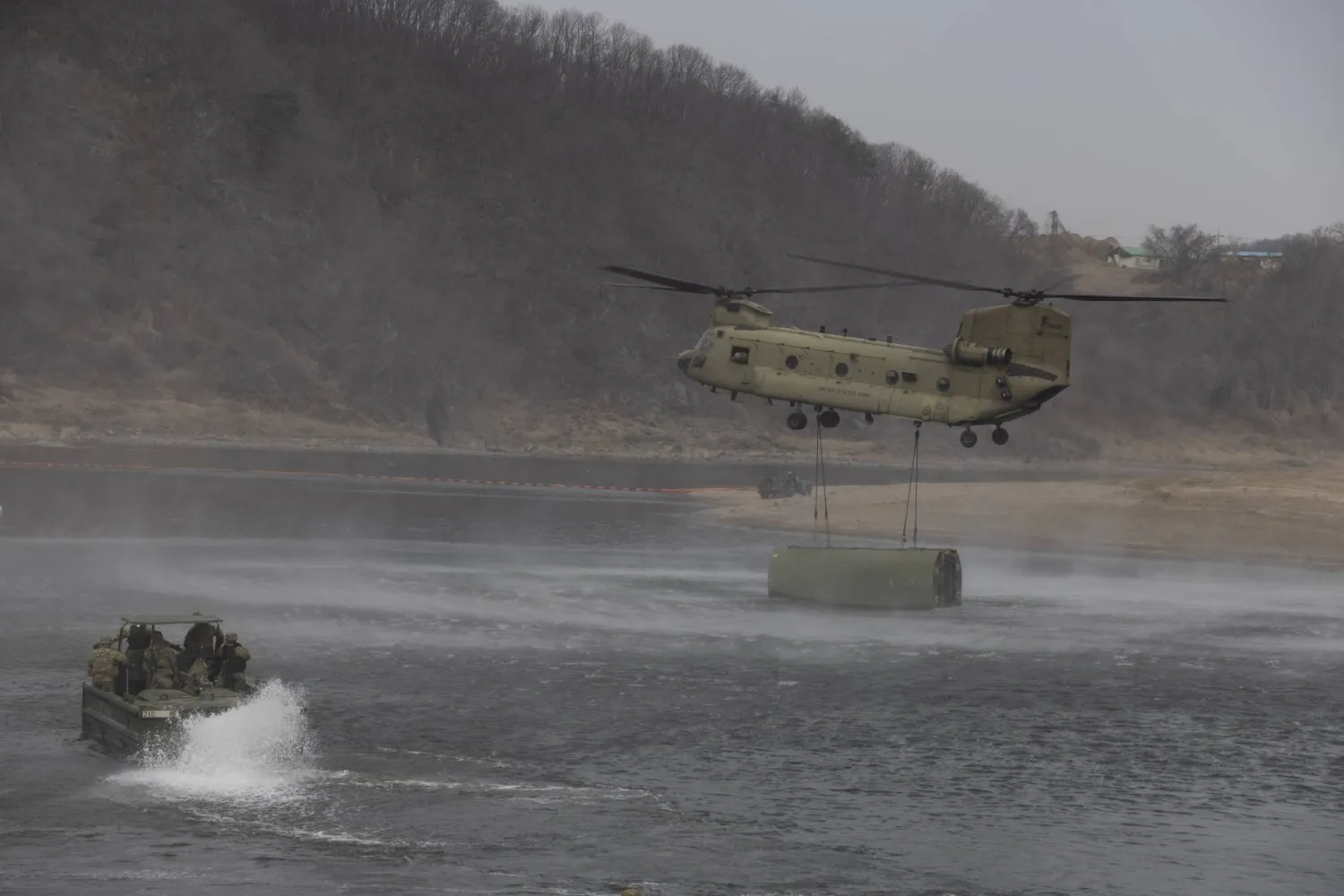
US soldiers from the 2nd Infantry Division/ROK-US Combined Division, conducts a combined exercise (maneuvering, wet gap crossing) with South Korean soldiers from the Lightning Brigade, Capital Mechanized Infantry Division and 7th Engineer Brigade, as part of the Freedom Shield 26 exercise, in Yeoncheon, Gyeonggi province, South Korea, 14 March 2026. EPA/JEON HEON-KYUN
TT

NKorea Fires About 10 Missiles Toward Sea During US-SKorea Drills

US soldiers from the 2nd Infantry Division/ROK-US Combined Division, conducts a combined exercise (maneuvering, wet gap crossing) with South Korean soldiers from the Lightning Brigade, Capital Mechanized Infantry Division and 7th Engineer Brigade, as part of the Freedom Shield 26 exercise, in Yeoncheon, Gyeonggi province, South Korea, 14 March 2026. EPA/JEON HEON-KYUN

North Korea on Saturday fired about 10 ballistic missiles toward the eastern sea, South Korea’s military said, staging its own show of force as the rival South conducts a joint military exercise with the United States.

South Korea’s Joint Chiefs of Staff said the missiles were fired from an area in Sunan, the site of Pyongyang’s international airport, and flew about 350 kilometers (220 miles).

Japanese Defense Minister Shinjiro Koizumi said the weapons landed outside the country’s exclusive economic zone and that there were no reports of damage to planes or ships.

The South’s Joint Chiefs said the military has stepped up surveillance and is maintaining readiness against possible additional launches while closely sharing information with the US and Japan.

The launches came as the US and South Korean militaries conduct their annual springtime exercises involving thousands of troops while the Trump administration also wages an escalating war in the Middle East.

The war has raised concerns about potential security lapses in South Korea, as local media — citing security camera footage and other images — have speculated that the US is relocating some missile defense assets stationed in the country to support operations against Iran.

When asked by The Associated Press this week whether US Forces Korea was moving interceptor missiles from its Terminal High Altitude Area Defense, or THAAD, system in Seongju to the Middle East, South Korean President Lee Jae Myung’s office said it could not confirm details about US military operations.

The office said the potential relocation of US military assets would not affect the allies’ defense posture against nuclear-armed North Korea, while also citing South Korea’s conventional military strength. It earlier gave a similar response to reports about the possible relocation of Patriot missile defense systems from South Korea.

The launches came hours after South Korean Prime Minister Kim Min-seok, Seoul’s No. 2 official after Lee, met US President Donald Trump in Washington and expressed hope for renewed diplomacy between Washington and Pyongyang. Lee seeks improved inter-Korean relations, and some of his top officials have said Trump’s expected visit to China, starting March 31, may create an opening with Pyongyang.

But Saturday’s launches appeared to dim such hopes, signaling defiance by Pyongyang, which in recent months has hardened its stance toward Seoul and urged Washington to drop denuclearization demands as a precondition for talks.



Iranian Official Says Kharg Oil Exports 'Normal', after US Strikes

A satellite image of Iran's Kharg Island (AFP)
TT

Iranian Official Says Kharg Oil Exports 'Normal', after US Strikes

A satellite image of Iran's Kharg Island (AFP)

Oil export operations from Iran's Kharg island in the Gulf were proceeding as normal Saturday after US strikes on the crude export hub which caused no casualties, a regional official said.

Activities of oil companies "at this export terminal are continuing as normal", said Ehsan Jahaniyan, deputy governor of Iran's southern Bushehr province, quoted by the IRNA news agency.

The Fars news agency, citing sources on the island, earlier reported there had been no damage to oil facilities after President Donald Trump said US strikes had destroyed only military targets, AFP reported.

Trump had threatened to target oil infrastructure on the island, a crucial hub for Iran, if Tehran continues to block the strategic Strait of Hormuz.

Iran has, in turn, threatened to target US-linked oil infrastructure.

Deputy governor Jahaniyan said that after the attacks "daily life and routine activities of the residents are also fully maintained."

The attack "did not cause any casualties among military personnel, company employees, or residents of Kharg island, he added.

According to Fars, the US operation "tried to damage the army's defenses, the Joshan naval base, the airport control tower and the helicopter hangar of the Iran Continental Shelf Oil Company."

Kharg Island, a scrubby stretch of land in the northern Gulf around 30 kilometres (19 miles) off the Iranian mainland, handles roughly 90 percent of Iran's crude exports.


Four Killed in Russian Air Attack on Ukraine

Four Killed in Russian Air Attack on Ukraine
TT

Four Killed in Russian Air Attack on Ukraine

Four Killed in Russian Air Attack on Ukraine

Russia hammered Ukraine with missiles and drones overnight, killing four people and causing damage across five regions of the country, Ukrainian officials said on Saturday.

The main target was energy infrastructure outside the capital Kyiv, President Volodymyr Zelenskiy said, adding that residential buildings, schools and businesses were also damaged, Reuters reported.

He said the Sumy, Kharkiv, Dnipro and Mykolaiv regions were also targeted in an attack that included around 430 drones and 68 missiles, most of which were downed by air defences.

Saturday's strikes come as the spiraling Iran conflict has distracted international attention from a US-backed peace push in the four-year war, which Kyiv says Moscow has no interest in ending.

"Russia will try to exploit the war in the Middle East to cause even greater destruction here in Europe, in Ukraine," Zelenskiy wrote on X.

He repeated his call for Kyiv's partners to boost production of critical air-defence weapons, stocks of which have been diminishing as the US and its allies in the Gulf have fended off Iranian strikes.

Russia's winter attacks on Ukraine have left swathes of major cities without power or heating, part of a campaign to weaken resolve as Moscow's troops press a battlefield offensive and demand Kyiv cede more territory in the east.

Ukraine's forces have targeted Russian strategic infrastructure such as oil refineries, depots and terminals in long-range strikes.

Ukraine's Energy Ministry said on Saturday that consumers in six regions were without electricity after the overnight strikes and Russian shelling of frontline areas.

"There's no way Russia will stop," said local resident Natalia Fetko, 57, whose building was damaged in the strike. "Nothing is enough for them."

All four deaths occurred in the Kyiv region, where 15 people were also wounded and damage recorded in four districts, according to regional military administrator Mykola Kalashnyk.

Saturday's attack also prompted NATO member Poland to scramble jets to protect its airspace, but no violations were observed, Warsaw's military said.


Son of Ousted Shah Says Ready for Iran Transition 'Under My Leadership'

Smoke rises following an explosion during a protest marking the annual al-Quds Day (Jerusalem Day) on the last Friday of the holy month of Ramadan, amid the US-Israeli conflict with Iran, in Tehran, Iran, March 13, 2026.- Reuters
TT

Son of Ousted Shah Says Ready for Iran Transition 'Under My Leadership'

Smoke rises following an explosion during a protest marking the annual al-Quds Day (Jerusalem Day) on the last Friday of the holy month of Ramadan, amid the US-Israeli conflict with Iran, in Tehran, Iran, March 13, 2026.- Reuters

The exiled son of Iran's last shah who was ousted by the 1979 revolution said on Saturday he was ready to lead a transition "as soon as the Islamic Republic falls".

In a message on his social media channels, US-based Reza Pahlavi said he had already been working to select individuals both inside and outside Iran to serve on what he called a "Transitional System".

Pahlavi leads one of several opposition movements based outside Iran but his prominence grew after January protests against the clerical system, with some demonstrators calling for a return of the monarchy, according to AFP.

Longstanding supreme leader Ali Khamenei was killed on February 28 in US-Israeli airstrikes but after a fortnight of war the clerical system remains in place even if his successor, his son Mojtaba, has yet to make a public appearance.

Pahlavi said that Saeed Ghasseminejad, senior Iran and financial economics advisor at the US-based think tank Foundation for Defense of Democracies (FDD), which is staunchly critical of the Islamic republic, had been leading the process to select members of a transitional body.

"Capable individuals both inside and outside the country have been identified and evaluated to lead various sections of the Transitional System," he said

"The Transitional System, under my leadership, will be ready to assume governance of the country as soon as the Islamic Republic falls, and in the shortest possible time, establish order, security, freedom, and the conditions for Iran's prosperity and flourishing," he added.

In a boost to Pahlavi, vast pro-monarchy rallies took place in February in Munich and several cities in North America in the biggest yet such show of support.

But he has notably also failed to win recognition from US President Donald Trump, who has never officially met with Pahlavi and repeatedly expressed scepticism over his ability to lead Iran.

"They talk about the son of the shah, they talk about other people, but (he) hasn't been there in many years," Trump said this week.

Pahlavi was undergoing air force training in the US when his father Mohammad Reza Pahlavi was ousted and never returned to the country.

Trump has repeatedly referred to Venezuela, where in January US forces captured president Nicolas Maduro, with Washington now working with his former deputy Delcy Rodriguez.

But it remains unclear how such a scenario could play out in Iran.

"I like the idea of internal because it works well, I think we have proven that so far in Venezuela," Trump said.