

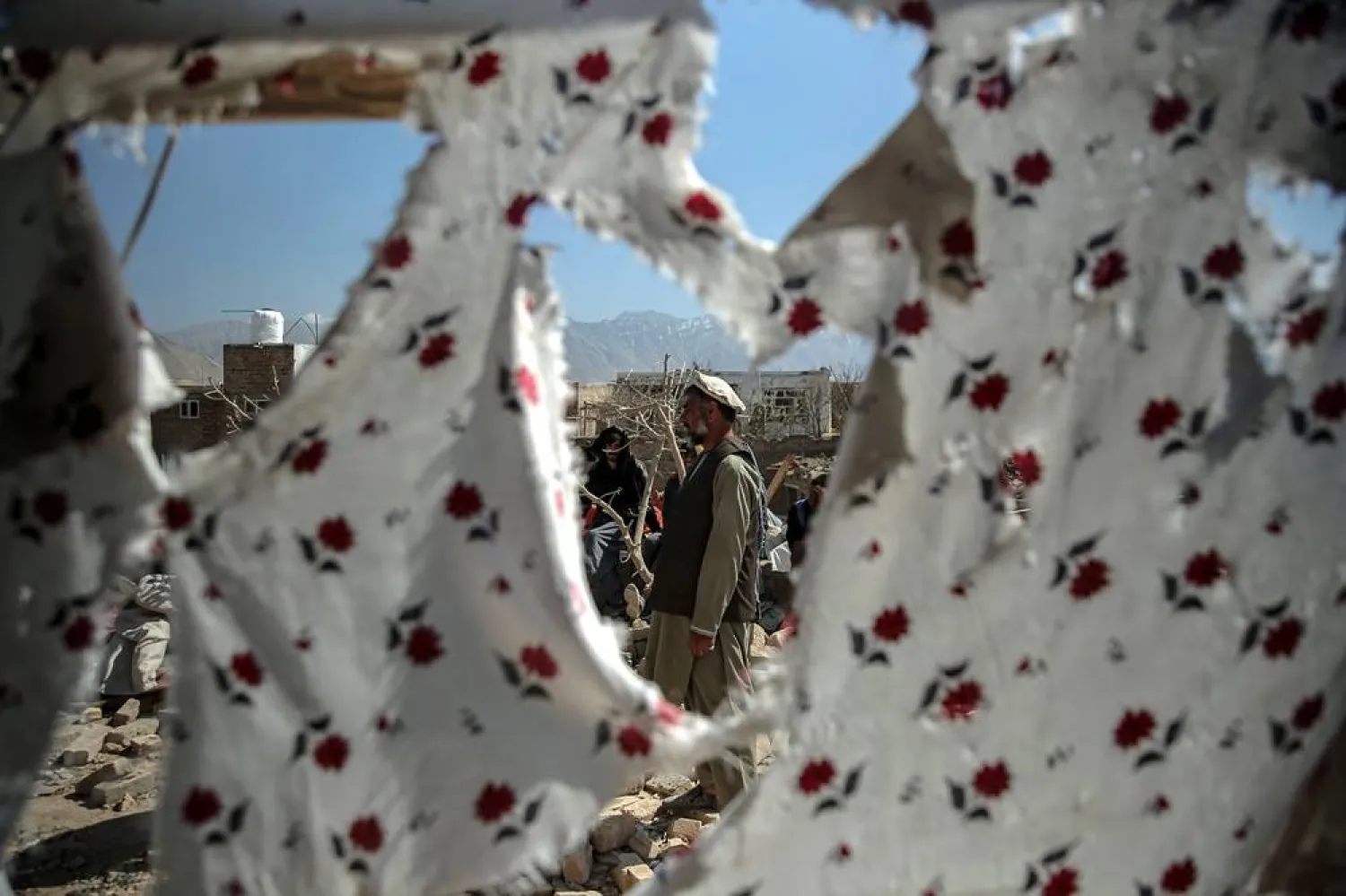

Pakistan Says Hit Military Facilities in Afghanistan

A man surveys the damage following alleged Pakistani airstrikes in Kabul, Afghanistan, 14 March 2026. (EPA)
TT

Pakistan Says Hit Military Facilities in Afghanistan

A man surveys the damage following alleged Pakistani airstrikes in Kabul, Afghanistan, 14 March 2026. (EPA)

Pakistan said on Sunday its forces had attacked military facilities in southern Afghanistan, as well as "terrorist hideouts", in the latest strikes between the two sides.

Security sources said troops "effectively destroyed technical support infrastructure and equipment storage facility in Kandahar", which is home to the Taliban administration's supreme leader Hibatullah Akhundzada.

Another strike targeted a tunnel in Kandahar purportedly used by the Afghan Taliban and the Pakistani Taliban militant group or TTP, which Islamabad blames for a wave of strikes, they added.

Local residents in Kandahar told AFP they saw jet planes flying over the city and heard explosions during the night.

"Military planes flew over the mountain where there is a military facility, and an explosion followed," one said, adding flames could be seen.

An air strike was also heard in Spin Boldak, southeast of Kandahar, residents said, while authorities in the eastern border province of Khost said there were clashes on Saturday night.

Taliban government spokesman Zabihullah Mujahid told AFP that the strikes caused some damage to a drug rehabilitation center and an empty container in Kandahar.

"The places they are talking about are far away from these two places," he added.

Pakistan said on Saturday it had thwarted "drone attacks" launched by Afghanistan which were intercepted on Friday night.

At least three locations were targeted, including the Pakistani military headquarters in Rawalpindi, near the capital Islamabad, authorities said.

Pakistan President Asif Ali Zardari's office said the Afghan Taliban had "crossed a red line" by targeting civilians and promised a response.

Islamabad launched a military operation against Afghanistan last month, targeting what it said were Islamist extremists following attacks in Pakistan.

The Taliban government has denied any involvement or the use of Afghan territory for militancy, while Pakistan insists it does not target civilians.

There have been repeated clashes at the border in recent weeks, hampering trade and forcing nearby residents to leave their homes.

The UN mission in Afghanistan said on Friday that at least 75 civilians have been killed and 193 injured in Afghanistan as a result of the clashes since February 26.



Google Maps Will Show ‘Lake America’ in US, not ‘Lake Ontario’

A sign reading "Lake Ontario, Now and Always," unveiled by Ontario Premier Doug Ford at Fifty Point Conservation Area, after US President Donald Trump signed an executive order renaming Lake Ontario as "Lake America," near Grimsby, Ontario, Canada, August 29, 2026. (Reuters)
TT

Google Maps Will Show ‘Lake America’ in US, not ‘Lake Ontario’

A sign reading "Lake Ontario, Now and Always," unveiled by Ontario Premier Doug Ford at Fifty Point Conservation Area, after US President Donald Trump signed an executive order renaming Lake Ontario as "Lake America," near Grimsby, Ontario, Canada, August 29, 2026. (Reuters)

Google Maps has changed the ‌name of "Lake Ontario" to "Lake America" for US users to reflect President Donald Trump's executive order renaming the lake, according to a Google statement.

Trump announced on Thursday that he was changing the name of the smallest of the five Great Lakes, part of an escalating trade feud with Canada that has prompted the two countries to impose reciprocal tariffs on billions of dollars in goods.

The president's order affects the US Geographic Names Information System (GNIS), which sets ‌the standards for ‌official US maps. It does not have ‌any ⁠impact on Canadian ⁠naming conventions or how the rest of the world refers to the lake.

"Since we update Google Maps to reflect name changes in official government sources, which is GNIS for the US, people using Maps in the US will see 'Lake America,' those in Canada will continue to see 'Lake ⁠Ontario,' and those outside of the US and ‌Canada will see both names," ‌Google said in a blog post issued on Saturday.

The White ‌House, Carney's office and Ford's office did not immediately comment ‌on Sunday on Google's decision.

Google Maps made a similar change to the Gulf of Mexico last year, labeling it the "Gulf of America" following Trump's executive order on his first day ‌in office renaming the body of water.

Canadian Prime Minister Mark Carney immediately rejected the lake's name ⁠change on ⁠Thursday. Democratic Governor Kathy Hochul of New York, which shares a long border with Canada, declared that "New York won't be calling it that," while Phil Scott, the Republican governor of neighboring Vermont, called Trump's decision "petty and disappointing" on social media.

The premier of Ontario, Doug Ford, on Saturday unveiled a large lakeside sign that reads, "Lake Ontario: Now and Always," in both English and French.

"President Trump can call it whatever he wants, but I can tell you, the rest of the world will always call it Lake Ontario," Ford said.


Trump Says US Will Refill Strategic Petroleum Reserve Using Venezuelan Oil

An oil tanker sails off the coast of Maracaibo, Venezuela, 29 August 2026. (EPA)
TT

Trump Says US Will Refill Strategic Petroleum Reserve Using Venezuelan Oil

An oil tanker sails off the coast of Maracaibo, Venezuela, 29 August 2026. (EPA)

US President Donald Trump said on Sunday that oil from a recently struck deal with Venezuela will be used to replenish the Strategic Petroleum Reserve, which has been drawn down sharply in recent years to respond to global supply disruptions ‌and high ‌fuel prices.

Trump said in ‌a ⁠social media post ⁠that the "topping out" process will begin shortly, describing the Venezuelan oil as a “Gift from Venezuela to the People of the United States.”

It is unclear ⁠how quickly the Venezuela ‌deal could ‌provide oil for the reserve or deliver ‌any near-term benefit to US motorists. ‌

The agreement Trump announced on Friday is aimed at reviving Venezuela's battered oil industry, but it will ‌require significant investment and infrastructure work before production can rise substantially.

The ⁠reserve ⁠held about 290 million barrels as of August 21, near a 44-year low, after the United States drew down its stockpile under both the Biden and Trump administrations in response to global supply disruptions, including Russia's invasion of Ukraine and the conflict with Iran.


Saved by a Lunch Break: Nepal Floods Destroyed Many Schools, but Students at This School Survived

 Mud covers the floor of a classroom damaged in the recent flash floods at the Shree Bagheswori Madhyamik School in Galchhi, Dhading district of Nepal Sunday, Aug. 30, 2026. (AP)
Mud covers the floor of a classroom damaged in the recent flash floods at the Shree Bagheswori Madhyamik School in Galchhi, Dhading district of Nepal Sunday, Aug. 30, 2026. (AP)
TT

Saved by a Lunch Break: Nepal Floods Destroyed Many Schools, but Students at This School Survived

 Mud covers the floor of a classroom damaged in the recent flash floods at the Shree Bagheswori Madhyamik School in Galchhi, Dhading district of Nepal Sunday, Aug. 30, 2026. (AP)
Mud covers the floor of a classroom damaged in the recent flash floods at the Shree Bagheswori Madhyamik School in Galchhi, Dhading district of Nepal Sunday, Aug. 30, 2026. (AP)

In one of the areas worst hit by Wednesday’s catastrophic floods in Nepal, a group of schoolchildren managed to survive when they happened to leave their classroom for their lunch break.

Children attending other classes at the school in Dhading also escaped because teachers told them to quickly evacuate their classrooms shortly before the waters came crashing in.

“The teachers said, ‘There is a flood and you should leave bags and tiffins,’” said Lakshmi Shrestha, the mother of a student attending the school. “That’s how they managed to survive.”

Shrestha was among mothers and children who began to return to their school on Sunday to find the kids' belongings and see what could be salvaged. The majority of the children at the school appeared to have survived the floods, the families said.

Thick brown and gray mud coated the surfaces of school benches, walls and notebooks while the school’s courtyard was filled with sediment. Lines on the walls showed how high the water rapidly rose. A pile of small mud-caked backpacks, some with colorful key chains, were on the benches and floors, waiting to be claimed.

Kopila Mizar, the mother of a student, was unable to find her son’s backpack, but remained positive.

“My son is alive, that is my biggest happiness,” she said.

At least 69 schools in Nepal’s flood-devastated districts have been destroyed or damaged, putting education at risk for nearly 19,000 children, according to the nonprofit Save the Children. Those numbers are likely to rise as rescue teams reach more areas, they said.

The government ordered schools and universities to shut down for three days following torrential rains that triggered severe flash floods and landslides across parts of the country. University exams were also paused.

With communities still receiving constant flood warnings advising them to move to higher, safer areas, it’s unclear when classes will be able to resume.

Nepal’s disaster agency said Sunday the death toll had climbed to 788 with 2,502 missing, while Chinese authorities reported 16 deaths and 546 missing on the Chinese side of the border.

The missing include hundreds of people from over a dozen countries who were in the region to work, visit the mountains or make a pilgrimage to a peak. On Sunday, Chinese state media said 261 foreigners were missing in Tibet, including over a hundred Nepalis and others from around the world.