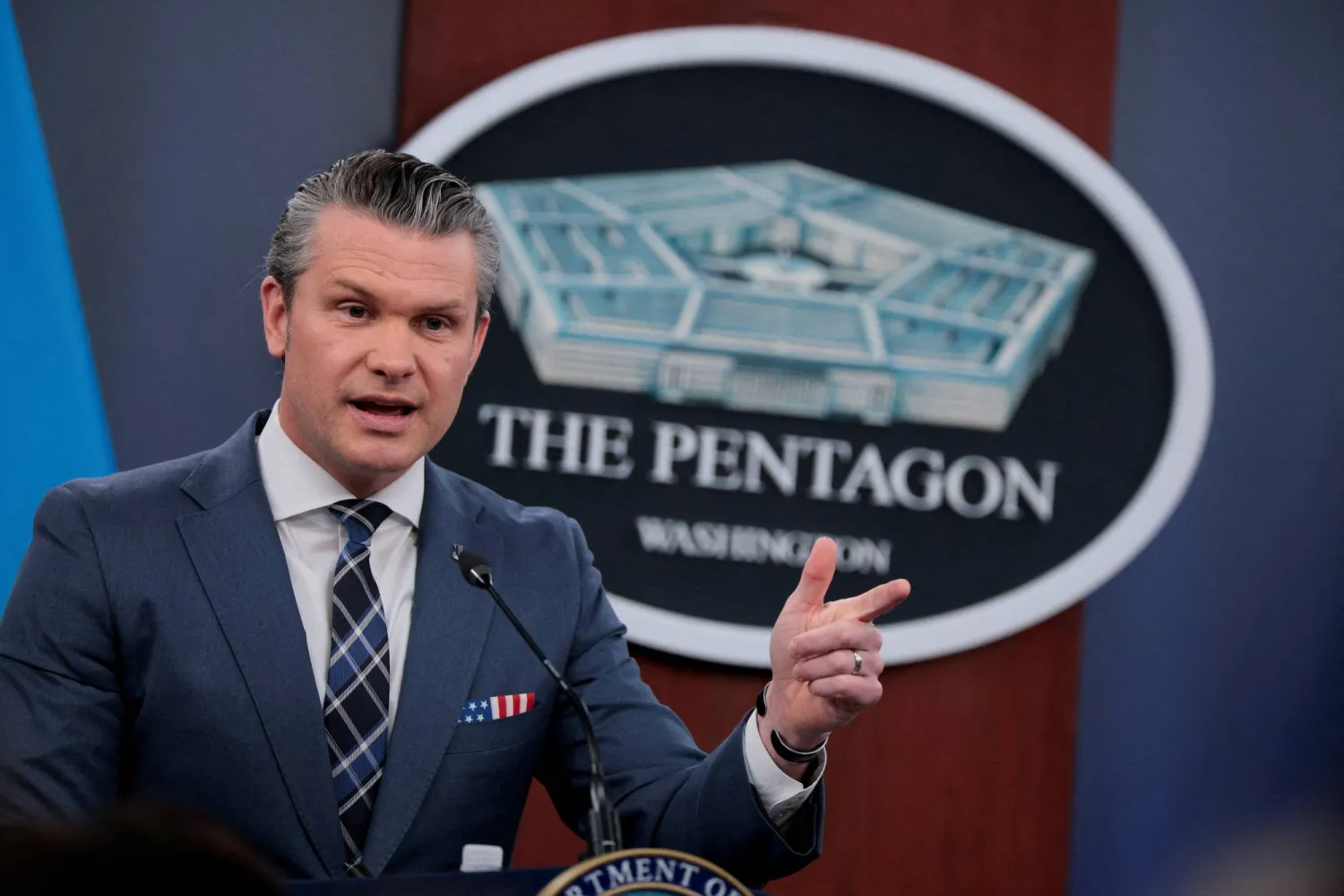
Pentagon Seeks $200 Billion in Additional Funds for the Iran War

US Secretary of Defense Pete Hegseth holds a briefing with Chairman of the Joint Chiefs of Staff General Dan Caine, amid the US-Israeli war on Iran, at the Pentagon in Washington, D.C., US, March 19, 2026. REUTERS/Evan Vucci
TT

Pentagon Seeks $200 Billion in Additional Funds for the Iran War

US Secretary of Defense Pete Hegseth holds a briefing with Chairman of the Joint Chiefs of Staff General Dan Caine, amid the US-Israeli war on Iran, at the Pentagon in Washington, D.C., US, March 19, 2026. REUTERS/Evan Vucci

The Pentagon is seeking $200 billion in additional funds for the Iran war, a senior administration official says.

The department sent the request to the White House, according to the official, who spoke on condition of anonymity to discuss the private information.

It’s an extraordinarily high number and comes on top of extra funding the Defense Department already received last year in President Donald Trump’s big tax cuts bill, The AP news reported.

Congress is bracing for a new spending request but it is not clear the White House has transmitted the request for consideration. It is unclear the spending request would have support.

The new funding request was first reported by The Washington Post. Asked about the figure at a press conference Thursday, Defense Secretary Pete Hegseth did not directly confirm the figure, saying it could change. But he said “we’re going back to Congress and our folks there to to ensure that we’re properly funded.”

“It takes money to kill bad guys,” Hegseth said.


Israel Defense Minister Denies Report of PM-Army Rift on Eve of Election

 Israeli Prime Minister Benjamin Netanyahu and Defense Minister Israel Katz attend a graduation ceremony of new Israeli army officers at a base near Mitzpe Ramon, Israel, October 21, 2026. (Reuters)
Israeli Prime Minister Benjamin Netanyahu and Defense Minister Israel Katz attend a graduation ceremony of new Israeli army officers at a base near Mitzpe Ramon, Israel, October 21, 2026. (Reuters)
TT

Israel Defense Minister Denies Report of PM-Army Rift on Eve of Election

 Israeli Prime Minister Benjamin Netanyahu and Defense Minister Israel Katz attend a graduation ceremony of new Israeli army officers at a base near Mitzpe Ramon, Israel, October 21, 2026. (Reuters)
Israeli Prime Minister Benjamin Netanyahu and Defense Minister Israel Katz attend a graduation ceremony of new Israeli army officers at a base near Mitzpe Ramon, Israel, October 21, 2026. (Reuters)

Israel's defense minister denied on Monday reports of a rift between Prime Minister Benjamin Netanyahu and the army over Iran, as the premier's rivals seized on the story as a line of attack a day before close elections.

Over the course of a neck-and-neck race, Netanyahu has campaigned heavily on his security credentials, insisting only he can "finish the job" in the US-Israeli war on Iran.

But his main rival, ex-army chief Gadi Eisenkot, has accused him of playing up the Iran threat when it suits him politically, and of failing to accomplish his war goals.

Israel's Channel 12 reported on Sunday, citing unnamed sources, that there had been a confrontation between Netanyahu and army chief Lieutenant General Eyal Zamir over an unspecified new directive on Iran.

The premier dismissed the report as "rubbish" during a TV appearance, and Katz characterized it as an effort to cast doubt on the Netanyahu bloc's judgement on the eve of the polls.

"The reports about gaps between the political echelon and the army on the Iran issue are entirely baseless and false," Katz said on X, insisting there was "complete" coordination between the two.

In its report, Channel 12 said Zamir had demanded a detailed discussion, as well as legal guarantees and the signatures of the political leadership before carrying out the directive he had received.

The outlet did not offer details of the directive, but cited sources saying there were concerns within the army that the war might be exploited for political gain.

Katz in his statement Monday said "unequivocally that there was no intention on Israel's part to initiate an attack on Iran before the elections".

- 'Restore responsibility' -

Opposition leader Yair Lapid referenced the report in a post on X, accusing Netanyahu of seeking to put off the vote.

"Tonight it was published that he wants to set off an escalation and a confrontation with Iran, just to postpone the elections," he said.

"This man has lost his grip. We absolutely must send him home."

Eisenkot, meanwhile, said Zamir had his complete trust, adding he would not stand for the military being "turned into a tool in Netanyahu's survival campaign".

"I warn Netanyahu: Do not dare place your political interests above the state's security," Eisenkot wrote on X Sunday night.

"In two days, the citizens of Israel will put an end to this reckless government and restore responsibility, decency and Israel's security."

On the campaign trail, Netanyahu has sought to portray Eisenkot as soft on Iran and beholden to Palestinian interests, playing to voters' opposition to the creation of a Palestinian state.

Netanyahu had warned on Sunday "that our enemies, Iran and its proxies, could challenge us with attacks in order to disrupt the elections", adding: "Don't test us."

But Iran's foreign ministry said it did not matter who prevailed in the vote.

"It makes no difference to us who, in these elections, takes the helm of a regime that has brought nothing but violence and massacres to our region," said ministry spokesman Esmaeil Baqaei.


Iran Says Outcome of Israeli Elections ‘Makes No Difference’

A woman walks past a mural bearing the Iranian national flag in Tehran on October 26, 2026. (AFP)
TT

Iran Says Outcome of Israeli Elections ‘Makes No Difference’

A woman walks past a mural bearing the Iranian national flag in Tehran on October 26, 2026. (AFP)

Iran's foreign ministry said Monday that the outcome of the Israeli elections in which Prime Minister Benjamin Netanyahu is facing a tight race will make "no difference".

"It makes no difference to us who, in these elections, takes the helm of a regime that has brought nothing but violence and massacres to our region," said ministry spokesman Esmaeil Baqaei in a weekly press briefing.

Tuesday's legislative elections will take place amid mounting threats by Israel and the United States to renew attacks on Iran after they launched their war in late February.

Netanyahu has in recent days repeatedly said the only way to remove the threat posed by Iran is to topple its government.

On Sunday, he told Israel's Channel 14 that he had "instructed the Mossad and the Israeli army to overthrow the Iranian regime".

Baqaei dismissed Netanyahu's remarks as "empty threats" and a "sign of desperation".


Thousands of Trucks Stuck as Partial Iran-Pakistan Trade Resumes

 Cargo trucks remain halted at the Gabd-Rimdan border crossing in Pakistan's Balochistan province on October 21, 2026, following the temporary suspension of trade between Pakistan and Iran. (AFP)
Cargo trucks remain halted at the Gabd-Rimdan border crossing in Pakistan's Balochistan province on October 21, 2026, following the temporary suspension of trade between Pakistan and Iran. (AFP)
TT

Thousands of Trucks Stuck as Partial Iran-Pakistan Trade Resumes

 Cargo trucks remain halted at the Gabd-Rimdan border crossing in Pakistan's Balochistan province on October 21, 2026, following the temporary suspension of trade between Pakistan and Iran. (AFP)
Cargo trucks remain halted at the Gabd-Rimdan border crossing in Pakistan's Balochistan province on October 21, 2026, following the temporary suspension of trade between Pakistan and Iran. (AFP)

Thousands of trucks remain stranded on both sides of the Iran-Pakistan border despite the resumption of limited overland trade between the two countries, southwest Pakistan business representatives told AFP on Monday.

Mir Naveed Jan Kalmati, president of the chamber of commerce for Gwadar city on Pakistan's Arabian Sea coast, said the frontier with Iran was "only partially open" to trade, with a vast backlog of vehicles at the border.

There were "three to four thousand trucks on the Iranian side and two to three thousand trucks on the Pakistani side," Kalmati said.

Only certain vehicles were being allowed across the border to clear the backlog after a week-long closure, he said.

Iran's ambassador to Pakistan, Reza Amiri Moghadam, said on X on Sunday there were no restrictions on the Iranian side, including for the export of liquefied petroleum gas (LPG).

He blamed the closures on "changes in the implementation of Pakistan's E-Form procedure for imports from Iran", which he said "have created a situation in which traders are effectively and literally unable to dispatch cargo from Iran to Pakistan".

Kalmati said companies on both sides of the border were urging authorities to allow the complete resumption of trade.

He said his members and drivers were "frustrated, they want to go back home, they want to continue their business".

Fida Ahmad Dashti a businessman in Kech district in Pakistan's southwest Balochistan province, said he had been told that only vehicles with paperwork prepared before October 16 were being allowed to cross the border.

Two other businessmen based in Balochistan confirmed their drivers had said only vehicles with documents prepared before October 16 were being allowed across the frontier.

The Gwadar Chamber of Commerce said in a statement on Saturday the suspension of the import of LPG and the "abrupt closure of the border" had led to "disrupting the national LPG supply chain, and causing prices to skyrocket".

Pakistan has attempted to mediate a peace deal in the Middle East war with Iran and its army chief, Field Marshal Asim Munir, was due to travel to Tehran on Monday, his second visit to the country in less than a week.