Cuba Hit by Second Nationwide Blackout in a Week

Cuba has been hit by several blackouts due to an aging power grid and a US fuel embargo. Yamil LAGE / AFP
TT

Cuba Hit by Second Nationwide Blackout in a Week

Cuba has been hit by several blackouts due to an aging power grid and a US fuel embargo. Yamil LAGE / AFP

Cuba plunged into darkness for the second time in less than a week on Saturday after its national power network failed again, strained by aging infrastructure and a US oil blockade.

As night fell, Havana's streets were mostly pitch black, with people navigating using phone lights or flashlights, just five days after the previous blackout.

In the touristy old city, some restaurants were able to stay open thanks to generators, with musicians playing music, but the regular blackouts have made life more difficult for Cubans.

"This is becoming unbearable," Ofelia Oliva, a 64-year-old Havana resident, told AFP.

"It hasn't even been a week since we experienced a similar situation. It is getting tiresome," Oliva said as she returned home after giving up on plans to visit her daughter.

The "total disconnection" of the national electricity system was due to an outage in a power unit at one of the country's thermoelectric plants, causing a "cascading effect", the state-owned Cuban Electric Union said.

It said it was activating micro-grids to provide power to critical facilities, including hospitals and water treatment plants.

"I wonder if we're going to be like this our whole lives. You can't live like this," Nilo Lopez, a 36-year-old taxi driver, told AFP.

- US blockade -

The country's electricity generation is sustained by a network of eight aging thermoelectric plants -- some in operation for over 40 years -- that suffer frequent breakdowns or must be shut down for maintenance cycles.

Cubans face daily blackouts of up to 15 hours in Havana. In the interior of the island, these outages can exceed 40 hours.

The breakdowns have intensified since Cuba's main regional ally and oil supplier, Venezuela's socialist leader Nicolas Maduro, was captured in a US military operation in January.

And US President Donald Trump has threatened to impose tariffs on countries that sell oil to Cuba.

No oil has been imported to the island since January 9, hitting the power sector while also forcing airlines to curtail flights to the island, a blow to the all-important tourism sector.

The blackout occurred as an international aid convoy began to arrive in Havana this week, bringing sorely-needed medical supplies, food, water and solar panels to the island.

- 'Honor of taking Cuba' -

The crisis in the country of 9.6 million people comes as Trump has made no secret of his desire to see regime change in Havana.

"I do believe I'll be...having the honor of taking Cuba," he said.

"Whether I free it, take it -- think I could do anything I want with it, you want to know the truth. They're a very weakened nation right now."

The next day, Cuban President Miguel Diaz-Canel warned that "any external aggressor will encounter an unbreakable resistance."

Tanieris Dieguez, Cuba's deputy chief of mission in Washington, told AFP earlier this week that Havana was open to broad talks with Washington and allowing more investment.

But she said Cuba's political system would "never" be part of the negotiations.

The outages as well as regular shortages of food, medicine and other basics are spurring frustrations, with demonstrators vandalizing a provincial office of the Cuban Communist Party last weekend.

With Cuba in desperate need of fuel, maritime trackers reported this week that two tankers carrying Russian oil and diesel appeared to be on their way to the island, but their status remains unclear.

Some took the latest outage in stride.

Meiven Rodriguez, 40, kept working in a small shop, selling cigarettes and using her phone light to count money.

"You have to keep going, otherwise you won't bring money home," she said.

A few fishermen cast for sardines into the dark waters of the oceanfront city.

"What would we do at home?" said Leonsio Suarez, 50.


Trump Says His Deportation Policy 'Might Have Been too Tough' for Voters in the Election

US President Donald Trump speaks, after signing a proclamation on the 'Establishment of the Oval Office National Monument', at the White House in Washington, DC, US, November 5, 2026. REUTERS/Elizabeth Frantz
TT

Trump Says His Deportation Policy 'Might Have Been too Tough' for Voters in the Election

US President Donald Trump speaks, after signing a proclamation on the 'Establishment of the Oval Office National Monument', at the White House in Washington, DC, US, November 5, 2026. REUTERS/Elizabeth Frantz

President Donald Trump in his first major interview since his party lost control of the House and Senate in the midterm elections said he thinks his administration was too aggressive on deportations and that he thinks he can work with Democrats in the new Congress on some kind of immigration deal, The Associated Press said.

Trump said his deportation policy was part of the reason Republicans lost, telling CBS’s “60 Minutes” in an interview that aired on Sunday: “I think it might be too tough, yeah.”

He added that he thinks he could reach an agreement with the new Democratic majority. “The deal would be we would work something out. And I think it’s something -- I think that’s something that’s actually doable,” he said in the interview.

Trump did not give specifics about what that deal would look like — and shortly after taping the interview on Friday, Trump named the key architect of his hard-line immigration agenda, Stephen Miller, as his new chief of staff.

“Trump says his immigration crackdown went too far,” Senate Democratic Leader Chuck Schumer scoffed on social media Sunday after the interview aired. “Apparently, his solution was to put the man responsible for it in charge of the White House. That’s not a course correction. That’s a promotion.”

The president's immigration crackdown was a prominent feature of his return to office with major operations in multiple cities sending arrests soaring. Two US citizens — Renee Good and Alex Pretti — were killed by federal officers during protests against the operations.

Democrats have said oversight of Immigration and Customs Enforcement and the Department of Homeland Security is a priority for the new Congress.

Trump said he believes that “killers” and “drug dealers” in the country illegally should be deported, but suggested he was open to the idea of a deal that would let others stay “if they’re good people working in a landscaping company, or working in a hotel, or doing something, right? And in some cases, paying taxes.”

Trump says he may stay on the sidelines for the 2028 race

On the race among Republicans to succeed him for the 2028 presidential election, Trump hinted at staying neutral.

Asked whether he’d endorse a potential successor, the president said “probably, not necessarily.”

“We have a tremendous bench. I have so many people that I have great relationships with,” Trump said in the interview.

Asked about possible candidates other than Vice President JD Vance, Trump only named Secretary of State Marco Rubio, who is viewed as a possible 2028 contender.

“I think Marco’s great,” Trump said. “But there are many others and I’d rather not mention their names. There’s some senators that are excellent. I know ’em all, I like ’em a lot.

“So I may or may not get involved. I don’t know. Maybe I’m better off not getting involved,” Trump said.

Trump brushes aside questions about becoming wealthier while in office

During the midterms, Democrats sought to make the president’s personal wealth a campaign issue. About half of voters nationally said government corruption was “crucial” for their vote for Congress, according to the AP Voter Poll.

Asked how his net worth went up by $3 billion since returning to the White House, Trump said he doesn’t pay much attention to it and said his sons look after the family business.

“I devote almost no time to my net worth. I don’t care. I make — I have a lotta money, and far more than I ever thought I’d have. And I guess it’s gone up. I don’t even know,” he said.

Trump was asked whether he thinks people from foreign countries investing in the company he co-owns with his sons are trying to buy influence. “I don’t know. But that’s true — look, every president has a problem,” he said.

Trump, who survived an assassination attempt while campaigning for reelection in 2024 and has lashed out against his political foes, was asked whether he could forgive his enemies. He said it would be easy to say yes.

But he added: “I probably cannot do that, no, because I do hate some of my enemies, and I always will.”


Erdogan Says He Conveyed Türkiye's Concerns on Potential Attacks on Iran to Trump

Erdogan pledged to continue investigations into the investment funds scandal until its eradication and to prevent its recurrence (Turkish Presidency)
TT

Erdogan Says He Conveyed Türkiye's Concerns on Potential Attacks on Iran to Trump

Erdogan pledged to continue investigations into the investment funds scandal until its eradication and to prevent its recurrence (Turkish Presidency)

Türkiye does not want to see a new wave of attacks against Iran, President Tayyip Erdogan said, adding that ‌he conveyed ‌his concerns ‌to ⁠US President Donald Trump ⁠in a recent phone call.

"We emphasize at every opportunity that ⁠it is possible ‌to resolve ‌these issues ‌through dialogue and ‌diplomacy. Unfortunately, we see a negative shift once again. ‌We are doing our utmost to prevent ⁠this," ⁠Erdogan told reporters on a return flight from Azerbaijan, according to a transcript shared by his office on Monday.


World Entering ‘Age of Climate Extremes’, Warns UN Chief

United Nations Secretary-General Antonio Guterres speaks at the UN headquarters, Friday, Oct. 30, 2026. (AP)
TT

World Entering ‘Age of Climate Extremes’, Warns UN Chief

United Nations Secretary-General Antonio Guterres speaks at the UN headquarters, Friday, Oct. 30, 2026. (AP)

The world is entering a new reality where climate extremes are the norm, the United Nations chief Antonio Guterres warned Monday, urging leaders at the COP31 climate conference in Türkiye to "get serious".

"A supersized El Nino is colliding with a planet already superheated by manmade climate change," the UN secretary general said in a statement.

"We have entered a new age of climate extremes."

As leaders gathered in Antalya for the UN climate summit, Guterres called on them to "get serious by cutting emissions faster, accelerating a just transition from fossil fuels and delivering the finance and protection vulnerable countries need".

His statement came as the UN's World Meteorological Organization released a report indicating that 2026 has continued a streak of exceptional global temperatures, melting ice and rising sea levels.

Each of the past 12 years have been among the hottest 12 years on record, the agency said, with this year expected to be among the hottest ever.

- 'Off the charts' -

"What we are seeing gives new meaning to the phrase off the charts," WMO chief Celeste Saulo told reporters in Geneva, cautioning that the current exceptionally strong El Nino could unleash more heat and extreme weather well into next year.

"We should prepare for another record-breaking year in 2027."

The global average surface temperature between January and September this year was around 1.47 degrees Celsius above the pre-industrial average, the WMO said.

And this year's El Nino -- expected to be the strongest since 1950 at least -- could push the figure higher by the end of the year.

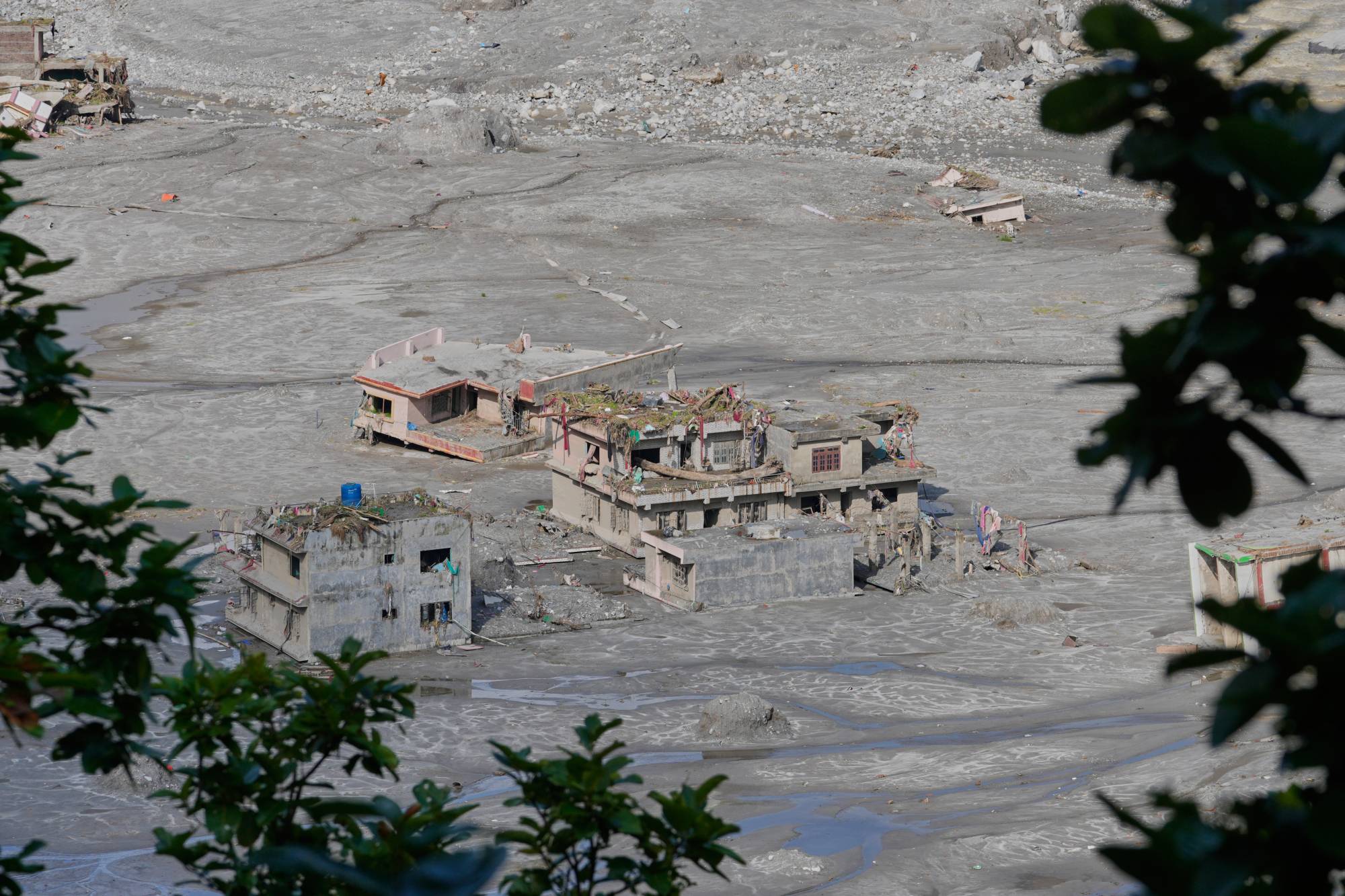
Houses damaged by recent flash floods stand amid thick layers of sludge, mud and debris in Nepal's Nuwakot district, Tuesday, Sept. 8, 2026. (AP)

Preliminary data shows 2026 figuring among the four hottest years on record, WMO climate information chief John Kenned told reporters, adding though that "with the El Nina developing, we might see when the final numbers come in that we're close to the top".

The naturally occurring weather phenomenon releases heat from the ocean, which this year has been the warmest ever measured, Saulo pointed out.

El Nino is declared when the sea surface temperature is half a degree above average in the tropical Pacific, but from now through January, WMO forecasts "it may be 3.8C above average", she said.

The WMO also reported that the global sea level was the highest on record, freshwater was dwindling and glaciers were continuing a long-term retreat.

In 2025, the annual mass loss of ice was enough to fill five Olympic pools every second that year, it said.

At the same time, "we are supercharging our weather and El Nino will be a risk multiplier", Saulo said, warning that "heatwaves, tropical cyclones, and rainstorms are intensifying faster than our historical baselines prepared us for".

On a positive note, the WMO hailed a significant increase of countries with essential multi-hazard early warning systems in place, from 55 in 2015 to 136 last year.

It urged the COP31 to ensure more investment in the sustained global observations, data-gathering and forecasting needed for such systems to work.

"We cannot afford to fly blind," Saulo said.