Pakistan Vows to 'Eradicate Terrorism' as Afghan Truce Nears End

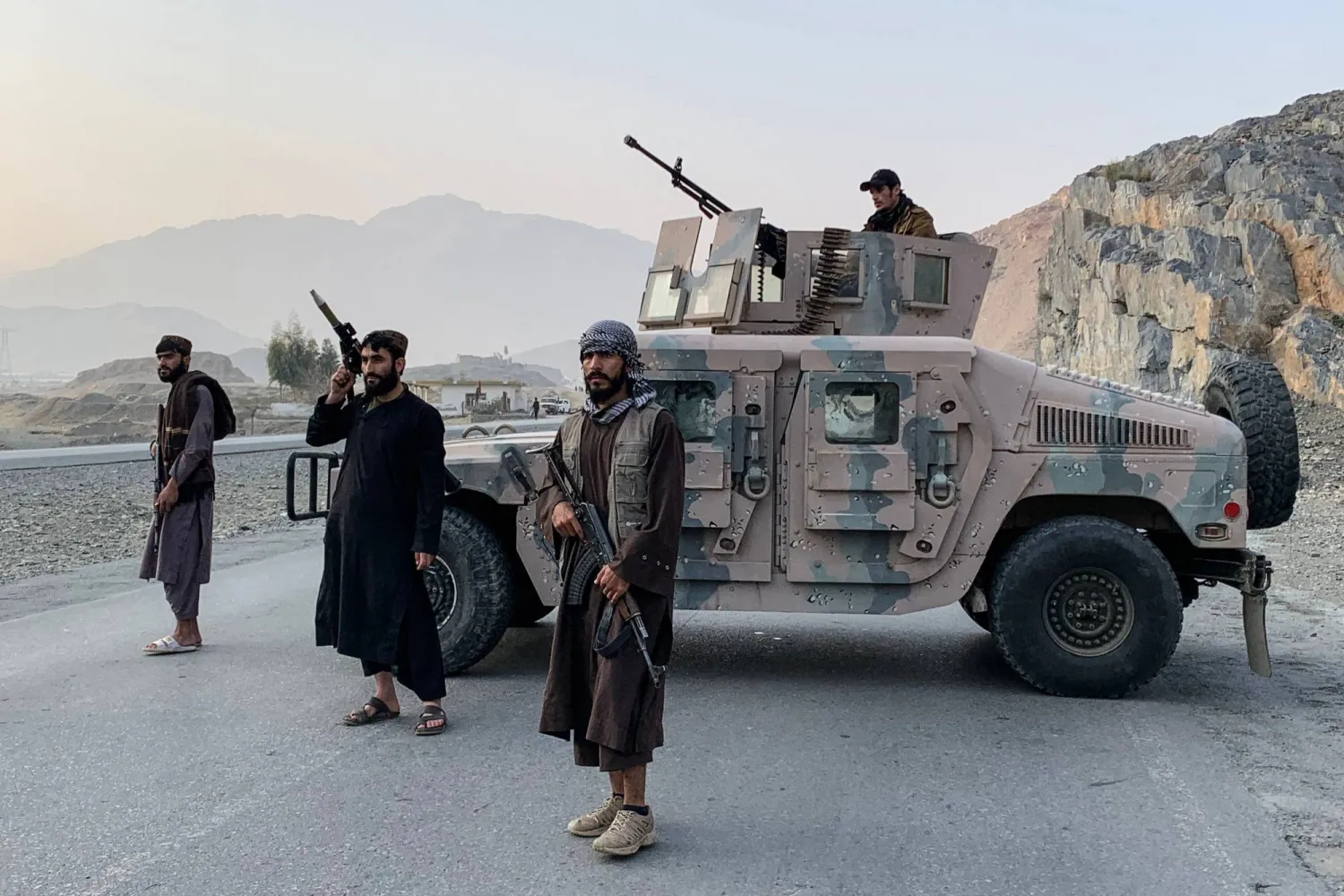
Taliban security personnel guard the Torkham border crossing between Afghanistan and Pakistan in the Afghan province of Nangarhar (AFP)
TT

Pakistan Vows to 'Eradicate Terrorism' as Afghan Truce Nears End

Taliban security personnel guard the Torkham border crossing between Afghanistan and Pakistan in the Afghan province of Nangarhar (AFP)

Pakistan's foreign minister said Monday that the country remains committed to "eradicating the menace of terrorism", as the clock ticked down to the end of a temporary ceasefire with Afghanistan.

Both countries last Wednesday announced a halt to weeks of hostilities for the Eid al-Fitr holiday marking the end of Ramadan, agreeing to a temporary ceasefire until midnight Monday, said AFP.

But in a message to mark Pakistan Day, a national holiday, Foreign Minister Ishaq Dar indicated that the country's approach to the conflict had not changed.

"Pakistan remains firmly committed to eradicate the menace of terrorism," he said in a statement. "Pakistan's actions inside Afghanistan... are directed towards this goal."

On Sunday, the Taliban government and a medical source said one person was killed by a mortar shell fired by Pakistan in the eastern border province of Kunar.

Afghanistan and Pakistan have been locked in conflict for months over claims from Islamabad that Kabul is harboring extremists behind cross-border attacks on its territory.

The Taliban authorities deny the claim.

The Eid truce came after a Pakistani strike on a drug rehabilitation center in Kabul last Monday, which Afghan authorities said killed more than 400.

The latest bout of skirmishes, which began in February, followed earlier failed mediation efforts including Gulf states and China.

In his own Pakistan Day message, Prime Minister Shehbaz Sharif on Monday said military action inside Afghanistan was "a symbol of our national resolve against terrorism".

"We will not allow any harm to the peace and security of our country," he added.


UN Shipping Agency Opposes Fees for Any Strait, More Details Sought on Trump Post on Cargo Charge

This picture shows ships sailing near the Strait of Hormuz off the eastern coast of the United Arab Emirates at Khor Fakkan on July 13, 2026. (AFP)
TT

UN Shipping Agency Opposes Fees for Any Strait, More Details Sought on Trump Post on Cargo Charge

This picture shows ships sailing near the Strait of Hormuz off the eastern coast of the United Arab Emirates at Khor Fakkan on July 13, 2026. (AFP)

More details are awaited after US President Donald Trump said in a post that Washington was reinstating a naval blockade on Iran and would be reimbursed 20% on ‌all cargo ‌shipped through ‌the ⁠Strait of Hormuz, ⁠the UN's shipping agency said on Monday.

"We are aware of the post and awaiting more details," ⁠a spokesperson with the ‌UN's ‌International Maritime Organization said.

"We have ‌always been consistent ‌on our stance on fees – IMO stands firmly against charging fees for passage ‌through straits used for international navigation. There ⁠is ⁠no legal basis through which to introduce mandatory tolls simply to transit through a strait."

Trump said in a Truth Social post the process would begin immediately, but did not elaborate.


US Citizen Is Found Guilty of Helping Export Tech to Iran in Violation of Sanctions

People walk near an anti-US mural in Tehran, Iran, July 13, 2026. Majid Asgaripour/WANA (West Asia News Agency) via Reuters
TT

US Citizen Is Found Guilty of Helping Export Tech to Iran in Violation of Sanctions

People walk near an anti-US mural in Tehran, Iran, July 13, 2026. Majid Asgaripour/WANA (West Asia News Agency) via Reuters

A Massachusetts man was found guilty Monday of conspiring to unlawfully export electronic components to Iran in violation of US sanctions.

Mahdi Mohammad Sadeghi, who worked at the global electronics company Analog Devices, was accused of helping an Iranian business associate get around American export control laws. US prosecutors say the business associate’s Tehran-based company makes navigation systems for the military drone program of Iran’s Revolutionary Guard. Authorities say the scheme included the creation of a front company in Switzerland.

The second defendant, Mohammad Abedininajafabadi, called Abedini in court documents, was not on trial. He is believed to be in Iran after an apparent prisoner exchange for an Italian journalist.

Sadeghi was found guilty on three of the five charges. He showed no visible reaction to the verdict, which came early in the fourth day of jury deliberations. He and his lawyers did not comment as they left court, and he will remain free until sentencing Oct. 13.

Sadeghi, a 43-year-old naturalized US citizen, chose not to testify. A father of two, he lost his job at Analog Devices due to the charges. Although he was arrested in December 2024, long before the current war with Iran, his trial has unfolded during the conflict.

“At its core, this case is straightforward. You cannot send goods, especially the goods at issue in this case, to Iran. Period. Full stop,” Assistant US Attorney Alathea Porter told the jury. “The defendant knew that, and conspired with Mr. Abedini to do that.”

Assistant U.S. Attorney Jared Dolan, in his closing remarks, said documents, text messages and photos proved that the illegal acts were the “fruits of this relationship” between Sadeghi and Abedini.

“The evidence established that he knew what Abedini was doing because he told him in writing,” Dolan said. “He helped him anyway.”

Sadeghi's attorney, William Fick, told jurors that the scheme laid out by the prosecution “makes no sense” and was full of holes. He said Sadeghi was only offering advice to a longtime friend about how to get business with the semiconductor company, and wasn’t responsible for procuring the parts for Abedini.

Fick said there was no proof the parts ended up in Iran, and he disputed that the Swiss company was a front.

“If you look at the world through dirty glasses, everything looks dirty,” Fick said. “That is fundamentally what the prosecution is asking you to do here.”

Fick also said prosecutors hadn't shown Sadeghi gained anything from the alleged plan — although the prosecution pointed out that they didn't need to prove a motive.

“He had nothing to gain and everything to lose,” Fick said. “He has lived in the country for decades. He was a well-regarded, respected employee on his way up in the company.”

Prosecutors had hoped to introduce evidence during the trial related to an Iranian drone used in a 2024 attack that killed three US troops at a remote base in Jordan.

However, before the trial, defense attorneys sought to exclude any evidence related to Abedini’s role in drone manufacturing or attacks on American troops.

The judge agreed, ruling that prosecutors could only give general evidence about Abedini’s Iranian company and how its technology had potential military applications, including for drones. During a hearing in February, prosecutors acknowledged they didn’t have evidence that Sadeghi “knew anything” about the technology he was accused of exporting was allegedly used on the drone involved in the Jordan attack.

Both defendants have been charged with export control violations. Abedini is separately charged with conspiring to provide material support to a foreign terrorist organization that resulted in the deaths of three service members.

Abedini was arrested at an airport in Italy on a US warrant in December 2024, but was released a month later and returned to Iran. Three days after his arrest, Italian journalist Cecilia Sala was detained while reporting in Iran. Sala, who was believed held as a bargaining chip for Abedini’s release, returned home in January 2025.


US Vows Campaign to End ICC ‘Threat’ to Americans

US Secretary of State Marco Rubio attends a trilateral meeting with Japanese Foreign Minister Motegi Toshimitsu and South Korean Foreign Minister Cho Hyun (not pictured) on the sidelines of the NATO Summit in Ankara on July 7, 2026. (AFP)
TT

US Vows Campaign to End ICC ‘Threat’ to Americans

US Secretary of State Marco Rubio attends a trilateral meeting with Japanese Foreign Minister Motegi Toshimitsu and South Korean Foreign Minister Cho Hyun (not pictured) on the sidelines of the NATO Summit in Ankara on July 7, 2026. (AFP)

The United States on Monday announced a campaign against the Hague-based International Criminal Court (ICC), accusing the tribunal of posing "an intolerable threat to US sovereignty" and threatening sanctions.

"The ICC and its friends are waging a war against our country, not with bullets or missiles, but with statutes, compacts and the force of so-called international law," Secretary of State Marco Rubio said in a video statement.

The State Department said in a statement the campaign will "systematically disable the ICC's ability to operate, target American servicemen or officials, or otherwise threaten American sovereignty."

Relations between the government of Donald Trump and the ICC have been extremely poor, with several court officials, including its chief prosecutor, already under US sanctions.

The sanctions bar the officials from entering the United States and block property and financial transactions involving them in the world's largest economy.

The measures have often focused on ICC investigations involving Israel, a US ally. The court issued arrest warrants in 2024 for Israeli Prime Minister Benjamin Netanyahu and others.

However, in its statement, the State Department focused on what it called the ICC's "intolerable threat to US sovereignty," saying the court "claims the authority to prosecute and even imprison American servicemen and officials operating on behalf of America's national interest."

"Americans never signed up for this, and all American presidents since the ICC's ratification have maintained that the ICC does not have jurisdiction over Americans," the State Department said.

The department listed a range of measures it was considering against the court, including having American diplomats call other nations to urge withdrawal from the body, as well as travel bans and sanctions against ICC officials.

Established in 2002, the ICC prosecutes individuals accused of the gravest atrocities, including war crimes, crimes against humanity and genocide.

Neither Israel nor the United States is a party to the international treaty that established the ICC. Russia is also not a member, and its President Vladimir Putin has been the subject of an ICC arrest warrant since March 2023.