


Venezuela's Maduro Back in US Court after Stunning Capture

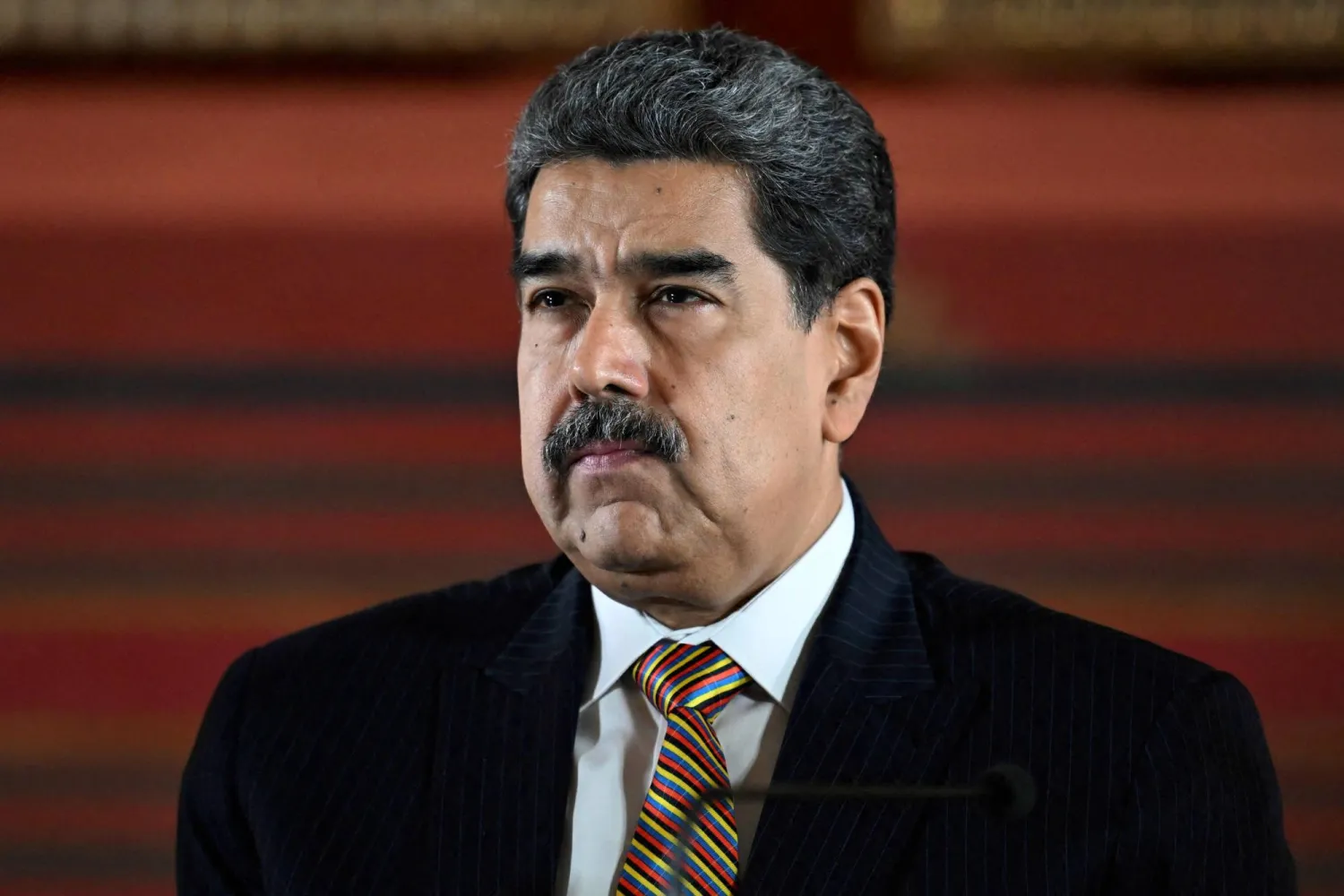
(FILES) Venezuela's President Nicolas Maduro looks on during a meeting at the National Assembly in Caracas on August 22, 2025. (Photo by Juan BARRETO / AFP)
TT

Venezuela's Maduro Back in US Court after Stunning Capture

(FILES) Venezuela's President Nicolas Maduro looks on during a meeting at the National Assembly in Caracas on August 22, 2025. (Photo by Juan BARRETO / AFP)

Ousted Venezuelan president Nicolas Maduro will appear Thursday in a New York court for the second time since his capture by US forces in an extraordinary nighttime raid.

Maduro, 63, and wife Cilia Flores have been held in a Brooklyn jail for almost three months after American commandos snatched the pair from their compound in Caracas in early January, said AFP.

The stunning operation deposed the strongman who had led Venezuela since 2013 and has since forced the oil-rich country to largely bend to the will of US President Donald Trump.

Maduro has declared himself a "prisoner of war" and pleaded not guilty to the four counts of "narco-terrorism" conspiracy, cocaine importation conspiracy, possession of machine guns and destructive devices, and conspiracy to possess machine guns and destructive devices.

Thursday's hearing at 11:00 am (1500 GMT) will likely see Maduro push for the dismissal of his case as lawyers tussle over who will pay the former leader's legal fees.

Venezuela's government is seeking to cover the costs, but because of Washington's sanctions, his lawyer Barry Pollack must obtain a US license that has not been issued.

Pollack argued in a court submission that the license requirement violated Maduro's constitutional right to legal representation and demanded the case be thrown out on procedural grounds.

- Deadly raid -

Detained in Brooklyn's Metropolitan Detention Center, a federal prison known for unsanitary conditions, Maduro is reportedly alone in a cell with no access to the internet or newspapers.

A source close to the Venezuelan government said the incarcerated Maduro reads the Bible and is referred to as "president" by some of his fellow detainees.

He is only allowed to communicate by phone with his family and lawyers for a maximum of 15 minutes per call, the source added.

"The lawyers told us he is strong. He said we must not be sad," said his son, Nicolas Maduro Guerra, adding his father told him: "We are fine, we are fighters."

Maduro and his wife were forcibly taken by US commandos in the early hours of January 3 in airstrikes on the Venezuelan capital backed by warplanes and a heavy naval deployment.

At least 83 people died and more than 112 people were injured in the assault, according to Venezuelan officials. No US service members were killed.

- US pressure -

At his first US court appearance in January, Maduro struck a defiant tone as he identified himself the president of Venezuela despite being captured.

The South American country is now led by Delcy Rodriguez, who had been Maduro's vice president since 2018.

Under US pressure, she is grappling with leading a country saddled with the world's largest proven oil reserves but an economy in shambles.

Rodriguez has since enacted a historic amnesty law to free political prisoners jailed under Maduro and reformed oil and mining regulations in line with US demands for access to her country's vast natural wealth.

This month, the State Department said it was restoring diplomatic ties with Venezuela in a sign of thawing relations.

Security is expected to be heightened around the New York courthouse for Thursday's hearing.

Presiding over the case is Alvin Hellerstein, a 92-year-old judge credited with overseeing several high-profile trials during his decades on the bench.



Suspected Measles Cases Kill Nearly 1,000 as Bangladesh Struggles to Contain Outbreak

A child receives treatment for measles, at Bangladesh Shishu Hospital & Institute in Dhaka on September 3, 2026. (Photo by Salahuddin Ahmed / AFP)
TT

Suspected Measles Cases Kill Nearly 1,000 as Bangladesh Struggles to Contain Outbreak

A child receives treatment for measles, at Bangladesh Shishu Hospital & Institute in Dhaka on September 3, 2026. (Photo by Salahuddin Ahmed / AFP)

Eight-month-old Rojatun Jannat Ramisa is struggling to breathe in a hospital in Bangladesh’s capital as her parents sit helplessly beside her. She's one of thousands of children sickened by a measles outbreak that's sweeping across the country and has killed hundreds of children following setbacks to the country's vaccine program.

Ramisa’s mother Ranu Akhter traveled hundreds of kilometers (miles) after doctors in eastern Bangladesh referred her to a specialized child hospital in Dhaka to seek treatment for the life-threatening condition, The Associated Press said.

“Fourteen days ago, when we were at the district hospital, there were other children being treated alongside my daughter. I saw that those children also had red rashes on their bodies, sores in their mouths and fevers,” Akhter told The Associated Press at Dhaka Shishu Hospital.

“It made me realize how widespread the measles outbreak is,” she said.

Every day, the death toll is rising.

Bangladesh races to vaccinate children Bangladesh has been racing to halt the outbreak's spread since March, when more than 100 children died in less than a month. By Tuesday, the death toll from suspected measles cases reached 999 since the start of the year, according to the government’s Directorate General of Health Services.

Since March, the country has recorded more than 166,000 suspected measles cases, including 19,835 laboratory-confirmed infections, according to the Ministry of Health.

The government launched an emergency vaccination drive in March together with the World Health Organization, the UN children’s agency and the Gavi vaccine alliance. It began with a focus on children from 6 months to 5 years old and later expanded nationwide in phases.

Measles is a highly contagious airborne disease that causes fever, respiratory symptoms and a characteristic rash. It can sometimes have severe or fatal complications, especially in young children, according to the WHO.

Two doses of a vaccine provide strong protection against measles, but the WHO says 95% of the population has to be vaccinated in order to stop the disease from spreading — which protects children like Ramisa who are too young to be vaccinated as well as immunocompromised people.

The pandemic and political upheaval set back vaccinations

A few years ago, Bangladesh had measles largely under control, with a vaccination program that was credited for decades for protecting children and mothers from the deadly diseases of tuberculosis, diphtheria, whooping cough, tetanus, poliomyelitis and measles. Between 2021 and 2025, the country recorded just 100 to 300 cases per year, down from 2,410 cases in 2020.

But in the last few years, disruptions to the vaccine program have left a growing number of children unvaccinated.

First the pandemic interrupted routine vaccinations, and then in 2024 the government largely missed a vaccination campaign previously carried out every four years.

Atiqul Islam, a neonatal and child specialist at Bangladesh Shishu Hospital and Institute, said during the pandemic period in 2021 and 2022, many did not take their children to get vaccinated.

“So, if you look at children who are now four or five years old, many of them missed their vaccinations. That created a gap. During the previous interim government, vaccines were also unavailable at many vaccination centers,” he said.

Rival politicians trade blame for vaccine shortfall Bangladesh's current government, headed by Prime Minister Tarique Rahman, said the failures in planning under ousted Prime Minister Sheikh Hasina and interim leader Muhammad Yunus left the country with shortages of vaccines and far behind on coverage.

The 2024 measles vaccination campaign was disrupted during the political upheaval that led to Hasina’s ouster. She left the country in the face of a mass uprising in August 2024, and was followed by Yunus, who led an interim administration that transferred power to an elected government after an election in February.

From exile in India, Hasina blamed the Yunus-led government for the disaster.

Doctor says things are getting better, but not fast enough At Bangladesh Shishu Hospital, Islam said the situation has improved, but not enough.

The doctor said his colleagues are struggling to treat infected children who often arrive at the hospital with serious complications like pneumonia, diarrhea and encephalitis, or brain swelling.

“For the past six months, we have been treating measles patients continuously, and we are exhausted,” he said.


Merz Says Disaster Narrowly Averted in Russia-Prepared Drone Attack at Airport

German Chancellor Friedrich Merz looks on during a debate at the German parliament, the Bundestag, in Berlin, Germany, 09 September 2026. (EPA)
TT

Merz Says Disaster Narrowly Averted in Russia-Prepared Drone Attack at Airport

German Chancellor Friedrich Merz looks on during a debate at the German parliament, the Bundestag, in Berlin, Germany, 09 September 2026. (EPA)

German Chancellor Friedrich Merz said on Wednesday that an attempted drone attack at Leipzig/Halle airport had been prepared in Russia over an extended period and that a disaster was only narrowly ‌averted.

"This attack ‌was planned in ‌Russia ⁠for months and ⁠was specifically targeted at Germany, and only by pure chance was major material damage and harm to people ⁠prevented," Merz told the lower ‌house ‌of parliament.

Merz spoke after ‌the far-right Alternative for ‌Germany scored a major victory in a state election in Saxony-Anhalt on Sunday, running ‌on a platform that includes calls for ⁠closer ties ⁠with Moscow.

Russia has rejected any involvement in the drone incident at Leipzig airport, and its foreign minister has said these accusations were "the start of a real war".


UK Rejects Israel’s ‘Damaging’ Sanctions Retaliation

A view shows the British Consulate General in East Jerusalem, 09 September 2026. (EPA)
TT

UK Rejects Israel’s ‘Damaging’ Sanctions Retaliation

A view shows the British Consulate General in East Jerusalem, 09 September 2026. (EPA)

British foreign minister Ed Miliband on Wednesday condemned as "regrettable and damaging" Israel's decision to order the closure of the UK's consulate in Jerusalem as retaliation for London-led Western sanctions over settler violence. 

"We anticipated this might happen because we saw other countries, the Dutch, for example, who had announced sanctions, who had seen these reprisals from Israel. I think they're regrettable and damaging," Miliband told BBC Radio. 

Israel on Tuesday ordered the closure after 12 countries including Britain, Canada and France announced they would sanction trade with Israeli settlements in the West Bank, following a surge in settler attacks against Palestinians in the occupied West Bank. 

Israel said it would also expel British representatives at a center monitoring the US-brokered ceasefire plan in Gaza, bar British training for Palestinian Authority forces and ban 12 Britons, mostly members of parliament, from visiting the country. 

Miliband rejected suggestions that the sanctions would impact intelligence cooperation with Israel. 

"We have important intelligence and security relationships with Israel, and I'm confident they will continue," he said, declining to go into details. 

"And I was very clear yesterday that we do believe in working with our Israeli partners when it comes to the threats they face from Iran," he added. 

Miliband also dismissed the criticism of the sanctions by Britain's chief rabbi. 

Ephraim Mirvis on Tuesday called the measures "little more than political flag-bearing". 

He said it was a "truly a dark day for British Jews", predicting that the measures "will succeed only in bolstering the very extremism they seek to target". 

Several antisemitic attacks in London this year have targeted synagogues and other Jewish sites.