


North Korea Conducts Engine Test for Missile Capable of Targeting US Mainland

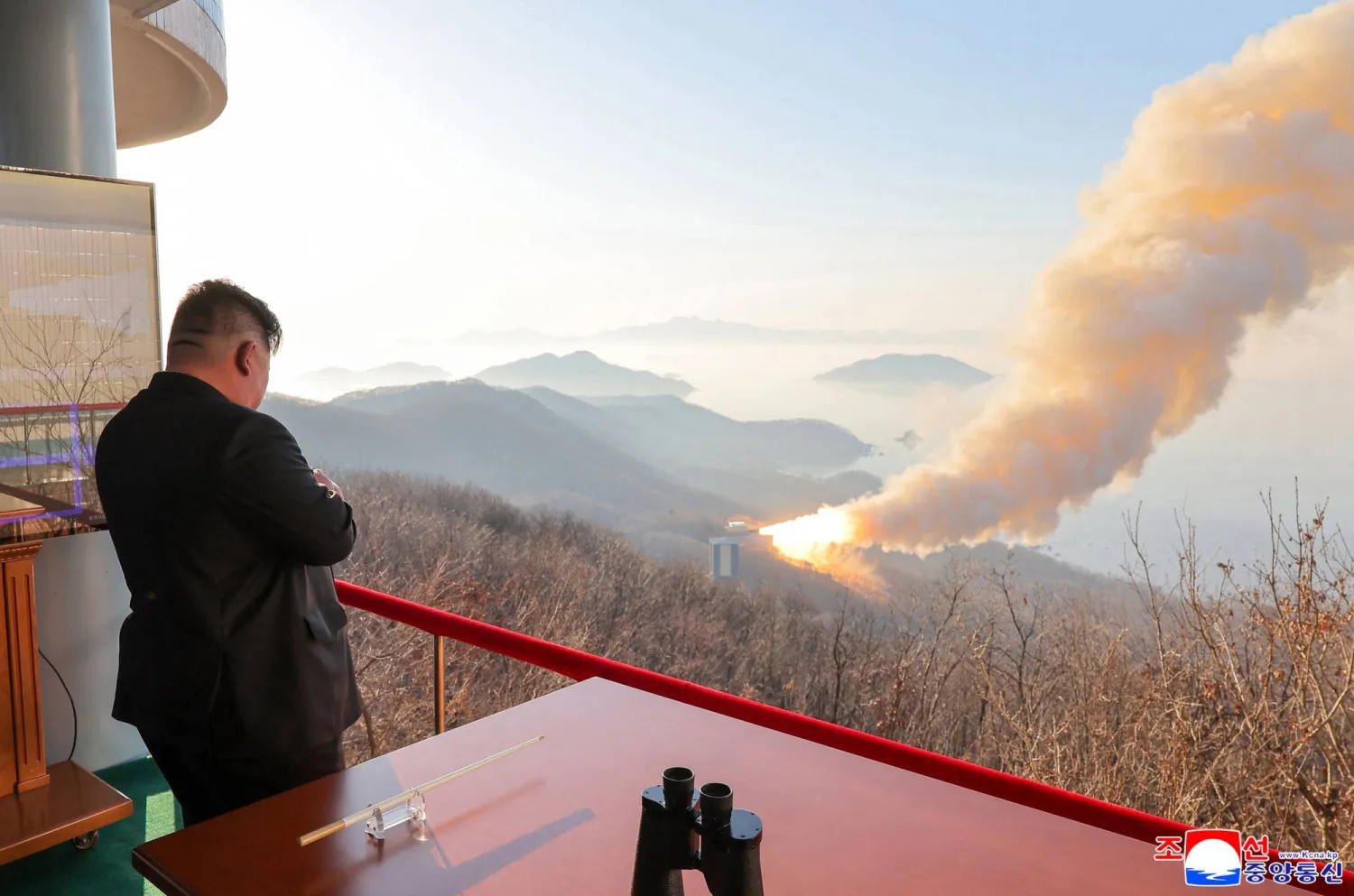
This undated picture released by North Korea's official Korean Central News Agency (KCNA) on March 29, 2026 shows North Korean leader Kim Jong Un inspecting a combustion test of a solid-fuel rocket engine at an undisclosed location in North Korea. (KCNA via KNS / AFP)
TT

North Korea Conducts Engine Test for Missile Capable of Targeting US Mainland

This undated picture released by North Korea's official Korean Central News Agency (KCNA) on March 29, 2026 shows North Korean leader Kim Jong Un inspecting a combustion test of a solid-fuel rocket engine at an undisclosed location in North Korea. (KCNA via KNS / AFP)

North Korean leader Kim Jong Un observed a test of a high-thrust, solid-fuel engine for weapons and hailed it as a development to boost the country’s strategic military capability, state media reported Sunday.

The test likely indicates Kim is intent on enlarging and modernizing an arsenal of missiles capable of reaching the United States mainland.

The report on Sunday from Korean Central News Agency came days after Kim delivered a speech at North Korea's Parliament pledging to irreversibly cement his country’s status as a nuclear power and accusing the US of global “state terrorism and aggression,” in an apparent reference to the war in the Middle East.

Kim watched the ground jet test of the newly upgraded engine using a composite carbon fiber material, according to KCNA, which reported the engine's maximum trust is 2,500 kilotons, up from about 1,971 kilotons reported in a similar solid fuel engine test in September.

A push to increase the engine power is likely associated with efforts to place multiple warheads on a single missile to increase chances of defeating US defenses, observers say.

KCNA did not report exactly when or where the test occurred.

The test was conducted as part of the country's five-year military escalation program. The plan's objectives include upgrading “strategic strike means,” KCNA reported.

The reference is understood to mean nuclear-capable, intercontinental ballistic missiles targeting the continental US.

Kim said the latest engine test had “great significance in putting the country’s strategic military muscle on the highest level,” KCNA reported.

In recent years, North Korea has test-fired a variety of ICBMs demonstrating the potential range to reach the US mainland, including missiles with solid propellants that make detection prior to liftoff more difficult. The country's older liquid-fuel missiles must be fueled before liftoffs and cannot last long.

Some foreign experts say North Korea still faces technological hurdles before it has a functioning ICBM, such as ensuring its warheads survive the harsh conditions of atmospheric reentry. But others dispute that assessment given the number of years the country has spent on its nuclear and missile programs.

North Korea has pushed hard to expand its nuclear arsenal since Kim's high-stakes diplomacy with US President Donald Trump collapsed in 2019. In a ruling Workers' Party congress in February, Kim left open the door for dialogue with Trump but urged Washington to drop demands for the North’s nuclear disarmament as a precondition for talks.



Hundreds Evacuated as Waves Batter New Zealand Capital

Stormy seas pound the coastline of Island Bay, a suburb of the New Zealand capital Wellington. Ben STRANG / AFP
TT

Hundreds Evacuated as Waves Batter New Zealand Capital

Stormy seas pound the coastline of Island Bay, a suburb of the New Zealand capital Wellington. Ben STRANG / AFP

Authorities evacuated hundreds of people from their seaside homes in New Zealand's capital on Tuesday as 11-meter (36-foot) waves lashed the coast.

Wellington Mayor Andrew Little declared a state of emergency on the eve of the swells for seaside residents in Owhiro Bay, Island Bay, Houghton Bay and Breaker Bay.

"You must stay away from the southern coastline," Little said in a statement, warning that emergency workers would not be coming to help anyone who stayed behind.

The evacuation order took effect on Tuesday morning, with police brought in to ensure people moved to higher ground, said AFP.

Officers set up cordons on surrounding roads to prevent people from heading to the coast.

The council said a similar event in 2021 affected many homes in Breaker Bay, and waves during that storm were about 6.5 meters.

Waves entering Wellington Harbour on Tuesday were measured at 11 meters, New Zealand's MetService said.

Wind gusts were so strong at Island Bay that two women were knocked off their feet as waves washed up over the road, an AFP journalist saw.

Some flights were cancelled at Wellington Airport where wind gusts were recorded of up to 128 kilometers per hour (80 miles per hour).

A small plane from local carrier Golden Bay Air tipped onto its side in the wind while parked at the airport with no-one aboard.

Airline boss Richard Molloy told national broadcaster RNZ that fire fighters had secured the plane to the ground.


Russian Strikes Kill 3 Near Ukraine’s Kharkiv

This handout taken and released by the State Emergency Service of Ukraine on June 9, 2026 shows smoke rising from a fire following Russian strikes in the Kharkiv region, amid the Russian invasion of Ukraine. (Photo by Handout / State Emergency Service of Ukraine / AFP)
TT

Russian Strikes Kill 3 Near Ukraine’s Kharkiv

This handout taken and released by the State Emergency Service of Ukraine on June 9, 2026 shows smoke rising from a fire following Russian strikes in the Kharkiv region, amid the Russian invasion of Ukraine. (Photo by Handout / State Emergency Service of Ukraine / AFP)

Russian strikes killed three people and wounded 10 others in Ukraine's northeastern Kharkiv region, its governor said early Tuesday.

"The enemy has hit the city of Chuguiv," Kharkiv regional governor Oleg Synegubov wrote on Telegram, adding that three people had been killed.

"The strikes caused fires and damaged at least 18 vehicles; windows were blown out and building facades damaged in residential multi-storey buildings," Synegubov said.

Separately, Kharkiv mayor Igor Terekhov reported 10 people were wounded in his city.

Daily Russian attacks that claim civilian lives have intensified in recent months, and Ukraine has hit back with its own drone strikes further into Russian territory, saying these are mainly against military and energy facilities.

According to a UN estimate published in April, at least 15,850 civilians have been killed in Ukrainian zones since Russia launched its invasion in February 2022.

More than 2,800 civilians have died in Russian-controlled zones, according to the UN toll, which added that more than 44,800 have been wounded in Ukrainian and Russian-occupied zones.


Congo’s Ebola Outbreak Rises to 100 Deaths out of 550 Cases as Conflict Slows Response

A health worker wearing a face mask as part of his personal protection equipment (PPE) looks on at the Mulago National Referral Hospital isolation unit in Kampala, Uganda, on July 8, 2026. (AFP)
TT

Congo’s Ebola Outbreak Rises to 100 Deaths out of 550 Cases as Conflict Slows Response

A health worker wearing a face mask as part of his personal protection equipment (PPE) looks on at the Mulago National Referral Hospital isolation unit in Kampala, Uganda, on July 8, 2026. (AFP)

At least 100 people have died from Ebola less than a month after authorities declared an outbreak of the disease in eastern Congo, authorities said.

Attacks on health workers from angry residents, skepticism among some locals and armed conflict in hot spots continue to challenge efforts to stop the outbreak declared on May 15.

Out of the 550 cases of the disease confirmed as of Sunday, there have been 101 deaths and 19 recoveries, according to the latest situation report late Monday.

The outbreak is concentrated in Congo’s eastern province of Ituri, which accounts for more than 90% of the cases. Cases have also been recorded in the North Kivu and South Kivu provinces, and has spread across the border to Uganda.

The number of cases in Congo is believed to be higher because the outbreak was confirmed weeks late, and the response has been challenging also because the virus has no approved vaccine or treatment.

The latest Ebola disease outbreak is caused by the rare Bundibugyo virus, which does not have an approved vaccine or treatment unlike the “Zaire virus,” another name for the Ebola virus, responsible for most of Congo’s past 16 outbreaks of the disease.

The rapid increase in the number of cases is in part due to the scale up of diagnostic capacities, enabling testing of the backlog of previously collected samples, authorities said.

Frontline health workers, with little pay or rest, have been attacked multiple times by angry residents and have not been able to reach some communities due conflict involving armed rebel groups.

Eastern Congo has for years seen attacks by dozens of separate rebel and militant groups, some of them with links to foreign countries or to the extremist Islamic State group.

Conflict is “constraining access for the response, disrupting surveillance and response activities, and increasing the risk of undetected transmission,” the World Health Organization said Monday.

“Such incidents underline the challenges of the context and the importance of working closely with local leaders and communities,” it added.