Rubio Says US Hopeful after Private Talks with Iran Officials

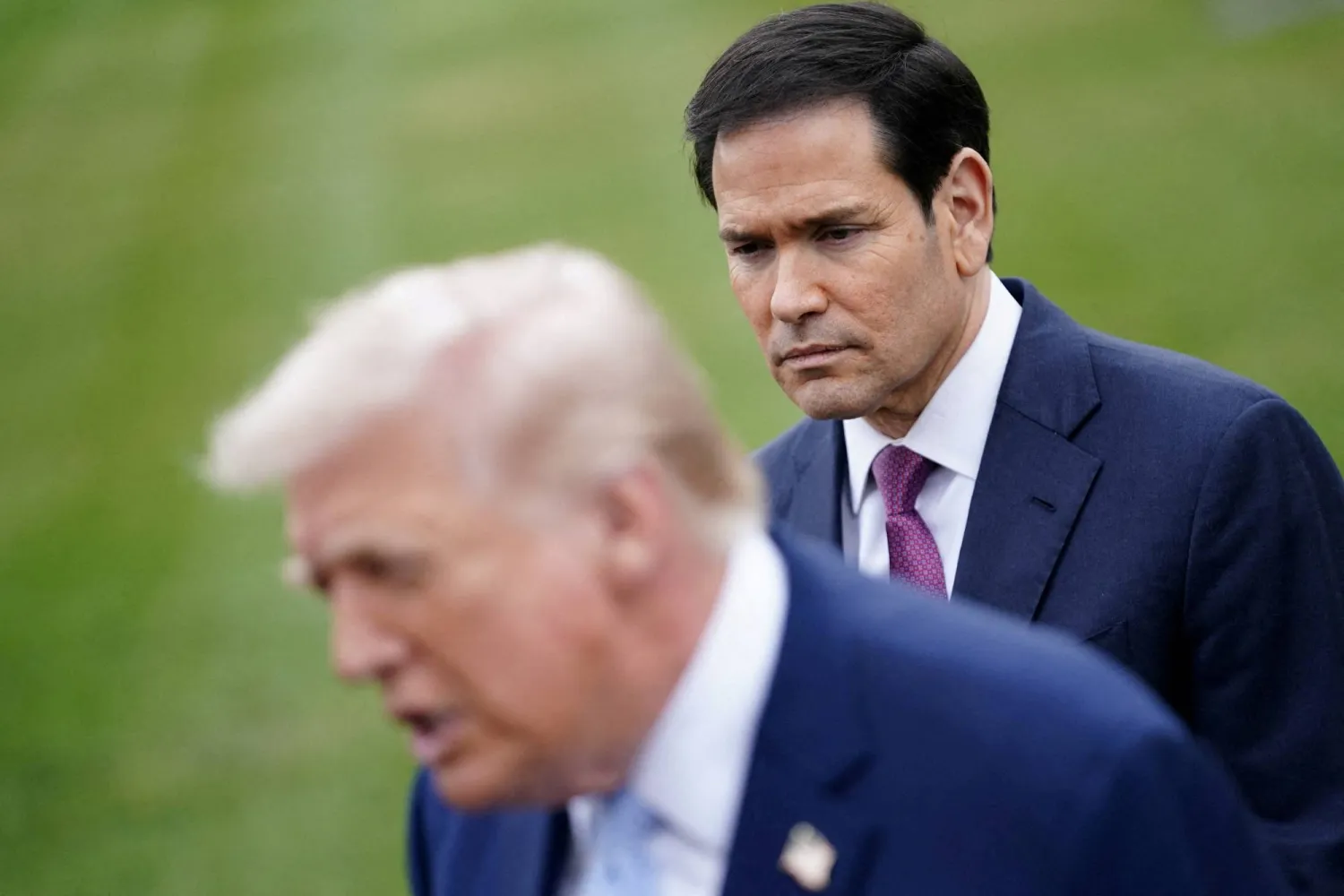
US Secretary of State Marco Rubio listens to US President Donald Trump speaking to the media, as Trump departs the White House for Florida, in Washington, D.C., US, March 20, 2026. REUTERS/Nathan Howard/File Photo
TT

Rubio Says US Hopeful after Private Talks with Iran Officials

US Secretary of State Marco Rubio listens to US President Donald Trump speaking to the media, as Trump departs the White House for Florida, in Washington, D.C., US, March 20, 2026. REUTERS/Nathan Howard/File Photo

US Secretary of State Marco Rubio on Monday voiced hope for working with elements within Iran's government, saying the United States privately had received positive messages, AFP reported.

Rubio said there were internal "fractures" inside the Iran and that the United States hoped that figures with "power to deliver" take charge.

"We are hopeful that that's the case," Rubio told ABC News program "Good Morning America."

"There are clearly people there talking to us in ways that previous people in charge in Iran have not spoken to us in the past, some of the things they're willing to do," he said.


Iran Executes Two More Convicted of Links to Banned Opposition

 A man holds a picture of the late Iranian Supreme Leader Ali Khamenei during a campaign in support of the government at the Enqelab-e-Eslami square in downtown Tehran, Iran, Monday, March 30, 2026. (AP)
A man holds a picture of the late Iranian Supreme Leader Ali Khamenei during a campaign in support of the government at the Enqelab-e-Eslami square in downtown Tehran, Iran, Monday, March 30, 2026. (AP)
TT

Iran Executes Two More Convicted of Links to Banned Opposition

 A man holds a picture of the late Iranian Supreme Leader Ali Khamenei during a campaign in support of the government at the Enqelab-e-Eslami square in downtown Tehran, Iran, Monday, March 30, 2026. (AP)
A man holds a picture of the late Iranian Supreme Leader Ali Khamenei during a campaign in support of the government at the Enqelab-e-Eslami square in downtown Tehran, Iran, Monday, March 30, 2026. (AP)

Iran executed two men on Tuesday convicted of membership in a banned opposition group and plotting to overthrow the Islamic republic, the judiciary said, a day after two others were hanged on similar charges.

"Babak Alipour and Pouya Ghobadi... were executed by hanging on Tuesday after legal procedures were completed and their sentences upheld by the Supreme Court," the judiciary's Mizan Online website said.

The men were found guilty of attempting "rebellion through involvement in multiple terrorist acts", as well as membership of the banned People's Mujahedin of Iran (MEK) and carrying out acts of sabotage aimed at overthrowing the regime.

The executions come with Iran at war with the United States and Israel following strikes on February 28 that triggered a wider regional conflict.

On Monday, Iranian authorities announced the execution of two other men convicted of links to the MEK and attempting to overthrow the regime.

It was not clear when the four men were arrested.

The MEK, which opposed the rule of the shah and initially supported the 1979 revolution before falling out with the leadership in the 1980s, has since been in exile and is designated a terrorist organization by Tehran.

Iran is the world's most prolific executioner after China, according to rights groups.

It has carried out several executions since the war began.

On March 19, Iran executed three men accused of killing police officers during mass protests which peaked in January -- the first executions related to that unrest.

In the same month Iran also executed Kouroush Keyvani, a dual Iranian-Swedish national, on charges of spying for Israel, drawing condemnation from Stockholm and the European Union.


New US Missile Hit Iranian Sports Hall and School, Analysis Shows

FILE - A thick plume of smoke rises from an oil storage facility hit by a US-Israeli strike in Tehran, Iran, March 8, 2026. (AP Photo/Vahid Salemi, File)  
TT

New US Missile Hit Iranian Sports Hall and School, Analysis Shows

FILE - A thick plume of smoke rises from an oil storage facility hit by a US-Israeli strike in Tehran, Iran, March 8, 2026. (AP Photo/Vahid Salemi, File)  

John Ismay and Christiaan Triebert

Washington: On the first day of the war with Iran, a weapon bearing the hallmarks of a newly developed US-made ballistic missile was used in an attack that struck a sports hall and adjacent elementary school near a military facility in southern Iran, according to weapons experts and a visual analysis by The New York Times.

Local officials cited in Iranian media said this strike and others nearby in the city of Lamerd killed at least 21 people.

The Feb. 28 attack occurred the same day as a US Tomahawk cruise missile struck a school in the city of Minab, several hundred miles away, killing 175 people. In the case of Lamerd, though, it involved a weapon that had been untested in combat.

The Times verified videos of two strikes in Lamerd, as well as aftermath footage from the attacks. Times reporters and munitions experts found that the weapon features, explosions and damage are consistent with a short-range ballistic missile called the Precision Strike Missile, or PrSM (pronounced like “prism”), which is designed to detonate just above its target and blast small tungsten pellets outward.

Videos that capture one strike, in a residential area about 900 feet from the sports hall and school, show the weapon in flight, with a distinctive silhouette that matches the PrSM. The missile erupts in a large fireball midair.

Another video, filmed from a security camera directly across from the sports hall, shows the strike on the hall and adjacent school. While the video does not capture an incoming missile, it clearly shows an explosion just above the structure.

Photos of the aftermath show both sites were pockmarked with holes, apparently from the tungsten pellets.

There is an Iranian Revolutionary Guards Corps, or IRGC, compound directly next to the sports hall. It’s not known if it was struck in the attack.

The PrSM completed prototype testing only last year, according to an Army press release. On March 1, US Central Command posted a video of a PrSM launch from the first 24 hours of the war. Days later, Adm. Brad Cooper, who leads Central Command, said the PrSM had been used in combat for the first time.

The military has been touting its debut.

Since the weapon is so new, it’s more difficult to assess whether the PrSM strikes in Lamerd were intentional, stemmed from a design flaw or manufacturing defect, or were the result of improper target selection.

It’s unclear if or how the school or sports hall might be affiliated with the IRGC compound, but according to archival satellite imagery, they have been walled off from the compound for at least 15 years.

The sports hall, at the time of the strikes, was being used by a female volleyball team, according to Amir Saeid Iravani, Iran’s representative to the United Nations.

Photos and videos posted to a social media account linked to the school show the premises were regularly used by children.

The sports hall has also for years been publicly identified as a civilian-use facility on readily available digital mapping platforms, including Google Maps, Apple Maps and Wikimapia, according to a review by The Times.

Ground-level and satellite images of the aftermath show the sports hall with scorch marks and a partly collapsed roof. Footage from inside the school shows blown-out windows, fire damage and splotches of blood.

The PrSM’s intended use is to kill enemy troops and destroy unarmored vehicles, and it can fly more than twice as far as any other missile in the Army’s arsenal.

A US official who spoke to The Times confirmed that the missile used in the Lamerd strike was the PrSM. The official was not authorized to comment publicly about the attack and spoke on the condition of anonymity.

Other experts consulted by The Times also provided an assessment of the weapon.

“While we knew PrSM was fired, this is the first look we’ve gotten at the business end of the system,” Jeffrey Lewis, a nuclear nonproliferation expert at Middlebury College, said after reviewing videos and photos of the incident.

Lewis’s observation was supported by Frederic Gras, another munitions expert.

He said the video showing airburst detonation was very clear, and “the pattern of fragmentation damages are impressive and match with the few technical information available on the PrSM.”

Capt. Tim Hawkins, a spokesman for US Central Command, said in a statement to The Times on Saturday: “We’re aware of the reports and are looking into them. US forces do not indiscriminately target civilians, unlike the Iranian regime.”

Lewis said the missile seen in the video also resembled another ground-launched American weapon — a guided rocket called GMLRS-ER, but since that munition has a range of only 93 miles, versus the PrSM’s 400 miles, it would have had to have been fired from inside Iran, which is highly unlikely.

In addition to the sports hall and school, and nearby residential area, a third location may have been hit in the attack.

The Times verified a video that shows another plume of smoke rising close to the other strikes at the same time. Local Telegram and media reports stated a cultural center had been hit, but that couldn’t be independently verified.

The BBC and public radio program “The World” reported earlier that the missiles used in Lamerd may have been PrSMs, and that the Pentagon was looking into the incident.

The strikes on Iran are being conducted by a joint Israeli-US coalition, but senior American military officials made it clear that in the opening days of the conflict the United States was operating in the southern part of the country, where Lamerd is located.

At least 21 people were killed in the strikes, according to Iran’s state news agency, IRNA.

While that figure has not been independently verified, photos and videos posted online by local media outlets show scenes from a mass funeral the next day, March 1. An additional hundred people were injured, said Amir-Saeid Iravani, Iran’s representative to the UN.

Some of the casualties were volleyball players who were training inside the hall when the missile struck, according to Iravani, and eyewitnesses cited by US-based online media outlet Drop Site News.

Tasnim, a semiofficial Iranian news agency, published the names of the 21 people it said were killed. An Iran-based journalist, Negin Bagheri, wrote about two of the victims: Helma Ahmadizadeh, a 10-year-old fourth-grader, and Elham Zaeri, a fifth-grader, both of whom were at volleyball practice when the missile struck. Khabar-e Jonoub, an Iranian newspaper, reported on the death of a sports coach identified as Mahmoud Najafi.

The PrSM is a short-range ballistic missile designed to replace the Army Tactical Missile System, or ATACMS, in the Army and Marine Corps arsenal.

Developed by Lockheed Martin in Camden, Arkansas, it’s capable of hitting targets at a range of approximately 400 miles.

But additional details about the weapon, including its expected accuracy and the quantity of explosives it carries, remain unknown to the public.

In past wars, the Pentagon has at times deployed developmental weapons like the PrSM to active war zones for what the military calls “combat evaluation,” so long as commanders knowingly accept the attendant risk of using a munition before it has gone through more testing.

The New York Times


Pentagon Denies Hegseth's Broker Looked to Buy Defense Fund before Iran Attack

FILE - Defense Secretary Pete Hegseth listens as President Donald Trump speaks in the Oval Office of the White House, March 24, 2026, in Washington. (AP Photo/Alex Brandon, File)
TT

Pentagon Denies Hegseth's Broker Looked to Buy Defense Fund before Iran Attack

FILE - Defense Secretary Pete Hegseth listens as President Donald Trump speaks in the Oval Office of the White House, March 24, 2026, in Washington. (AP Photo/Alex Brandon, File)

A broker for US Defense Secretary Pete Hegseth attempted to make a big investment in major defense companies in the weeks leading up to the US-Israeli attack on Iran, the Financial Times reported on Monday, citing three people familiar with the matter.

Chief Pentagon spokesman Sean Parnell said on X the story was "entirely false and fabricated" and ‌demanded a ‌retraction.

The FT report said Hegseth's ‌broker ⁠at Morgan Stanley contacted ⁠BlackRock in February, about making a multimillion-dollar investment in the asset manager's Defense Industrials Active ETF, shortly before the US launched military action against Tehran.

According to the FT report, the investment discussed by Hegseth’s broker did not ultimately ⁠go ahead as the fund, ‌which launched in May last ‌year, was not yet available for Morgan Stanley ‌clients to buy. The FT report did not ‌say how much discretion the broker had to make investments on Hegseth's behalf, or whether Hegseth knew what the broker was doing.

"Neither Secretary Hegseth nor ‌any of his representatives approached BlackRock about any such investment," Parnell said.

BlackRock ⁠declined ⁠to comment on the report, while Morgan Stanley did not immediately respond to Reuters' request for comment.

The report on the investment attempt comes amid a wider scrutiny of trades made in financial and prediction markets ahead of US President Donald Trump's major policy decisions. Some of these decisions have been preceded by well-timed bets, leading some experts to raise questions about whether information had somehow leaked ahead of time.