


Iran Hangs Two ‘Political Prisoners’ from Banned Opposition

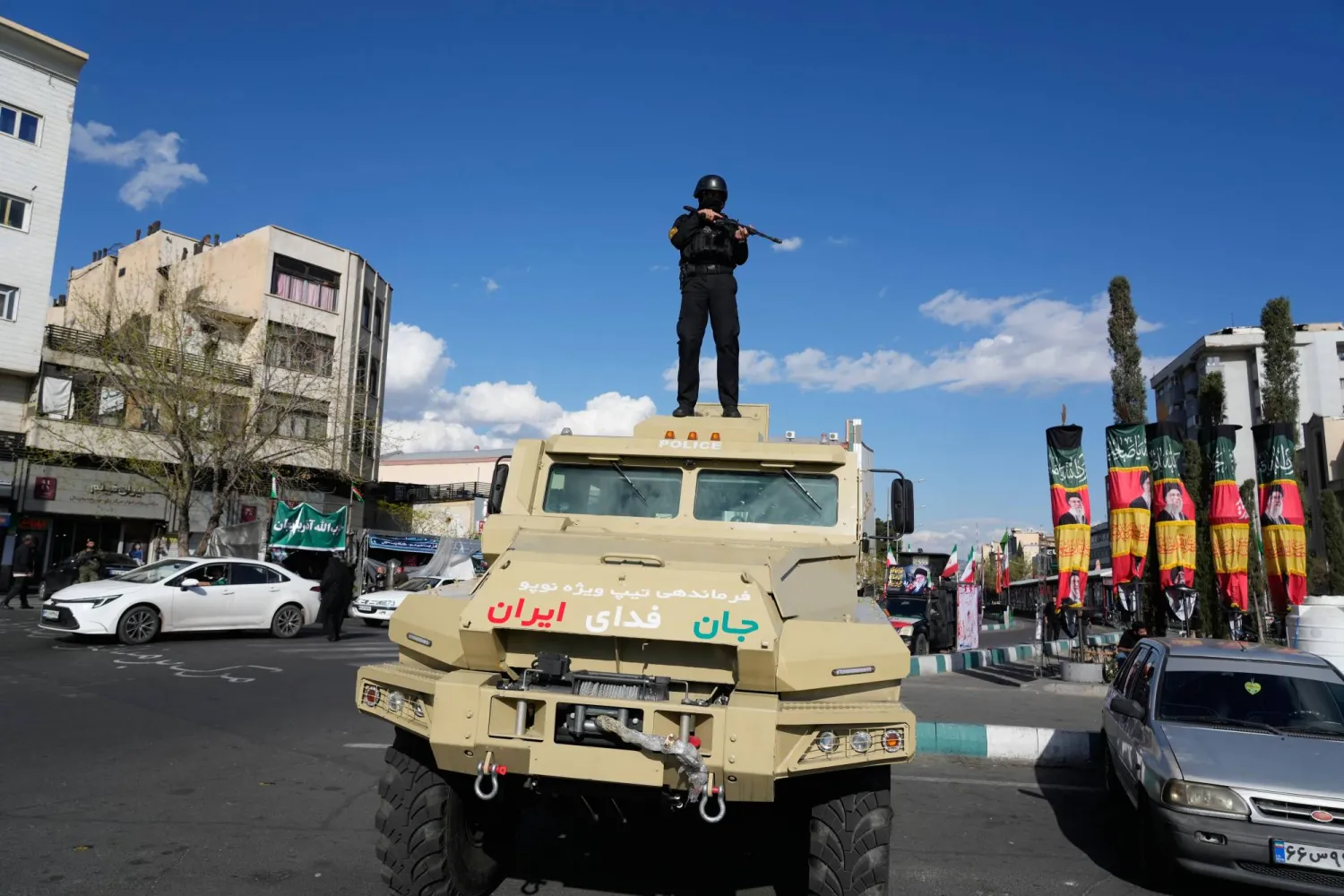
A member of police special forces stands guard on top their car at the Enqelab-e-Eslami square in downtown Tehran, Iran, Monday, March 30, 2026. (AP)
TT

Iran Hangs Two ‘Political Prisoners’ from Banned Opposition

A member of police special forces stands guard on top their car at the Enqelab-e-Eslami square in downtown Tehran, Iran, Monday, March 30, 2026. (AP)

Iran hanged two men on Monday for membership of a banned opposition group, with rights groups describing them as political prisoners and expressing fear of a surge in executions aimed at cowing the population during the Middle East war.

Akbar Daneshvarkar, 60, and Mohammad Taghavi-Sangdehi, 59, were hanged at dawn in the notorious Gehzel Hesar prison in the Tehran satellite city of Karaj for membership of the outlawed People's Mujahedin of Iran, also known as Mujahedeen-e-Khalq (MEK).

They were executed "after confirmation and final approval of the sentence by the Supreme Court", the judiciary's Mizan Online website said.

The MEK opposed the rule of the shah and initially supported the 1979 revolution but rapidly fell out with the new clerical leadership in the 1980s. It is now based in exile and is designated as a terrorist organization by Tehran.

The group's political wing, the National Council of Resistance of Iran (NCIR), confirmed in a statement that the two were members of the MEK.

Its leader Maryam Rajavi said "the desperate clerical regime, in fear of the people's uprising, vainly attempts to delay the explosion of the people's anger for a short while by executing the bravest children of Iran."

Activists expressed fear that there would be a new surge in executions as authorities sought to spread fear throughout society against the backdrop of the war against Israel and the United States.

Amnesty International described the executions as arbitrary and said the two men had been subjected "to torture and other ill-treatment in detention" and also not allowed a final goodbye to families.

- 'Ruthless execution machinery' -

"Even amid the aerial bombardment, authorities are continuing their ruthless execution machinery, weaponizing the death penalty against dissidents in a desperate bid to stifle dissent and tighten their grip on power," Amnesty said.

Mahmood Amiry-Moghaddam, the director of the Norway-based Iran Human Rights group, said "we fear that the Islamic Republic will exploit the current wartime conditions to carry out mass executions inside prisons to instill societal fear".

IHR said the two men were political prisoners and were "subjected to physical and psychological torture, denied due process rights and sentenced to death in a process that did not meet minimum fair trial standards".

It warned that four co-defendants were "at grave and imminent risk of execution" in Ghezel Hesar prison after being sentenced to death in the same case.

Shadi Sadr, co-founder of the NGO Justice for Iran, which seeks legal accountability for rights violations in the country, said "the Iranian people are trapped between an international war and severe internal repression".

Mizan said the two executed men were charged with participating in "terrorist acts", carrying out actions aimed at overthrowing the regime, and disrupting national security.

According to the NCRI, the MEK regularly carried out actions inside Iran aimed at the clerical authorities.

Iran on March 19 executed three men who were accused of killing police officers during protests in January, the first hangings Iran has carried out related to the nationwide demonstrations that were met with a brutal crackdown by the authorities.

It also executed Kouroush Keyvani, a dual Iranian-Swedish national, the same month on charges of spying for Israel, drawing condemnation from Stockholm and the EU.

Iran is the world's most prolific executioner after China, according to rights groups. Last year it hanged at least 1,500 people, according to figures from IHR.



Rubio Says US Hopeful in Private Talks After Iran ‘Fractures’

 US Secretary of State Marco Rubio looks on as he speaks to the press before his departure following a G7 Foreign Ministers' meeting with Partner Countries before his departure at the Bourget airport in Le Bourget, outside Paris, France, March 27, 2026. (Reuters)
US Secretary of State Marco Rubio looks on as he speaks to the press before his departure following a G7 Foreign Ministers' meeting with Partner Countries before his departure at the Bourget airport in Le Bourget, outside Paris, France, March 27, 2026. (Reuters)
TT

Rubio Says US Hopeful in Private Talks After Iran ‘Fractures’

 US Secretary of State Marco Rubio looks on as he speaks to the press before his departure following a G7 Foreign Ministers' meeting with Partner Countries before his departure at the Bourget airport in Le Bourget, outside Paris, France, March 27, 2026. (Reuters)
US Secretary of State Marco Rubio looks on as he speaks to the press before his departure following a G7 Foreign Ministers' meeting with Partner Countries before his departure at the Bourget airport in Le Bourget, outside Paris, France, March 27, 2026. (Reuters)

US Secretary of State Marco Rubio on Monday voiced hope for working with elements within Iran's government, saying the United States privately had received positive messages.

Rubio said there were internal "fractures" inside the country and that the United States hopes figures with "power to deliver" take charge.

"We are hopeful that that's the case," Rubio told the ABC News program "Good Morning America."

"There are clearly people there talking to us in ways that previous people in charge in Iran have not spoken to us in the past, some of the things they're willing to do," he said.

Rubio nonetheless also denounced Tehran in broad strokes, insisting that the war aimed to end its nuclear weapons building capacity, which President Donald Trump said he accomplished during an attack last year.

"These people are lunatics. They are insane. They are religious zealots who can never be allowed to possess a nuclear weapon because they have an apocalyptic vision of the future," Rubio said.

In a separate interview with Al Jazeera, Rubio said there were "messages and some direct talks going on between some inside of Iran and the United States."

The communication is "primarily through intermediaries, but there's been some conversation," he told the Qatar-based news channel.

"I think the president always prefers diplomacy."

Iran denies seeking a nuclear weapon and the UN nuclear watchdog has said no bomb was imminent.

Rubio's comments came a day after Trump said that Iran has already gone through "regime change," one month into the war launched by the United States and Israel.

Trump said that the United States was speaking to a "whole different group of people" and that they were "very reasonable."

On the first day of the war Israel assassinated Iran's longtime supreme leader, Ali Khamenei, and subsequent strikes have killed other top leaders.

Rubio said that there was a difference between private and public messages coming from Iran.

"Obviously they're not going to put it out in press releases, and what they say to you or put out there for the world doesn't necessarily reflect what they're saying in our conversations," Rubio said in the ABC interview.

Despite the Trump administration's public talk of diplomacy, the United States has been reinforcing its military presence in the region and Trump on Monday threatened to "blow up" Iran's oil-exporting island of Kharg if purported talks fail.

The comments from the administration signal a readiness to work with some form of the regime, after the United States and Israel at the start of the war spoke of toppling the government which weeks earlier killed thousands of people as it crushed mass protests.


Türkiye Says NATO Defenses Down Missile from Iran

Türkiye's ‌defense ministry did not say where it thought the missile was heading ‌on Monday. (Reuters file)
TT

Türkiye Says NATO Defenses Down Missile from Iran

Türkiye's ‌defense ministry did not say where it thought the missile was heading ‌on Monday. (Reuters file)

A ballistic missile fired from Iran entered Turkish airspace on Monday and was shot down by NATO defenses, Ankara said, in the fourth such incident reported since the start of the US-Israeli war on Iran.

There was no immediate comment from ‌Tehran which has ‌denied specifically targeting its neighbor Türkiye during the ‌conflict and ⁠has said it ⁠was not involved in the previous three missile launches, which were all downed by NATO defenses.

NATO's spokesperson said the alliance intercepted an Iranian missile heading towards its member country Türkiye, adding that it was "prepared for such threats and will always do what is necessary to defend all Allies".

Iran has fired missiles at countries across the Middle East since the ⁠start of the conflict, striking oil infrastructure and bases ‌with US forces in the region.

Türkiye's ‌defense ministry did not say where it thought the missile was heading ‌on Monday.

Türkiye's Incirlik Air Base in the southern Adana province hosts ‌US, Turkish, Polish, and other personnel.

US personnel are also stationed at NATO's Kurecik radar station in Türkiye's southeastern Malatya province where the alliance recently deployed a Patriot missile defense system.

Separately, Türkiye's Chief of the General Staff, ‌General Selcuk Bayraktaroglu, held a video conference with NATO Military Committee Chair Admiral Giuseppe Cavo Dragone on Monday, ⁠to discuss regional ⁠defense and security issues, the defense ministry said.

The ministry said all necessary measures were being taken "decisively and without hesitation" against any threat directed at Türkiye's territory and airspace.

The incident comes after talks in Islamabad at the weekend between the top diplomats of Türkiye, Pakistan, Egypt, and Saudi Arabia on potential ways to end the war and reopen the Strait of Hormuz to shipping.

Türkiye had offered and tried to mediate between Iran and the United States before the war started at the end of last month.

Ankara has repeatedly called for an end to the conflict, criticized the US-Israeli attacks as illegal, and described Iran's attacks on regional countries as unacceptable.


Trump Threatens to Destroy Iran’s Civilian Infrastructure if a Deal Is Not Reached ‘Shortly’

First responders work on the rubble of a building targeted by an Israeli airstrike in the southern Lebanese village of Hanouiyeh, east of Tyre, on March 30, 2026. (AFP)
TT

Trump Threatens to Destroy Iran’s Civilian Infrastructure if a Deal Is Not Reached ‘Shortly’

First responders work on the rubble of a building targeted by an Israeli airstrike in the southern Lebanese village of Hanouiyeh, east of Tyre, on March 30, 2026. (AFP)

US President Donald Trump on Monday threatened widespread destruction of Iran’s energy resources and other vital infrastructure, including desalination plants that supply drinking water, if a deal to end the war is not reached “shortly.”

Iran meanwhile struck a key water and electrical plant in Kuwait, and an oil refinery in Israel came under attack. Israel and the US launched a new wave of strikes on Iran, as the war raged with no end in sight.

Trump’s new threat came in a social media post. Earlier comments to the Financial Times suggested American troops could seize Iran’s Kharg Island oil export hub. Trump has repeatedly claimed to be making diplomatic progress— though Tehran denies negotiating directly — while ramping up his threats and sending thousands more US troops to the Middle East.

It remains unclear where the diplomatic effort facilitated by Pakistan stands. Iran’s continuing attacks on its Gulf neighbors could further complicate any talks.

Trump says diplomacy is going well but threatens major escalation

In a social media post, Trump said “great progress is being made” in talks with Iran to end military operations. But he said if a deal is not reached “shortly,” and if the Strait of Hormuz is not immediately reopened, the US would broaden its offensive by “completely obliterating” power plants, oil wells, Kharg Island and possibly even desalination plants.

The strait is a crucial waterway through which a fifth of the world’s oil is shipped in peacetime.

The laws of armed conflict allow attacks on civilian infrastructure such as energy plants only if the military advantage outweighs the civilian harm, legal scholars say. It’s considered a high bar to clear, and causing excessive suffering to civilians can constitute a war crime.

A 22-year-old resident of Karaj, near Tehran, said his area lost power for several hours overnight following nearby strikes.

“I was really scared. I thought that they’d hit the power plants and that we are not going to have power anymore,” he said, speaking on condition of anonymity out of security fears.

In the FT interview, Trump said his preference would be to “take the oil in Iran.”

“Maybe we take Kharg Island, maybe we don’t,” he said, referring to a terminal through which nearly all of Iran's oil exports pass.

Iran says US demands are ‘excessive, unrealistic and irrational’

The US already has targeted military positions on Kharg.

Iranian Foreign Ministry spokesman Esmail Baghaei said Tehran had received a 15-point proposal from the Trump administration containing “excessive, unrealistic and irrational” demands, while denying there had been any direct talks.

Earlier, Iran’s parliament speaker, Mohammad Bagher Qalibaf, dismissed the talks in Pakistan as a cover while more US troops are brought to the region. He said Iranian forces were “waiting for the arrival of American troops on the ground to set them on fire and punish their regional partners forever,” according to state media.

Twice during Trump’s second term, the US has attacked Iran during high-level diplomatic talks, including with the Feb. 28 strikes that started the current war.

Iran attacks Israel

Sirens sounded at dawn near Israel’s main nuclear research center, a part of the country that has been targeted repeatedly in recent days. Israel’s military also said it had taken out two drones launched from Yemen, where the Iran-backed Houthis entered the war on Saturday with their first missile attack.

Iran kept up the pressure on its Gulf Arab neighbors: Saudi Arabia intercepted five missiles targeting its Eastern province; a fireball erupted over Dubai, United Arab Emirates, as a missile was intercepted; and in Kuwait, an Iranian attack hit a power and desalination plant, killing one worker and wounding 10 soldiers, the state-run KUNA news agency reported.

An Emirati official signaled that the UAE wants more than just a ceasefire.

“An Iranian regime that launches ballistic missiles at homes, weaponizes global trade and supports proxies is no longer an acceptable feature of the regional landscape,” Noura Al Kaabi, a minister of state at the UAE’s Foreign Ministry, wrote in a column published by the state-linked, English-language newspaper The National.

She added: “We want a guarantee that this will never happen again.”

NATO air defenses intercepted a ballistic missile over Türkiye that was fired from Iran, Türkiye’s Defense Ministry said, in the fourth such incident since the start of the war. Iran has denied firing the previous missiles. Türkiye has tried to maintain a neutral position and is taking part in mediation efforts.

Israel launched a new wave of attacks on Iran, saying it was striking “military infrastructure” across Tehran. Explosions were heard in the Iranian capital and Iranian state media reported a petrochemicals plant in Tabriz, in the north, sustained damage in an airstrike.

Peacekeeper killed in Lebanon

In southern Lebanon, which Israel has invaded as it battles the Iran-backed Hezbollah, an Indonesian United Nations peacekeeper was killed and three others were wounded by an exploding projectile.

An Israeli airstrike on a Beirut suburb killed one person and wounded 17, including four children, according to Lebanon's Health Ministry.

Over the weekend, Israeli Prime Minister Benjamin Netanyahu said the military would widen its invasion, expanding the “existing security strip” in southern Lebanon.

In Iran, authorities say more than 1,900 people have been killed, while 19 have been reported dead in Israel.

Two dozen people have been killed In Gulf states and the occupied West Bank. In Lebanon, officials said more than 1,200 people have been killed, and more than 1 million have been displaced. Six Israeli soldiers have died in Lebanon, while 13 US service members have been killed in the war.

Oil prices rise again

Iran’s attacks on the energy infrastructure of the region and its stranglehold on the Strait of Hormuz have threatened global supplies of oil, natural gas and fertilizer. They have sent fuel prices skyrocketing and given rise to growing concerns about an energy crisis.

Trump has said that Iran had agreed to allow 20 oil tankers through the Strait of Hormuz starting Monday as “a sign of respect.” There wasn’t any information on whether those ships were actually moving.

Brent crude oil, the international standard, was trading around $115 Monday, up nearly 60% from when the war started.