


Russian Tanker Set to Deliver Oil to Crisis-hit Cuba

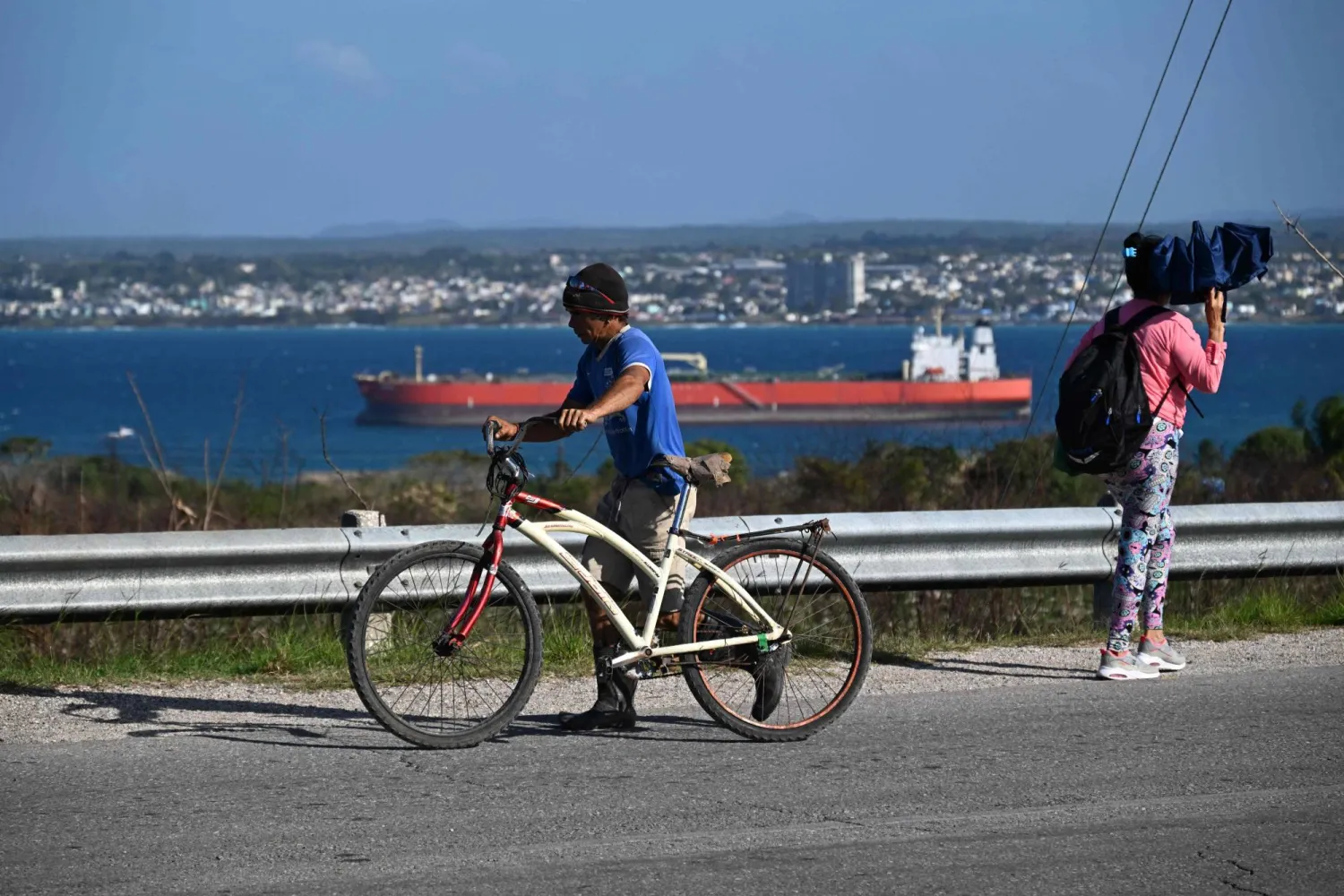
A man walks with a bike as an oil tanker ship sails on Matanzas Bay, Cuba on March 30, 2026. (Photo by Yamil LAGE / AFP)
TT

Russian Tanker Set to Deliver Oil to Crisis-hit Cuba

A man walks with a bike as an oil tanker ship sails on Matanzas Bay, Cuba on March 30, 2026. (Photo by Yamil LAGE / AFP)

A Russian oil tanker was set to deliver the first crude shipment to Cuba since January on Tuesday after Washington gave the crisis-hit island a reprieve from an effective fuel blockade.

The Anatoly Kolodkin, a tanker under US sanctions, was on its way to the port of Matanzas, east of Havana, with 730,000 barrels of crude.

US President Donald Trump's decision to let Russia deliver the oil avoids a confrontation with Moscow and provides temporary relief to a country that has endured blackouts, fuel rationing and dwindling public transportation.

"We'll welcome it with open arms. You have no idea how badly we need that oil," said Rosa Perez, a 74-year-old retiree whose home in Matanzas had lost power again.

"Let's see if things improve for us, even just a little... I can't take it anymore," she told AFP, voicing hope that more shipments will follow.

Trump said Sunday that he did not object to Russia or others sending oil to the island because Cubans "have to survive."

The White House denied however that there was any change to US sanctions policy.

"We allowed this ship to reach Cuba in order to provide humanitarian needs to the Cuban people. These decisions are being made on a case-by-case basis," White House Press Secretary Karoline Leavitt said.

Cuba was cut off from oil supplies in January after US forces ousted its main regional ally, Venezuela's socialist leader Nicolas Maduro, and Trump threatened tariffs on countries that send crude to the country.

The US president has mused about "taking" the communist-ruled island, though Cuban President Miguel Diaz-Canel confirmed in March that Cuban and US officials had held talks.

Ricardo Herrero, executive director of the Cuba Study Group, a nonpartisan policy group in Washington, said the aim of restricting oil was to force Havana "to make real concessions at the negotiating table."

"The strategy here is to drive the system to the brink," Herrero told AFP. "But it's not to precipitate a full-blown societal or humanitarian collapse."

"It's all consistent with idea that the US holds all the cards and they'll decide when to hold, when to fold and when they go all in," he said.

Cubans have endured seven nationwide blackouts since 2024, including two in March, and fuel prices have soared.

The blackouts as well as persistent shortages of food and medicine have fueled public frustration and some rare protests.

Analysts said the Russian oil would buy the Cuban economy only a few weeks.

Jorge Pinon, an expert on Cuba's energy sector at the University of Texas at Austin, said the more urgent need is diesel, which could be used for backup power generators or for transportation systems to keep the economy running.

It would take a month to refine the oil and deliver the diesel, which would be enough to cover demand for about two weeks, he said.

Herrero said the shipment was just "another donation" by Cuba's Russian ally, but he doubted that Moscow wanted to subsidize the Cuban economy in the long term.

"This is not going to help the economy recover," he said. "This is just humanitarian aid."


Hundreds Evacuated as Waves Batter New Zealand Capital

Stormy seas pound the coastline of Island Bay, a suburb of the New Zealand capital Wellington. Ben STRANG / AFP
TT

Hundreds Evacuated as Waves Batter New Zealand Capital

Stormy seas pound the coastline of Island Bay, a suburb of the New Zealand capital Wellington. Ben STRANG / AFP

Authorities evacuated hundreds of people from their seaside homes in New Zealand's capital on Tuesday as 11-meter (36-foot) waves lashed the coast.

Wellington Mayor Andrew Little declared a state of emergency on the eve of the swells for seaside residents in Owhiro Bay, Island Bay, Houghton Bay and Breaker Bay.

"You must stay away from the southern coastline," Little said in a statement, warning that emergency workers would not be coming to help anyone who stayed behind.

The evacuation order took effect on Tuesday morning, with police brought in to ensure people moved to higher ground, said AFP.

Officers set up cordons on surrounding roads to prevent people from heading to the coast.

The council said a similar event in 2021 affected many homes in Breaker Bay, and waves during that storm were about 6.5 meters.

Waves entering Wellington Harbour on Tuesday were measured at 11 meters, New Zealand's MetService said.

Wind gusts were so strong at Island Bay that two women were knocked off their feet as waves washed up over the road, an AFP journalist saw.

Some flights were cancelled at Wellington Airport where wind gusts were recorded of up to 128 kilometers per hour (80 miles per hour).

A small plane from local carrier Golden Bay Air tipped onto its side in the wind while parked at the airport with no-one aboard.

Airline boss Richard Molloy told national broadcaster RNZ that fire fighters had secured the plane to the ground.


Russian Strikes Kill 3 Near Ukraine’s Kharkiv

This handout taken and released by the State Emergency Service of Ukraine on June 9, 2026 shows smoke rising from a fire following Russian strikes in the Kharkiv region, amid the Russian invasion of Ukraine. (Photo by Handout / State Emergency Service of Ukraine / AFP)
TT

Russian Strikes Kill 3 Near Ukraine’s Kharkiv

This handout taken and released by the State Emergency Service of Ukraine on June 9, 2026 shows smoke rising from a fire following Russian strikes in the Kharkiv region, amid the Russian invasion of Ukraine. (Photo by Handout / State Emergency Service of Ukraine / AFP)

Russian strikes killed three people and wounded 10 others in Ukraine's northeastern Kharkiv region, its governor said early Tuesday.

"The enemy has hit the city of Chuguiv," Kharkiv regional governor Oleg Synegubov wrote on Telegram, adding that three people had been killed.

"The strikes caused fires and damaged at least 18 vehicles; windows were blown out and building facades damaged in residential multi-storey buildings," Synegubov said.

Separately, Kharkiv mayor Igor Terekhov reported 10 people were wounded in his city.

Daily Russian attacks that claim civilian lives have intensified in recent months, and Ukraine has hit back with its own drone strikes further into Russian territory, saying these are mainly against military and energy facilities.

According to a UN estimate published in April, at least 15,850 civilians have been killed in Ukrainian zones since Russia launched its invasion in February 2022.

More than 2,800 civilians have died in Russian-controlled zones, according to the UN toll, which added that more than 44,800 have been wounded in Ukrainian and Russian-occupied zones.


Congo’s Ebola Outbreak Rises to 100 Deaths out of 550 Cases as Conflict Slows Response

A health worker wearing a face mask as part of his personal protection equipment (PPE) looks on at the Mulago National Referral Hospital isolation unit in Kampala, Uganda, on July 8, 2026. (AFP)
TT

Congo’s Ebola Outbreak Rises to 100 Deaths out of 550 Cases as Conflict Slows Response

A health worker wearing a face mask as part of his personal protection equipment (PPE) looks on at the Mulago National Referral Hospital isolation unit in Kampala, Uganda, on July 8, 2026. (AFP)

At least 100 people have died from Ebola less than a month after authorities declared an outbreak of the disease in eastern Congo, authorities said.

Attacks on health workers from angry residents, skepticism among some locals and armed conflict in hot spots continue to challenge efforts to stop the outbreak declared on May 15.

Out of the 550 cases of the disease confirmed as of Sunday, there have been 101 deaths and 19 recoveries, according to the latest situation report late Monday.

The outbreak is concentrated in Congo’s eastern province of Ituri, which accounts for more than 90% of the cases. Cases have also been recorded in the North Kivu and South Kivu provinces, and has spread across the border to Uganda.

The number of cases in Congo is believed to be higher because the outbreak was confirmed weeks late, and the response has been challenging also because the virus has no approved vaccine or treatment.

The latest Ebola disease outbreak is caused by the rare Bundibugyo virus, which does not have an approved vaccine or treatment unlike the “Zaire virus,” another name for the Ebola virus, responsible for most of Congo’s past 16 outbreaks of the disease.

The rapid increase in the number of cases is in part due to the scale up of diagnostic capacities, enabling testing of the backlog of previously collected samples, authorities said.

Frontline health workers, with little pay or rest, have been attacked multiple times by angry residents and have not been able to reach some communities due conflict involving armed rebel groups.

Eastern Congo has for years seen attacks by dozens of separate rebel and militant groups, some of them with links to foreign countries or to the extremist Islamic State group.

Conflict is “constraining access for the response, disrupting surveillance and response activities, and increasing the risk of undetected transmission,” the World Health Organization said Monday.

“Such incidents underline the challenges of the context and the importance of working closely with local leaders and communities,” it added.
