Trump Says US Strongly Considering NATO Exit

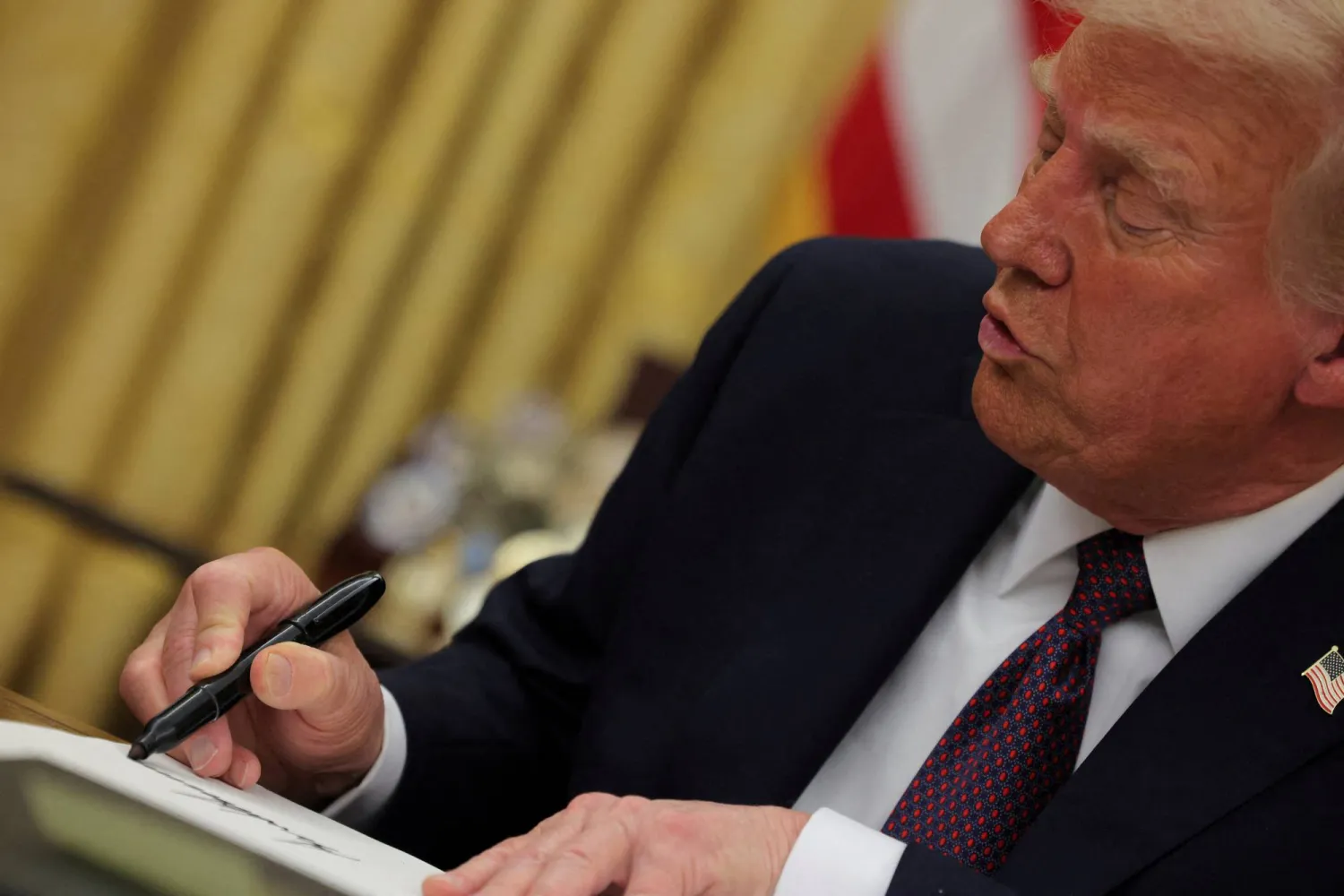
FILE PHOTO: US President Donald Trump signs documents at the White House in Washington, US, January 20, 2025.  REUTERS/Carlos Barria/File Photo
FILE PHOTO: US President Donald Trump signs documents at the White House in Washington, US, January 20, 2025. REUTERS/Carlos Barria/File Photo
TT

Trump Says US Strongly Considering NATO Exit

FILE PHOTO: US President Donald Trump signs documents at the White House in Washington, US, January 20, 2025.  REUTERS/Carlos Barria/File Photo
FILE PHOTO: US President Donald Trump signs documents at the White House in Washington, US, January 20, 2025. REUTERS/Carlos Barria/File Photo

President Donald Trump said he was strongly considering pulling the United States out of NATO after allies failed to back US military action against Iran, according to an interview with Britain's Daily ⁠Telegraph.

Trump described the ⁠alliance as a "paper tiger" and said removing the United States from the defense pact was ⁠now "beyond reconsideration," the newspaper reported. He said he had long held doubts about NATO's credibility.

"Oh yes, I would say [it’s] beyond reconsideration," Trump told the newspaper when asked about whether he would reconsider US ⁠membership ⁠of the alliance after the conflict.

"I was never swayed by NATO. I always knew they were a paper tiger, and (Russian President Vladimir) Putin knows that too, by the way."

US Defense Secretary Pete Hegseth said on Tuesday other countries needed to "be prepared to stand up" and help reopen the Strait of Hormuz, echoing criticism from Trump, who has singled out NATO members Britain and France.

Rubio told Fox News Washington would not overlook the lack of assistance from other NATO members. "After this conflict is concluded, we ⁠are going to have to reexamine ⁠that relationship," he said.


Kyiv Says Russia Has Returned 528 Bodies to Ukraine

A handout photo made available by the Ukrainian Presidential Press Service shows Ukrainian prisoners of war (POWs) reacting following their release in a prisoner swap at an undisclosed location in Ukraine, 15 May 2026. (EPA/Ukrainian Presidential Press Service Handout)
TT

Kyiv Says Russia Has Returned 528 Bodies to Ukraine

A handout photo made available by the Ukrainian Presidential Press Service shows Ukrainian prisoners of war (POWs) reacting following their release in a prisoner swap at an undisclosed location in Ukraine, 15 May 2026. (EPA/Ukrainian Presidential Press Service Handout)

Kyiv said on Saturday that Russia had returned 528 bodies to Ukraine identified as Ukrainian soldiers killed in action, in one of the few areas of cooperation between the warring neighbors.

"As a result of repatriation efforts, the bodies of 528 deceased individuals have been returned to Ukraine; according to the Russian side, they may be Ukrainian servicemen," Ukraine's prisoners of war center stated on social media, without specifying when the remains were received.

Investigators and experts "will take all necessary steps to identify the repatriated deceased", the center said, a day after Russia and Ukraine exchanged 205 prisoners of war each.

Last Friday, US President Donald Trump announced a three-day ceasefire in the conflict from Saturday to Monday, as well as an exchange of 1,000 prisoners from each side.

Ukrainian President Volodymyr Zelensky confirmed that Friday's exchange of prisoners marked the first phase of the swap announced by Trump.

Since the start of the Russian invasion of Ukraine more than four years ago, exchanges of prisoners and the remains of fallen fighters have been one of the few areas of cooperation between Moscow and Kyiv.


End of the ‘People’s Army’ Myth: Israel Weighs Resorting to Mercenaries

Israeli soldiers seen in the village of Aitaroun in southern Lebanon, January 27, 2025. (AP)
TT

End of the ‘People’s Army’ Myth: Israel Weighs Resorting to Mercenaries

Israeli soldiers seen in the village of Aitaroun in southern Lebanon, January 27, 2025. (AP)

As Israel’s military grapples with a severe manpower shortage estimated at 15,000 troops — a situation Chief of Staff Eyal Zamir has described as “dangerous for the future of the Jewish state” —

Israeli ultra-Orthodox parties continue to reject military service in favor of Torah study even as Israel’s military grapples with a severe manpower shortage estimated at 15,000 troops - a situation Chief of Staff Eyal Zamir has described as “dangerous for the future of the Jewish state”.

Former senior government official Shlomo Maoz has proposed recruiting 12,000 mercenary soldiers with generous pay packages to address the shortage.

Maoz presented the idea as a personal initiative inspired by Ukraine’s recruitment of 10,000 foreign fighters, however, he said the Israeli army has long relied on a similar force known as “lone soldiers,” currently numbering 7,365.

According to Maoz, 52 percent are soldiers from Jewish families living abroad, while the remaining 48 percent are effectively mercenaries “in every sense of the word.” They come from several countries, including 30 percent from the US, 12 percent from France and 7 percent from Ukraine, while the rest come from Spain, Italy, Germany, Canada and Britain.

These soldiers receive salaries equivalent to $4,000 a week and they currently serve through “secret” arrangements, he revealed.

His new proposal is aimed at bringing these arrangements into the open and formalize the system publicly through the creation of an “Israeli Foreign Legion” composed of four brigades operating under Israeli officers.

Speaking to Israel’s Maariv daily, Maoz stressed that the main problem with the proposal was moral rather than military, as it would mark Israel’s abandonment of the “people’s army” myth.

He described the Israeli military as historically built on the integration of Israelis from more than 100 cultural backgrounds — Ashkenazi and Mizrahi Jews, urban and rural communities, native-born Israelis and new immigrants, people from Europe and Western countries, as well as from Arab and Muslim states, alongside Jews, Muslims, Christians, Druze and Circassians — into what he called a cohesive force that overcame social divisions.

But Maoz argued that the benefits of recruiting mercenaries outweigh the symbolic costs.

He said the military faces an acute shortage, with even conservative estimates pointing to a need for 15,000 additional troops, including at least 9,000 combat soldiers, while religious Jews remain adamantly opposed to conscription.

At the same time, he said, the government is waging an ongoing war on seven fronts, pursuing further occupation and expansion, and establishing 134 new settlements and outposts that all require protection.

“To fill this need, solutions outside the box must be explored,” Maoz urged.

He added that hundreds of thousands of retired military officers from around the world, including fighters, snipers, tank operators, drone specialists and even pilots, could be recruited easily, particularly from Eastern European countries.

Maoz, an economist by background, said financing the project was one of its key challenges. He estimated each soldier would cost between $8,000 and $10,000 a month, with additional state expenses amounting to roughly half that figure.

He revealed that the total cost of a mercenary force would reach around $2.5 billion — a manageable amount given Israel’s foreign currency reserves of $236 billion, equivalent to about 38 percent of gross domestic product.

Pointing to the Ukrainian model, Maoz said around 600 mercenaries join Ukraine’s army every month, bringing the total number of foreign fighters there to 10,000 from 75 nationalities. Kyiv pays them an average of $4,000 per month.

Maoz added that Israel was particularly suited to integrating mercenaries because it has millions of citizens who speak foreign languages as their mother tongue, such as Russian, Slavic languages, English and Spanish.


Putin to Visit China May 19-20 After Trump Trip

 Russian President Vladimir Putin pauses as he meets with newly appointed acting governor of Belgorod region Alexander Shuvaev at the Kremlin in Moscow, Wednesday, May 13, 2026. (Mikhail Metzel/Sputnik, Kremlin Pool Photo via AP)
Russian President Vladimir Putin pauses as he meets with newly appointed acting governor of Belgorod region Alexander Shuvaev at the Kremlin in Moscow, Wednesday, May 13, 2026. (Mikhail Metzel/Sputnik, Kremlin Pool Photo via AP)
TT

Putin to Visit China May 19-20 After Trump Trip

 Russian President Vladimir Putin pauses as he meets with newly appointed acting governor of Belgorod region Alexander Shuvaev at the Kremlin in Moscow, Wednesday, May 13, 2026. (Mikhail Metzel/Sputnik, Kremlin Pool Photo via AP)
Russian President Vladimir Putin pauses as he meets with newly appointed acting governor of Belgorod region Alexander Shuvaev at the Kremlin in Moscow, Wednesday, May 13, 2026. (Mikhail Metzel/Sputnik, Kremlin Pool Photo via AP)

Russian President Vladimir Putin will travel to China on May 19 for a two-day visit, hot on the heels of US President Donald Trump's trip to Beijing, the Kremlin said on Saturday.

During the trip, the Russian leader will discuss with his Chinese counterpart Xi Jinping how to "further strengthen the comprehensive partnership and strategic cooperation" between Moscow and Beijing, according to a Kremlin statement.

Putin and Xi will "exchange views on key international and regional issues" and sign a joint declaration at the conclusion of their talks, it added.

As part of the visit, Putin is also scheduled to discuss economic and trade cooperation with Chinese Premier Li Qiang.

The announcement of Putin's trip comes just after Trump wrapped up on Friday the first visit to China by a US president in nearly a decade, with the grand reception belying a roster of unresolved trade and geopolitical tensions, including over the Ukraine-Russia conflict.

Although Trump and Xi discussed the more than four-year-long conflict -- as well as the US leader's stalemated war with Iran -- the Republican president took off from China on Friday without appearing to secure a breakthrough on either front.

While China has regularly called for talks to end the fighting, it has never condemned Russia for sending troops into Ukraine in February 2022 and presents itself as a neutral party.

Beijing also denies providing Moscow with weapons and military components for its defense industry, blaming Western countries for prolonging Europe's deadliest conflict since World War II by arming Ukraine instead.

As the world's top buyer of Russian fossil fuels, China has become Moscow's key economic partner, especially since Western countries imposed economic sanctions on Russian oil and gas over the conflict.

Negotiations to end the fighting in Ukraine, brokered by the United States, have appeared stalled since the beginning of the US-Israeli war with Iran which broke out on February 28.

Moscow has ruled out a ceasefire or comprehensive negotiations with Ukraine unless Kyiv caves to the Kremlin's maximalist demands.