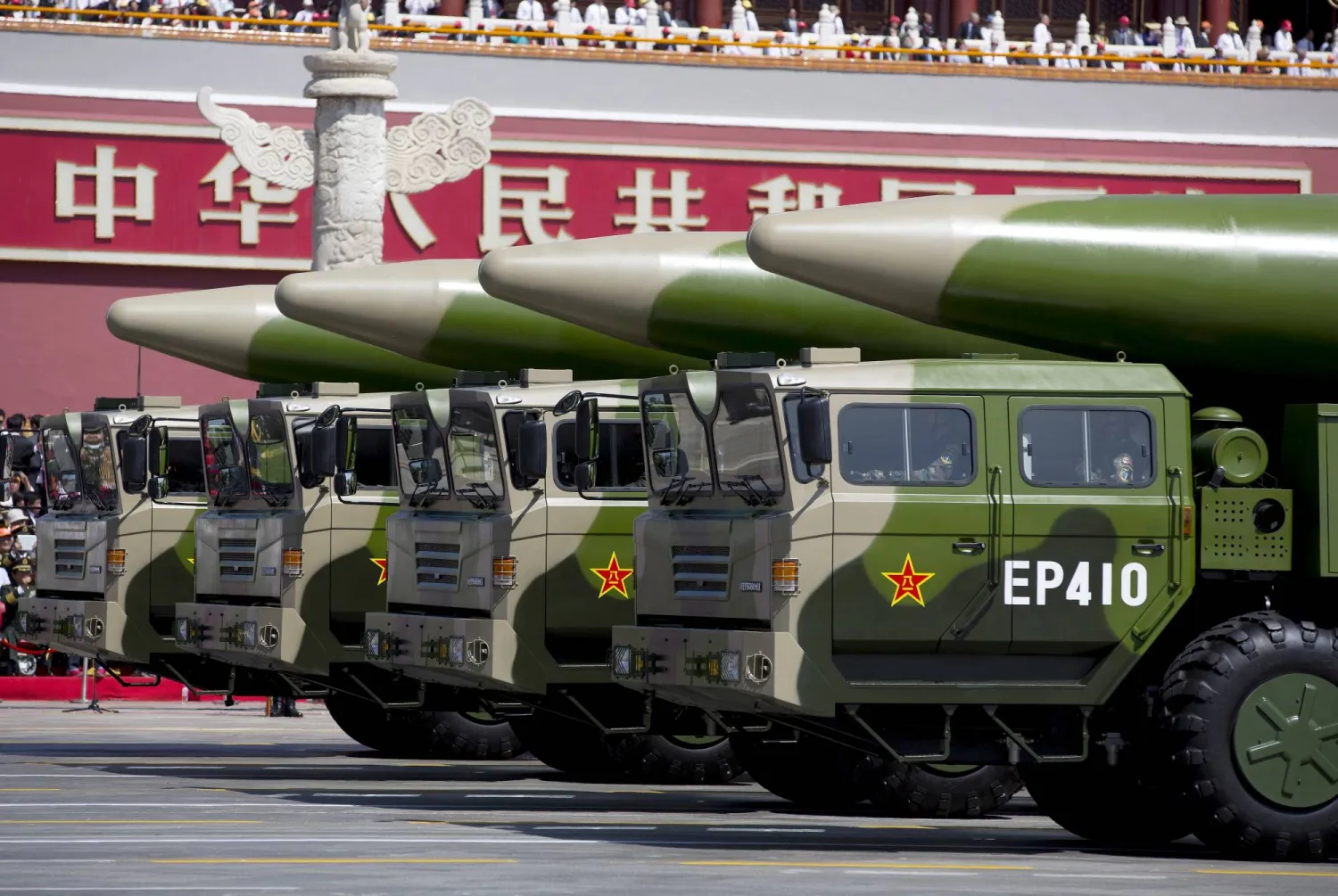
Iran War as a New Catalyst...China Secretly Enters Nuclear Arms Race

China asserts that it follows a defensive strategy and is committed to the no-first-use of nuclear weapons (file-Reuters).
TT

Iran War as a New Catalyst...China Secretly Enters Nuclear Arms Race

China asserts that it follows a defensive strategy and is committed to the no-first-use of nuclear weapons (file-Reuters).

When three villagers from China’s Sichuan Province wrote to local officials in 2022 questioning why the government was confiscating their land and evicting them from their homes, they received a brief response: "It is a state secret."

An investigation by CNN revealed that this secret centers on China's plans to significantly expand its nuclear capabilities. More than three years after the citizen evacuations, satellite imagery shows their village has been leveled, replaced by new buildings designed to support some of China’s most critical nuclear weapons production facilities.

CNN reported that the expansion of these sites in Sichuan, observed through satellite imagery and a review of dozens of Chinese government documents, confirms recent allegations by President Donald Trump’s administration that Beijing is conducting its largest nuclear modernization campaign in decades.

President Trump is scheduled to visit Beijing on a historic trip next month, where he is expected to seek a dialogue on an agreement to curb Chinese President Xi Jinping’s nuclear ambitions.

Most Significant New Facilities in Sichuan Province

Among the most prominent of these facilities is a massive, fortified dome built on the banks of the Tongjiang River in less than five years. It appears to still be undergoing outfitting, suggesting it may not yet be operational.

The reinforced dome covers an area of 3,344 square meters (equivalent to 13 tennis courts). It is encased in a concrete and steel structure equipped with radiation monitoring devices and blast-proof doors, with a network of pipes extending from the facility to a building featuring a high ventilation chimney.

According to several experts, these features, along with advanced air-handling equipment, are designed to contain highly radioactive materials, such as uranium and plutonium, within the dome, indicating an expansion of the Chinese nuclear program's production capacity. The facility is also surrounded by three layers of security fencing.

No Sign of Retreat

This development comes at a time of rising international tensions, particularly following the expiration of the latest nuclear arms limitation treaty between the United States and Russia (known as "New START") earlier this year. Trump is seeking to broker a new and improved agreement with Moscow that would also include China.

However, the radical changes witnessed in Sichuan indicate that the Chinese military's nuclear weapons development shows no sign of slowing down, according to the CNN report.

In contrast, China denies the accusations; military spokesperson Jiang Bin emphasized that his country "follows a defensive strategy and is committed to no-first-use of nuclear weapons."

However, experts believe the significant changes on the ground reflect a fundamental shift in the nuclear program. Analyst Decker Eveleth said that this extensive modernization suggests a fundamental restructuring of the technology underpinning the entire system.

Renny Babiarz, Vice President of Analysis and Operations at AllSource Analysis, who reviewed the satellite imagery for CNN, also pointed to the potential development of "new processes and different types of equipment" within these facilities. He said it was clear that there are many changes happening on the ground."

This expansion coincides with directives issued by the Chinese President to accelerate the building of strategic deterrence capabilities amid escalating regional tensions, particularly regarding Taiwan.

Observers believe these moves could lead to a new nuclear arms race more complex than the Cold War era, with China emerging as a major third party. There are also concerns that the United States might overestimate China's capabilities, thereby exacerbating nuclear proliferation.

Jeffrey Lewis, a distinguished scholar in global security at the Middlebury Institute, said some in the US will argue that we need to radically expand our nuclear weapons production capacity to match China..."but we won't be matching what they are doing; we will be matching what we think they are doing. We will be matching our own nightmare. And that is extremely dangerous."

Impact of the Iran War on China’s Nuclear Program

Experts say that the ongoing US-Israeli war on Iran may have strengthened China's resolve to expand its nuclear program.

"If you were Chinese and looked at what is happening, you wouldn't see that disarmament or weakening yourself makes any sense," Lewis said. He added: "One outcome of what the Trump administration is doing in Iran will not be to intimidate or subdue China, but rather to push it to build more nuclear weapons."

Lewis noted that, given these factors, the chances of reaching arms control agreements appear limited, pointing out that China may engage in "formal" dialogues to de-escalate tensions without offering substantial concessions.


Sailor Killed in Gulf as Iran Says Tankers on Fire

Vessels at the Strait of Hormuz, as seen from Musandam, Oman, November 3, 2026. (Reuters)
TT

Sailor Killed in Gulf as Iran Says Tankers on Fire

Vessels at the Strait of Hormuz, as seen from Musandam, Oman, November 3, 2026. (Reuters)

A seafarer on a Greek-owned oil tanker was killed in an apparent missile attack in the Gulf, its owner said Friday, after Tehran said ships were on fire after hitting mines in the Strait of Hormuz.

The Marshall Islands-flagged tanker Velos Sapphire was sailing to Bahrain empty of cargo when the attack happened on Thursday, Velos Tankers said in a statement carried by the Greek news agency ANA.

The Athens-based company said the explosion was likely caused by an unidentified projectile that struck the vessel's port quarter, sparking a fire.

On Thursday, Iranian media reported that five oil tankers and a tugboat caught fire after hitting mines in the Strait of Hormuz.

In a statement carried by state media Friday, Iran's Revolutionary Guards said two more oil tankers were on fire in the strategic gateway to the energy-rich Gulf.

British maritime agency UKMTO said on Friday that the master of a tanker transiting the strait the previous day had reported an explosion "at the waterline, port side" off Oman.

"The crew are safe... The tanker is still under its own power and is continuing on its voyage," it added.

Since the outbreak of the Middle East war on February 28, Tehran has sought to limit traffic through the waterway, which normally carries about one-fifth of global oil consumption.

The United States has in response imposed a blockade on Iranian ports and escorted tankers through the strait.


Rubio Denies Plans to Leave Post for White House Bid

US Secretary of State Marco Rubio speaks during a memorandum of understanding signing ceremony with Paraguay's Foreign Minister Ruben Ramirez Lezcano on strategic civil nuclear cooperation, at the State Department in Washington, DC, US, August 4, 2026. (Reuters)
TT

Rubio Denies Plans to Leave Post for White House Bid

US Secretary of State Marco Rubio speaks during a memorandum of understanding signing ceremony with Paraguay's Foreign Minister Ruben Ramirez Lezcano on strategic civil nuclear cooperation, at the State Department in Washington, DC, US, August 4, 2026. (Reuters)

US Secretary of State Marco Rubio dismissed reports Thursday that he was planning to leave the Trump administration as he weighs his next moves after Republicans' losses in midterm elections, according to The New York Times.

It has "always been my plan" to work for President Donald Trump until the end of his term, Rubio told The Times in an interview.

Rubio, who also serves as Trump's national security adviser, is widely considered a potential successor to Trump in the 2028 presidential race.

Just days before Tuesday's midterm elections, he made an unusual appearance alongside the US leader on the campaign trail, briefly stepping up on the podium to address a cheering crowd at a rally.

Rubio declined to answer questions about his political future on Thursday, however, saying: "I literally will not talk about 2028 anymore."

On reports that he was considering an exit from the Trump administration, he told The New York Times: "I don't know where these things come from, to be honest with you."

Earlier Thursday, Bloomberg News reported that Rubio was weighing whether to leave the administration.

The report added that Rubio spoke to White House officials about stepping down, and was asked to stay.

But the State Department has hit back sharply against reports that Rubio might leave.

Dylan Johnson, Assistant Secretary of State for global public affairs, called the Bloomberg article "totally made up."

He also called a report by news outlet The Independent, which said Rubio was planning to launch a bid for the 2028 Republican presidential nomination, "completely baseless fake news."

Rubio has previously said that he would support Vice President JD Vance if he ran for president.

Vance is also widely considered a possible 2028 candidate.


Trump Says to ‘Soon’ Take Decision on Whether to Resume Iran War

A hat reading "VETO" sits on the Resolute Desk as US President Donald Trump speaks in the Oval Office of the White House, Washington, DC, on November 5, 2026. (AFP)
TT

Trump Says to ‘Soon’ Take Decision on Whether to Resume Iran War

A hat reading "VETO" sits on the Resolute Desk as US President Donald Trump speaks in the Oval Office of the White House, Washington, DC, on November 5, 2026. (AFP)

US President Donald Trump said on Thursday that he would decide “soon” on whether to resume the war on Iran following a meeting with his top national security advisers.

"Now we will make a decision," Trump told reporters in the Oval Office.

"Do we want to go further" with strikes to ensure Iran's nuclear program is over and that "it will never happen again?" he added.

"I would rather not destroy the rest of the country if possible, but maybe I will have to. You'll know soon enough."

Trump held meetings at the White House on Wednesday and Thursday to discuss the resumption of military operations, according to senior officials who spoke to US media.

While the US Central Command continues its military preparations, Qatari mediators are advancing a draft agreement aimed at fostering confidence between Washington and Tehran.

The president, at least for now, is considering three options: launch new strikes, continue to strangle Iran's regime economically, or cut a deal that includes significant concessions to the Iranians, reported Axios.

Trump on Thursday said Iran could not do ‌anything regarding ‌its nuclear program ‌without ⁠US approval.

"They're not ⁠doing anything without our approval," ⁠Trump told reporters ‌in ‌the Oval ‌Office ‌in response to a question regarding a ‌set of proposals made ⁠to ⁠Iran by mediators about the future of its nuclear program.