


Israel Wary of Sudden Trump Shift Despite War Pledge

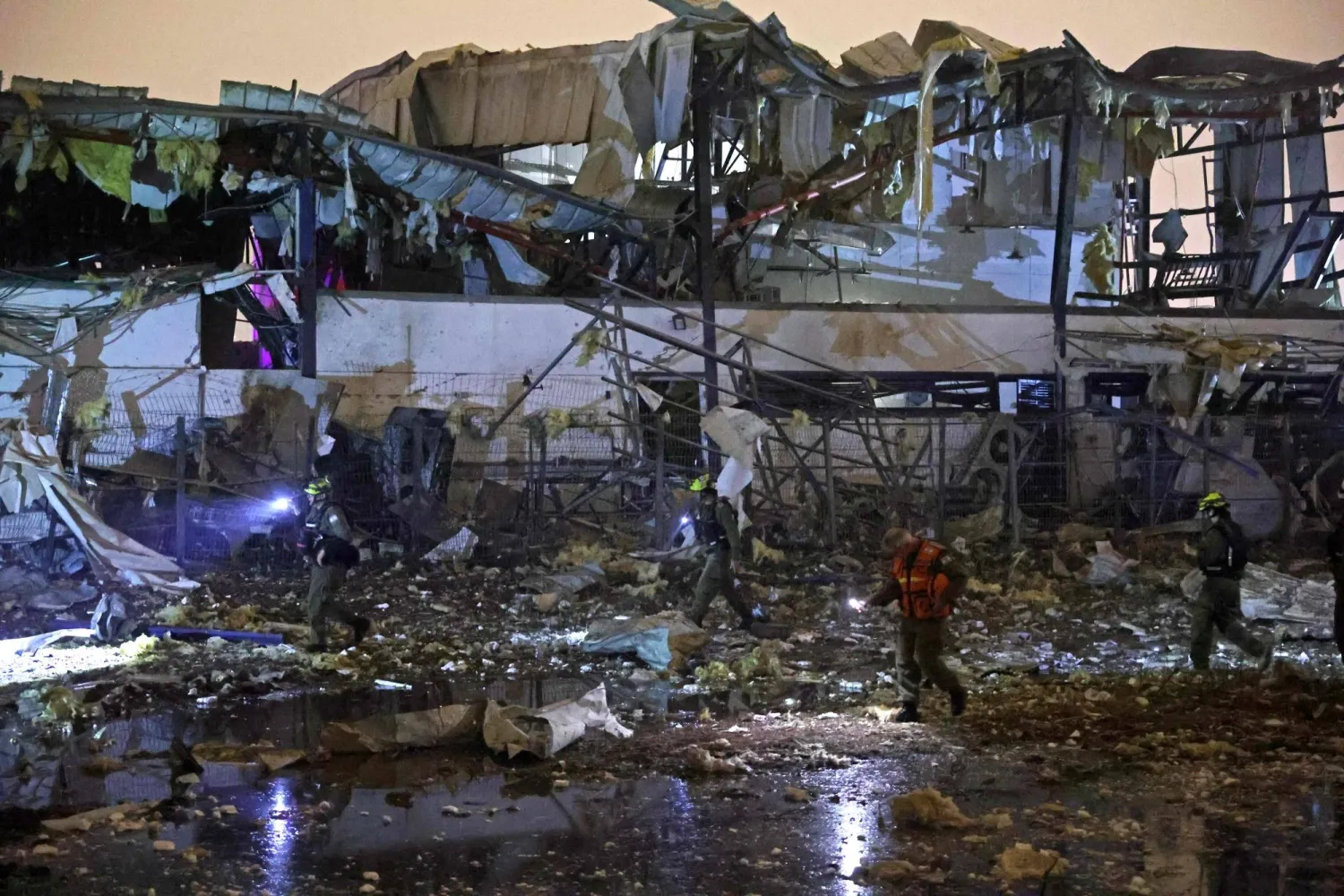
Israeli security forces and first responders inspect the site of an Iranian strike that hit a residential neighborhood in Petah Tikva on April 2, 2026. (AFP)
TT

Israel Wary of Sudden Trump Shift Despite War Pledge

Israeli security forces and first responders inspect the site of an Iranian strike that hit a residential neighborhood in Petah Tikva on April 2, 2026. (AFP)

Despite reassurances in Israel after US President Donald Trump said the war on Iran would continue for another two to three weeks, Israeli assessments still warn of a possible abrupt policy shift that could halt the conflict “before its objectives are complete.”

Security sources say Iran’s Revolutionary Guard Corps (IRGC) remains intent on prolonging the war despite heavy losses, seeking to turn it into a drawn-out war of attrition. Trump, however, is viewed as aiming to deny Tehran that leverage.

Sources quoted by Israeli outlet Walla said ending the war sooner could allow Israel and the United States to better assess the impact of their strikes, amid growing opposition to the conflict in the United States and Western countries, as well as waning support within Israel.

According to Channel 12, Iran has sustained extensive damage. The United States and Israel have struck 19,650 targets — including 11,000 by US forces — killing 55 senior figures, among them 22 top-level leaders. Around 4,700 sites linked to ballistic missile production and storage were destroyed, eliminating about 90 percent of that capability, along with 150 naval vessels.

Still, Iran has continued to launch missiles. Only 14 percent of its strikes targeted Israel — 411 barrages involving 585 missiles and 765 drones — while the rest were directed at roughly 14 countries, most of them Arab or Muslim states, the report underlined.

Better prepared than expected

Danny Citrinowicz, a researcher at Tel Aviv University’s Institute for National Security Studies and former head of the Iran desk in Israeli military intelligence, told Ynet that Iran retains significant capabilities and appears better prepared than Israel and the United States had expected.

He said statements by Iranian parliament speaker Mohammad Bagher Ghalibaf about an “eye-for-an-eye” policy indicate that Iran’s command structure remains intact and that its missile launches follow a coordinated strategy.

“This is not random fire,” Citrinowicz said. “There is a strategic and operational plan.”

He cited a pattern of reciprocal strikes, including attacks in southern Iran followed by the first strike on the Haifa oil refinery, then an attack on the Natanz nuclear facility and a retaliatory strike on Israel’s Dimona reactor.

Further exchanges included strikes on Iranian steel plants and on an Israeli facility in Neot Hovav in the Negev desert. Iran later targeted the Haifa refinery again after Israeli attacks on its electricity infrastructure.

Citrinowicz said Tehran is seeking to establish a deterrence equation that goes beyond Israel alone. He pointed to an attack on Ras Laffan that disrupted 17 percent of Qatar’s gas production following strikes on the South Pars field in southern Iran.

He also highlighted a new risk: threats by Yemen’s Iran-backed Houthis to close the Bab el-Mandeb Strait in response to any major escalation or ground incursion.

Such a move would mark a significant escalation, he warned. Iran’s strategy is not parity, but escalation to impose new rules of engagement and deter future attacks.

Citrinowicz said the next phase could include strikes on academic institutions, noting recent threats by the Revolutionary Guard against Israeli universities.

These assessments reflect a broader shift in Israel, where officials increasingly believe the war will not destroy Iran, but could delay its strategic programs for several years, requiring future confrontation.

Israeli Foreign Minister Gideon Saar said Israel had removed an existential threat, but cautioned the conflict would not be its last.

He stated: “Our enemies still exist. They have suffered a severe blow, but we must remain prepared.”

Israeli and US forces, meanwhile, are continuing their intensive strikes, aiming to further weaken Iran. According to Maariv, both sides agree Iran will not return to its pre-war status after the conflict.

French, Japanese Ships Cross Strait of Hormuz in First Since War

A cargo ship in the Gulf, near the Strait of Hormuz, as seen from northern Ras al-Khaimah, near the border with Oman’s Musandam governance, amid the US-Israeli conflict with Iran, in United Arab Emirates, March 11, 2026. (Reuters)
TT

French, Japanese Ships Cross Strait of Hormuz in First Since War

A cargo ship in the Gulf, near the Strait of Hormuz, as seen from northern Ras al-Khaimah, near the border with Oman’s Musandam governance, amid the US-Israeli conflict with Iran, in United Arab Emirates, March 11, 2026. (Reuters)

One French- and another Japanese-owned vessel are among a handful of vessels to have crossed the war-torn Strait of Hormuz, maritime tracking data showed Friday.

The passage, a vital maritime route for oil and liquified natural gas, has been virtually blocked by Iran since the start of the war, said AFP.

But both ships made the crossing on Thursday, according to ship tracking company Marine Traffic's website.

The Maltese-flagged Kribi belonging to the French maritime transport group CMA CGM crossed the waterway to leave the Gulf on Thursday afternoon, Marine Traffic's data showed.

By early Friday, it was off Muscat, Oman, still broadcasting the message "owner France" on its transponder system in the field usually used to give the destination.

The vessel's navigation data showed it had crossed via an Iranian-approved route through its waters, dubbed the "Tehran Toll Booth" by leading shipping journal Lloyd's List.

- Southern route -

In addition, three tankers -- including one co-owned by a Japanese company -- crossed the Strait of Hormuz on Thursday by taking an alternative, southern route.

They hugged close to the shore of Oman's Musandam Peninsula -- a first in nearly three weeks according to Lloyd's List.

Before the war, which started more than a month ago, about a fifth of global oil and liquefied natural gas (LNG) passed through the Strait.

All three ships signaled they were an "OMANI SHIP" in the message broadcast by their transponder as they crossed the strait.

The Sohar LNG, which was empty when crossing, is co-owned by Japanese shipping company Mitsui O.S.K.

That makes it the first Japanese vessel to exit the Gulf since the start of the war, according to a company statement quoted by Japanese media.

The Hong-Kong flagged New Vision, which crossed the strait on March 1 right after the war started, is expected in the French port of Le Havre on Saturday evening.

Since the conflict started however, that has dwindled to a trickle as Iran selectively attacks ships and energy facilities throughout the Gulf in retaliation for US and Israeli attacks.

A few commercial ships crossing the Strait of Hormuz recently have passed through the Iranian-approved route in the north of the waterway.

- Down to a trickle -

Just 221 commodities vessels have crossed the Strait of Hormuz since March 1, some more than once, according to Kpler data up to Friday morning.

In peacetime, the same waterway handles around 120 daily transits, according to Lloyd's List.

Of the vessels that made the crossing, 60 percent either came from Iran or were heading there.

It was not clear from the data how many had been cleared to make the crossing by Tehran.

But it did show that, among the 118 crossings by ships carrying cargo, 37 had left the Gulf carrying crude oil.

Most of those oil tankers -- 30 of them -- came from Iran or sailed under the Iranian flag. And most ships carrying Iranian oil did not specify their destination on their transponder.

Of those who did, all but one reported they were heading to China.

In the early days of the war, transponder data showed dozens of ships broadcasting messages such as "Chinese crew" or "Chinese owner" in the field usually used for their destination.

This appeared to be an attempt by the ships to avoid being targeted by Iran.


Iran Executes Two Linked to Opposition Group

Executions in Iran have surged in recent years - AFP
TT

Iran Executes Two Linked to Opposition Group

Executions in Iran have surged in recent years - AFP

Iran on Saturday executed two men it said were convicted of links to an opposition group, the People's Mojahedin Organization of ‌Iran, and ‌of carrying out armed ‌attacks, ⁠domestic media reported.

The ⁠executions were the latest in recent days of individuals with PMOI links.

The PMOI confirmed ⁠Saturday's executions, saying ‌in ‌a statement that Iran was "trying ‌to hide its ‌weakness by executing political prisoners, especially PMOI members and supporters." Four PMOI ‌members were executed earlier this week, ⁠it ⁠said.

The group said the two men executed on Saturday were arrested in January 2024 and had their death sentences upheld in December 2025.


Earthquake Kills 8 Members of Same Family near Afghan Capital

Previous earthquake in Afghanistan (Archive-Reuters)
TT

Earthquake Kills 8 Members of Same Family near Afghan Capital

Previous earthquake in Afghanistan (Archive-Reuters)

An earthquake that struck Afghanistan overnight killed eight members of the same family in Kabul province, the health ministry said on Saturday.

The 5.8-magnitude quake struck at 8.42 pm (1612 GMT) on Friday at a depth of 186 kilometers (115 miles) at the epicenter in northeastern Badakhshan province, according to the US Geological Survey (USGS).

Shaking was felt in multiple parts of the country, including the capital Kabul, according to AFP journalists.

"In the Gosfand Dara area of Kabul Province, eight members of a family died as a result of the earthquake," Health Ministry spokesman Sharafat Zaman said in a message to media.

He added that a child aged around two years old was the only survivor from the household and the country's disaster management agency said the boy had been injured in the tremor.

Afghanistan is frequently jolted by earthquakes, particularly along the Hindu Kush mountain range near where the Eurasian and Indian tectonic plates meet.

In August, a shallow magnitude 6 earthquake wiped out mountainside villages and killed more than 2,200 people in eastern Afghanistan, making it the deadliest tremor in the country's recent history.
