
Iran Rejects Latest Ceasefire Proposal as Trump Deadline Approaches

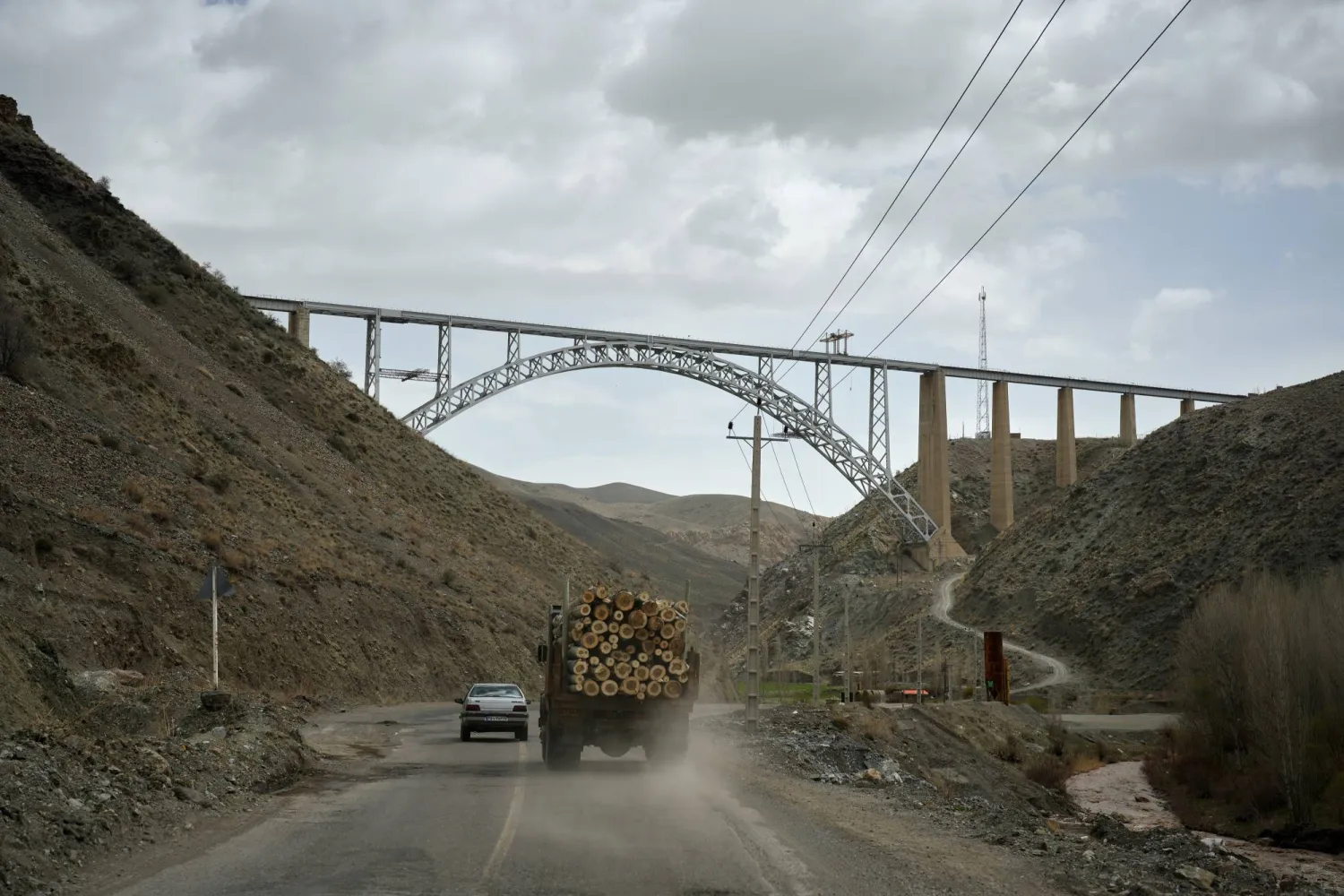
A truck loaded with logs and other vehicles drive along a road toward Tehran near the Turkish border on the outskirts of Razi, northwestern Iran, Saturday, April 4, 2026. (AP Photo/Francisco Seco)
TT

Iran Rejects Latest Ceasefire Proposal as Trump Deadline Approaches

A truck loaded with logs and other vehicles drive along a road toward Tehran near the Turkish border on the outskirts of Razi, northwestern Iran, Saturday, April 4, 2026. (AP Photo/Francisco Seco)

Iran on Monday rejected the latest ceasefire proposal and instead said it wants a permanent end to the war, even as US President Donald Trump’s ultimatum loomed for progress to avoid a major escalation in attacks against power plants and bridges. 

"We won’t merely accept a ceasefire," Mojtaba Ferdousi Pour, head of the Iranian diplomatic mission in Cairo, told The Associated Press. "We only accept an end of the war with guarantees that we won’t be attacked again." 

Iran’s state-run IRNA news agency said Tehran had conveyed its response through Pakistan, a key mediator. 

Trump's deadline centers on Tehran opening the Strait of Hormuz, through which a fifth of the world’s oil is shipped in peacetime. Ferdousi Pour said Iranian and Omani officials were working on a mechanism for administrating the shipping chokepoint. 

Iran’s grip on the strait has caused oil prices to surge and shaken the world economy. 

Iran's rejection came after Israel struck a key petrochemical plant in the massive South Pars natural gas field and killed two paramilitary Revolutionary Guard commanders. 

The gas field attack aimed at eliminating a major source of revenue for Iran, Israel said. The field is critical to electricity production, but the strike appeared to be separate from Trump’s threats.  

Under pressure at home as consumers worry, meanwhile, Trump has warned Iran that if no deal is reached to reopen the strait, the US would set the country "back to the stone ages." 

Trump has given multiple deadlines to Iran. The report of Iran's rejection came as he was making comments to journalists at an annual Easter event at the White House, ahead of more extensive comments Monday afternoon. 

It was not clear whether Trump was aware of the news. He called Iran a "strong" enemy but "not so strong like they were about a month ago." 

Asked if Tuesday at 8 p.m. Washington time was his final deadline, Trump replied simply, "Yeah." 

Israel threatens Iranian officials as mediators try to buy time  

Egyptian, Pakistani and Turkish mediators had sent Iranian Foreign Minister Abbas Araghchi and US Mideast envoy Steve Witkoff a proposal calling for a 45-day ceasefire and the reopening of the strait, two Mideast officials told The Associated Press. The officials spoke on condition of anonymity to discuss the private negotiations. 

Iran’s foreign ministry spokesman Esmail Baghaei earlier told journalists that messages were being exchanged with mediators but "negotiations are entirely incompatible with ultimatums, crimes and threats of war crimes." 

In Islamabad, two senior officials said Pakistan’s ceasefire efforts are at an advanced stage but "several spoilers and detractors" are trying to sow confusion. The officials spoke on condition of anonymity because they were not authorized to speak publicly about the talks. 

Meanwhile, explosions boomed in Tehran and low-flying jets could be heard for hours. 

Among those killed was the head of intelligence for Iran’s Revolutionary Guard, Maj. Gen. Majid Khademi, according to Iranian state media and Israel’s defense minister. Israel said it also killed the leader of the Revolutionary Guard’s undercover unit in its expeditionary Quds Force, Asghar Bakeri. 

Israel’s defense minister vowed to keep targeting top-ranking officials. "We will continue to hunt them down one by one," Israel Katz said. 

Israel’s military later said it struck three Tehran airports overnight — Bahram, Mehrabad and Azmayesh — hitting dozens of helicopters and aircraft it said belonged to the Iranian Air Force. 

A Tehran resident said "constantly there is the sound of bombs, air defenses, drones," speaking on condition of anonymity for her safety. At least one recent attack hit near her home, waking her, she said. 

Separately, Kuwait, the United Arab Emirates and Saudi Arabia activated air defenses to intercept Iranian missiles and drones. Tehran has kept up pressure on Gulf neighbors, which has included strikes against infrastructure like oil fields. In Israel, Iranian missiles hit the northern city of Haifa, where four people from one family were found dead in the rubble of a residential building. 

Oil prices unsettled as pressure grows  

Iran’s attacks on regional energy infrastructure and its hold on the Strait of Hormuz have sent global energy prices soaring. 

Brent crude oil, the international standard, rose to $109 in early Monday spot trading, about 50% higher than when the war started, then wavered. US stocks were mostly holding steady. 

Iran has let some vessels through Hormuz since the war began with US and Israeli attacks on Feb. 28. Some have paid Iran for passage but the flow of traffic is down more than 90% over the same period last year. 

Airstrikes kill more than 25 across Iran  

Thick smoke rose near Tehran’s Azadi Square after an airstrike hit the grounds of the Sharif University of Technology. Multiple countries have sanctioned the university for its work with the military, particularly on Iran’s ballistic missile program. 

Araghchi called university "the MIT of Iran," posting on social media that "Aggressors will see our might." 

Iranian media reported damage to buildings and a natural gas distribution site next to campus. The university is empty as the war has forced all schools into online classes. 

A strike near Eslamshar, southwest of Tehran, killed at least 15 people, authorities said. Five were killed in a residential area in Qom, and six were killed in strikes on other cities, the state-run IRAN daily newspaper reported. Three people were killed at a home in Tehran, state television reported. 

In Lebanon, where Israel has launched air attacks and a ground invasion that it says target the Iran-linked Hezbollah, an airstrike hit an apartment in Ain Saadeh, a predominately Christian town east of Beirut. It killed an official in the Lebanese Forces, a political party strongly opposed to Hezbollah, his wife and another woman. 

"We had always felt safe here," family friend Nadine Naameh said. 

More than 1,900 people have been killed in Iran since the war began, but the government has not updated the toll for days. 

More than 1,400 people have been killed in Lebanon and more than 1 million people have been displaced. Eleven Israeli soldiers have died there. 


Lukashenko Says Meeting with Trump Possible Once ‘Big Deal’ Is Ready

27 January 2024, Russia, St. Petersburg: Belarus' President Alexander Lukashenko attends an event at the Gazprom Arena stadium in Saint Petersburg. (Vyacheslav Prokofiev/Kremlin/dpa)
TT

Lukashenko Says Meeting with Trump Possible Once ‘Big Deal’ Is Ready

27 January 2024, Russia, St. Petersburg: Belarus' President Alexander Lukashenko attends an event at the Gazprom Arena stadium in Saint Petersburg. (Vyacheslav Prokofiev/Kremlin/dpa)

Belarusian President ‌Alexander Lukashenko said he would be ready to meet US President Donald Trump once a "big deal" between the two countries has been prepared.

"We are ready for a deal, but it needs to be prepared in a way that reflects the interests of both the United States and Belarus," Lukashenko ‌said in ‌an interview with Russian ‌TV network ⁠RT, excerpts of ⁠which were published on Sunday.

Lukashenko is a close ally of Russian President Vladimir Putin and has supported Russia's invasion of Ukraine, although without sending Belarusian troops to fight there.

In ⁠March, Trump's envoy John ‌Coale said that ‌the Belarusian president may soon visit the ‌United States, a trip that would signal ‌a breakthrough for the veteran authoritarian leader after years of being treated as a pariah because of human rights abuses ‌and his backing for Putin in the war.

Lukashenko said in ⁠the ⁠RT interview that Minsk had adapted to Western sanctions and that any potential deal with Washington should go beyond sanction relief.

"We have far more issues to resolve, and that's the subject of a big deal," he said without specifying these issues. "Once we finalize this at a lower level, we're ready to meet with Donald and sign the agreement."


Pope Leo Downplays Feud with Trump, Says ‘Not in My Interest’ to Debate Him

Pope Leo XIV delivers a speech during a meeting with the authorities, civil society and the diplomatic corps at the Presidential Palace in Luanda, Angola, 18 April 2026. (EPA)
TT

Pope Leo Downplays Feud with Trump, Says ‘Not in My Interest’ to Debate Him

Pope Leo XIV delivers a speech during a meeting with the authorities, civil society and the diplomatic corps at the Presidential Palace in Luanda, Angola, 18 April 2026. (EPA)

Pope Leo sought to downplay his feud with US President Donald Trump on Saturday, saying reporting about comments he has made so far during his Africa tour "has not been accurate in all its aspects".

Speaking to reporters in English aboard his flight to Angola for the third leg of his ambitious 10-day Africa tour, the first US pope said comments he made two days earlier in Cameroon decrying that the world was being "ravaged by a handful of tyrants" were not aimed at Trump.

That speech, said Leo, "was prepared two weeks ago, well before the president ‌ever commented on ‌myself and on the message of peace that ‌I ⁠am promoting".

Vice President ⁠JD Vance, who had criticized the pope's remarks last week, welcomed his latest comments.

"I am grateful to Pope Leo for saying this," Vance posted on social media platform X. "While the media narrative constantly gins up conflict — and yes, real disagreements have happened and will happen — the reality is often much more complicated."

On Sunday, as Leo prepared to embark on his ⁠tour, Trump called him "WEAK on Crime, and terrible for ‌Foreign Policy" in a post on Truth ‌Social.

Pope Leo told Reuters on Monday that he would keep speaking out about the war, and ‌Trump reiterated his criticism on Tuesday. On Thursday, Pope Leo blasted leaders who spend billions on wars and said ⁠the world ⁠was "being ravaged by a handful of tyrants", though he did not mention Trump directly again.

"As it happens, it was looked at as if I was trying to debate the president, which is not in my interest at all," the pontiff said on Saturday.

Leo, originally from Chicago, kept a relatively low profile for a pope in his first 10 months but has debuted a new forceful speaking style in Africa, sharply denouncing war, inequality and global leaders.

His Africa tour is one of the most complicated ever arranged for a pontiff, with stops in 11 cities and towns in four countries, traversing nearly 18,000 km (11,185 miles) over 18 flights.


Iran Says Final Deal Still Far off as Hormuz Strait Shuttered

This handout photo released by US Central Command via their X account (@CENTCOM) on April 18, 2026 shows AH-64 Apaches flying above the Strait of Hormuz during a patrol on April 17, 2026. (US Central Command (CENTCOM) / AFP)
TT

Iran Says Final Deal Still Far off as Hormuz Strait Shuttered

This handout photo released by US Central Command via their X account (@CENTCOM) on April 18, 2026 shows AH-64 Apaches flying above the Strait of Hormuz during a patrol on April 17, 2026. (US Central Command (CENTCOM) / AFP)

The strategic Strait of Hormuz was again closed on Sunday in the stand-off between Iran and the United States, with Iran's powerful parliament speaker signalling a final peace deal remained "far" off despite some movement in negotiations. 

As mediation efforts continued following high-level talks in Pakistan that failed to reach a deal, Iran said it will not allow the crucial maritime trade chokepoint to re-open until the United States ends a blockade of Iranian ports. 

Mohammad Bagher Ghalibaf, speaker of the Iranian parliament, said in a televised address on Saturday night that there had been "progress" with Washington "but there are many gaps and some fundamental points remain". 

"We are still far from the final discussion," said Ghalibaf, one of Tehran's negotiators in the talks aimed at ending the war launched by Israel and the United States against Iran. 

A two-week ceasefire is set to end on Wednesday unless it is renewed. 

US President Donald Trump said "very good conversations" were going on with Iran but warned Tehran against trying to "blackmail" the United States. 

On Friday, Tehran had declared the Strait of Hormuz, through which a fifth of the world's oil and liquefied natural gas usually transits, open after a temporary ceasefire was agreed to halt Israel's war with Iran's ally Hezbollah in Lebanon. 

That prompted elation in global markets and sent oil prices plunging, but Tehran reversed course after Trump insisted the US blockade of Iranian ports would continue until a final deal was struck. 

"If America does not lift the blockade, traffic in the Strait of Hormuz will definitely be limited," Ghalibaf said. 

Iran's supreme leader Mojtaba Khamenei, who has yet to be seen since taking power after his father was killed in the war's opening strikes, said in a written message that Iran's navy "stands ready" to defeat the United States. 

Trump accused Iran of getting "a little cute" with its recent moves and warned Tehran not to try to "blackmail" Washington by flip-flopping on the strait. 

"We have very good conversations going on," the president told reporters at the White House, adding that the United States was "taking a tough stand". 

- 'Targeted' - 

Iran's Revolutionary Guards warned that any attempt to pass through the strait without permission "will be considered cooperation with the enemy, and the offending vessel will be targeted". 

A handful of oil and gas tankers crossed the strait early on Saturday during the brief reopening, tracking data showed, but others retreated and hardly any vessels were crossing the waterway by the late afternoon. 

A UK maritime security agency said the Revolutionary Guards fired at one tanker, while security intelligence firm Vanguard Tech reported the force had threatened to "destroy" an empty cruise ship that was fleeing the Gulf. 

In a third incident, the UK agency said it received a report of a vessel "being hit by an unknown projectile, which caused damage" to shipping containers but no fire. 

The Indian foreign ministry said it had summoned the Iranian ambassador to lodge a protest over a "shooting incident" involving two Indian-flagged ships in the strait. 

- French UN peacekeeper killed - 

On the diplomatic front, Egypt, which has been involved in mediation efforts with Pakistan, appeared optimistic on Saturday with Foreign Minister Badr Abdelatty saying Cairo and Islamabad hoped to secure a final agreement "in the coming days". 

A major sticking point has been Iran's stockpile of near-weapons-grade enriched uranium. 

Trump said Friday that Iran had agreed to hand over its roughly 440 kilograms of enriched uranium. "We're going to get it by going in with Iran, with lots of excavators," he said. 

Iran's foreign ministry has said the stockpile, thought to be buried deep under rubble from US bombing in last June's 12-day war, was "not going to be transferred anywhere" and surrendering it "to the US has never been raised in negotiations". 

The Middle East war began on February 28 with a massive wave of US-Israeli attacks on Iran, despite Washington and Tehran being engaged in negotiations at the time. 

The conflict rapidly spread across the region, with Iran targeting neighboring Gulf countries that are home to US military bases, and Iran-backed Hezbollah dragging Lebanon into the war by launching rockets at Israel. 

A French soldier was killed and three others wounded in an ambush on Saturday on UN peacekeepers in Lebanon that France's president blamed on Hezbollah, an accusation the group denied. 

Israel's military reported that two of its soldiers had also been killed in combat in southern Lebanon since the start of a 10-day truce on Friday between Israel and Lebanon.