


Afghanistan Says Peace Talks Held in China to End Fighting with Pakistan Have Been Constructive

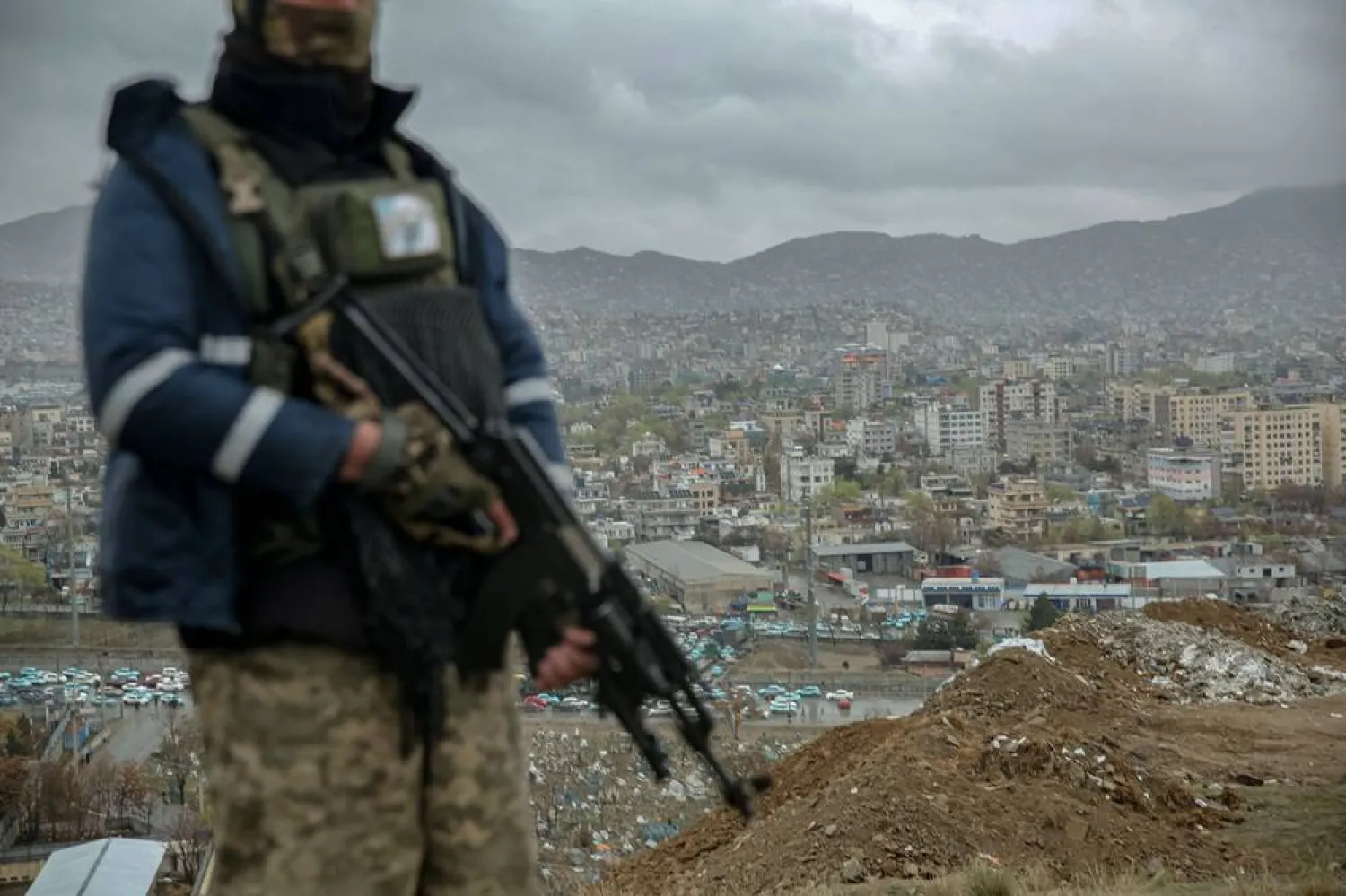
A Taliban security official patrols in Kabul, Afghanistan, 06 April 2026. (EPA)
TT

Afghanistan Says Peace Talks Held in China to End Fighting with Pakistan Have Been Constructive

A Taliban security official patrols in Kabul, Afghanistan, 06 April 2026. (EPA)

Afghanistan’s Foreign Ministry said Tuesday peace talks held in China between Afghanistan and Pakistan to halt cross-border fighting between the two neighbors have been constructive.

The talks began last week in the western Chinese city of Urumqi following an invitation by China, in an effort to stop the conflict that began between the two countries in February, leaving hundreds dead. Pakistan, which declared it was in “open war” with its neighbor, has also carried out airstrikes inside Afghanistan, including in the capital Kabul.

The United Nations' office for the coordination of humanitarian affairs in Afghanistan posted on X Tuesday that the conflict had displaced 94,000 people overall, while 100,000 people in two Afghan districts near the border have been completely cut off by the fighting since February.

The conflict has alarmed the international community, particularly as the area is one where other militant organizations, including al-Qaeda and the ISIS group, still have a presence in the region.

In a post on X, Foreign Ministry deputy spokesman Zia Ahmad Takal said Afghanistan’s Foreign Minister Amir Khan Muttaqi met with China’s ambassador to Afghanistan Tuesday, Foreign Ministry deputy spokesman Zia Ahmad Takal wrote on X, thanking Beijing for arranging and hosting the talks, and Saudi Arabia, Türkiye, Qatar and the United Arab Emirates for their mediation efforts.

“Noting that constructive discussions have taken place so far, FM Muttaqi expressed hope that minor interpretations would not hinder the progress of the negotiations,” Takal wrote.

There have been few official statements regarding the discussions since they began on April 1 between mid-level delegations from the two sides.

Even during the talks, Afghanistan accused Pakistan of carrying out shelling across its border on several occasions, killing and wounding civilians. Pakistan has not commented.

Pakistan often accuses Afghanistan of providing a safe haven to militants who carry out deadly attacks inside Pakistan, especially the Pakistani Taliban, known as Tehrik-e-Taliban Pakistan or TTP. The group is separate from but allied with the Afghan Taliban, which took over Afghanistan in 2021 following the chaotic withdrawal of US-led troops. Kabul denies the charge.

On Tuesday, Pakistan’s military commanders vowed to continue ongoing counterterrorism operations until, as they put it, “militant safe havens” are eliminated and “the use of Afghan territory against Pakistan” ends.

The remarks came during a meeting of top military commanders chaired by Army Chief Field Marshal Asim Munir, according to a statement from the military.

The meeting reviewed the prevailing internal and external security environment. The statement said “terrorist proxies” operating on behalf of “external sponsors,” along with their facilitators, would be pursued and eliminated “relentlessly and without exception.”

The recent fighting, the most severe between the two neighbors, began after Afghanistan launched cross-border attacks in response to Pakistani airstrikes inside Afghanistan. The clashes disrupted a ceasefire brokered by Qatar in October, after earlier fighting had killed dozens of soldiers, civilians and suspected militants.

On March 17, a Pakistani airstrike hit a drug-treatment center in Kabul, which Afghan officials said killed more than 400 people. Pakistan denied it had targeted civilians, saying its strikes were against military facilities.



Iran and US Closing in on Deal to End War

Vessels in the Strait of Hormuz, Iran, May 22, 2026. Majid Asgaripour/WANA (West Asia News Agency) via REUTERS
TT

Iran and US Closing in on Deal to End War

Vessels in the Strait of Hormuz, Iran, May 22, 2026. Majid Asgaripour/WANA (West Asia News Agency) via REUTERS

The United States and Iran could strike a deal to end the Middle East war as early as Sunday, Washington's top diplomat said, while Tehran insisted the agreement would do nothing to limit its nuclear program.

Washington and Tehran have observed a ceasefire since April 8 while mediators push for a negotiated settlement, although Iran has imposed controls on shipping and the US has blockaded Iran's ports.

On Sunday, during a visit to India, US Secretary of State Marco Rubio told reporters: "I do think perhaps there is the possibility that in the next few hours the world will get some good news."

This came after US President Donald Trump posted on social media that the deal "has been largely negotiated, subject to finalization between the United States of America, the Islamic Republic of Iran, and the various other Countries".

Rubio said the agreement would start a "process that can ultimately leave us where the president wants us to be, and that is a world that no longer has to fear or worry about an Iranian nuclear weapon".

Trump's post stressed that the Strait of Hormuz would be re-opened, a development that would bring relief to energy markets after a long Iranian blockade of a crucial waterway that in peacetime carries a fifth of world oil exports.

Iranian officials confirmed the existence of a draft agreement but stressed that -- contrary to earlier long-standing US demands -- talks on the issue of Iran's contested nuclear program have been deferred for 60 days after any deal.

- 'Lasting peace' -

According to Iran's Fars news agency, Washington has agreed to release part of Tehran's funds frozen abroad under international economic sanctions and to end its naval blockade of ships travelling to and from Iranian ports.

In exchange, "according to this draft, passage through the Strait of Hormuz would return to pre-war levels under Iranian management".

And, Fars said, "sanctions on oil, gas, petrochemicals and their derivatives would be temporarily lifted during the negotiation period so that Iran can freely sell its products".

Leaders from Saudi Arabia, the United Arab Emirates, Qatar, Egypt, Jordan and Bahrain, as well as representatives from Türkiye and Pakistan, joined a call with Trump to discuss the deal on Saturday.

Pakistan, which mediated historic face-to-face negotiations between US and Iranian delegations in April, hopes to host another round of talks "very soon", Prime Minister Shehbaz Sharif said.

He said Pakistan's powerful army chief Asim Munir, who visited Tehran on Friday and Saturday, also joined the call, which "provided a useful opportunity... to move the ongoing peace efforts forward to bring lasting peace in the region".

- Lebanese front -

Trump said a separate call with Israeli Prime Minister Benjamin Netanyahu "went very well". US strikes on Iran have been carried out together with Israel since the war began on February 28.

Iran's chief negotiator Mohammad Bagher Ghalibaf had warned earlier that Washington would face a tough response if it resumed hostilities, as Trump has often threatened.

"Our armed forces have rebuilt themselves during the ceasefire period in such a way that if Trump commits another act of folly and restarts the war, it will certainly be more crushing and bitter for the United States than on the first day of the war," Ghalibaf said.

On the war's other main front in Lebanon, state media reported that Israel struck the country's south on Saturday, where fighting has continued despite an April 17 ceasefire.

Lebanon's military said a strike targeted an army barracks and wounded a soldier, while Israel said one of its soldiers was killed on Friday near the border.

On Sunday, Lebanon's civil defense agency said its regional facility in the city of Nabatieh had been destroyed by an Israeli strike.


EU's Kallas: Russia Showing 'Reckless Nuclear Brinkmanship' in Latest Attacks on Ukraine

European Union foreign policy chief Kaja Kallas speaks with the media as she arrives for a meeting of EU foreign ministers at the European Council building in Brussels, Monday, May 11, 2026. (AP Photo/Marius Burgelman)
TT

EU's Kallas: Russia Showing 'Reckless Nuclear Brinkmanship' in Latest Attacks on Ukraine

European Union foreign policy chief Kaja Kallas speaks with the media as she arrives for a meeting of EU foreign ministers at the European Council building in Brussels, Monday, May 11, 2026. (AP Photo/Marius Burgelman)

Russia's latest attacks against Ukraine, which President Volodymyr Zelenskiy said involved an Oreshnik intermediate-range ballistic missile, showed 'reckless nuclear-brinkmanship,' the European ‌Union's foreign policy ‌chief Kaja ‌Kallas ⁠said on Sunday.

"Russia ⁠hit a dead-end on the battlefield, so it terrorizes Ukraine with ⁠deliberate strikes on ‌city ‌centers. These ‌are abhorrent acts of ‌terror meant to kill as many civilians as possible," ‌Kallas wrote on X.

"Moscow reportedly using ⁠Oreshnik ⁠intermediate-range ballistic missiles – systems designed to carry nuclear warheads – is a political scare tactic and reckless nuclear brinkmanship," Kallas said.


Taiwan, China Coast Guards in Standoff at Top of South China Sea

A person poses for photo holding a Taiwan flag at a rally to support government plans to increase defense spending in Taipei, Taiwan May 23, 2026. (Reuters)
TT

Taiwan, China Coast Guards in Standoff at Top of South China Sea

A person poses for photo holding a Taiwan flag at a rally to support government plans to increase defense spending in Taipei, Taiwan May 23, 2026. (Reuters)

The Taiwanese and Chinese coast guards were engaged in a tense standoff for the second day near the strategically located Pratas islands at the top of the South China Sea, Taiwan's Coast Guard said on Sunday.

China claims democratically governed Taiwan as its own territory, a position the government in Taipei rejects.

China has pressured Taiwan by increasing its military presence around the island, and Taipei is on high alert for further Chinese actions after President Xi Jinping discussed Taiwan with US President Donald Trump in Beijing this ‌month.

Lying roughly ‌between southern Taiwan and Hong Kong, the Taiwan-controlled Pratas are ‌seen ⁠by some security ⁠experts as vulnerable to Chinese attack due to their distance - more than 400 km (250 miles) - from Taiwan island.

Taiwan's Coast Guard said on Saturday it had spotted a Chinese Coast Guard ship heading to the Pratas and immediately sent its own ship which broadcast warnings and the two sides "engaged in an intense verbal confrontation over sovereignty via radio."

The Chinese ship broadcast that it was on a ⁠routine mission and that China had sovereignty and jurisdiction over ‌the Pratas, the Taiwan Coast Guard said.

“Please do ‌not destroy peace. You should return and strive for democracy. That is the correct ‌way to serve your country,” the Taiwan ship broadcast back, according to ‌video provided by its coast guard.

China's Taiwan Affairs Office did not respond to a request for comment.

A Taiwan Coast Guard official told Reuters the Chinese ship was 21 nautical miles to the northeast of the Pratas and the standoff was continuing as of Sunday ‌afternoon.

China's wording on having jurisdiction and sovereignty was unusual as was the length of its stay in the ⁠waters so close ⁠to the Pratas, the official added, speaking on condition of anonymity due to the sensitivity of the situation.

The coast guard said on Friday night it had also driven away for the second time this month the Chinese research ship "Tongji" in waters close to the island.

The Pratas, an atoll which is also a Taiwanese national park, is only lightly defended by Taiwan, and its coast guard has that responsibility rather than the military.

In January, Taiwan said a Chinese reconnaissance drone briefly flew over the Pratas.

On Saturday, Taiwan's National Security Council Secretary-General Joseph Wu took to his X account to detail the 100 Chinese ships he said were currently in the first island chain, referring to an area running from Japan through Taiwan and into the Philippines.