


Israel Opposition Leaders Slam Netanyahu Over Ceasefire with Iran

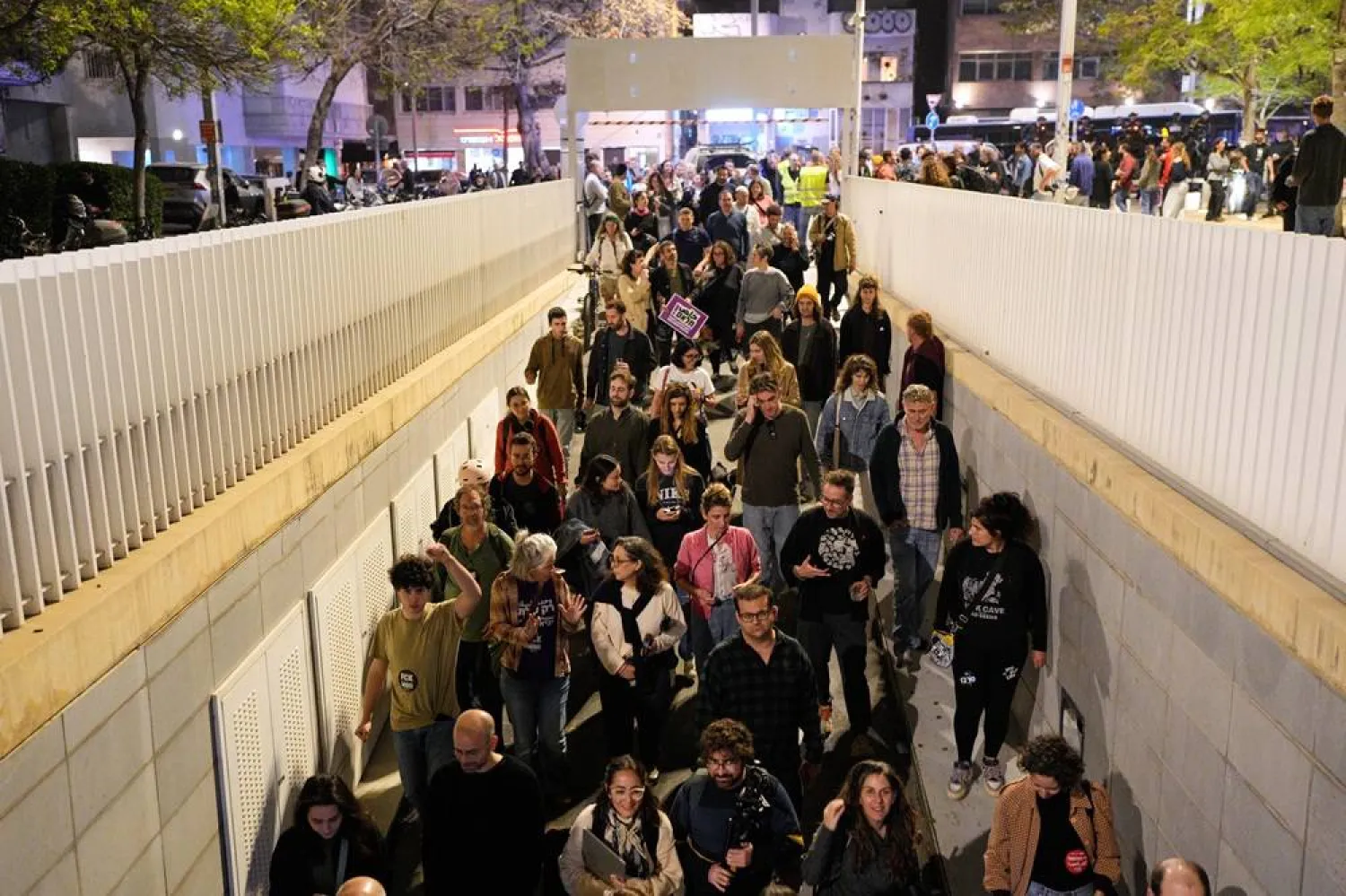
 People enter an underground parking garage as sirens warn of an incoming missile fired from Yemen in Tel Aviv, Israel, Saturday, April 4, 2026. (AP)
People enter an underground parking garage as sirens warn of an incoming missile fired from Yemen in Tel Aviv, Israel, Saturday, April 4, 2026. (AP)
TT

Israel Opposition Leaders Slam Netanyahu Over Ceasefire with Iran

 People enter an underground parking garage as sirens warn of an incoming missile fired from Yemen in Tel Aviv, Israel, Saturday, April 4, 2026. (AP)
People enter an underground parking garage as sirens warn of an incoming missile fired from Yemen in Tel Aviv, Israel, Saturday, April 4, 2026. (AP)

Israel's opposition leaders swiftly criticized the ceasefire with Iran on Wednesday, accusing Prime Minister Benjamin Netanyahu of failing to achieve the war's objectives. 

The United States and Iran agreed to a two-week ceasefire in an 11th-hour bid to avert all-out destruction of Iran threatened by US President Donald Trump. 

Netanyahu's office said Israel supported Trump's decision to suspend the bombing of Iran, but maintained the ceasefire "does not include Lebanon" where Israeli forces are fighting Iran-backed Hezbollah. 

"There has never been a political disaster like this in our entire history. Israel was not even close to the table when decisions were made concerning the core of our national security," the country's main opposition leader Yair Lapid wrote on X. 

"The army carried out everything that was asked of it, and the public showed remarkable resilience, but Netanyahu failed politically, failed strategically, and did not achieve any of the goals he himself set." 

Netanyahu had set the elimination or at least severe degradation of Iran's nuclear program as a central goal of the war, describing it as an "existential threat" to Israel. 

He also called for the neutralizing of Iran's ballistic missile capabilities, the weakening or potentially toppling of the Iranian regime and the curbing of Tehran's regional influence by targeting its network of allied groups. 

"It will take us years to repair the political and strategic damage that Netanyahu caused due to arrogance, negligence, and lack of strategic planning," Lapid said. 

The head of the left-wing Democrats party, Yair Golan, called the ceasefire a "strategic failure" by Netanyahu. 

"He promised a historic victory and security for generations, and in practice, we got one of the most severe strategic failures Israel has ever known," Golan said on X. 

"It's a total failure that endangers Israel's security for years to come." 

Member of parliament and opposition figure Avigdor Liberman also denounced the truce, saying it gave the Iranian regime "an opportunity to regroup". 

"Any agreement with Iran that does not include renouncing the destruction of Israel, uranium enrichment, the production of ballistic missiles, and support for terrorist organizations in the region means that we will have to return to another campaign under more difficult conditions and pay a heavier price," Liberman said on X. 

More reaction was expected to come later on Wednesday after the end of the Jewish holiday of Passover. 

Even as Israel backed Trump's ceasefire plan with Iran, it said the truce did not include Lebanon. 

Israel has been fighting a war with Hezbollah since the Lebanese armed group launched rocket fire at Israel in March after the killing of Iran's supreme leader Ali Khamenei on the first day of the war. 


Iran Executed 18 Protesters in 2026, Says UN

 UN High Commissioner for Human Rights Volker Turk speaks to the media, at the Office of the United Nations High Commissioner for Human Rights (OHCHR) Palais Wilson, in Geneva, Switzerland, Wednesday, June 10, 2026. (Keystone via AP)
UN High Commissioner for Human Rights Volker Turk speaks to the media, at the Office of the United Nations High Commissioner for Human Rights (OHCHR) Palais Wilson, in Geneva, Switzerland, Wednesday, June 10, 2026. (Keystone via AP)
TT

Iran Executed 18 Protesters in 2026, Says UN

 UN High Commissioner for Human Rights Volker Turk speaks to the media, at the Office of the United Nations High Commissioner for Human Rights (OHCHR) Palais Wilson, in Geneva, Switzerland, Wednesday, June 10, 2026. (Keystone via AP)
UN High Commissioner for Human Rights Volker Turk speaks to the media, at the Office of the United Nations High Commissioner for Human Rights (OHCHR) Palais Wilson, in Geneva, Switzerland, Wednesday, June 10, 2026. (Keystone via AP)

Iran has executed at least 40 people, including 18 protesters, on "national security grounds" since the start of 2026, the United Nations said Monday.

UN rights chief Volker Turk said he felt "deeply for the people in Iran, caught between war and cruel repression".

Since the start of the year, the Iranian authorities "have executed at least 40 people on national security grounds... including 18 protesters", he told the UN Human Rights Council.

Iran executes more people annually than any other nation besides China, according to rights groups.

Turk lamented that Tehran had ramped up repression since a deadly crackdown on protests in January, on top of the Middle East war, sparked in February by US and Israeli attacks on Iran.

He welcomed the announcement on Sunday that the United States and Iran had agreed a peace deal, stressing that "it is clear all sides need to exercise maximum restraint and work to implement the agreement reached, quickly and in good faith".

The conflict, he said, "has had a devastating impact on human rights across the region and around the world".

Repression in Iran was dire even before the war.

In late December, a protest movement sparked by economic pains quickly expanded into mass anti-government rallies, which were met by a crackdown that rights groups say killed thousands.

Iranian authorities portrayed the protests as riots backed by the United States and Israel and said the violence killed around 3,000 people.

Rights groups abroad put the toll higher and accused the security forces of firing at demonstrators.

"Since killing thousands of people during the egregious crushing of protests in January, the authorities have intensified their brutal crackdown, arresting thousands and imposing even more severe restrictions on civic space," Turk said.


Congo Reports Record One-Day Increase in Ebola Cases, a Month After Outbreak’s Declaration

Dz'na Lipe Jean‑Marie, secretary of the displacement camp, speaks during an Ebola awareness session as humanitarian agencies intensify efforts to contain a new Ebola outbreak involving the Bundibugyo strain, at Kpangba displacement camp where Ebola cases were observed, Djugu territory in Ituri province, Democratic Republic of Congo, June 13, 2026. (Reuters)
TT

Congo Reports Record One-Day Increase in Ebola Cases, a Month After Outbreak’s Declaration

Dz'na Lipe Jean‑Marie, secretary of the displacement camp, speaks during an Ebola awareness session as humanitarian agencies intensify efforts to contain a new Ebola outbreak involving the Bundibugyo strain, at Kpangba displacement camp where Ebola cases were observed, Djugu territory in Ituri province, Democratic Republic of Congo, June 13, 2026. (Reuters)

Congolese authorities have reported one of the highest increase in Ebola cases in one day, as weak contact tracing, insecurity and funding gaps continue to hinder the response a month after the outbreak was declared.

The Congolese Ministry of Health said Sunday 72 new cases were reported in a 24-hour period, bringing the total number of confirmed cases to 782. This includes 181 confirmed deaths, after 32 new deaths were confirmed.

However, the number of cases in Congo is believed to be higher because the outbreak was confirmed on May 15, weeks after it is suspected to have begun, and the contact tracing coverage rate is at 56%, a sharp decrease from last week.

The latest Ebola outbreak is caused by the rare Bundibugyo virus, which has no approved vaccine or treatment, unlike the Zaire virus, which was responsible for most of Congo’s past 16 outbreaks of the disease.

Fifty-six people have recovered, and the current fatality rate of the outbreak is 23%, the ministry said.

The World Health Organization said Sunday it is intensifying testing and contact tracing and treatment.

Africa's top health body said the same day it is deploying technical expertise and supporting laboratory systems, active case finding and community engagement efforts to accelerate the response to the disease outbreak.

“We remain committed to supporting affected countries until transmission is stopped. We call on partners and donors to urgently mobilize resources to strengthen the response and save lives,” said the head of the Africa Centers for Disease Control and Prevention, or Africa CDC, Jean Kaseya.

The outbreak is concentrated in Congo’s eastern province of Ituri, which accounts for more than 90% of the cases. Cases have also been recorded in the North Kivu and South Kivu provinces, and have spread across the border to Uganda.

Nearly a million people have been displaced by conflict in Ituri, according to the UN humanitarian office, making contact tracing difficult as people flee attacks or move frequently in the vast province with dense forests, poor roads and remote villages that can take days to reach.

Tracing is also difficult among the thousands of artisanal miners who regularly move between remote sites in the mineral-rich region.


Iran's Fars News Agency Says Hormuz Maritime Fees Added to US Deal Last Minute

Vessels at the Strait of Hormuz, as seen from Musandam, Oman, June 14, 2026. REUTERS/Stringer
TT

Iran's Fars News Agency Says Hormuz Maritime Fees Added to US Deal Last Minute

Vessels at the Strait of Hormuz, as seen from Musandam, Oman, June 14, 2026. REUTERS/Stringer

Iran's Fars news agency said on Monday, quoting what it said was an informed source, that Tehran added a clause on imposing maritime service fees to the framework deal with the United States shortly before its announcement.

"In the final moments of the negotiations, the text of the memorandum of understanding was amended to clearly and explicitly emphasize the issue of the Iranian-Omani sovereignty over the Strait of Hormuz," said Fars, citing the unidentified source.

"The use of the term 'maritime services' means that the United States has accepted that fees will be paid to Iran," it added.
