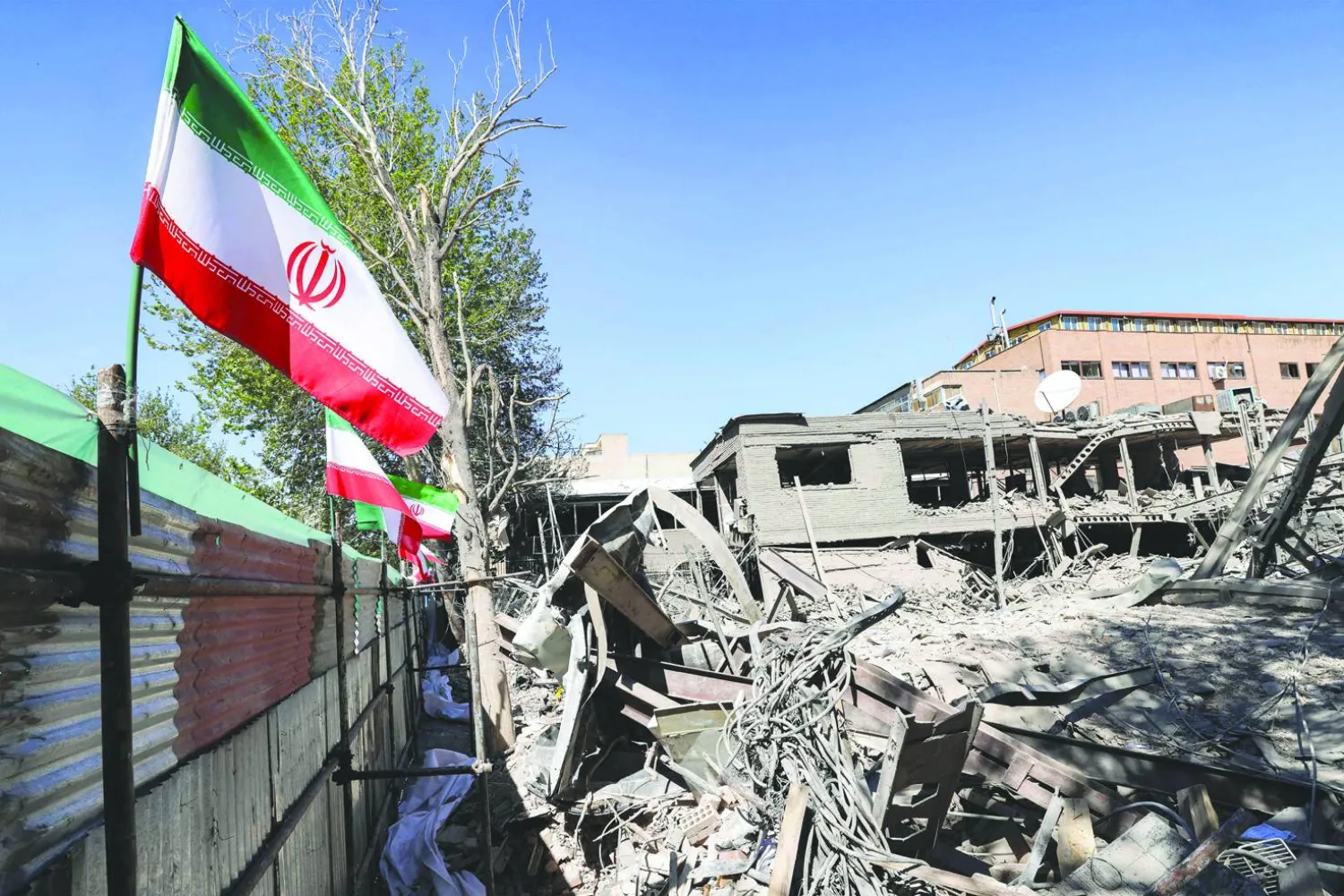
Iran Downs Israeli-made Drone above Town in South: State TV

An Iranian national flag is placed by the rubble of a collapsed building following strikes at Sharif University of Technology in Tehran on April 7, 2026. (Photo by ATTA KENARE / AFP) /
TT

Iran Downs Israeli-made Drone above Town in South: State TV

An Iranian national flag is placed by the rubble of a collapsed building following strikes at Sharif University of Technology in Tehran on April 7, 2026. (Photo by ATTA KENARE / AFP) /

Iranian forces downed an Israeli-made Hermes drone flying above the town of Lar in the south of the country on Wednesday, state television said, citing a statement from the Revolutionary Guards.

"Minutes ago, an advanced Hermes 900 drone was intercepted and destroyed in the sky over Lar, Fars Province, by fire from the Revolutionary Guards' modern aerospace defence system," the statement reported by broadcaster IRIB said.

It added that "the entry of any type of enemy American or Zionist aircraft into the country's skies, even without conducting military operations, is considered a violation of the ceasefire and a decisive response will be given".


Pakistani Army Chief Visits Tehran in Bid to Broker Renewed Talks between US and Iran

Image published by the Iranian Foreign Ministry of Araghchi receiving Pakistani Army Chief Asim Munir in Tehran on Wednesday.
TT

Pakistani Army Chief Visits Tehran in Bid to Broker Renewed Talks between US and Iran

Image published by the Iranian Foreign Ministry of Araghchi receiving Pakistani Army Chief Asim Munir in Tehran on Wednesday.

Pakistan’s army chief is set to meet with Iranian officials in Tehran on Thursday in a bid to ease tensions in the Middle East and arrange a second round of negotiations between the United States and Iran after almost seven weeks of war.

The White House said any further talks would likely take place in the Pakistani capital of Islamabad, though no decision had been made on whether to resume negotiations.

The US naval blockade of Iranian ports continued as US Treasury Secretary Scott Bessent said the Trump administration would ramp up economic pain on Iran with new economic sanctions on countries doing business with it, calling the move the “financial equivalent” of a bombing campaign.

Pakistan has emerged as a key mediator after it hosted direct talks between the US and Iran in Islamabad that authorities said helped narrow differences between the two sides. Mediators are seeking a new round before the ceasefire expires next week.

Meanwhile, Trump wrote late Wednesday on Truth Social that leaders from Israel and Lebanon would speak the next day in a renewed effort to broker a ceasefire after the countries' first direct talks in decades ended the previous day in Washington without a deal. It was not clear what leaders Trump was referring to. The Israeli prime minister’s office did not immediately respond for comment, which was posted before dawn in Israel and Lebanon.

The war has jolted markets and rattled the global economy as shipping has been cut off and airstrikes have torn through military and civilian infrastructure across the region. Oil prices have fallen amid hopes for an end to fighting, and US stocks on Wednesday surpassed records set in January.

Officials say US and Iran are making progress

Even as the US blockade on Iranian ports and renewed Iranian threats strained the ceasefire agreement, regional officials reported progress, telling The Associated Press the United States and Iran had an “in principle agreement” to extend it to allow for more diplomacy. They spoke on condition of anonymity to discuss sensitive negotiations.

Iran's foreign minister, Abbas Araghchi, took part in a preliminary meeting Wednesday with Asim Munir, Pakistan's army chief of staff, Iranian state media reported.

But even as mediators worked for peace, tensions simmered.

The commander of Iran’s joint military command, Ali Abdollahi, threatened to halt trade in the region if the US does not lift its naval blockade, and a newly-appointed military adviser to Iranian Supreme Leader Mojtaba Khamenei said he doesn’t support extending the ceasefire.

Mediators seek compromise on sticking points

Mediators are pushing for a compromise on three main sticking points that derailed direct talks last weekend — Iran’s nuclear program, the Strait of Hormuz and compensation for wartime damages, according to a regional official involved in the mediation efforts.

Iranian Foreign Ministry spokesman Esmail Baghaei said Iran is open to discussing the type and level of its uranium enrichment, but his country “based on its needs, must be able to continue enrichment,” Iranian state media reported.

The fighting has killed at least 3,000 people in Iran, more than 2,100 in Lebanon, 23 in Israel and more than a dozen in Gulf Arab states. Thirteen US service members have also been killed.

China calls for Strait of Hormuz to reopen

Chinese Foreign Minister Wang Yi said the window of peace was opening during a phone call with his Iranian counterpart, who briefed him on the latest developments in Iran-US negotiations and Tehran’s considerations on the next step, according to a statement from China’s foreign ministry late Wednesday.

Wang told Araghchi that the situation has reached a critical juncture between war and peace, and said Iran’s sovereignty, security, and legitimate rights should be respected as a littoral state of the Strait of Hormuz, while freedom of navigation and safety through the strait should be ensured.

Since the war began, Iran has curtailed maritime traffic through the Strait of Hormuz, which a fifth of global oil transited through in peacetime. Tehran’s effective closure of the strait sent oil prices skyrocketing, raising the cost of fuel, food and other basic goods far beyond the Middle East, and the US has responded with a blockade on Iranian shipping.

US Central Command said Wednesday that no ships had made it past the blockade since it was imposed two days earlier, while 10 merchant vessels complied with direction from US forces to turn around and reenter Iranian waters.

The blockade is intended to pressure Iran, which has exported millions of barrels of oil, mostly to Asia, since the war began Feb. 28. Much of it has likely been carried by so-called dark transits that evade sanctions and oversight, providing cash that’s been vital to keeping Iran running.

Strikes continue in Lebanon after Washington talks

Meanwhile, Israel pressed ahead with its aerial and ground war in Lebanon. The country's National News Agency reported airstrikes and artillery shelling throughout southern Lebanon on Wednesday, including near Bint Jbeil, where Israeli forces have encircled Hezbollah fighters.

Israeli Prime Minister Benjamin Netanyahu said Israeli troops were about to “eliminate this great stronghold of Hezbollah” and would continue expanding control of areas in southern Lebanon.

Netanyahu said negotiations are continuing, with disarming Hezbollah a key goal.

The Lebanese Health Ministry said Israel struck three teams of paramedics Wednesday in southern Lebanon, first hitting one team and then two more that rushed to help. The attacks killed three paramedics and wounded six others, the ministry said.

The Israeli military did not immediately respond to a request for comment.

Israel and Lebanon have technically been at war since Israel was established in 1948, and Lebanon remains deeply divided over diplomatic engagement with Israel.


Mounting Pressure on Iran Revives the Specter of the 2000 Aden Attack

US Navy aircraft carrier USS George H.W. Bush
TT

Mounting Pressure on Iran Revives the Specter of the 2000 Aden Attack

US Navy aircraft carrier USS George H.W. Bush

US author Anne-Marie Slaughter argues in The Chessboard and the Web: Strategies of Connection in a Networked World that the world no longer operates or interacts according to the logic of a traditional chessboard.

The old model was linear and two-dimensional, centered on a single objective: toppling the king by controlling territory.

That logic no longer defines 21st-century conflict. Today’s world operates across overlapping, interlocking layers that interact and often collide simultaneously, within a continuously evolving network that includes military, economic, political, alliance, and informational dimensions.

As this network evolves, it generates both solutions and complications so rapidly that they outpace the ability of leadership to make timely decisions. Improvisation comes to dominate decision-making, errors multiply and accumulate, feeding back into the system and further deepening its complexity.

On the escalation ladder

Escalation depends on strategic flexibility and the tools available. In practical terms, the greater the flexibility, the greater the ability of actors to climb the escalation ladder, from low-intensity conflict to higher levels, until reaching a peak where one side yields, either on the battlefield or at the negotiating table.

But this climb is inherently a trap. Each step builds on the last. As these steps accumulate over time, the cost compounds, making it increasingly difficult to step back without incurring significant losses.

The US blockade

This is not the first time the US Navy has imposed a maritime blockade. The most notable case was Cuba in the 1960s during the Cuban Missile Crisis, labeled a “quarantine,” a term deliberately used to indicate a measure short of full wartime blockade. Cuba’s geography made it relatively easy to encircle.

A similar approach was later applied to Venezuela. Today, the focus has shifted to Iranian ports, both inside and outside the Gulf.

Direct comparisons are limited by differing contexts. Still, one constant remains: the US Navy possesses the capability to enforce such blockades, particularly given its dominance over global seas and oceans.

In Cuba, Soviet missiles targeted major US cities and the world was divided between two superpowers. In Venezuela, President Donald Trump invoked the Monroe Doctrine and implemented a national security strategy prioritizing the Western Hemisphere and America’s immediate sphere.

The Strait of Hormuz, however, is fundamentally different. Other waterways can be bypassed; Hormuz cannot. It is a closed corridor through which oil, gas, petrochemicals, helium, fertilizers, and other critical goods must pass. There is no alternative route; all shipments must transit Hormuz in both directions.

Iran’s strategy

Since the Shah’s era, aligned with the Nixon Doctrine, Tehran has pursued control over Gulf waters and influence over the Strait of Hormuz. The continued occupation of the UAE islands of Greater Tunb, Lesser Tunb, and Abu Musa since the 1970s underscores this long-standing strategic objective.

More than 30 islands are scattered across the Gulf’s deep waters, precisely along the routes used by oil tankers that require significant depth to pass safely. If linked together as part of a military-security network, they reveal long-term planning for scenarios such as the current one.

Iran’s naval doctrine relies on both the Revolutionary Guards and the regular navy, employing small submarines, torpedoes, fast attack boats, naval mines, drones, and ballistic missiles.

At its core lies an anti-access strategy designed to deny adversaries freedom of movement in Gulf waters.

Centers of gravity

Qeshm Island is critical for controlling access to the Strait of Hormuz. Kharg Island follows, serving as the hub for more than 80 percent of Iran’s oil exports, supplied by the oil fields of Khuzestan.

Beyond the islands, the South Pars gas field in Bushehr province is central to Iran’s energy system, providing more than 70 percent of the country’s domestic electricity needs.

These key sites have already been targeted during the conflict by US or Israeli airpower. To expand the scope of escalation and increase pressure, Trump deployed additional forces, including Marine units and elements of the 82nd Airborne Division, aimed at broadening military options and forcing Iran to soften its negotiating position. After talks in Pakistan failed, he moved to announce the blockade.

The current US approach

By declaring the blockade, Trump effectively altered the existing rules of engagement in the Gulf, imposing an asymmetric approach that avoids Iran’s strengths and prevents it from dictating the battlefield dynamics.

Instead, the US leverages distance, operating from the Arabian Sea, along with its technological superiority and strategic flexibility.

This effectively turns Iran’s own strategy against it. What once constrained US freedom of movement inside the Gulf is now being used to impose external pressure on Iran from the Arabian Sea.

If successful, the strategy could deprive Iran, according to The Wall Street Journal, of roughly $435 million per day, or $13 billion per month, while avoiding the costs of direct military action such as seizing islands like Kharg.

It would also confine Iran’s asymmetric capabilities within the Gulf and strip it of its most effective operational tools.

The central question now is how Iran will respond. How will it adapt its strategy in the face of this pressure? Will escalation continue? And could that escalation take the form of a maritime attack similar to the 2000 strike on the US destroyer USS Cole near Aden?


Iran Can Go up to Two Months without Oil Exports Before Cutting Output, Analysts Say

A man rides past a large billboard referring to the Strait of Hormuz in Tehran's Vanak Square on April 15, 2026. (AFP)
TT

Iran Can Go up to Two Months without Oil Exports Before Cutting Output, Analysts Say

A man rides past a large billboard referring to the Strait of Hormuz in Tehran's Vanak Square on April 15, 2026. (AFP)

Iran can withstand a complete halt in oil exports of up to two months before being forced to curb production, analysts said, after the US began blocking shipping in and out of the country's ports on April 13.

The blockade could prevent roughly 2 million barrels per day (bpd) of Iranian crude from reaching its main buyer China.

Any Iranian production shutdowns would add to more than 12 million bpd of supply already disrupted by the regional war, tightening markets further and ‌lifting oil ‌prices.

With its exports blocked, Iran faces having to ‌divert ⁠crude into onshore storage ⁠tanks. Once those tanks are filled, the OPEC member would be required to curb upstream output.

Consultancy FGE NextantECA estimates Iran has about 90 million barrels of available onshore crude storage capacity, out of total capacity of roughly 122 million barrels.

"Iran can sustain current production of around 3.5 million bpd for roughly two months without exports, extendable to around three months with a modest ⁠500,000 bpd production cut," FGE NextantECA said in a ‌note.

Iranian domestic refineries process about 2 million ‌bpd of oil, they added.

The relevant Iranian authorities were not immediately available for comment.

Energy ‌Aspects assumes significantly lower available onshore storage of about 30 million barrels, ‌based on data from Kayrros.

Under that scenario, Iran could maintain current export levels for about 16 days before storage capacity runs out, based on export levels of 1.8 million bpd.

"The blockade may not have a significant impact on Iranian production in ‌April, but if it continues into May then output would need to be reduced substantially," said Richard ⁠Bronze, co-founder of Energy ⁠Aspects.

He said the consultancy assumes Iran cannot utilize its full nameplate storage capacity, adding that historic data show stocks peaked at 92 million barrels in May 2020, which likely marks a realistic ceiling.

Bronze also said Iran will likely deploy available oil tankers in ports as floating storage, delaying production cuts.

The US military said more vessels were being turned back under the blockade, including the Chinese-owned tanker Rich Starry, which is under US sanctions and which was seen heading back through the Strait of Hormuz on Wednesday.

Eight Iran-linked oil tankers have been intercepted since the blockade began on Monday, the Wall Street Journal reported. A US destroyer stopped two tankers attempting to leave Iran's Chabahar port on the Gulf of Oman on Tuesday, a US official said.